
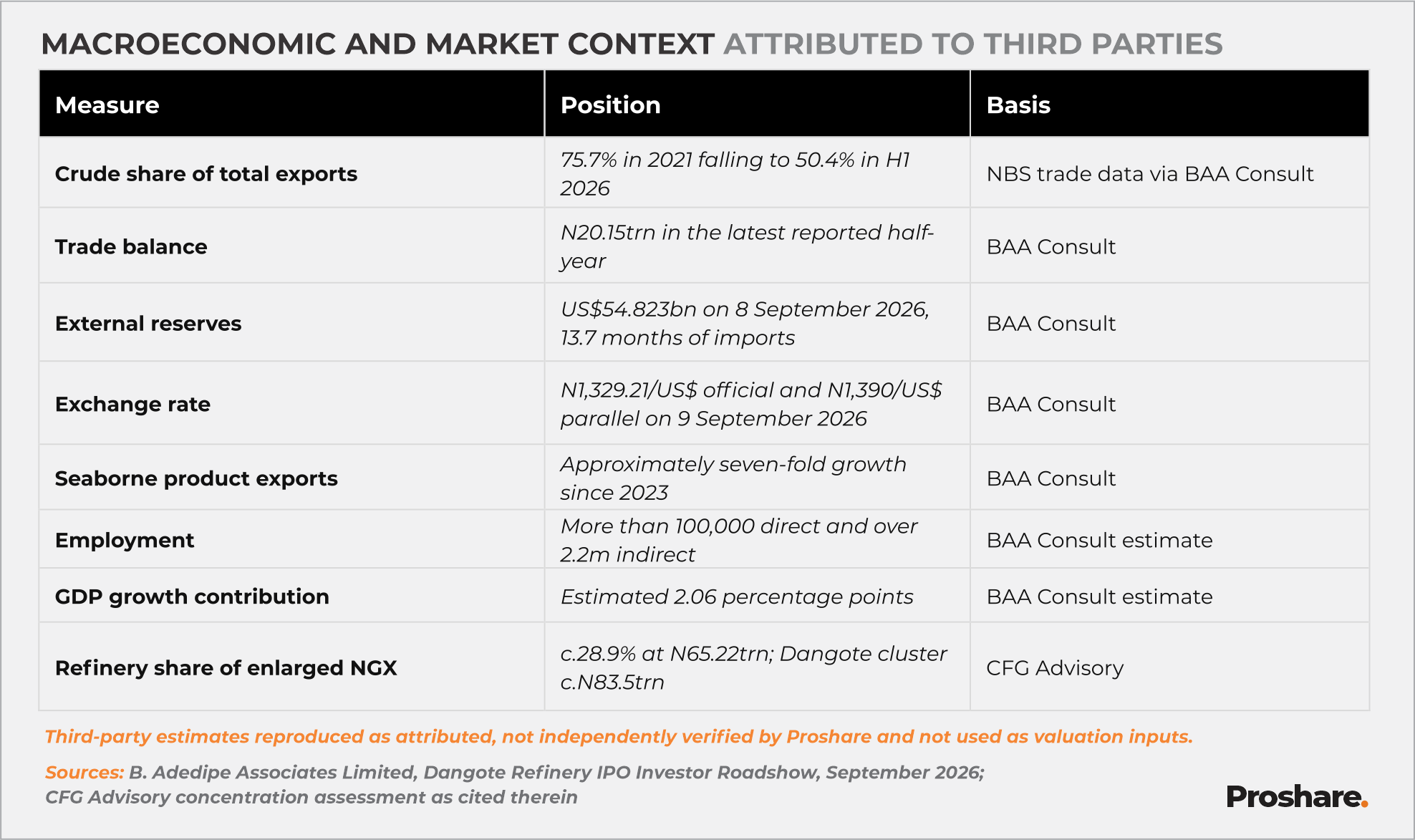
Dangote Petroleum Refinery and Petrochemicals FZE approaches its listing with an operating record materially stronger than at commissioning. Audited H1 2026 revenue was US$13.91bn, operating profit US$2.37bn, and profit after tax N2.50trn, equivalent to US$1.82bn, reversing losses in FY2024 and FY2025. Nigeria’s crude share of total exports has fallen from 75.7% in 2021 to 50.4% in the first half of 2026, and the Offer is entirely primary, with no selling shareholder and all net proceeds applied to expansion.
Nigeria economic reports
The N525 price is a separate question. It capitalises the business at N65.22trn, some 8.6 to 9.1 times forecast FY2026 EBITDA, and assumes refining margins hold above the Issuer’s own 2026 estimate of US$24.2 per barrel, utilisation stays high, crude supply remains continuous, and a US$14.3bn expansion targeted for 2029 is delivered on funding the Offer supplies to the extent of about 11%. Free float is 3.30% ( a cause for slight anxiety among retail investors) after the base offer and closer to 2.46% once the anchor commitment is allotted (the Refinery’s free float shrinks below that of the Dangote cement business).
This note reconciles each material figure to the prospectus, attributes every forecast to its source, records the disclosures qualifying that research, and lists the items still awaiting confirmation. The investment decision emerges from the equity subscriber’s investment objective and risk capacity rather than from market enthusiasm, brand loyalty, or the refinery’s national significance.
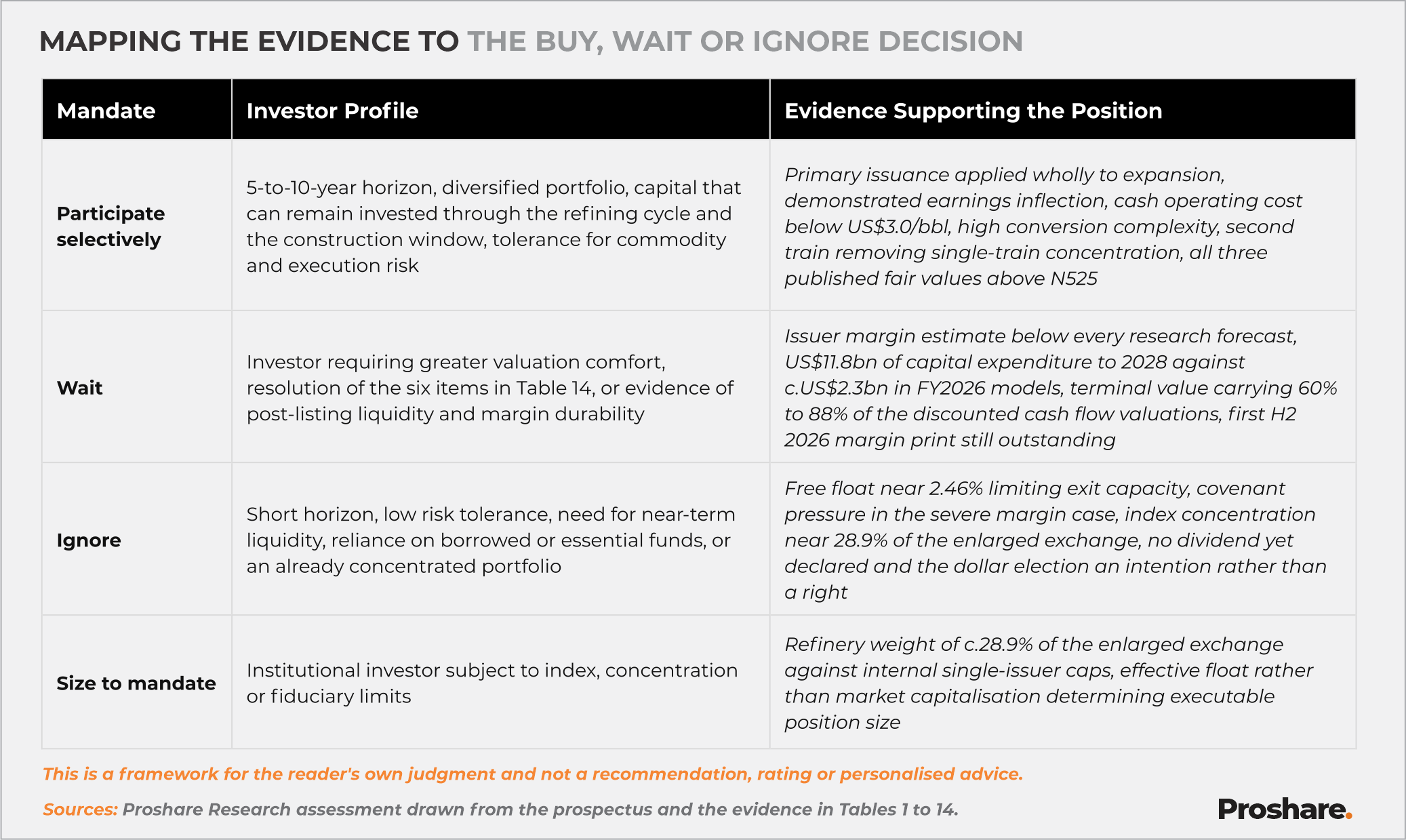
Table 15 shows how the available data maps the investment decision to buy, wait, or ignore. Proshare applies no buy, hold or sell classification to this transaction, and readers requiring a personal recommendation should consult a licensed investment adviser who can weigh their objectives, investment horizon, liquidity needs and concentration limits.
Executive Summary
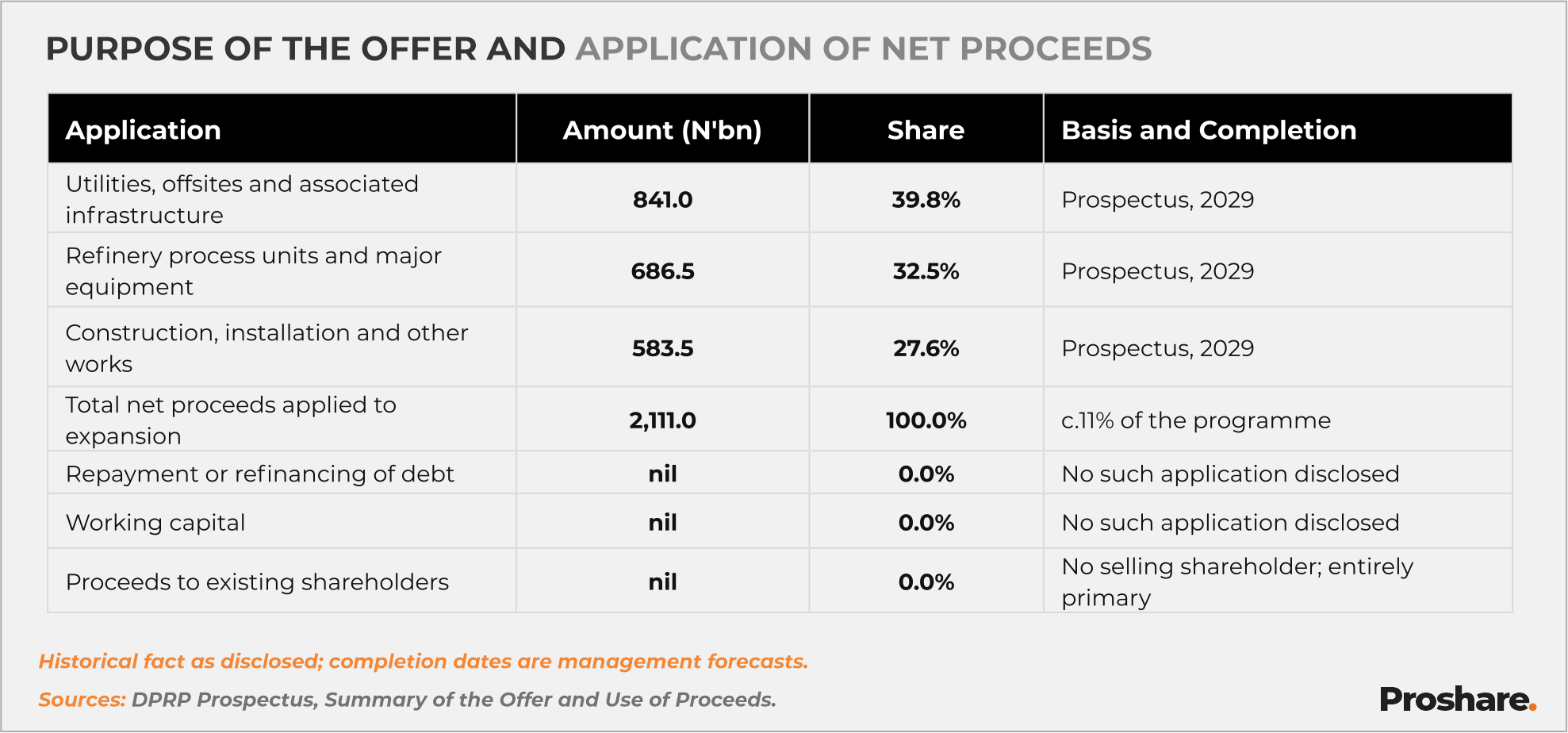
The prospectus answers the first question an offer document should answer. The Offer is 4.10bn new ordinary shares at N525; no existing shareholder is selling (meaning a total Offer for Subscription), and all N2.11trn of estimated net proceeds is assigned to the refinery’s Phase 2 programme. This means subscribers would fund expansion rather than give existing shareholders a pay cheque that refinances debt or give early-bird investors a near-term loyalty bonus.
Investment advisory service
The Initial Public Offering (IPO) is a materially different proposition from a secondary market sell-down by early equity interest and is verifiable from the use-of-proceeds disclosure rather than inferred. However, it does not remove the execution and funding risks associated with the scaling of the refinery’s Phase 2 expansion project, which is expected to raise production throughput to 1.4mbd by 2028.
The industrial case and the entry-price case require separate judgments, and this Analyst Note keeps them apart.
DPRP is an operating, high-complexity refinery with integrated infrastructure, dollar-linked revenue and strategic weight in a structurally short African products market. The N525 price capitalises the enlarged company at approximately N65.22trn and depends on sustained utilisation, adequate crude supply, resilient margins, disciplined Phase 2 delivery, currency management and credible minority protections. Industrial importance supports a long-term ownership thesis. It does not by itself establish a margin of safety at the offer price.
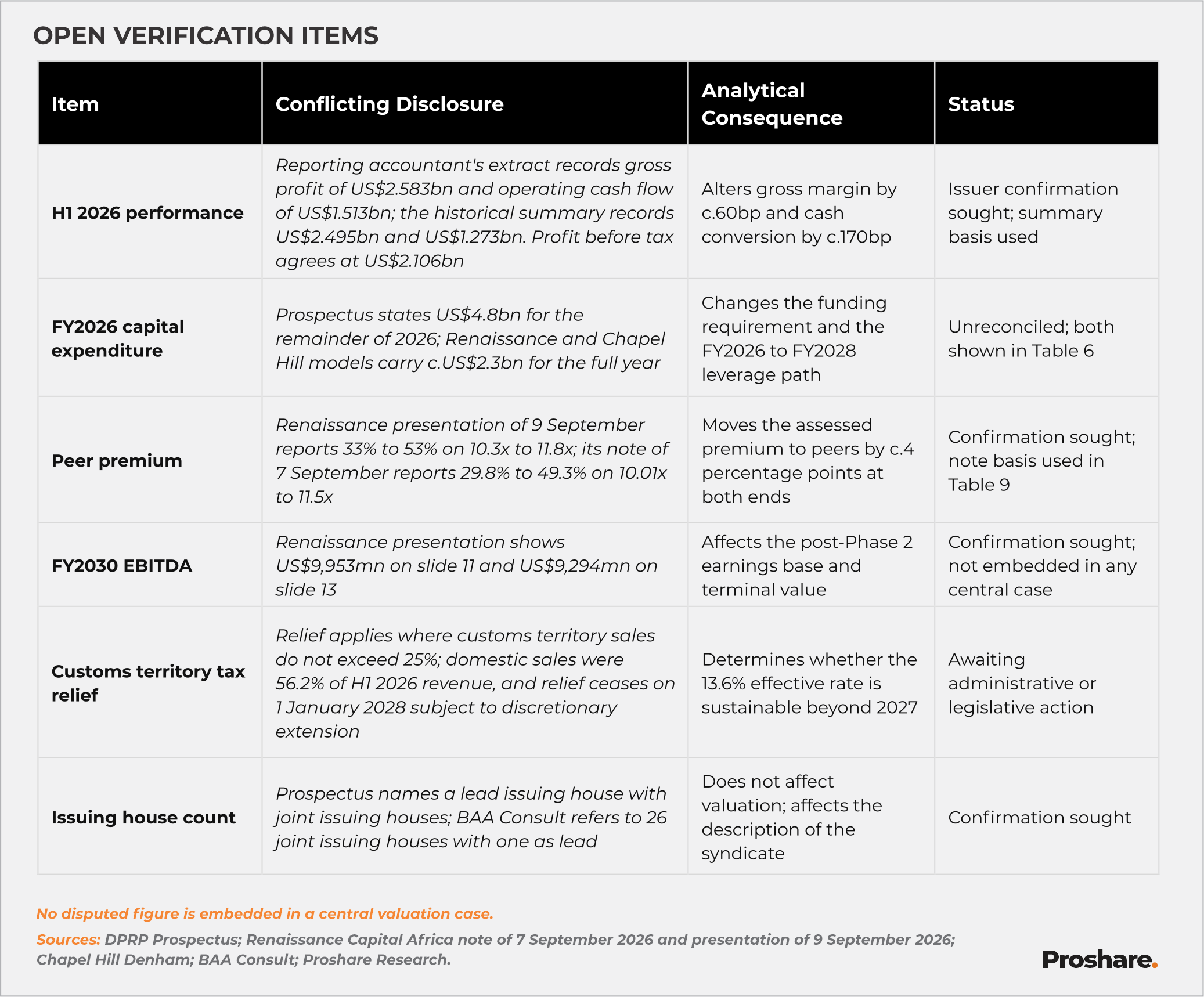
Three findings shape the assessment. The Issuer’s own 2026 margin estimate of approximately US$24.2 per barrel sits below every published research forecast. The prospectus discloses capital expenditure of US$11.8bn to 2028, compared with roughly US$2.3bn in the FY2026 research models. All three research houses (Chapel Hill, Rencap and Cardinal Stone) whose fair values exceed the offer price are joint issuing houses to the Offer, with two disclosing qualifications on independence. Six disclosures remain unreconciled and are set out in Table 14; none is embedded in a central valuation case.
Market data feed
The purpose of the Offer
The Offer raises N2.15trn gross and N2.11trn after expenses of N41.49bn, or 1.93% of gross proceeds. It is not underwritten, there is no greenshoe, and the Issuer may absorb up to 30% of the Offer on oversubscription subject to approval. At N525 the post-offer equity value is N65.22trn, approximately US$47.8bn at the prospectus reference rate of N1,364, and net debt of US$1.40bn gives an enterprise value near US$49.2bn. Table 2 shows nil against each application that would transfer value away from the business.
Table 1: Reconciled Offer Terms
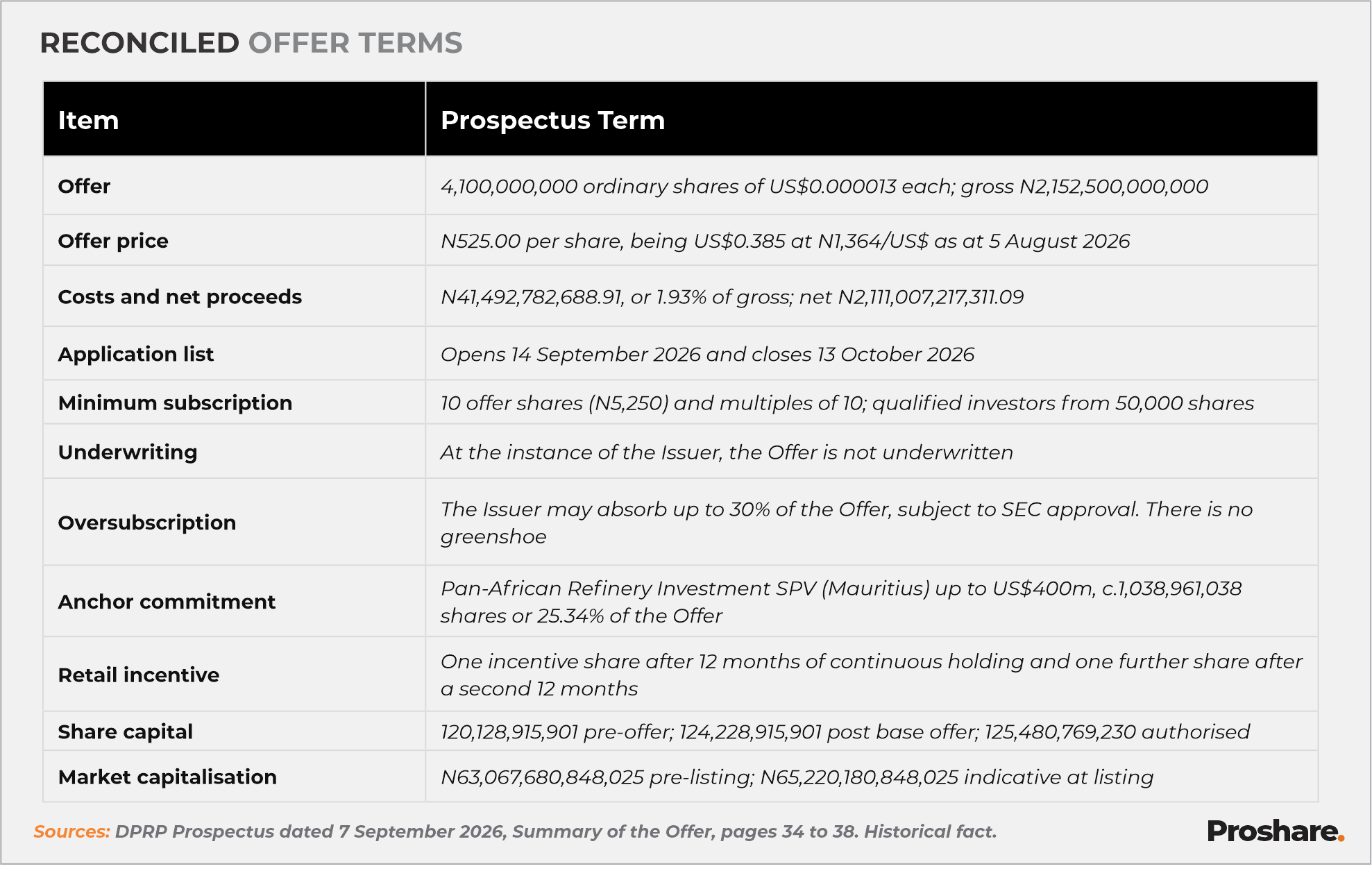
Table 2: Purpose of the Offer and Application of Net Proceeds
Investment research reports
What the prospectus settles
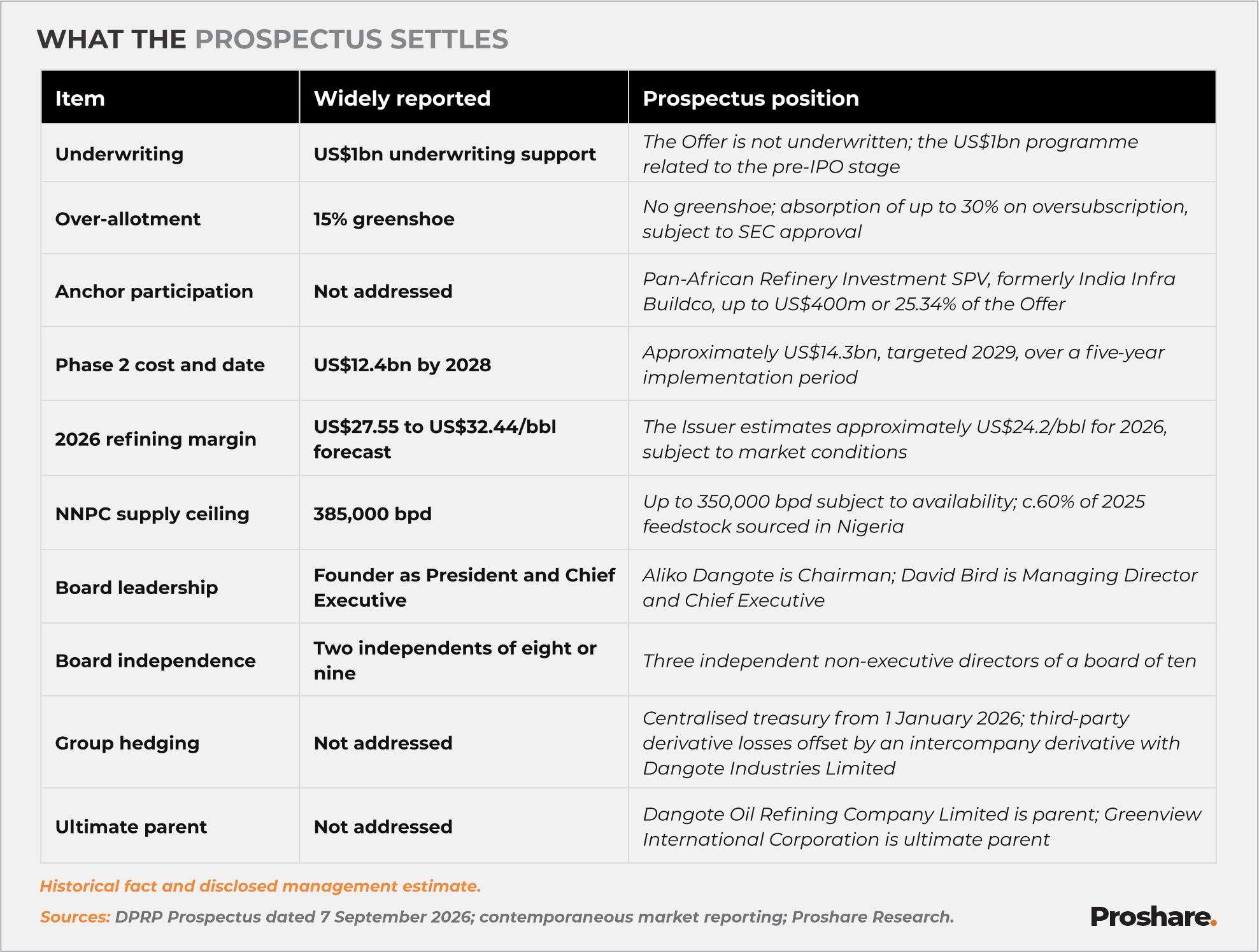
The document corrects several figures in circulation before publication. The Offer is not underwritten, the expansion is US$14.3bn targeted for 2029 rather than US$12.4bn by 2028, the NNPC ceiling is 350,000 bpd, the board is chaired separately from the chief executive with three independent directors of ten, and the ultimate parent is Greenview International Corporation. The Issuer also discloses a 2026 margin estimate below every research forecast.
Table 3: What the Prospectus Settles
Earnings quality and cash conversion
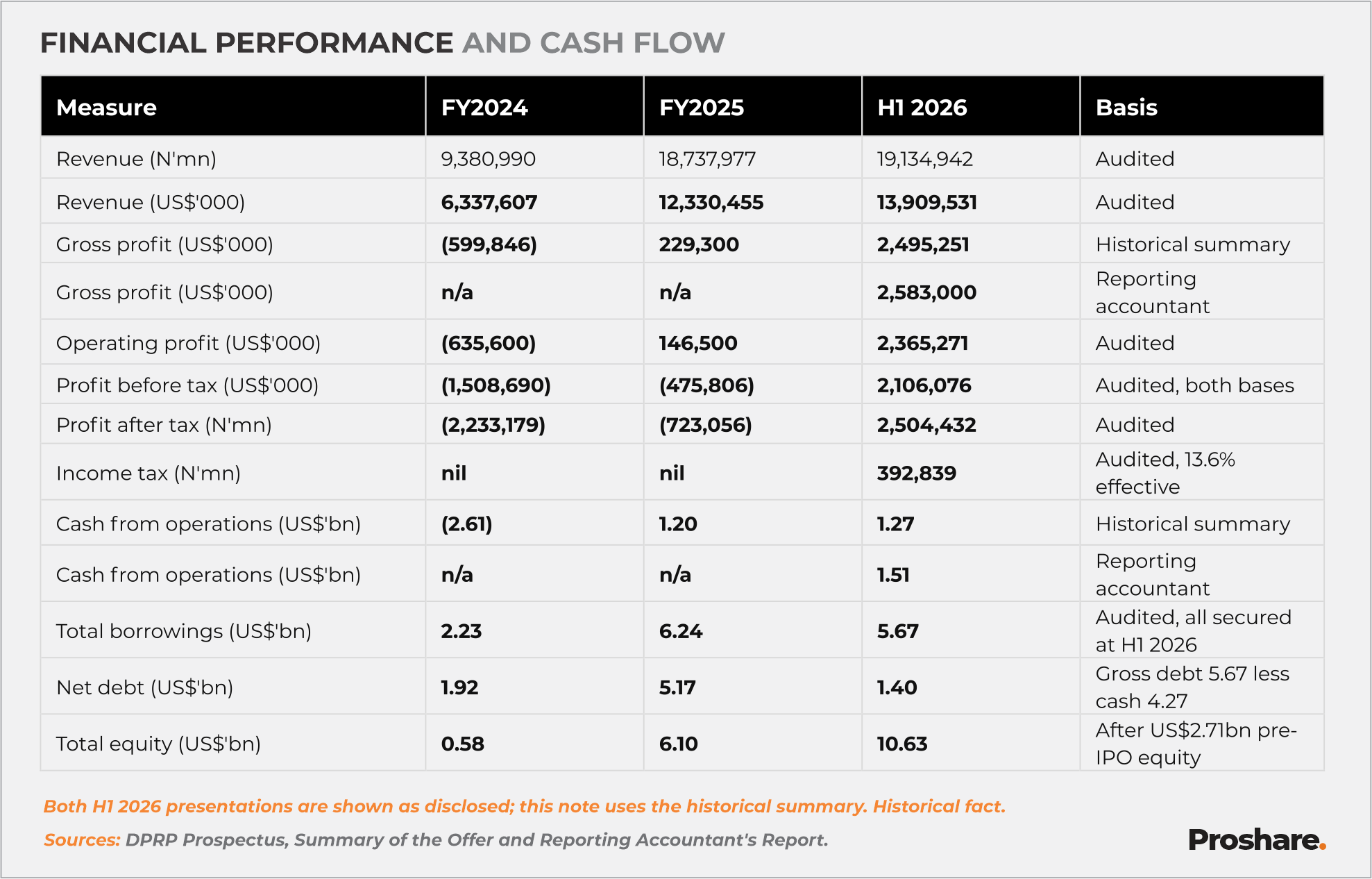
H1 2026 revenue exceeded the whole of FY2025, and the FY2024 and FY2025 losses reflected a completed asset carrying full fixed and financing costs below scale rather than structural impairment. The prospectus presents the half-year on two bases. The reporting accountant’s extract records gross profit of US$2.583bn and cash generated from operations of US$1.513bn, while the historical summary records US$2.495bn and US$1.273bn, with profit before tax agreeing at US$2.106bn.
This note uses the historical summary and identifies the difference rather than selecting the higher figure. Operating cash conversion of 9.2% of revenue sits below the 13.1% net margin, consistent with working capital absorbing cash as volumes rise, and it matters because internally generated cash must carry most of the expansion.
Table 4: Financial Performance and Cash Flow
Margin sustainability
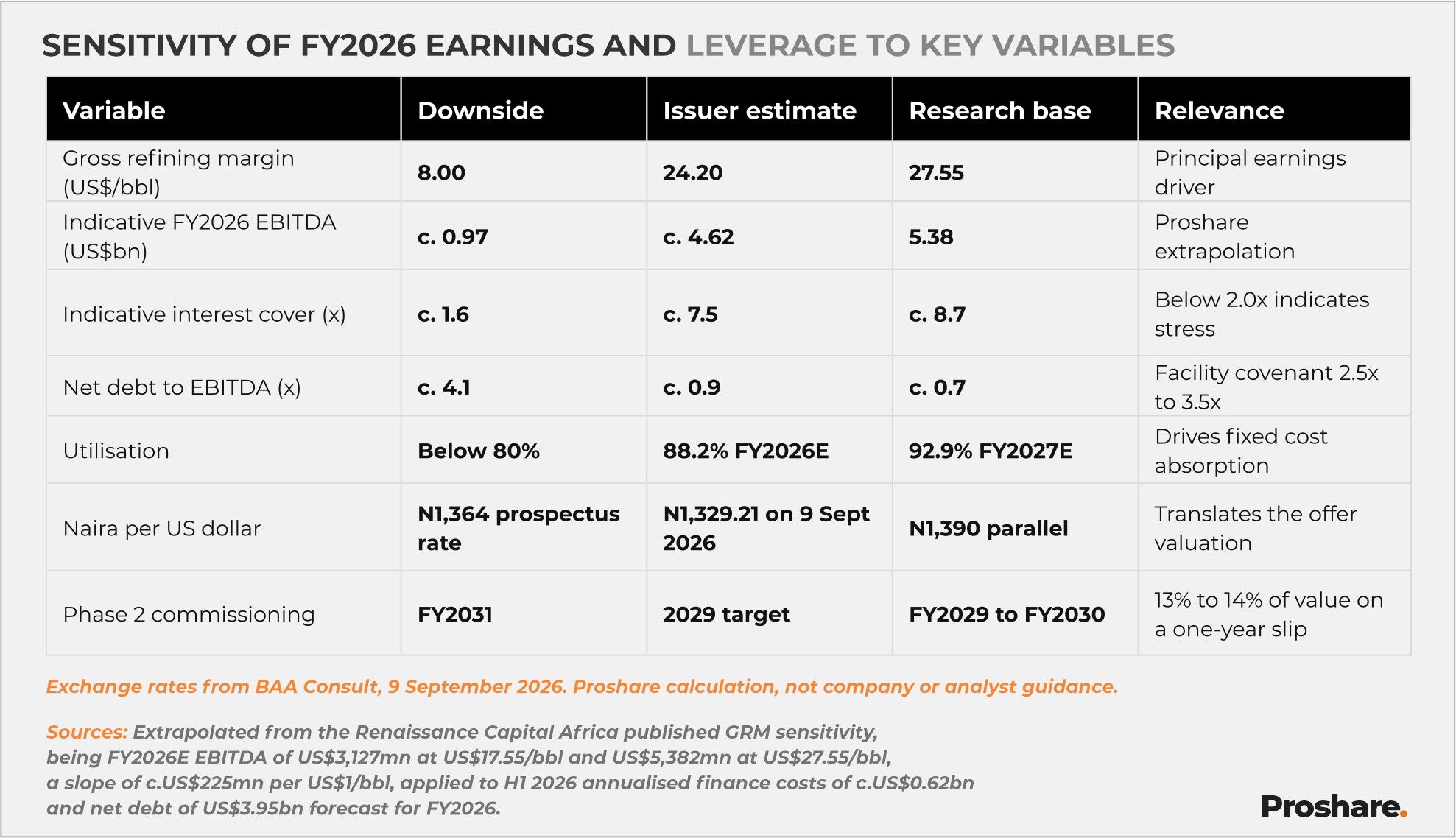
Gross refining margin was US$10.7 per barrel in FY2024 and US$13.7 in FY2025, rising to US$24.5 in H1 2026, with the first quarter at US$33.7 as Middle East disruption widened cracks. An estimated 20% to 28% of Russian primary refining capacity was offline at the mid-2026 peak, so some of that strength is event driven.
The Issuer’s own estimate for 2026 is approximately US$24.2. At US$8 per barrel, indicative EBITDA near US$1.0bn would imply interest cover of about 1.6 times and leverage above the facility covenant range, which makes a severe margin outcome a covenant question rather than an earnings question alone.
Table 5: Sensitivity of FY2026 Earnings and Leverage to Key Variables
Crude supply, currency and financing
Approximately 60% of 2025 feedstock was sourced in Nigeria, with access to NNPC volumes of up to 350,000 bpd subject to availability, and 36 grades processed by June 2026. Chapel Hill Denham reports deliveries at about 43% of the contractual ceiling, so spot and imported barrels carry a balance that brings freight, working capital and currency requirements growing at 1.4mbpd.
Roughly 43.8% of H1 2026 revenue was export-related and dollar-linked, though the prospectus expresses an intention rather than an obligation to declare dividends in dollars. Borrowings of US$5.67bn, all secured, sit against equity of US$10.63bn. Net debt to EBITDA of 0.27 times follows US$2.71bn of pre-IPO share issues and deposits, and cash of US$4.27bn largely committed to construction, so it is a post-raise position rather than a settled one.
Funding and executing Phase 2
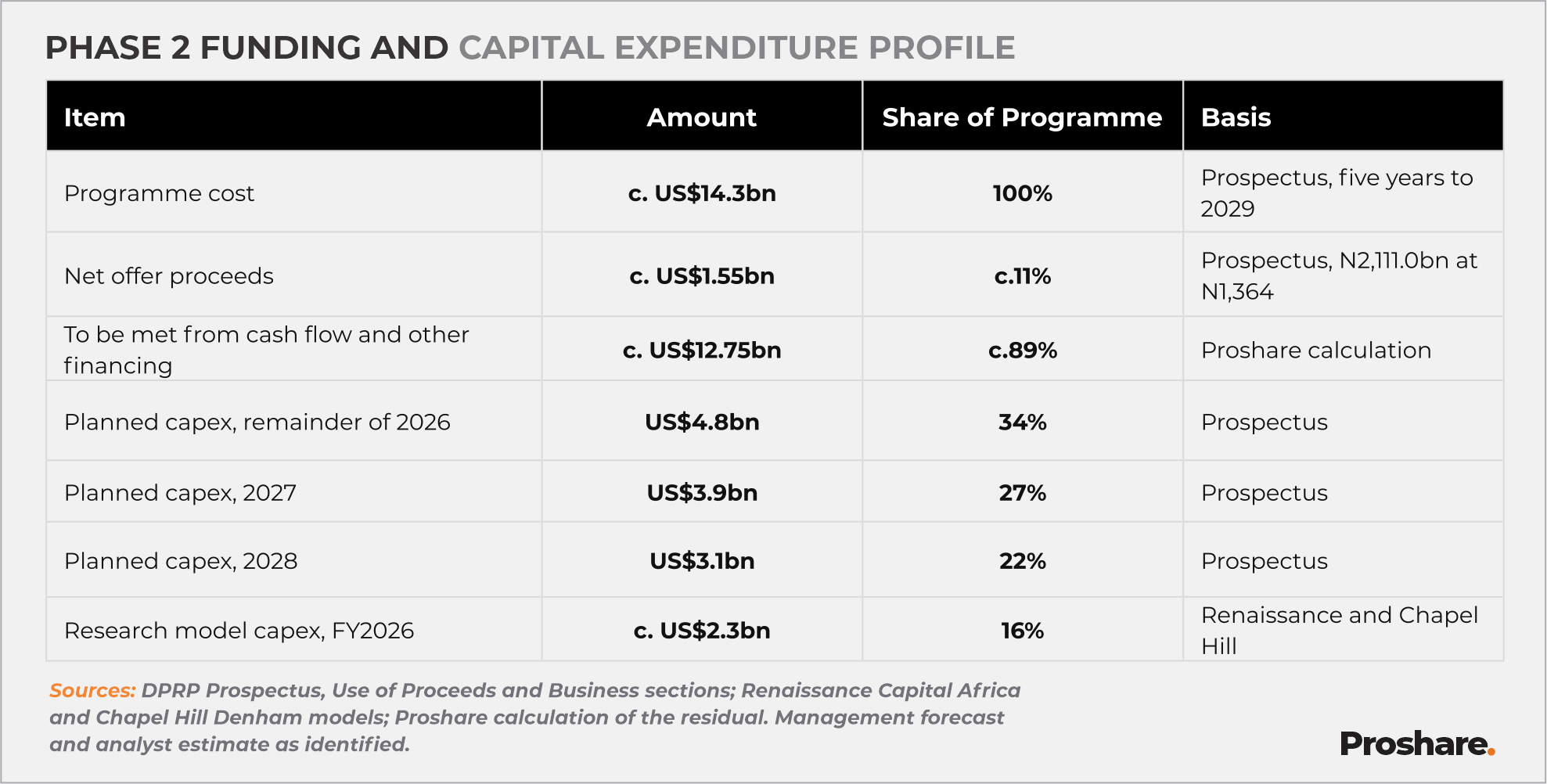
Net proceeds of approximately US$1.55bn fund about 11% of the programme, leaving the balance to operating cash flow and further financing. The prospectus sets out planned capital expenditure of US$4.8bn for the remainder of 2026, US$3.9bn in 2027 and US$3.1bn in 2028. The research models carry roughly US$2.3bn for the whole of FY2026, less than half of what the Issuer states it will spend in the second half alone.
Phase 2 is a brownfield replication on an operating site with established infrastructure and a proven configuration, which lowers execution risk relative to the greenfield first train and removes single-train concentration on completion.
Table 6: Phase 2 Funding and Capital Expenditure Profile

Related parties and governance
The board comprises ten directors with the Chairman and Chief Executive roles separated and three independent non-executive directors, or 30% against the one-third standard in the Nigerian Code of Corporate Governance. Four committees were reconstituted before the Offer and, on the prospectus’s own account, had not met at its date.
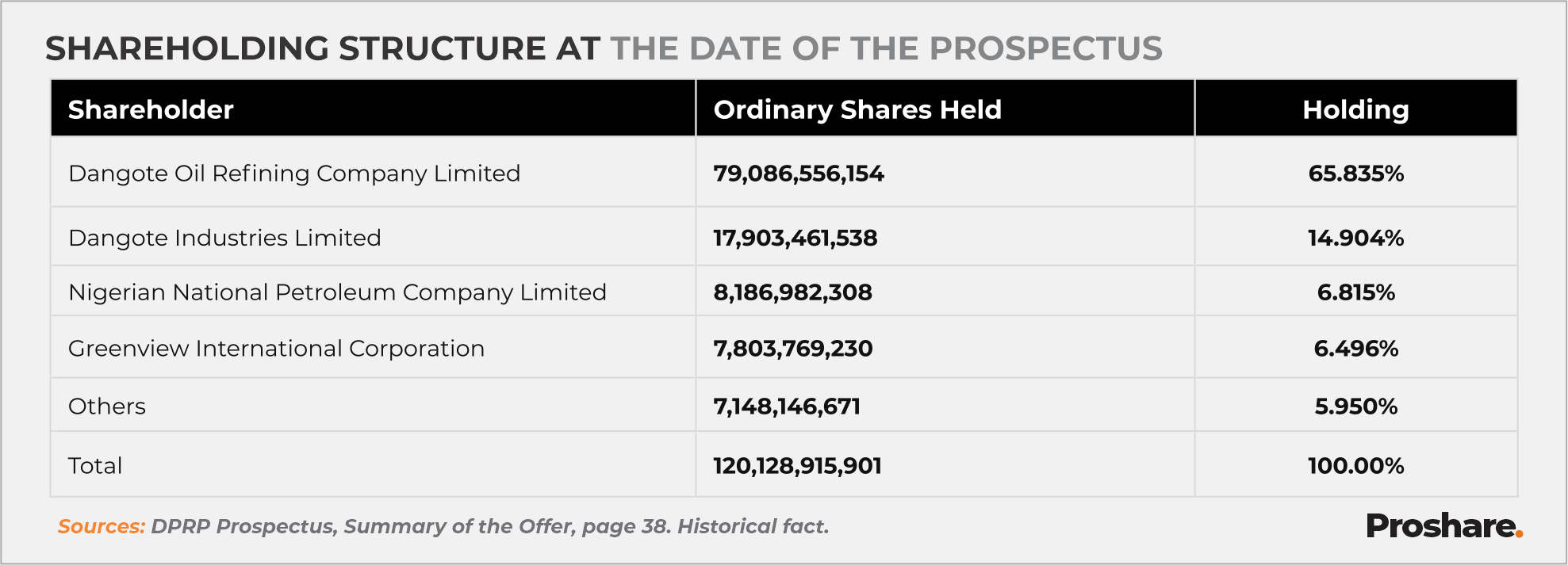
From 1 January 2026, the Issuer moved to the group centralised treasury model, under which H1 2026 losses on third-party commodity derivatives were offset by a gain on an intercompany derivative with Dangote Industries Limited, so the reported margin is presented net of outcomes borne at group level. NNPC Limited is at once a 6.815% shareholder, crude supplier, product offtaker and the adverse party in the Issuer’s import licence challenge, and its Chief Financial Officer sits on the board and on the Audit and Risk Committee, as the prospectus discloses.
Table 7: Shareholding Structure at the Date of the Prospectus
Valuation against comparables
Peer benchmarks range from a 5.0 times median to a 7.7 times market-weighted average and a 9.5 times adjusted emerging-market average, so the offer multiple carries a premium on most constructions. All three published fair values exceed N525, and all three houses are joint issuing houses to the Offer.
CardinalStone discloses that the Company approved its report and that the responsible analyst holds positions in and is a board member, officer, or director of the Company, and Renaissance states that its communication is not independent investment research. CardinalStone’s relative methods return approximately N320 per share before being weighted at 15% each against a 70% weighting to its discounted cash flow, so the offer price is supported mainly by intrinsic valuation rather than trading comparables.
Table 8: The N525 Offer Price Against Published Valuation Ranges
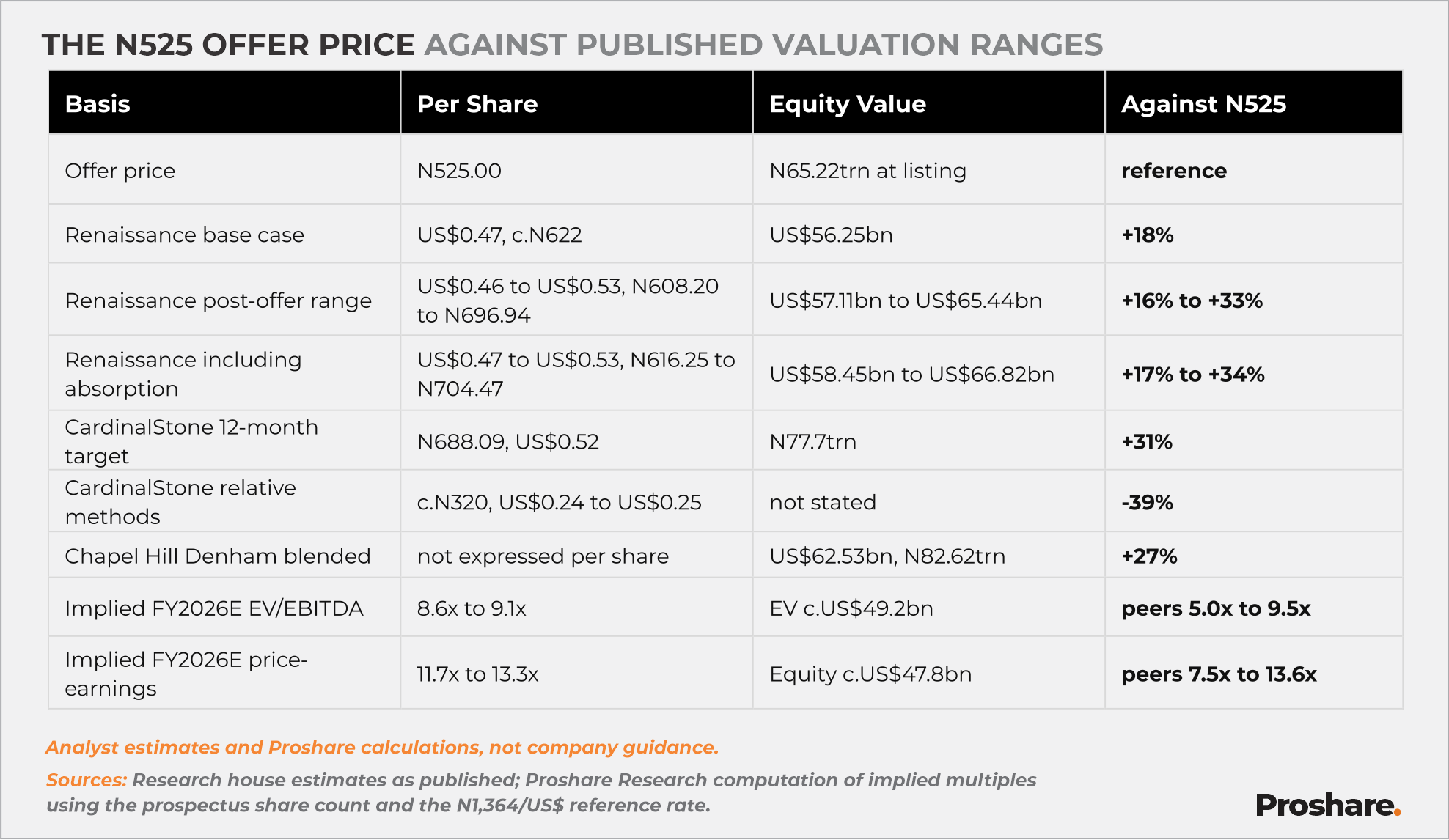
Table 9: Research House Reconciliation and Disclosed Relationships
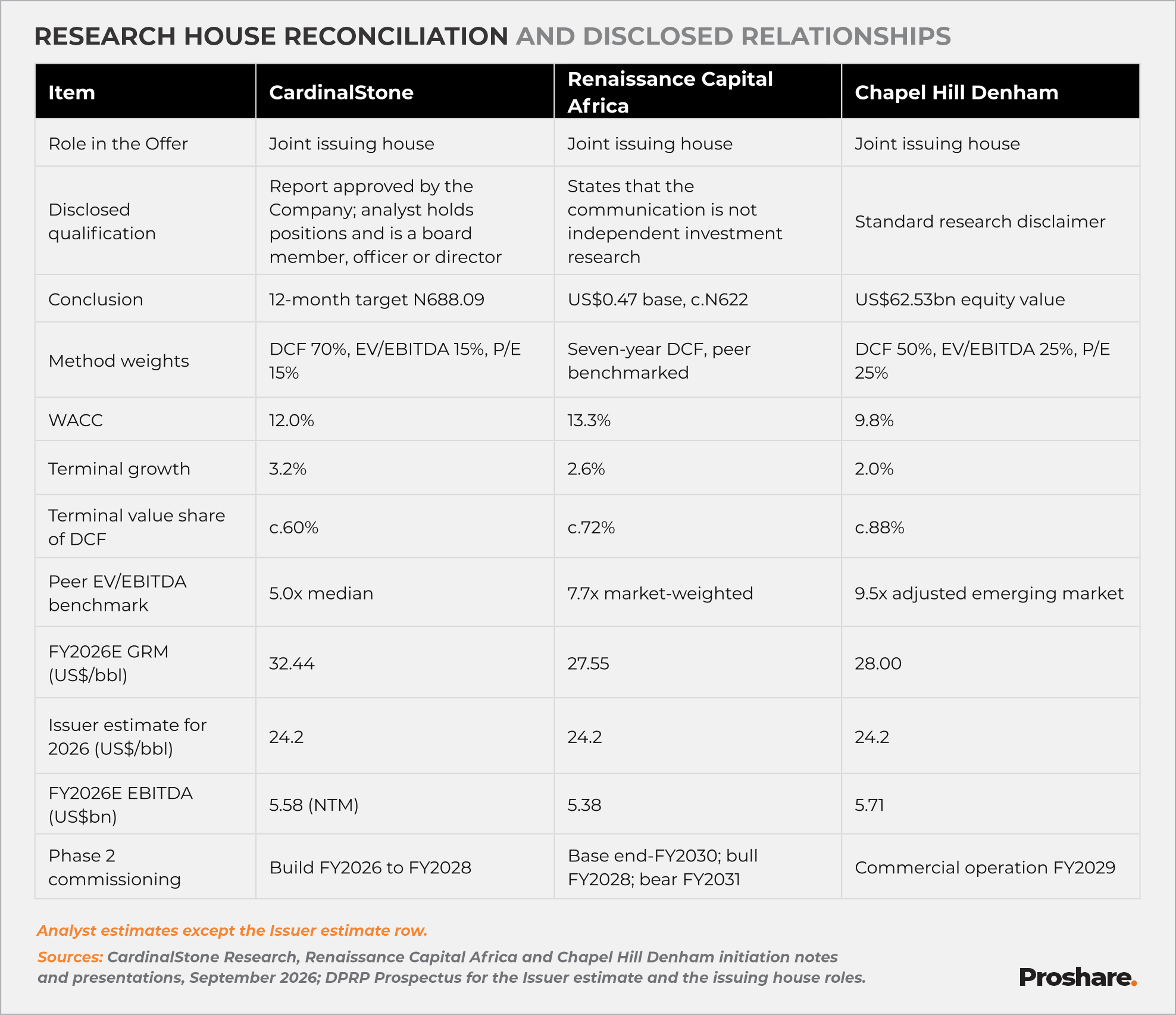
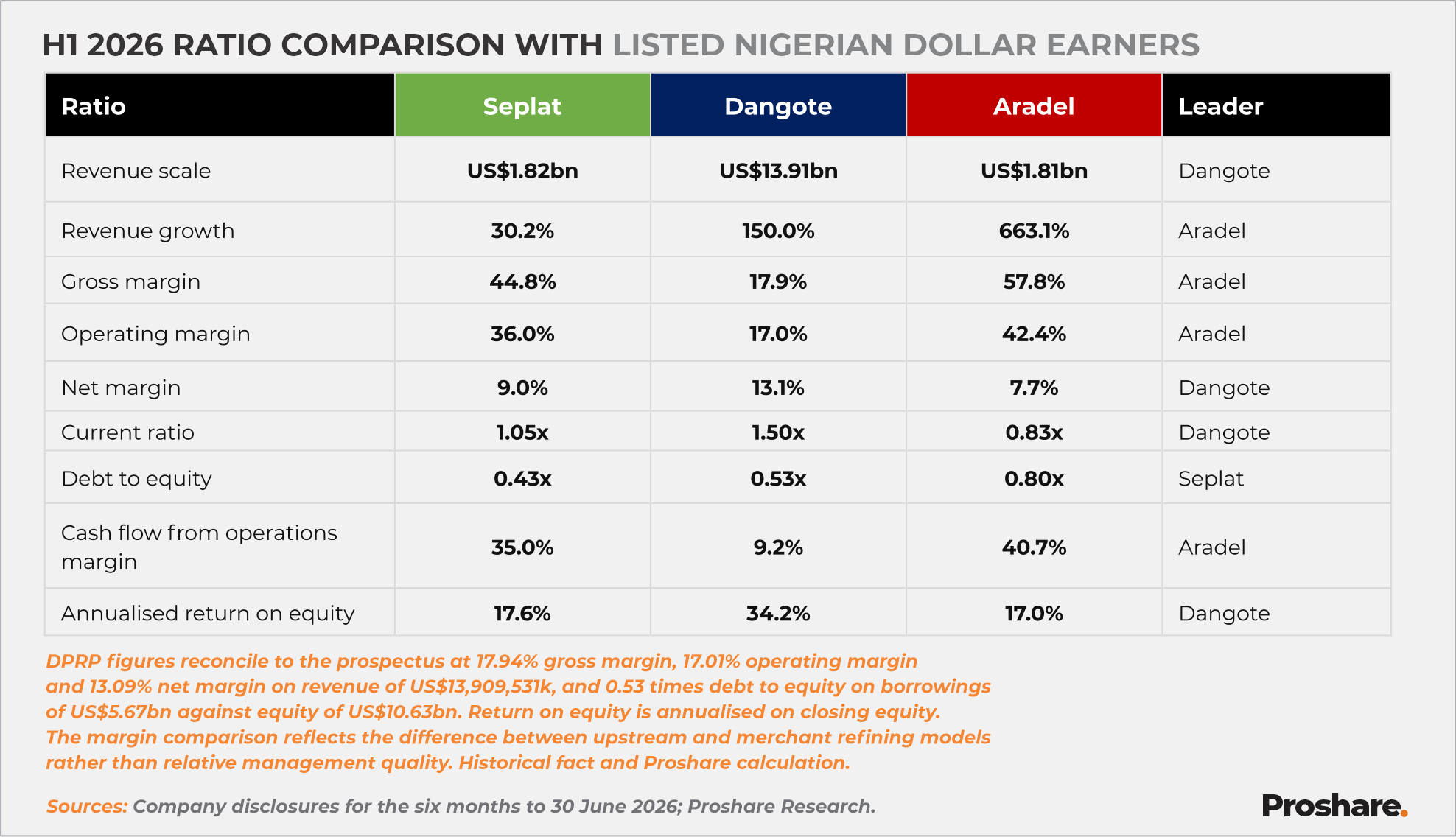
Table 10: H1 2026 Ratio Comparison with Listed Nigerian Dollar Earners
Nigeria economic reports
Concentration, liquidity and the market context
Market data feed
CFG Advisory puts the refinery at about 28.9% of the enlarged Nigerian Exchange, with the Dangote-listed cluster at about N83.5trn, raising index concentration and portfolio-construction questions for pension and mutual funds. Free float is 3.30% of the enlarged share count after the base offer and about 2.46% once the anchor commitment of up to 1.04bn shares is allotted.
A float of that size can support scarcity value while limiting price discovery and the ability to execute a large exit, so effective float rather than market capitalisation determines exit capacity.
Table 11: Macroeconomic and Market Context Attributed to Third Parties
The analyst concerns tested against the prospectus
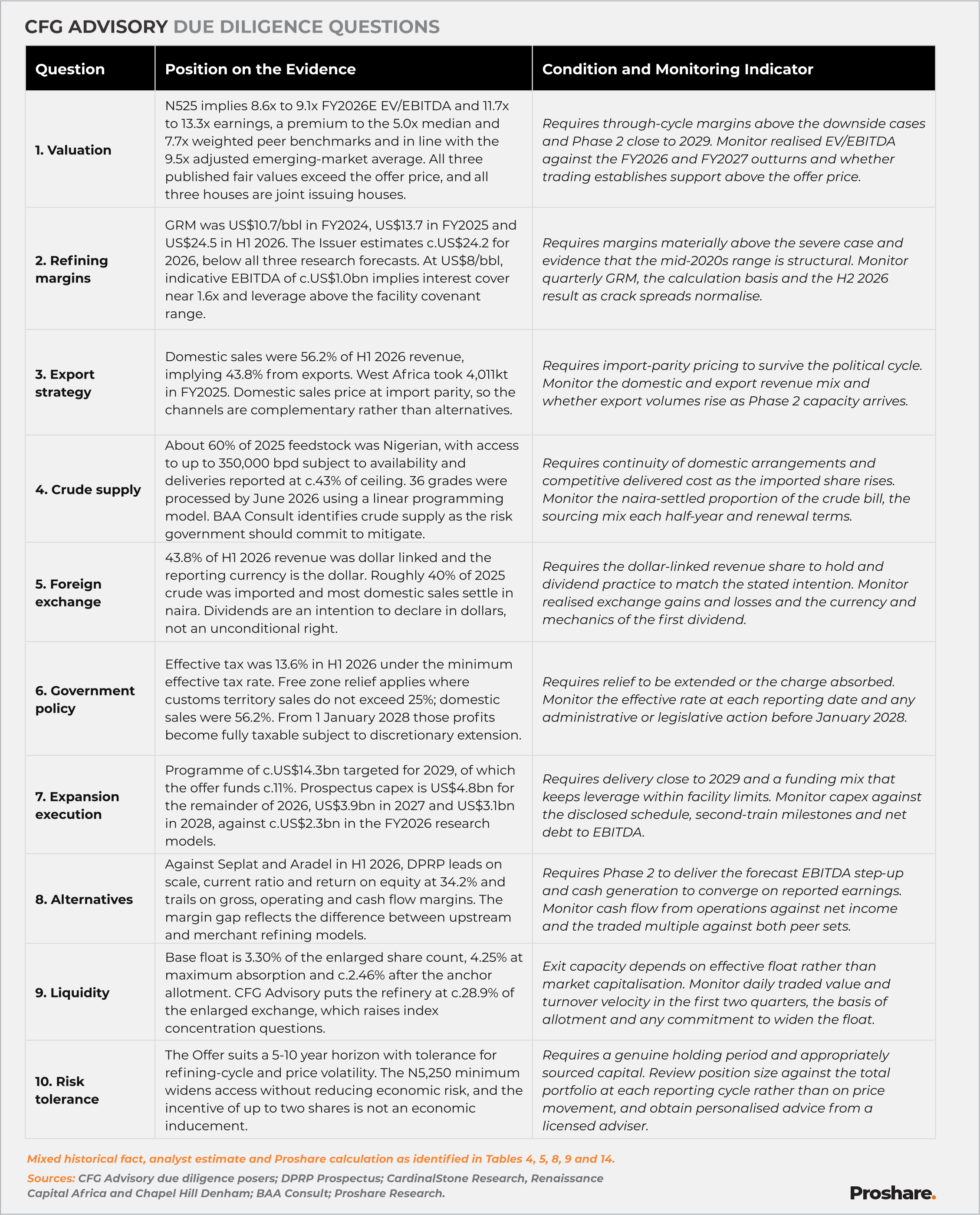
The concerns raised across the market converge on the ten due diligence questions posed by CFG Advisory, and we answer them here against the controlling document rather than commentary, with four carrying most of the weight.
On valuation, the premium to peers is real and is supported by intrinsic rather than relative methods. On margins, the Issuer’s own estimate is the most conservative published figure and the severe case reaches the covenant rather than only the earnings line. On crude supply, three sourcing channels and a wide processed slate reduce dependence on one counterparty while raising currency and working capital requirements. On liquidity, a float near 2.46% is the binding constraint on exit. The remaining six are answered in Table 12 below, each with the condition on which the reading depends and the indicator to track.
Table 12: CFG Advisory Due Diligence Questions

Risks and what to monitor
Each material risk carries an observable indicator, which is the only basis on which a long-horizon holder can review the thesis between reporting dates. Table 14 keeps unresolved disclosures separate, and none are embedded in a central valuation case.
Table 13: Risk and Monitoring Matrix
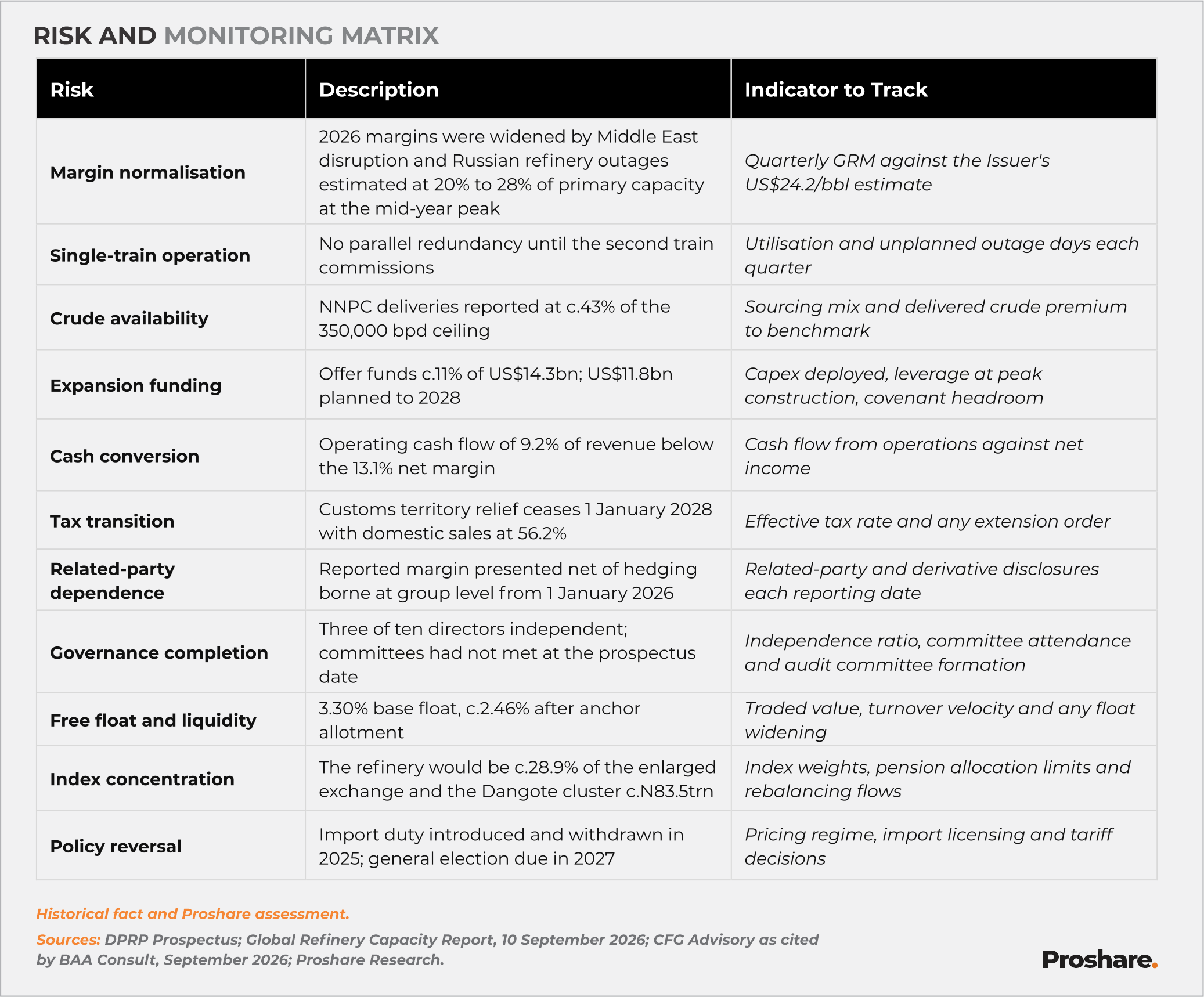
Table 14: Open Verification Items
Concluding Thoughts and Outlook
The purpose of the Offer is to fund expansion, and the industrial case is clear and not projected. The entry price is the open question. N525 assumes margins hold near a level above the Issuer’s own 2026 estimate. It assumes high market utilisation, continuous crude supply and competitive pricing. It presumes a US$14.3bn programme is delivered close to 2029 on a funding framework the current equity Offer does not completely provide.
Market data feed
Independent analysts perceive that value could be impaired by margin normalisation below that estimate, a shortfall in domestic crude delivery, the 2028 change in free zone tax treatment, cash conversion that continues to lag reported earnings while capital expenditure accelerates, and a free float near 2.46% that limits exit capacity.
The investment decision emerges from the equity subscriber’s investment objective and risk capacity rather than from market enthusiasm, brand loyalty or the refinery’s national significance. Table 15 shows how the available data maps the investment decision to buy, wait, or ignore.
Proshare applies no buy, hold or sell classification to this transaction, and readers requiring a personal recommendation should consult a licensed investment adviser who can weigh their objectives, investment horizon, liquidity needs and concentration limits.
Table 15: Mapping the Evidence to the Buy, Wait or Ignore Decision
Download the Repor