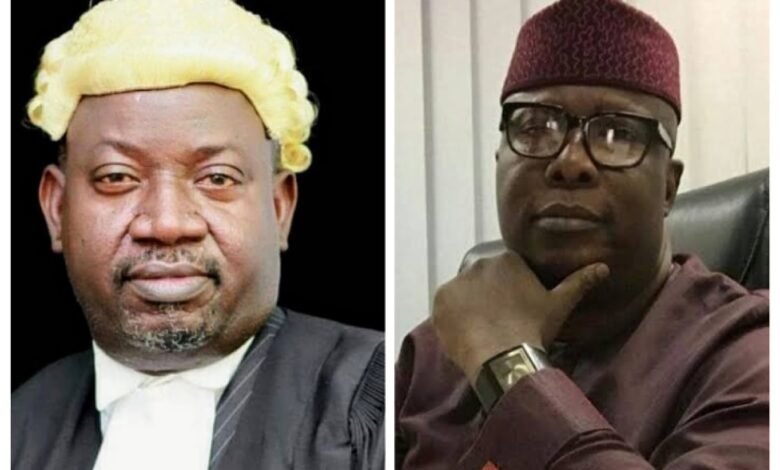
“Silence in power and sermons in opposition is not courage. It is calculation.” That single line from Oloroogun Sola Ajisafe’s open reply to Senator Babafemi Ojudu captures the entire drama of Ojudu’s latest open letter to President Bola Ahmed Tinubu. For Ajisafe, the Akure-based Lawyer and Journalist whose article provides the raw material for this intervention, Ojudu’s letter is not statesmanship – it is arithmetic. It is the calculation of a man who kept quiet for eight years when he had salary, access and influence as Special Adviser on Political Matters to President Muhammadu Buhari, and who has suddenly found his voice now that the doors of 2023 shut against him in Ekiti and in Abuja. The quote exposes the desperate agenda: stay silent while the sharing is going on, then become a prophet once you are out of the sharing formula.
In fact, as Ajisafe documents, Ojudu’s last three years have been a textbook study in that calculation. When the Ekiti Central senatorial ticket went to Senator Opeyemi Bamidele and the people affirmed it, Ajisafe notes, Ojudu jumped camp looking for appointment. When appointment did not come, he manufactured visibility with the Afe Babalola Road controversy in Ado-Ekiti. When citizens confronted him with facts, he answered with insults, not ideas. Now he has found a new script – an Independence Anniversary letter to President Tinubu. According to Ajisafe, it is loud, sanctimonious and hollow. It is not about Nigeria. It is about staying in the news cycle.
Ojudu begins, as Ajisafe observed, with memory and friendship, and that is convenient. He reminds the President of the pro-democracy struggle, of NADECO nights and long years of activism.
However, memory, as Ajisafe warns, cuts both ways. Ojudu conveniently forgets what came after the struggle. Ajisafe reminds Nigerians that Ojudu forgets the eight years he spent not on the street, but inside government. For eight years, Ajisafe writes, Ojudu was in the room where Nigeria was borrowed into a corner. For eight years, he watched the Central Bank print money through Ways and Means until it rose from less than N1 trillion to over N22.7 trillion, until the naira lost meaning in the market. For eight years, he served in a government that produced a CBN governor who turned monetary policy into political warfare with a naira redesign that shut down markets in Akure and Ado-Ekiti, emptied hospital accounts, and left ordinary Nigerians queuing for their own money. The question that will not go away, as Ajisafe framed it, is simple: What did you say then? What memo did you write? What policy did you resign over? In Ajisafe’s words, silence in power and sermons in opposition is not courage. It is calculation.
Today, Ojudu speaks of hardship as if it was invented in May 2023. Ajisafe calls this the politics of amnesia. Hunger is real. Prices are painful. No honest person denies it. But to pretend, as Ojudu does, that this crisis began with subsidy removal is to insult the intelligence of Nigerians. As Ajisafe argues, fuel subsidy was a N2 trillion annual fraud that bled the treasury. Multiple exchange rates were a racket that rewarded a few briefcase billionaires and punished manufacturers. Public debt rose from about N12 trillion to over N77 trillion before Tinubu took over. The President Ojudu is lecturing, Ajisafe insists, inherited a balance sheet that was already on fire. He chose to fight the fire. Ojudu and his colleagues chose to manage the smoke and hope Nigerians would not notice the heat. That is why, in Ajisafe’s assessment, Ojudu’s moral authority today is thin. Very thin.
Governance, as Ajisafe rightly notes, is not a spectator sport. Ojudu was Senator. He was Adviser. He was insider. If advisers were shielding the President from bad news, as he now accuses Tinubu’s team of doing, Ajisafe argues he had a duty to say so while he was being paid to say so. He did not. If he could not speak truth to power when he had power, he should not pretend that his retirement from relevance qualifies him as the nation’s conscience. Conscience, Ajisafe writes, is tested at the moment of decision, not in a press release after the fact.
There is also the matter of consistency that destroys his pose as an outsider, a point Ajisafe drives home with Yoruba wisdom. You cannot be a beneficiary of the federal system on Monday and its chief accuser on Tuesday and expect to be taken seriously. Yoruba have a name for it, as Ajisafe wrote: “Elenu m’awi m’aje” – eating from two pots. It is the same inconsistency that defines his politics since 2022, Ajisafe contends. When the Ekiti ticket eluded him, he moved camp. When appointment did not come, he moved to commentary. When commentary did not trend, he moved to road controversy. Now he has moved to open letters. Each move, in Ajisafe’s reading, is not about Nigeria. It is about Ojudu.
On elections, Ojudu calls for free and fair 2027. We all do. But as Ajisafe points out, democracy also demands respect for rotation and for the fragile trust that holds this federation. The Presidency just left the North after eight years. It is now in the South. To begin to agitate for its return after one term, Ajisafe warns, is to destabilize the very understanding Ojudu was part of producing.
As Ajisafe concludes, Nigeria needs honest critics. What it does not need is revisionists – men who were inside the house when it was burning and now stand outside with a bucket of water claiming they discovered the fire. If Senator Ojudu wants to help President Tinubu, Ajisafe advises, the place to start is truth. Admit his part in the accumulation of our problems. Apologize for the years of silence. Then propose solutions without sanctimony.
The President’s job is not to be popular. It is to be right. The reforms are painful because the alternative was collapse. Every nation that recovered did so through hard choices, not by returning to the policies that destroyed it. As Ajisafe submitted, judge the government by results in 2027, not by sermons in 2026.
Until then, spare us the performance of sudden concern. Nigerians remember. And history, unlike politics, does not forget.