SHE POISONED HIS FOOD, HID KILLERS IN HER BATHROOM, THEN CALLED POLICE TO REPORT ROBBERS

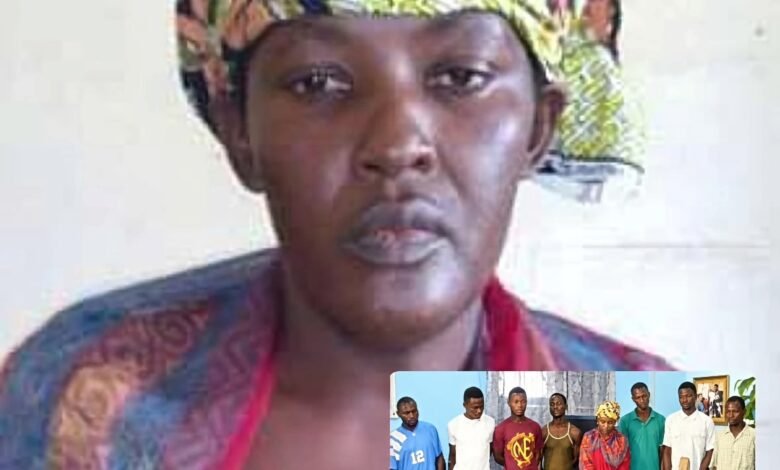
They called her Mother at ACP Estates near Pokuase. A married woman, living under the same roof with a husband who, even police records noted, subjected her to severe beatings. But in her phone was another life. A white boyfriend in the United States who had promised to come to Ghana to marry her, a ticket out, a new identity. In her mind there was only one problem left, and his name was Abdul Karim. Her husband was alive, and as long as he was alive, the American dream could collapse the moment he discovered the other relationship. It is that collision between domestic violence, fantasy, and cold calculation that would lead to a four month plot and a death that was first reported as a robbery.
The plan did not start with the killers. It started with her brother. About four months before the murder, Salamatu Karim reached out to Awudu Alhassan Sulemana, known as Dozer, and told him about the white man in America and her fear that her husband’s presence would ruin the marriage plan. She also told him about the beatings. Awudu did not counsel her, did not report it, did not distance himself. He became the recruiter. He brought in Mohammed Sulemana, alias Banana, and Kofi Nyagbedzi, and according to police investigations, the price put on Abdul’s life was GH¢1,000. That amount tells its own story about how cheaply life was valued and how deeply loyalty to a sister was twisted into conspiracy. For months the idea sat, maturing, until a date was fixed and logistics began.
June 15th, 2013 was not random. It was choreographed. A taxi driver who would later walk into a police station on his own after hearing the case in the media said Salamatu herself hired him to move the men from Dodowa to her residence at ACP Estates. She opened the door and she did not hide them in a bush or an uncompleted building. She hid them inside her own bathroom, armed with clubs and pieces of wood, listening to her husband’s house. While they waited, she was in the kitchen. Into her husband’s food she mixed diazepam, Valium, a sedative meant to make him weak, drowsy, unable to resist. When Abdul Karim returned home, he ate the food his wife had prepared, his body began to give way, and at that precise moment of vulnerability, Salamatu called the men out. The medical evidence presented later did not describe a single blow. It described a sustained attack, a fractured skull, a fractured jaw, injuries that spoke of multiple attackers hitting a defenseless man who had been drugged by his own wife. He was rushed to hospital but was pronounced dead, and after the men left, Salamatu began to scream for help. At 9:35 p.m. she placed the call that was supposed to seal the plan. Unknown robbers had entered while she was bathing and killed her husband.
For three days it worked. The police had a robbery-murder on their hands. Then an entirely different robbery exposed it. On June 18th, 2013, police acting on information that a gang was preparing to attack a hotel at Adenta moved in and arrested several suspects. In custody, one suspect’s phone rang. It was Kofi, checking whether the hotel job had succeeded. Officers instructed the suspect to say it had and to invite Kofi to come for his share. When Kofi arrived to collect, he was arrested for the hotel plot. It was during that interrogation that the Pokuase case cracked. Kofi began to talk, linking himself, Salamatu, Awudu and Mohammed to the killing of Abdul. Acting on that, police traced Awudu and Mohammed to Dodowa. Both, the prosecution said, gave confession statements admitting involvement and naming Salamatu as the person who planned and facilitated everything. The taxi driver’s identification corroborated the movement of the men. The Valium in the food, the hiding place in the bathroom, the timing of the distress call, all began to fit a pattern no robbery could explain.
The legal journey that followed tested that pattern. Salamatu, Awudu and Mohammed were first remanded by the Osu Magistrate Court and then tried at the High Court in Accra, Salamatu for abetment of murder, Awudu for murder and conspiracy, Mohammed for conspiracy. All pleaded not guilty, and Awudu and Mohammed challenged their confessions as products of beatings, electric shocks and threats. The High Court on December 1st, 2015 paused the main trial to hold a trial-within-a-trial, calling the investigator and an independent witness who was present during recording. On December 17th, 2015 it ruled the statements were voluntary and admitted them. They appealed that ruling mid-trial to the Court of Appeal, which on July 28th, 2016 dismissed the appeal, finding proper recording with an independent witness. When the main trial resumed, the jury returned unanimous guilty verdicts and the judge imposed death sentences on all three. On November 15th, 2018 the Court of Appeal affirmed those convictions, holding that the jury had been properly directed and the evidence supported the verdicts. A further appeal to the Supreme Court on thirteen grounds, attacking the confessions, witness credibility and jury directions, was unanimously dismissed on July 29th, 2026 by a five-member panel which found the confessions were corroborated by Kofi’s testimony, medical findings and the circumstances, and that the prosecution had proved beyond reasonable doubt that the killing was planned, participated in by Awudu and Mohammed, and intentionally facilitated by Salamatu. Their death sentences were affirmed. Published judgments focused on the confessions, medical evidence and roles of the three convicts, while details such as the GH¢1,000 promise, the white boyfriend, the Valium, and the taxi driver’s account came from police investigations and initial media briefings, and no reliable record was found on what became of Kofi’s separate robbery case or other suspects not in the final judgment.
What remains is not just a murder but a study in how a plan built on deception collapses under its own weight. A woman enduring abuse believed a foreign marriage would be salvation and that murder would clear the path. A brother turned family protection into procurement of killers. Young men traded a life for GH¢1,000. A house became a trap, with a bathroom as a hideout and a drugged meal as a weapon, and a fake robbery report as the final act. It ended not because the plan was flawed in its own logic, but because a different crime, in a different hotel, on a different night, brought one conspirator to a phone call that unraveled everything.