
The proposed listing of the Dangote Petroleum Refinery brings Nigeria’s largest private industrial project into a global class of refining businesses whose histories show that capacity is only one part of corporate value. Jamnagar, Valero, S-Oil, SATORP, YASREF, Pengerang and Petrobras were built through different combinations of promoter equity, public capital, bank debt, strategic ownership, state participation and operating cash flow. Their results have depended on crude flexibility, logistics, integration, utilisation, maintenance, market pricing and disciplined capital allocation.
Nigeria economic reports
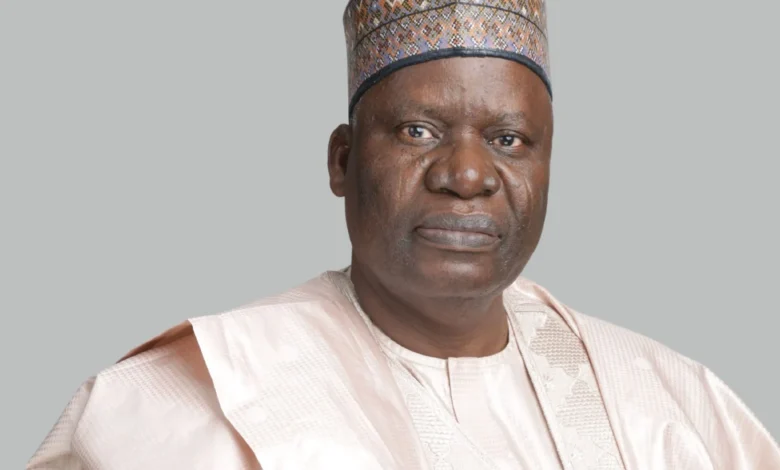
Suleyman A. Ndanusa, uses these models to assess the transition of Dangote Refinery from a founder-led private project to a listed company seeking capital for a second expansion phase. He places the offer within a short but improving earnings record, a substantial future funding requirement, concentrated ownership and the governance obligations created when public shareholders enter alongside a dominant promoter. The comparison also separates industrial achievement from valuation, since construction cost and processing capacity do not determine the cash flows attributable to shareholders.
Ndanusa’s conclusion extends beyond the offer itself. Nigeria’s return will depend on predictable crude-supply rules, commercial pricing, transparent treatment of related-party transactions and the development of a refining and petrochemical corridor around Lekki, Lagos and Ogun. The refinery’s next stage will be measured by reliable operations, prudent financing, minority-shareholder protection and productive linkages that convert refined products into wider manufacturing capacity.
Jamnagar and the Value of Industrial Capability
Market trend analysis
In Jamnagar, on India’s western coast, stands a refining and petrochemical complex that changed India’s position in the global energy market. Its story is remarkable not because India discovered an ocean of crude oil beneath Gujarat, but because an Indian company discovered that industrial capability could be more valuable than natural endowment.
Reliance Industries built the first Jamnagar refinery in the 1990s at a scale many considered unnecessarily ambitious. It was India’s first major private sector refinery and one of the largest industrial projects undertaken in the country. Reliance says the complex was commissioned in approximately 30 months, an extraordinary achievement for a project of such magnitude. A second export oriented refinery was subsequently constructed beside it, taking the combined complex to roughly 1.4 million barrels per day.
The Jamnagar journey was not financed by one heroic cheque from the Ambani family. Promoter capital was important, but it was combined with public equity, domestic and international borrowing, project finance and export credit support. Reliance Petroleum approached the Indian capital market to help finance the original development. For the later US$6 billion export refinery, contemporary transaction reports indicate a financing structure of approximately 42% equity and 58% debt. The US Export-Import Bank provided a US$500 million loan guarantee to support the purchase of American equipment and services.
That financing structure tells us something important. The risk was deliberately shared. The promoters contributed equity and retained control. Public investors supplied risk capital. Banks provided long term debt. Export-credit institutions supported equipment purchases. Contractors and lenders imposed milestones, completion tests and financial discipline. The refinery was not simply large; it had to be bankable.
Public investors were admitted before all the risks had disappeared. They participated in the uncertainty of construction, commissioning and market development. In return, they had the possibility of capturing the value created as the project moved from engineering drawings to operating cash flow. The public market was not invited merely to admire a finished monument; it helped finance the journey.
Jamnagar’s eventual profitability did not come from size alone. Its real advantage emerged from complexity, crude flexibility, export logistics and integration with petrochemicals. The complex can process numerous crude grades, including heavier and less expensive varieties, and convert them into higher value products meeting demanding international specifications. It can purchase crude from different markets, adjust its product mix and sell into whichever geography offers the best economics.
India therefore converted a natural resource disadvantage into an industrial advantage. Oil-producing countries supplied crude; Jamnagar supplied the capability that added value to it. Oil-rich countries may still import fuel from countries with limited crude production when refining capacity, technology, and logistics are stronger elsewhere.
Valero and the Discipline of a Mature Refiner
From Jamnagar, our journey moves to the United States, where Valero Energy represents a different model. Valero is not the product of one enormous greenfield project. The modern company developed largely through restructuring and acquiring existing refineries. It assembled a portfolio across the United States, Canada and the United Kingdom, and now operates 14 petroleum refineries with combined throughput capacity of approximately 3.0 million barrels per day.
Valero is a publicly traded company. It financed its growth through a combination of retained cash flow, shares, and corporate debt. Rather than ask investors to wait through the construction of one gigantic refinery, it frequently purchased operating assets, improved them, integrated them with pipelines and terminals, and sold or closed facilities that no longer justified the capital committed to them.
Its journey demonstrates the difference between financing construction and financing a refining business. Once a refinery is operational, the central questions change. Investors become less interested in how many tonnes of steel were installed and more interested in utilisation, refining margins, maintenance, operating costs, free cash flow, debt and dividends.
Valero’s profitability is openly cyclical. When product demand is strong, crude differentials are favourable and competing refineries experience outages, earnings can rise dramatically. When margins contract, environmental costs increase or a particular refinery loses competitiveness, profits can fall just as quickly. Valero has sometimes returned substantial cash to shareholders and, at other times, recognised large impairments. In 2025, it recorded a US$1.1 billion pre-tax impairment relating to its California refining operations while considering the closure or restructuring of one facility.
A refinery’s construction cost is not its permanent market value. Market value reflects the future cash the asset can generate. A refinery may have cost US$20 billion to build and still be worth less if margins, regulation, maintenance requirements or market demand weaken.
Valero also shows why capable refiners conserve cash during prosperous periods. Refining margins are cyclical. Prudent management uses stronger periods to reduce debt, maintain plants and return excess capital to shareholders without assuming favourable conditions will persist.
S-Oil and Strategic Shareholder Control
Our next stop is Ulsan in South Korea, where S-Oil presents another model: a listed company with a powerful strategic shareholder. South Korea has little crude oil of its own, yet it developed one of the world’s leading refining and petrochemical industries. S-Oil’s refinery has grown in stages over several decades, combining fuels, lubricants and petrochemicals within an export-oriented industrial system.
Saudi Aramco became its strategic controlling shareholder, bringing capital, technical relationships and greater security of crude supply. S-Oil also maintained a long-term crude purchase arrangement with Aramco. The company nevertheless remained publicly listed, allowing minority investors to participate alongside the controlling shareholder.
This combination can be powerful. The strategic investor brings patient capital and feedstock security, while public listing introduces market scrutiny, disclosure requirements and access to additional equity. But it also requires a credible governance framework. Where one shareholder controls crude supply, strategic direction and the majority of votes, minority shareholders need confidence that related transactions are conducted fairly.
S-Oil’s long operating history has not removed the refining cycle. Its earnings move with margins, petrochemical conditions and maintenance requirements. Its refinery utilisation reached about 96% in 2025 but fell to 85% in Q1 2026 and 76% in Q2 as conditions changed. Even sophisticated refineries do not operate continuously at full capacity.
Strategic Joint Ventures and Project Finance
Saudi Arabia’s SATORP and YASREF ventures represent a fourth funding model. These were not conventional public companies financed by millions of retail shareholders. They were strategic joint ventures backed by large national and international oil companies.
SATORP brought together Saudi Aramco and TotalEnergies. YASREF combined Saudi Aramco and China’s Sinopec. The sponsors contributed equity, crude supply, technology, project management capability and market access. Debt was then raised against the strength of the sponsors and the projected cash flows of the facilities. YASREF, which processes about 400,000 barrels of crude per day, involved a reported total investment of approximately US$8.6 billion and subsequently obtained substantial syndicated financing.
The ownership arrangement reduced several risks simultaneously. Saudi Aramco could assure feedstock. Its international partners brought refining and marketing expertise. The projects were constructed with clearly defined shareholder agreements and supported by lenders able to monitor completion, performance and debt service requirements.
Wealth management solutions
But SATORP and YASREF are not independently listed companies. Their shares do not trade daily, and their standalone valuations and dividend histories are not as visible as those of Valero or S-Oil. They are therefore strong comparators for construction, financing, crude supply and industrial integration, but weak comparators for deciding the fair share price of a publicly listed refinery.
Enthusiastic valuation exercises often overlook differences in ownership, feedstock and sponsor support. Two plants may process similar quantities of crude without their companies deserving similar valuations. One may be a private joint venture with guaranteed feedstock and sponsor support, while another is a standalone listed company purchasing crude at market prices. A barrel is a unit of capacity, not a complete valuation model.
Pengerang and Integrated Industrial Development
Malaysia’s Pengerang complex provides yet another variation. Petronas, the Malaysian state-owned energy company, developed a major integrated refinery and petrochemical project and later brought Saudi Aramco into the venture as an equal partner. Aramco’s investment provided both equity and an arrangement to supply a substantial part of the refinery’s crude requirements.
The complex combined a refinery of approximately 300,000 barrels per day with petrochemical production, storage, terminals, utilities and supporting infrastructure. It was conceived not as an isolated plant but as the anchor of a broader industrial ecosystem.
Construction, commissioning and operational setbacks delayed the smooth emergence of earnings. Strong sponsors and state ownership supplied patient capital but could not eliminate engineering and execution risk.
The ownership structure has also evolved. In May 2026, Aramco and Petronas announced the transfer of Aramco’s interests to Petronas, which would make the Malaysian company the full owner of the refining and petrochemical ventures, subject to completion conditions.
The Pengerang experience demonstrates that strategic partners may enter at one development stage and depart at another. Each investor continues to assess whether the asset serves its commercial strategy.
Petrobras and the Limits of State Control
Brazil’s Petrobras offers a mixed public-private model. The Brazilian government controls the company, but it also has private shareholders and securities traded in domestic and international markets. It has funded its operations through government capital, retained earnings, bonds, bank borrowing, and public equity. Unlike a standalone refiner, Petrobras also produces crude oil, giving it a large integrated upstream business.
Integration provides some protection against the refining cycle. When crude prices rise and refinery input costs come under pressure, upstream earnings may improve. A standalone refiner buying crude at market prices does not enjoy the same natural hedge. This makes Petrobras a useful corporate comparator but an imperfect valuation comparator for a pure refining company.
Petrobras has achieved strong operational performance. Its refinery utilisation reached 93.2% in 2024, with record production of gasoline, and low sulphur diesel. But politics has also shaped its profitability. At various times, government priorities have influenced domestic fuel pricing, investment decisions, and dividend policies.
This is the central risk of a state-controlled listed company. Private investors may own shares while government retains decisive influence over pricing, investment and distributions, and policy priorities can change after elections.
Public Ownership and Public Value
The experiences of Tema Oil Refinery in Ghana and Nigeria’s government-owned refineries provide the less glamorous part of our tour. They demonstrate that public ownership is not the same as public value.
Tema began with Italian ownership before the Ghanaian government became the sole shareholder in 1977. Over time, political pricing, weak working capital, accumulated debt, maintenance problems, and operational interruptions undermined its performance. Nigeria’s refineries followed a similarly unhappy route on a larger financial scale. Government financed construction, borrowed for rehabilitation, allocated crude, approved operating budgets and repeatedly announced reopening dates. The public carried the risk but rarely received reliable products, profits or dividends.
The problem was not state ownership alone. Saudi Aramco and Petronas show that publicly owned enterprises can build and operate successful refining systems. The difference lies in governance, professional autonomy, maintenance, commercial pricing, and accountability.
There are therefore no magical ownership labels. A privately owned refinery can fail. A government refinery can succeed. A listed company can destroy value. A strategic joint venture can encounter delays. The real divide is between disciplined and undisciplined capital.
Dangote’s Transition to Public Capital
Table 1: Global Refinery Models and Their Relevance to Dangote
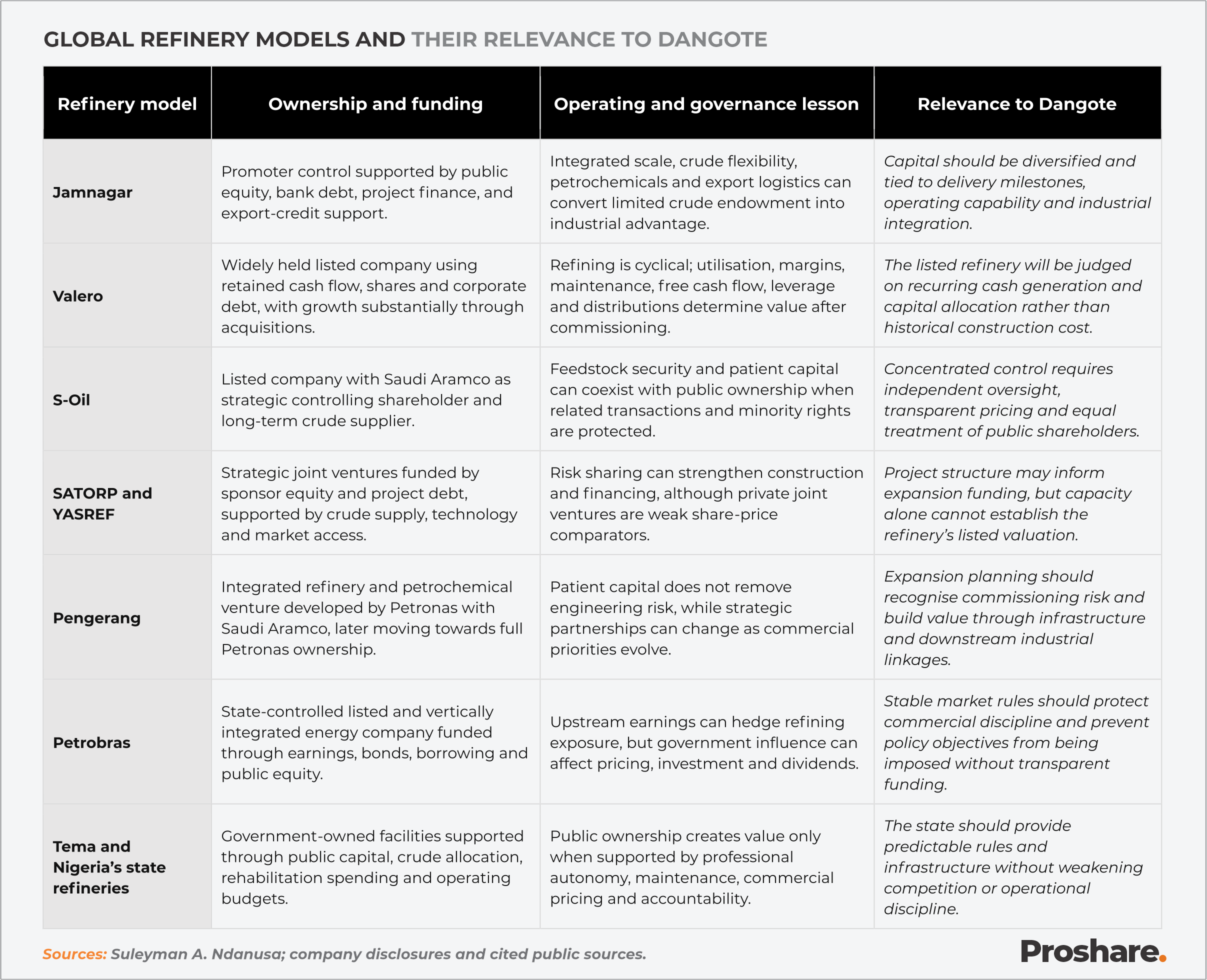
This global journey provides a more useful background for examining the Dangote Petroleum Refinery.
Dangote’s original funding model was founder-led and predominantly private. Sponsor capital and related party financing were combined with bank borrowing, customer advances, strategic investment, and other funding arrangements. The NNPC acquired a minority interest, introducing state participation without transferring operational control to government.
This was not a conventional limited-recourse project finance structure established once and preserved until completion. As costs rose, timelines extended, and the financing environment changed, the capital structure evolved. The founder and related companies carried much of the early risk, while lenders and strategic investors entered at different stages.
Public investors were not asked to finance the original development when it consisted largely of sand, engineering drawings and promises. They are entering after the refinery has been substantially completed, commissioned and brought into commercial production. In that respect, their risk is lower than that assumed by the early promoters and lenders.
Pricing Profitability and Expansion Risk
Shortly before the public offer, the company completed a private placement of approximately US$2.5 billion and issued about 7.15 billion shares. This implies a price of roughly US$0.35 per share. The public offer price of ₦525 is equivalent, at the prospectus exchange rate, to about US$0.385 per share, approximately 10% higher.
That premium may be defensible. The public is entering after substantial construction risk has passed and after the refinery reported strong H1 2026 results. Listing can also improve liquidity and disclosure. Nevertheless, the prospectus should explain more clearly why public investors are paying more than private placement investors admitted only shortly before them, and whether those earlier investors are subject to meaningful lock-up restrictions.
The IPO itself is an offer for subscription, not an offer for sale. The 4.1 billion shares are new shares, and the proceeds will go to the refinery company rather than to existing shareholders. This is positive because the promoters are not using the listing principally to cash out.
But the destination of the new money introduces another layer of risk. The company intends to use the net proceeds toward a US$14.3 billion programme that would double refining capacity from approximately 700,000 to 1.4 million barrels per day. The IPO is expected to provide only about US$1.55 billion net at the exchange rate used in the prospectus roughly 11% of the estimated expansion cost.
The balance must come from operating cash flow and additional debt, trade finance or project financing. The offer therefore places Dangote between two development stages. The original refinery has only recently reached substantial profitability, but the company is already embarking on another greenfield scale expansion.
Public investors avoided much of the first construction risk but will participate in the execution and financing risks attached to the second expansion phase.
The profitability journey requires equal caution. The refinery recorded losses of approximately US$1.51 billion in 2024 and US$476 million in 2025 as operations ramped up and financing costs remained heavy. In the first half of 2026, however, revenue rose to approximately US$13.9 billion, operating profit reached about US$2.37 billion and profit after tax was approximately US$1.82 billion.
This is an impressive transformation. Importantly, the profit was driven predominantly by operating performance rather than foreign exchange gains. But one successful half-year is not yet a normalised earnings history. Gross margin increased from less than 2% in 2025 to almost 18% in H1 2026. Investors need to know how much of that improvement represents sustainable efficiency and how much reflects favourable crude costs, product prices, inventory timing or exceptional refining margins.
If the H1 2026 profit were simply doubled, annual profit would be approximately ₦5 trillion and the ₦525 offer price would represent roughly 13 times annualised earnings. That is not obviously unreasonable for a world scale refinery with growth potential. But the calculation rests heavily on the assumption that H1 2026 represents a repeatable performance rather than a particularly favourable period.
The proposed expansion complicates the dividend story. Mature refiners such as Valero can allocate cash among maintenance, debt reduction, dividends and share repurchases because their principal assets are already operating. Dangote must finance maintenance and working capital for the existing refinery while also contributing internal cash to a US$14.3 billion expansion.
The prospectus gives no firm dividend payout ratio or commencement date. The offer should therefore be regarded primarily as a long-term growth proposition rather than an immediate income investment. Cash committed to contractors, lenders and working capital cannot simultaneously support distributions to shareholders.
Governance Crude Supply and Market Rules
Dangote’s ownership structure also aligns it more with S-Oil than with Valero. Aliko Dangote beneficially controls approximately 87% of the company before the public offer and will remain overwhelmingly dominant afterward. This concentration can provide strategic stability and prevent short-term market pressure from disrupting long-term investment.
But it also makes governance critical. The company engages in transactions with other entities within the Dangote Group involving financing, procurement, logistics, treasury and shared services. These arrangements may be commercially efficient, but minority shareholders must be assured that they are conducted at arm’s length.
The board should assess every material related-party transaction against terms it would accept from an unrelated counterparty.
The board must therefore possess genuine independence, technical competence and the authority to challenge management and the controlling shareholder. A public-company board must provide substantive oversight rather than serve as an extension of the promoter’s office.
Nigeria also has a major part to play. The Saudi experience shows the value of dependable crude supply, but Nigeria should provide this through transparent and enforceable market rules rather than private privilege. Dangote should not receive subsidised crude or regulatory protection that prevents future competitors from entering. Equally, the refinery should not face arbitrary supply uncertainty while Nigeria exports crude abroad.
Domestic crude supply obligations, pricing, payment currency and settlement arrangements must be clear and predictable. Government should regulate the market, not negotiate its rules afresh whenever the parties quarrel publicly.
The Petrobras experience also warns against converting the refinery into an unofficial social protection agency. Local refining should reduce freight charges, import costs, supply disruptions and pressure on foreign exchange. But it cannot make crude oil economically free.
If government wishes to subsidise consumers, it should do so transparently through the budget. It should not pressure a listed refinery to sell below commercially sustainable prices or accumulate unpaid claims. Commercial sustainability remains necessary to meet operating and financing obligations.
Building a Refining and Manufacturing Corridor
Malaysia and South Korea offer Nigeria perhaps the greatest opportunity. Their refineries became anchors for ports, storage, petrochemicals, plastics, synthetic fibres, pharmaceuticals, engineering services and export manufacturing. The highest national return from Dangote Refinery will not come merely from replacing imported petrol. It will come from the industries built around its outputs.
Nigeria should deliberately develop a Lekki–Lagos–Ogun refining, petrochemical and manufacturing corridor. Roads, rail, ports, power, industrial land, customs procedures, universities and technical training should be coordinated around the complex. Nigerian businesses should be supported to convert petrochemical feedstocks into packaging, textiles, pharmaceuticals, paints, fertilizers, construction materials and thousands of consumer and industrial products.
Otherwise, Nigeria may celebrate local crude refining while continuing to import much of the value created from its outputs. That would leave the industrial opportunity only partly realised.
The Standard for a Great Refining Company
The global evidence therefore delivers a balanced conclusion. Reliance teaches that entrepreneurial control can be combined with public equity, project finance and international lending to build an extraordinary industrial platform. Valero teaches that mature refiners survive through operating discipline, balance sheet strength and sensible capital allocation. S-Oil shows how a dominant strategic shareholder can coexist with public investors where governance and disclosure are credible. Saudi joint ventures demonstrate the strength of sponsor equity, secured feedstock and technical partnership. Petronas shows the value of patient state capital, while also proving that powerful sponsors cannot eliminate construction and commissioning risk. Petrobras warns about political pricing, and Africa’s troubled public refineries remind us that money without accountability merely finances the next rehabilitation ceremony.
Dangote has already achieved what many considered impossible. But its next test is different from the first. The original challenge was to mobilise capital and build the refinery. The next is to operate it reliably, finance expansion prudently, protect minority shareholders and generate sustainable returns across the refining cycle.
Nigeria must also move beyond applause. It should neither privilege the refinery nor frustrate it. Stable rules, competitive markets, infrastructure and industrial linkages are required.
Nigeria economic reports
The greatness of a refinery is not measured only by its barrels, pipes or construction cost. It is measured by the quality of capital that built it, the discipline with which that capital is employed, the time required to achieve sustainable cash flow and the fairness with which value is shared among founders, lenders, government, workers and public investors.
Steel and ambition can build an enormous refinery. Only profitable operations, prudent finance, sound governance and strong institutions can build a great refining company.
That is the central lesson from the world’s great refineries for Dangote, Nigeria and its public shareholders.
ABOUT THE AUTHOR:
Suleyman A. Ndanusa, PhD, OON, is an economist, lawyer, strategic studies scholar, and public policy thinker and practitioner with extensive experience in financial markets, regulation, governance, national security, and development.