

Nigeria’s financial markets opened the week of June 17, 2026 with a crowded issuance calendar that puts both sovereign borrowing strategy and corporate funding appetite on full display. Across Treasury bills, bonds, commercial paper, private notes, preference shares, and equity rights, the pipeline now totals N1.54 trillion in active offerings. The sheer size is striking, but the composition tells the real story. Sovereign instruments dominate, with the Central Bank’s N1.00 trillion Treasury bill auction accounting for nearly 65% of all open offers. That concentration underscores how much of Nigeria’s short-term funding still runs through the CBN’s window, even as the Debt Management Office prepares to re-anchor the long end of the curve next week with N1.20 trillion in FGN Bond reopenings.
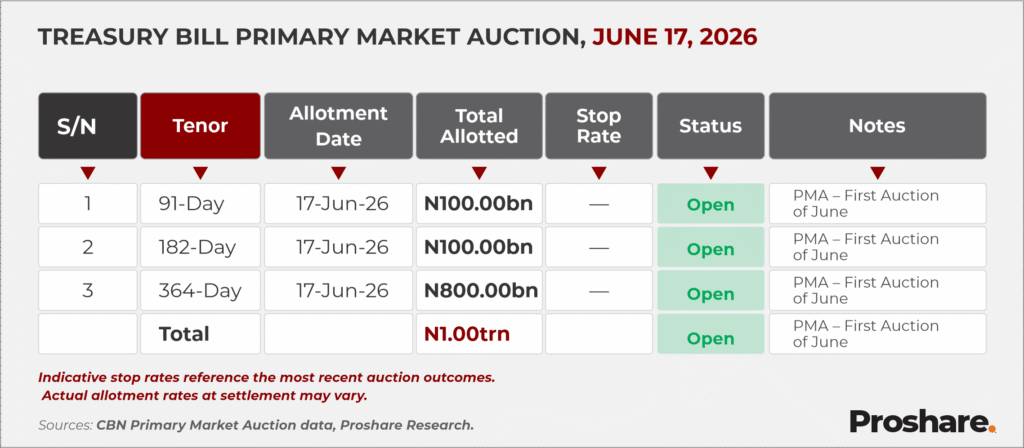
The CBN’s Primary Market Auction is structured to do more than just roll over debt. By placing N800 billion, or 80% of the total, into the 364-day tenor, the bank is extending the maturity profile of its short-term liabilities and signaling a preference for locking in funding for a full year rather than returning to market every quarter. For investors, that makes the one-year bill the single largest opportunity this week and the clearest gauge of institutional appetite. Stop rates from prior auctions have sat between 16.05% and 16.35%, but the bid-to-cover ratio on the 364-day paper will be the number that matters once results settle. A ratio above 2.0x would confirm that institutions still have room for duration at the short end despite heavy supply. Anything below 1.5x would suggest fatigue and the risk of rates repricing higher at subsequent auctions.
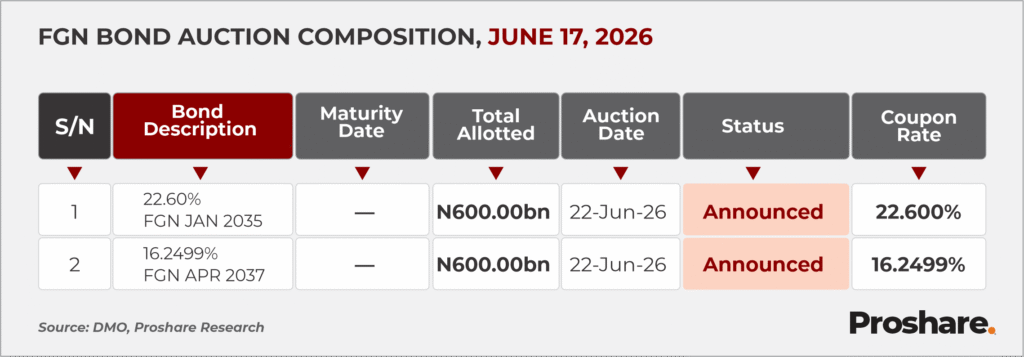
The long end returns to focus on June 22 when the DMO reopens N600 billion each of the 22.60% FGN JAN 2035 and 16.2499% FGN APR 2037 bonds. This is not a one-off tap. It’s the second reopening of these lines since May, when the JAN 2035 cleared at 17.00% and the APR 2037 at 17.04%. The strategy is deliberate. Rather than creating new benchmark bonds, the DMO is building size at existing 10-year and 20-year points to deepen secondary market liquidity. That helps trading and price discovery over time, but it also concentrates supply risk. Frequent taps at the long end test how much duration the market can absorb without demanding higher yields. Next week’s clearing levels will therefore set the tone for pension funds, insurers, and corporate issuers pricing their own debt. A stop rate above May’s would indicate that investors want more compensation for tying up capital amid recurring supply. A print at or below 17% would show that demand for duration remains resilient.
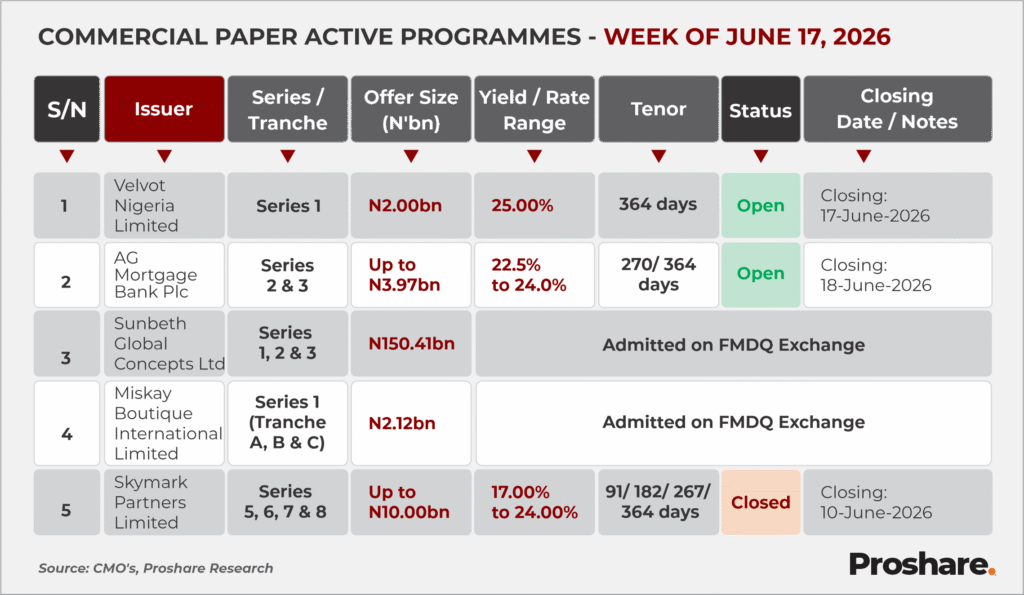
Corporate issuers are not standing still while sovereign paper crowds the calendar. Velvot Nigeria Limited’s N2 billion Series 1 Commercial Paper closes June 17, aimed at funding working capital and expansion in cloud and payments. AG Mortgage Bank Plc’s N3.97 billion Series 2 and 3 CP closes June 18, offering yields of 22.50% for 270 days and 24.00% for 364 days, targeted strictly at qualified institutional and high net worth investors. Beyond short-term CP, De Rich et Taste Chickens Nigeria Limited is raising N2 billion through 27% Fixed Rate Secured Private Notes due 2027, closing June 19, while Polysmart Packaging Limited’s multi-instrument private placement of up to US$20 million remains open until July 3. Polysmart’s structure is notable. It splits into a conventional Series A for up to US$15 million at 10.0% p.a. USD or 21.0% p.a. naira, and a Shari’ah-compliant Series B Mudarabah note for up to US$5 million at the same return. The dual structure widens the investor base and channels proceeds into rPET recycling equipment, linking capital markets directly to industrial capacity and ESG-aligned capex.
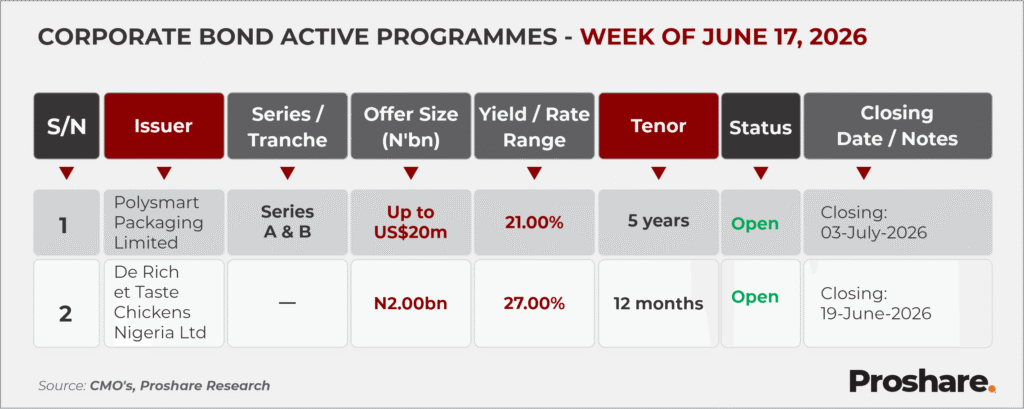
The exchange itself is facilitating larger ticket sizes. FMDQ has admitted Sunbeth Global Concepts Limited’s N150.41 billion Series 1-3 commercial paper under a N200 billion programme, one of the biggest multi-series CP issuances to date, and Miskay Boutique International’s N2.12 billion Series 1. Sunbeth’s scale reflects how agro-commodity firms are increasingly using market-based funding to manage working capital across export cycles, while Miskay’s entry shows consumer retail names testing the CP route. The message is that commercial paper is no longer just a stopgap for banks and manufacturers. It is becoming a mainstream working capital tool for mid-sized and sector-diverse corporates.
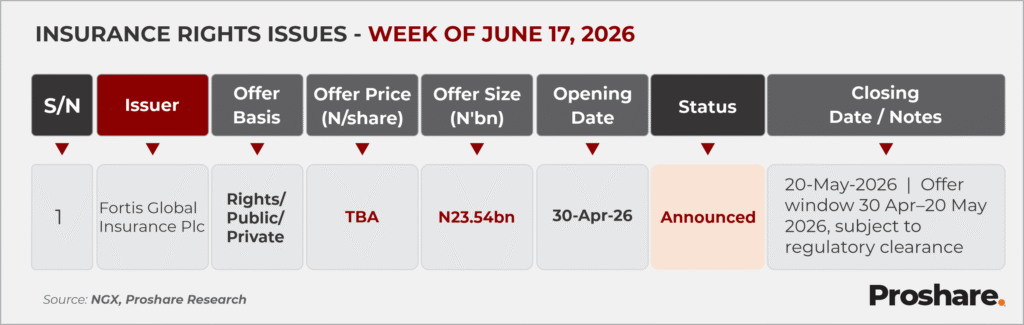
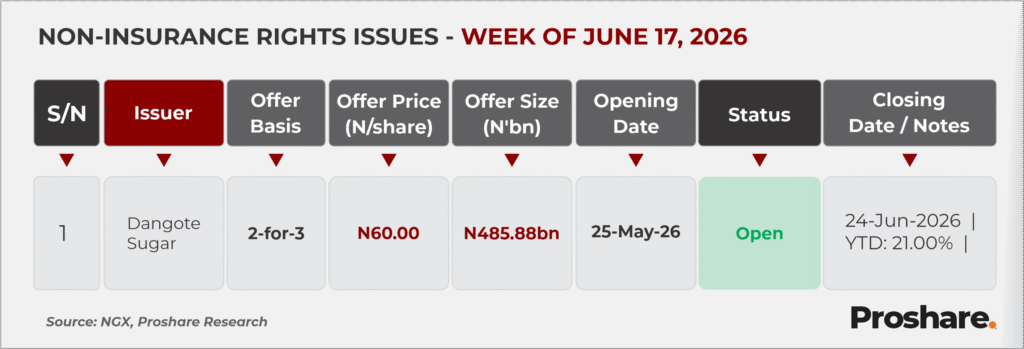
Equity markets are running a parallel capital raise story. Dangote Sugar Refinery Plc’s N485.88 billion rights issue remains open until June 24, offering 2 new shares for every 3 held at N60.00. That is a substantial dilution and a test of shareholder conviction in the company’s growth plan. Alongside it, the NAICOM-mandated insurance recapitalisation is moving toward its July 2026 deadline. Seven of the eight insurers have already closed subscription windows, including Linkage Assurance, Guinea Insurance, Lasaco Assurance, SUNU Assurances, Sovereign Trust, Universal Insurance, and International Energy Insurance. Fortis Global Insurance is still in the announced phase, while Coronation Insurance secured shareholder approval in April for a N9.26 billion private placement. The recapitalisation wave is reshaping sector balance sheets and creating a pipeline of rights issues and private placements that will continue to compete for investor attention.
Taken together, the week’s activity reveals three underlying dynamics. First, the sovereign is using both ends of the curve to manage its funding profile, pushing duration out to 364 days on bills while rebuilding liquidity at 10-year and 20-year bond points. Second, corporates are pricing at a premium to sovereign, with CP and private notes offering yields from 22.5% to 27%, reflecting both credit risk and the need to attract funds away from risk-free government paper. Third, the market is absorbing multiple forms of capital formation at once: short-term sovereign and corporate debt, medium-term private notes and preference shares, and long-term equity and bond reopenings.
The forward outlook hinges on how next week’s FGN Bond auction clears. If stop rates hold near May’s 17.00% to 17.04%, it will confirm that institutional demand can digest repeated long-end supply without repricing risk sharply higher. Combined with the bid-to-cover on this week’s 364-day T-bill, those two prints will define funding costs for the rest of the quarter. For corporates, the implication is clear. Pricing will track the sovereign curve, and any upward move in FGN yields will force issuers to offer more to get deals done. For investors, the choice is between locking in high short-term rates on T-bills and CP, or taking duration risk in bonds and equity rights at a time when supply is heavy and liquidity is being tested.
Nigeria’s market is not short of paper. It is short of neutral ground. Every naira raised by the CBN and DMO is a naira that corporates must compete for, and every rights issue in insurance or manufacturing is a claim on the same pool of institutional capital. The N1.54 trillion on offer this week is therefore less a sign of excess liquidity than a stress test of depth. How the market clears these issues will set pricing, sentiment, and capacity for the second half of 2026.