
For months on the Nigerian Exchange, almost every recommendation was Buy. Last week, that changed completely. For the week of September 28, 2026, the people who professionally advise investors on what to buy, the Capital Market Operators, or stockbroking and research firms, did something unusual. They downgraded almost everything from Buy to Hold. Across banking, consumer goods, cement and flour companies, they essentially told clients to wait. Only eight stocks were upgraded to Buy. This is not a panic or a crash. It is a sign that prices have gone up so fast that there is little cheap stock left, and experts now want to see real earnings before they recommend buying again.
Take banking, which is the biggest part of our market. In one move, one research firm, PAC Research, downgraded six banks at once from Buy to Hold: Access Corporation, FCMB, Fidelity Bank, FirstHoldCo, Stanbic and UBA. Two other firms downgraded Sterling Bank and Zenith Bank to Hold as well. Even when they still saw upside, like 11% upside in Zenith, 23% in Sterling and 9% in Stanbic, they refused to call it a Buy. Lead Capital downgraded Fidelity Bank to Hold because it only saw 3.24% upside left. What does this mean for an average investor? It means the banks have rallied a lot already this year. The profit from recapitalisation and high interest rates is already in the price. To call a bank a Buy now, these firms want to see more than 20% potential gain, not 8% or 10%. So banks are no longer bad, but they are no longer cheap either.
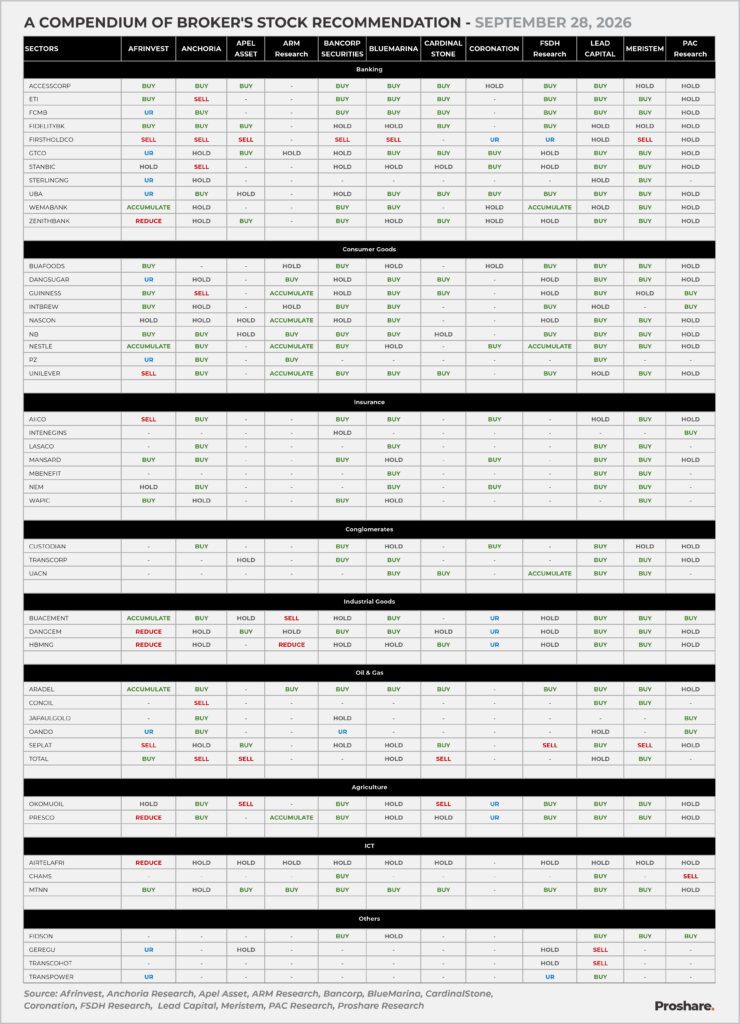
The same thing happened in consumer goods, the companies that sell food and drinks. Four different research firms all downgraded NASCON, the salt company, to Hold on the same week. They quoted tiny upsides of 0.8%, 3.45% and 14.1%. Nigerian Breweries and International Breweries were also moved to Hold. The problem here is simple. Nigerians are buying less because prices are high, and the cost of making these products is also high. So these companies cannot grow profit fast. Their share price is fair, but not exciting. For you as an investor, it means holding them will not lose you money, but it will not make you much money quickly.
Industrial goods, which includes cement and flour, looked even weaker. Honeywell Flour Mills was downgraded three times in one week by three different firms, with one firm even saying it will lose 1.2% from its current price. Dangote Cement, the biggest company on the exchange, was moved from Buy to Hold on just 8% upside. The only good news was BUA Cement, which was moved from Sell to Hold on 9.4% upside, meaning it is less bad than before. The issue here is that building activity has slowed, diesel is expensive, and companies are struggling to increase prices. So cement and flour stocks, which used to drive the whole market up, are now dragging it.
Oil and gas was the most confusing. On Total Energies, one firm said Buy because it expects 13.65% gain, another said Hold even though it expects a 9.9% loss, and a third said Sell because it expects a 17.1% loss. That is a 30% difference in opinion on one company. It shows nobody is sure what will happen with fuel prices and government policy. The only clear Buys were small oil stocks, Japaul Gold and Oando, upgraded to Buy on 13.25% and 10.85% upside. So you cannot buy oil and gas as a group anymore. You have to pick one company at a time and be ready for big price swings.
The only place where experts are still clearly optimistic is insurance. While they downgraded some insurance stocks to Hold, they upgraded three others to Buy: Mansard on 18.06% upside, Custodian on 15.71% and Lasaco on 22.4% upside. Lasaco and Fidelity Bank and Wema Bank actually offer the biggest potential gains in the whole report, with Fidelity offering 29.6% and Wema 23.2%. Why insurance? Because like banks last year, insurance companies are being asked to raise more capital, and the ones that do well will grow fast. So money is slowly moving from big banks into insurance stocks.
What does all this mean for the future? First, you can no longer make money by just buying the whole market. You have to be selective. Buying all banks will give you average results. Buying the few that still have high upside like Fidelity and Wema is what will make a difference. Second, if any company reports bad results for the third quarter, its share price may fall sharply because expectations are now very high. Third, prices will be more volatile because experts strongly disagree on the same stock, like Total and Fidelity Bank where one firm sees 3% upside and another sees 29% upside on the same share. Fourth, insurance may be the next big theme after banking.
In plain language, the market is telling us to be careful, hold what we have, and only buy the few stories with real upside left.