

When Nigeria removed fuel subsidy and floated the naira, the implicit promise was that more money to states would translate into more roads, better schools, cleaner water and more jobs. Two years into that fiscal expansion, the money has arrived in full force, but the results have not left the treasury. That is the uncomfortable verdict of the Revised 2026 pcl. State Performance Index, published by Phillips Consulting .
To understand the verdict, one must understand what the revised Index is. It was first launched on 23 July 2026, then subjected to audit, recalculated on FY2025 audited accounts instead of FY2024, and reissued with two lenses: a performance snapshot for 2026 and a rank trajectory across the 2024, 2025 and 2026 editions. It ranks 33 of 37 jurisdictions, meaning 36 states plus the FCT, with four unranked for failing data requirements. The methodology is deliberately designed not to equate fiscal size with governance quality. Citizen satisfaction carries 30% of the composite score, revenue self-reliance 25%, debt sustainability 20%, revenue growth 15% and transparency 10%, so that 70% rests on objective audited evidence standardized as z-scores and 30% on citizen perception. The revision improved two critical pillars. Debt sustainability now weights debt per capita and debt-to-revenue equally, recognizing that a debt stock weighs differently depending on population and revenue base, and transparency is now scored on the date each state published its audited accounts against the 31 July statutory deadline. The Index is not a credit rating or audit opinion, it is a governance screening tool, and its Foreword by Foluso Phillips frames it from a practical premise that many public services that shape daily life are delivered at state level.
The core argument that emerges from this rigorous measurement is that fiscal capacity and citizen outcomes are now two separate measures, and the latter has not kept pace with the former. Federation Account distributions rose substantially after reform due to higher naira-denominated oil receipts and stronger VAT collections, enlarging state treasuries across the federation. Yet the national citizen score from 38,312 responses is 3.01 out of 5, sitting exactly on the neutral midpoint of 3.00. Education affordability leads the 16 parameters at 3.71, but finding employment, the most critical need in a youthful population, records 2.31, the only parameter rated critical nationally. Clean water stands at 2.67, government support for business at 2.71, security at 2.84, law-enforcement conduct at 2.85 and economic opportunity at 2.88. Ten parameters meet or exceed the midpoint and six fall below it. Across three editions, sentiment on honesty of public servants has risen most while confidence in government support for business has fallen most, a telling trade-off that suggests states are collecting more but enabling less. The survey itself reveals another problem of comparability. Lagos contributed 12,256 responses, the FCT 5,968 and Kaduna 2,374, against 193 each in Enugu and Taraba and 64 in Kebbi. Phillips Consulting computes national scores from state-level results so large samples do not dominate, but uneven samples still affect precision. Citizen satisfaction carries a fixed 30% of each state’s composite, so states with tiny samples have less reliable perception scores.
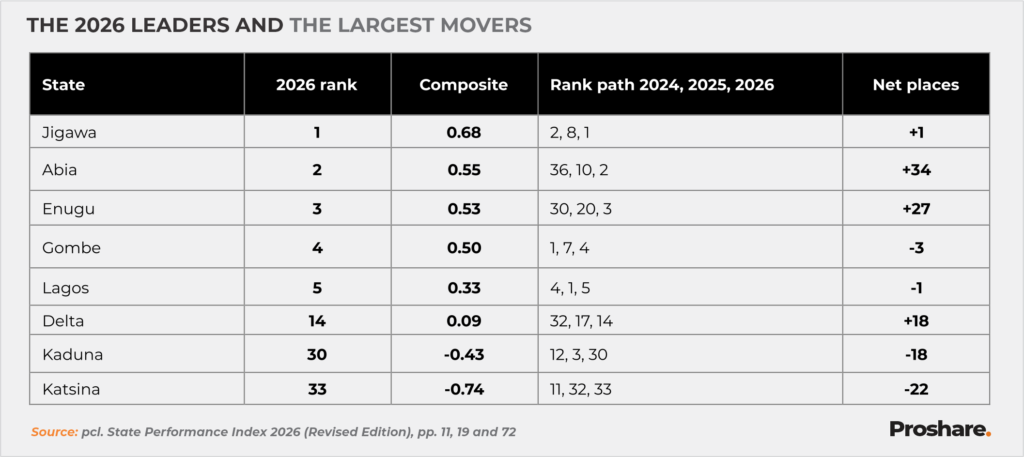
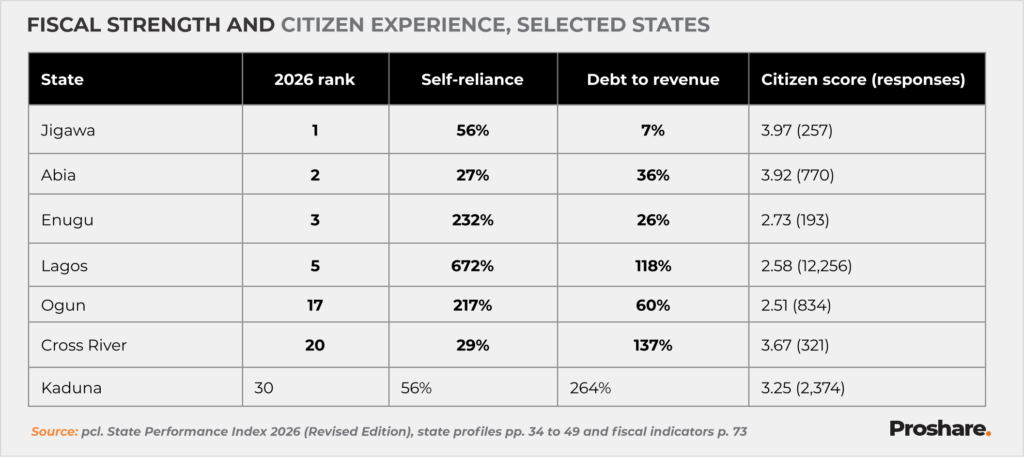
The ranking picture and the revision movement tell a story of movers, shakers and weaklings that justifies both praise and criticism. Jigawa heads the 2026 table with a composite score of 0.68, followed by Abia at 0.55, Enugu at 0.53, Gombe at 0.50 and Lagos at 0.33. Jigawa’s leadership is not about being the richest, but the most disciplined. Its debt is 7% of revenue, the lowest in the federation, compared to Kaduna at 264%, Bauchi at 145%, Cross River at 137% and Lagos at 118%. With low debt per capita, positive debt sustainability and timely audit disclosure, Jigawa proves prudence beats size. Abia is the true shaker, moving from 36th in 2024 to 2nd in 2026, a gain of 34 places, the largest movement across three editions. In 2024 Abia was near the bottom, by FY2025 audited accounts it had rebuilt revenue self-reliance and growth. Enugu rose from 30th to 3rd on the back of 126% revenue growth, the highest in the sample, and now generates 232% of its net federation receipts internally. Delta moved from 32nd to 14th. These are not just rank changes, they represent a shift from dependence on FAAC to building internal capacity. Indeed, only Lagos, Enugu and Ogun generate more internally than they receive in net federation transfers, together accounting for roughly 54% of internally generated revenue of ranked states, with Lagos alone close to 39%, while 18 of 33 ranked states generate less than 30% of their transfers. The eight ranked oil-producing states hold an average rank of 19.5 against 16.2 for 25 non-oil states, and their self-reliance averages about 27%, proving that derivation has not translated into durable local revenue.
The revision itself is a critical issue because it moved many states materially, showing how sensitive governance rankings are to method. The revised ranking correlates at about 0.74 with the launched one. Lagos moved from 19th at launch to 5th in the revised edition, Oyo from 27th to 12th and Delta from 25th to 14th, while Osun fell from 4th to 21st, Kaduna from 15th to 30th and Kogi from 12th to 24th. Phillips Consulting attributes the largest changes to the revised debt measure, the FY2025 financial data and the treatment of transparency. Osun and Kaduna were previously rewarded for fiscal size, but under a method that weighs debt per capita equally with debt-to-revenue, their leverage was exposed. The fact that a state can improve on a measure and still fall in rank where peers improve faster is explicitly noted in the report, which measures movement by change in published rank because three editions were computed on different score scales. This volatility is both a strength and a warning. It corrects past weaknesses, as Edo’s engagement on its ranking contributed to scrutiny, but it also means in a pre-election year, as the Foreword notes, rankings are easily read as political verdicts.
Four jurisdictions are unranked, and their exclusion is itself a governance verdict. Rivers and the FCT had not published qualifying FY2025 audited accounts by the assessment cut-off, and Yobe and Zamfara returned too few survey responses for a reliable citizen score. The report states their exclusion reflects data requirements and carries no assessment of performance, and that Rivers and FCT become eligible once accounts are published, but failing the basic test of publishing accounts on time and letting citizens be heard is a serious issue of transparency. The concentration of self-reliance is another structural weakness. The fiscal tables show debt capacity varies wildly and that stronger revenues improve debt-to-revenue ratios without removing underlying burden. Maturity profiles, currency composition, debt-service schedules and guarantees are still needed before conclusions on affordability, which is why the Index remains a screening tool, not a rating.
Perhaps the most powerful illustration of the core argument is Lagos. It is the clearest case of the perception-performance gap. It is the most self-reliant state, with internally generated revenue at 672% of net federation receipts and IGR per capita of N102.0k, and it ranks fifth overall, yet its citizen score is 2.58 on the largest sample in the survey. Its profile carries debt per capita of N190.8k, a debt-sustainability z-score of -2.79 and a capital share of expenditure of 25%. In other words, citizens experience high debt and low capital spend despite massive IGR. Enugu ranks third on revenue growth and self-reliance but with a citizen score of 2.73 from just 193 responses, while Cross River, Adamawa and Sokoto show the opposite pattern, with citizen sentiment stronger than fiscal measures would suggest. The divergence leaves fiscal strengths intact but shows why household welfare must be measured alongside financial ratios.
The operating conditions and investment case flow from this. A state’s investability rests on dependable electricity, land and property processes, logistics, security, tax administration, contract enforcement and predictable payments. The pSPI captures some through citizen perception and fiscal measures, naming Jigawa, Akwa Ibom and Delta among states with more manageable debt positions, but it does not supply a comprehensive investment-risk rating. State governments can make assessment easier by publishing procurement milestones, project completion and maintenance reports, ageing of contractor payments, land-service turnaround times and electricity-market implementation schedules, and the report records that several states including Abia, Lagos and Ogun have begun to take responsibility for their electricity markets.
The practical opportunity, as the report recommends, is to convert the annual league table into a management process. Each government can publish a baseline of its weakest indicators, name responsible agencies, set annual targets, disclose funding and report independently verifiable progress alongside audited accounts, with measures such as school attendance and learning, primary healthcare access, clean water, project completion and service turnaround times helping distinguish money spent from services delivered. Local governments belong in that process where they deliver services citizens experience directly, given the 2024 Supreme Court decision supporting direct payment of statutory allocations to elected councils. The index provider carries a parallel obligation to ensure stability and credibility through a public methodology and version log, clear minimum state-level sample thresholds, independent technical review of material changes and stability between editions, with continued disclosure on sampling, eligibility and comparability to help users distinguish changes in performance from changes in measurement.
In closing, Nigeria’s enlarged subnational fiscal resources create room for institutional improvement, and the revised pSPI shows that room has been used unevenly. Its citizen scorecard records a national perception score of 3.01 beside substantially higher transfers, and its fiscal tables show self-reliance concentrated in three states and wide differences in debt capacity. The next stage of scrutiny connects audited spending, execution records and observable change in service reliability, employment and cost of doing business. Proshare says it will track publication of FY2026 audited accounts against the 31 July deadline, including whether Rivers and FCT return to ranking, companion state and indicator reports announced by Phillips Consulting, the effect on IGR of tax laws taking effect from 2026, and stability of method in the 2027 edition prepared in an election year, which will be read for stability of method as much as for results.