Nigeria’s Inflation Fell To 14.06%, But Prices Rose Again In October

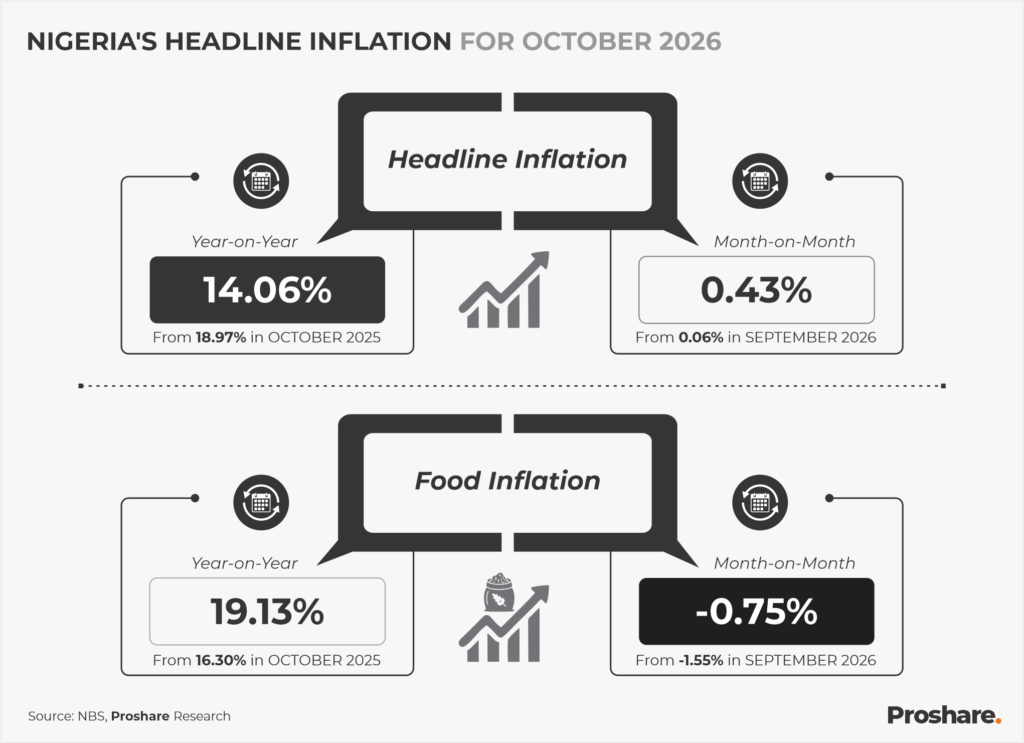
Nigeria’s headline inflation fell to 14.06% in October 2026, according to the National Bureau of Statistics. That is down from 14.63% in September 2026 and down sharply from 18.97% in October 2025. On a 12-month average basis, inflation has now fallen to 15.40% from 26.05% a year ago, a decline of 10.65 percentage points. Core inflation, which excludes volatile food and energy, fell even more dramatically to 10.78% year-on-year, down from 21.25% in October 2025. On paper, this is clear evidence that disinflation is working and that the tightening cycle, exchange rate stability and a high base from last year are finally bringing the annual rate down.
But the same report shows that prices rose again in October. Month-on-month headline inflation accelerated to 0.43% from 0.06% in September, a sevenfold increase in the pace of monthly price rises. The Consumer Price Index rose to 147.0 points from 146.4 points, a 0.6 point increase in the actual price level. This is the critical distinction that explains the headline. Year-on-year inflation is falling because October 2025 was so bad that almost any comparison looks better. Month-on-month inflation is rising because October 2026 was worse than September 2026. Nigerians are not paying less. They are paying more than last month, but more slowly than they were paying a year ago. That is disinflation, not deflation, and it is why the headline fall has not yet translated into relief.
The clearest evidence of that gap is food. Food inflation year-on-year stood at 19.13% in October 2026, up from 16.30% in October 2025. That is a 2.83 percentage point increase in the rate at which food prices are rising compared to a year ago, even as headline inflation fell by 4.91 percentage points over the same period. Food is now rising 5.07 percentage points faster than headline inflation. Month-on-month food inflation remained negative at -0.75%, which means food prices fell slightly in October, but that fall was much slower than September’s -1.55% decline, an increase of 0.80 percentage points. The pace of food price relief is fading. The NBS cited price changes in vegetable oil, sardines, green peas, frozen mackerel, croakers, locally produced rice, fresh catfish, beef tripe, palm oil and millet flour. These are not imported luxuries. They are the staples of the daily food basket. When those items drive inflation, the problem is supply, distribution, energy costs and insecurity in food-producing areas, not just monetary policy.
Core inflation offers a more hopeful signal, but it also confirms the mixed picture. Core inflation year-on-year fell to 10.78% from 21.25% a year ago, a fall of 10.47 percentage points. Month-on-month core inflation fell to -0.53% in October, down from 1.11% in September, a drop of 1.64 percentage points. The 12-month average core inflation fell to 15.67% from 25.07%. This means that once food and energy are removed, underlying pressures in the economy have eased considerably. Services, rent, transport excluding fuel, and other core categories are no longer driving inflation the way they were a year ago. For the Central Bank of Nigeria, this is the number that gives it room to pause and assess. It suggests that previous rate hikes are working through the system and that demand-side pressures are contained.
For monetary policy, the implication is caution, not celebration. The fall to 14.06% gives the CBN room to hold rates and avoid over-tightening. A rate cut now would be premature because month-on-month headline inflation has jumped from 0.06% to 0.43% and food year-on-year is still accelerating. A rate hike would be equally misguided because core inflation is already down sharply and the 12-month trend is clearly downward. The most rational path is to hold, and to coordinate with fiscal policy on food supply, storage, transport, energy and exchange rate stability. Interest rates cannot solve a food supply problem. Without that coordination, monetary policy will keep fighting a supply shock with a demand tool, and households will keep paying the price.
Nigeria’s Inflation Fell To 14.06%, But Prices Rose Again In October
Nigeria’s headline inflation fell to 14.06% in October 2026, according to the National Bureau of Statistics. That is down from 14.63% in September 2026 and down sharply from 18.97% in October 2025. On a 12-month average basis, inflation has now fallen to 15.40% from 26.05% a year ago, a decline of 10.65 percentage points. Core inflation, which excludes volatile food and energy, fell even more dramatically to 10.78% year-on-year, down from 21.25% in October 2025. On paper, this is clear evidence that disinflation is working and that the tightening cycle, exchange rate stability and a high base from last year are finally bringing the annual rate down.
But the same report shows that prices rose again in October. Month-on-month headline inflation accelerated to 0.43% from 0.06% in September, a sevenfold increase in the pace of monthly price rises. The Consumer Price Index rose to 147.0 points from 146.4 points, a 0.6 point increase in the actual price level. This is the critical distinction that explains the headline. Year-on-year inflation is falling because October 2025 was so bad that almost any comparison looks better. Month-on-month inflation is rising because October 2026 was worse than September 2026. Nigerians are not paying less. They are paying more than last month, but more slowly than they were paying a year ago. That is disinflation, not deflation, and it is why the headline fall has not yet translated into relief.
The clearest evidence of that gap is food. Food inflation year-on-year stood at 19.13% in October 2026, up from 16.30% in October 2025. That is a 2.83 percentage point increase in the rate at which food prices are rising compared to a year ago, even as headline inflation fell by 4.91 percentage points over the same period. Food is now rising 5.07 percentage points faster than headline inflation. Month-on-month food inflation remained negative at -0.75%, which means food prices fell slightly in October, but that fall was much slower than September’s -1.55% decline, an increase of 0.80 percentage points. The pace of food price relief is fading. The NBS cited price changes in vegetable oil, sardines, green peas, frozen mackerel, croakers, locally produced rice, fresh catfish, beef tripe, palm oil and millet flour. These are not imported luxuries. They are the staples of the daily food basket. When those items drive inflation, the problem is supply, distribution, energy costs and insecurity in food-producing areas, not just monetary policy.
Core inflation offers a more hopeful signal, but it also confirms the mixed picture. Core inflation year-on-year fell to 10.78% from 21.25% a year ago, a fall of 10.47 percentage points. Month-on-month core inflation fell to -0.53% in October, down from 1.11% in September, a drop of 1.64 percentage points. The 12-month average core inflation fell to 15.67% from 25.07%. This means that once food and energy are removed, underlying pressures in the economy have eased considerably. Services, rent, transport excluding fuel, and other core categories are no longer driving inflation the way they were a year ago. For the Central Bank of Nigeria, this is the number that gives it room to pause and assess. It suggests that previous rate hikes are working through the system and that demand-side pressures are contained.
For monetary policy, the implication is caution, not celebration. The fall to 14.06% gives the CBN room to hold rates and avoid over-tightening. A rate cut now would be premature because month-on-month headline inflation has jumped from 0.06% to 0.43% and food year-on-year is still accelerating. A rate hike would be equally misguided because core inflation is already down sharply and the 12-month trend is clearly downward. The most rational path is to hold, and to coordinate with fiscal policy on food supply, storage, transport, energy and exchange rate stability. Interest rates cannot solve a food supply problem. Without that coordination, monetary policy will keep fighting a supply shock with a demand tool, and households will keep paying the price.
For households, the implication is that purchasing power remains under severe pressure. A family that spent N100,000 on food in October 2025 now needs N119,130 for the same basket, while their overall cost of living is up 14.06%. Wages have not kept pace with either number. The small monthly fall in food prices of 0.75% offers only marginal relief, and because that fall is slowing, the relief may not last into November and December, when seasonal demand typically pushes food prices up. This is why the NBS warning that sustaining the downward trajectory will require attention to food supply is not a footnote. It is the central economic challenge for the next quarter. Until food inflation falls sustainably toward headline, the 14.06% figure will remain a macro achievement that households cannot feel.
For businesses and banks, the data is double-edged. Lower headline and core inflation supports the case for eventual lower rates, which would support loan growth, lower cost of funds and improved asset quality. But persistent food inflation at 19.13% keeps household balance sheets weak, which keeps retail and SME non-performing loan risk alive. It also keeps input costs high for food processors, retailers and logistics companies. The same tension was visible in Fidelity Bank’s 2025 results, where record gross earnings of N1.52 trillion on high rates were offset by a N223.8 billion derivative loss and a dividend pause to preserve capital. Banks are benefiting from disinflation on paper, but still operating in a volatile, high-cost real economy underneath it.
The conclusion is therefore not that Nigeria has beaten inflation, but that Nigeria is in the hardest phase of beating it. The easy part, bringing the annual rate down from a 26.05% average to a 15.40% average through base effects and tightening, is largely done. The hard part, bringing monthly momentum down sustainably, bringing food inflation down from 19.13% toward headline, and turning statistical disinflation into tangible relief at the market, remains. Until monthly prices stop rising and food prices fall consistently, the story of October 2026 will remain exactly as the data tells it: inflation fell to 14.06%, but prices rose again in October.
For households, the implication is that purchasing power remains under severe pressure. A family that spent N100,000 on food in October 2025 now needs N119,130 for the same basket, while their overall cost of living is up 14.06%. Wages have not kept pace with either number. The small monthly fall in food prices of 0.75% offers only marginal relief, and because that fall is slowing, the relief may not last into November and December, when seasonal demand typically pushes food prices up. This is why the NBS warning that sustaining the downward trajectory will require attention to food supply is not a footnote. It is the central economic challenge for the next quarter. Until food inflation falls sustainably toward headline, the 14.06% figure will remain a macro achievement that households cannot feel.
For businesses and banks, the data is double-edged. Lower headline and core inflation supports the case for eventual lower rates, which would support loan growth, lower cost of funds and improved asset quality. But persistent food inflation at 19.13% keeps household balance sheets weak, which keeps retail and SME non-performing loan risk alive. It also keeps input costs high for food processors, retailers and logistics companies. The same tension was visible in Fidelity Bank’s 2025 results, where record gross earnings of N1.52 trillion on high rates were offset by a N223.8 billion derivative loss and a dividend pause to preserve capital. Banks are benefiting from disinflation on paper, but still operating in a volatile, high-cost real economy underneath it.
The conclusion is therefore not that Nigeria has beaten inflation, but that Nigeria is in the hardest phase of beating it. The easy part, bringing the annual rate down from a 26.05% average to a 15.40% average through base effects and tightening, is largely done. The hard part, bringing monthly momentum down sustainably, bringing food inflation down from 19.13% toward headline, and turning statistical disinflation into tangible relief at the market, remains. Until monthly prices stop rising and food prices fall consistently, the story of October 2026 will remain exactly as the data tells it: inflation fell to 14.06%, but prices rose again in October.