From Coordination to Alignment: An Operating Framework for Coherent Economic Policy in Nigeria


Nigeria already has forums in which the Ministry of Finance (MoF) and the Central Bank of Nigeria (CBN) meet, yet a new Economic Associates synthesis, drawing on contributions from Suleyman A. Ndanusa, PhD, OON, Dr Ayo Teriba, Olufemi Awoyemi and Dimeji Salaudeen, holds that the test of coordination lies in whether combined policy actions deliver the intended national outcome.
Take Economics Courses
The synthesis presents the problem through four connected lenses. Ndanusa establishes the need for the fiscal and monetary authorities to avoid working at cross-purposes. Teriba widens the scope to the many policy hands that shape national outcomes beyond the MoF and the CBN. Awoyemi locates the machinery within Nigeria’s existing institutional architecture, including MFPCC and FLAC. Salaudeen provides comparative evidence from seven jurisdictions that coordinate through layered routines while protecting the central bank’s operational independence.
The resulting framework rests on shared macroeconomic assumptions, predictable data exchange, aligned forecasting, explicit cash and liquidity interfaces, contradiction mapping, named decision owners and escalation rules, with the existing MAC Quarterly Dashboard serving as the evidence layer. The paper is a MAC discussion synthesis and does not represent a jointly adopted Government position.
Four Contributions and One Operating Question
Explore Policy Courses
Nigeria already has forums in which the MoF and the CBN meet, from high-level economic-management structures to operational committees such as the Monetary and Fiscal Policy Co-ordinating Committee (MFPCC) and the Fiscal Liquidity Assessment Committee (FLAC). The two institutions added a formal instrument when they signed a Memorandum of Understanding (MoU) on fiscal-monetary policy coordination in Abuja on 18 September 2026, covering government cash management, debt-issuance planning, liquidity forecasting, macroeconomic analysis and periodic policy consultations. The synthesis takes that machinery as its starting point and asks how Nigeria can move from bilateral fiscal-monetary coordination to an operating discipline for coherent economic policy.
The four contributors approach the problem from different vantage points, and the synthesis’s value lies in their sequence. Suleyman A. Ndanusa, PhD, OON, establishes the need for coordination between the two dominant macro policy hands. Dr Ayo Teriba widens the scope from two institutions to every policy hand that shapes national outcomes. Olufemi Awoyemi places the proposed machinery within Nigeria’s existing institutional architecture. Dimeji Salaudeen supplies comparative evidence on how other jurisdictions operationalise coordination while protecting central-bank independence. Read in that order, the contributions move from why coordination is required, to what it must cover, to where it should sit, to how it works in practice.
Ndanusa and the Case for Coordination
Ndanusa’s starting proposition is that the fiscal and monetary authorities should not work at cross-purposes, because each authority’s actions pass directly into the other’s operating environment. Fiscal actions affect system liquidity, sovereign yields, debt service, inflation and credit conditions. Monetary actions, in turn, affect the Government’s financing costs, bank liquidity, private credit, investment and aggregate demand.
Download Interactive Maps
On Ndanusa’s reading, coordination leaves each mandate intact. Its purpose is to make the interfaces between fiscal and monetary policy predictable, evidence-based and internally consistent, so that a borrowing programme, a liquidity operation and a policy-rate decision can be read against one another before they reach the market. Where those interfaces are left unmanaged, the argument runs, one authority’s action can offset the intended effect of the other’s.
Teriba and the Wider Policy Hands
Teriba widens the frame. Nigeria’s macroeconomic outcomes are shaped by many policy hands beyond the MoF and the CBN, including prudential rules, foreign-exchange management, trade policy, regulation, energy pricing, agricultural supply, infrastructure, security and subnational implementation. On Teriba’s argument, a monetary stance aimed at disinflation can be supported or offset by decisions on energy pricing, food supply and trade taken outside either institution.
The relevant test, in Teriba’s formulation, is whether the combined actions of all these hands produce the intended national outcome. That test converts coordination from a bilateral exercise between two institutions into outcome-based alignment across the whole policy system. It also shifts the unit of accountability, since an outcome such as price stability can fall short even when each institution has discharged its mandate.
Awoyemi and the Nigerian Institutional Architecture
Awoyemi’s contribution is institutional. Nigeria’s existing machinery already includes high-level economic-management forums, such as the Economic Management Team (EMT), the National Economic Council (NEC) and ministerial structures, alongside operational mechanisms such as MFPCC and FLAC. The MoF-CBN MoU therefore enters a crowded field.
Compare Credit Cards
The discipline Awoyemi proposes is reconciliation. On his argument, implementation of the MoU should state plainly whether it revives a dormant mechanism, updates an existing one, consolidates several into one or adds a function that no current body performs. Without that clarity, the new arrangement risks duplicating MFPCC and FLAC and congesting the calendars of the officials on whose time effective coordination depends.
Salaudeen and the Comparative Operating Evidence
Salaudeen’s cross-country review stands as a separate paper in its own right, and the synthesis draws on it as its evidence layer. Its central finding is that effective coordination rarely depends on a single forum. Successful jurisdictions combine layered routines for shared assessment, debt and cash coordination, liquidity management, inflation and supply-side coordination, and crisis response, while preserving the central bank’s operational independence.
The seven comparators illustrate different layers of that architecture. India illustrates debt and cash coordination, Tanzania illustrates recurring coordination of expenditure and resources, and Kenya illustrates statutory consultation. South Africa operates a joint macroeconomic forum alongside an independent Monetary Policy Committee (MPC), Indonesia layers fiscal-monetary arrangements with financial-stability arrangements, Brazil combines high-level policy coordination with independent rate setting, and Malaysia coordinates across the broader economic-policy space. Table 1 maps each comparator to the layer of the coordination model, set out in Table 2, that it most clearly illustrates.
Table 1: Comparative Coordination Features
Research Municipal Bonds
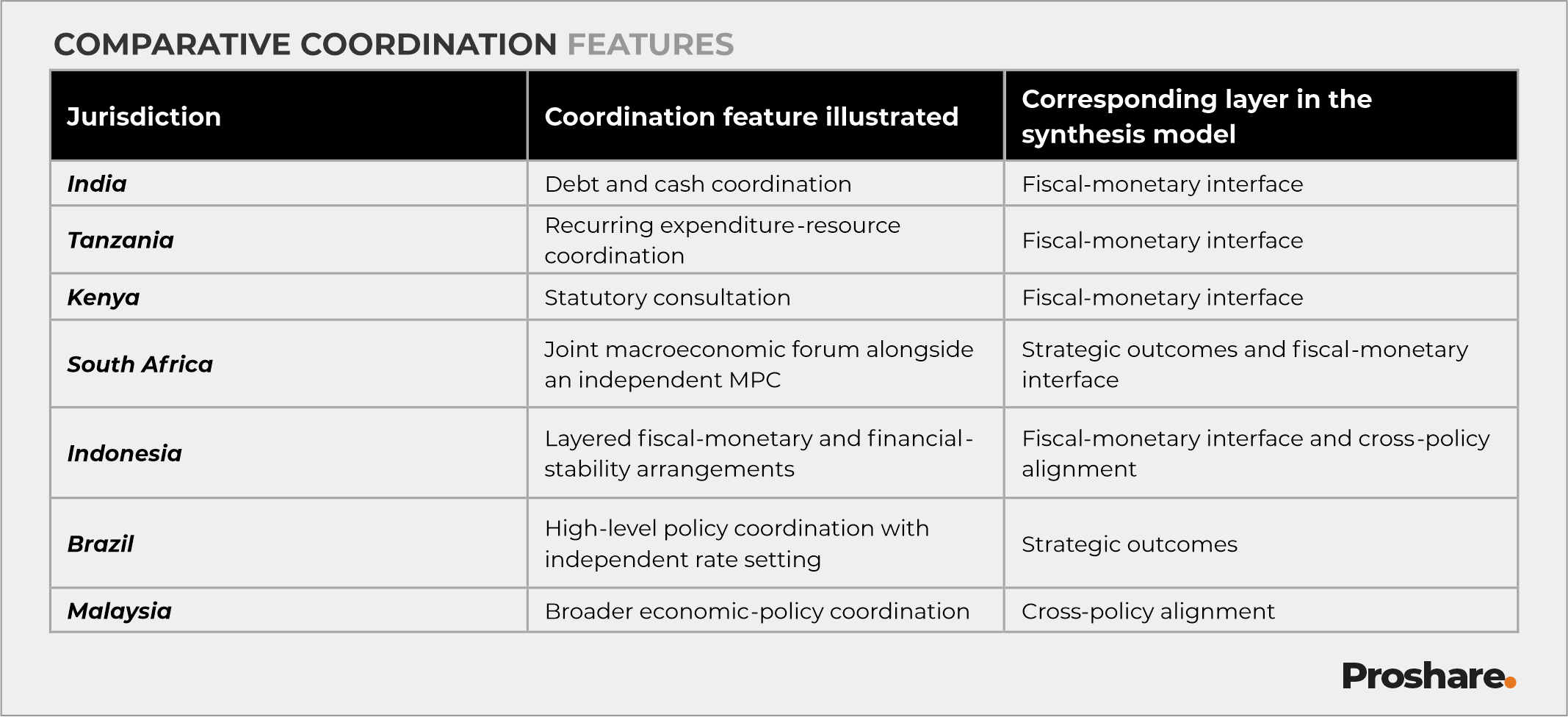
The comparative lesson is that coordination should be operational, layered and mandate-preserving. Salaudeen’s evidence also carries a limit, in that foreign institutional forms should be tested against Nigerian conditions before any element is adopted.
From Meetings to Operating Discipline
The synthesis draws one practical conclusion from the four contributions, which is that coordination must be built on routines that produce decisions capable of being tracked. It identifies six such routines. The first is one shared baseline of macroeconomic assumptions. The second is a predictable data-sharing calendar with common definitions. The third is joint review of material forecast deviations. The fourth is an explicit set of cash, debt and liquidity interfaces. The fifth is a decision log recording owners, timelines and follow-up. The sixth is a set of escalation rules for policy contradictions that remain unresolved at working level.
Compare Investment Apps
A Layered Coordination and Alignment Model
The synthesis organises these routines into four layers. The strategic-outcomes layer agrees national objectives and the macroeconomic assumptions that underpin them. The fiscal-monetary interface coordinates the fiscal, monetary, debt, cash and liquidity implications of each authority’s actions. The cross-policy alignment layer identifies contradictions across prudential, regulatory and sectoral policies. The delivery and feedback layer tracks owners, milestones, outcomes and unresolved issues. Each layer maps to existing or proposed mechanisms, consistent with Awoyemi’s principle that new machinery should be reconciled with what already exists.
Table 2: Layered Coordination and Alignment Model
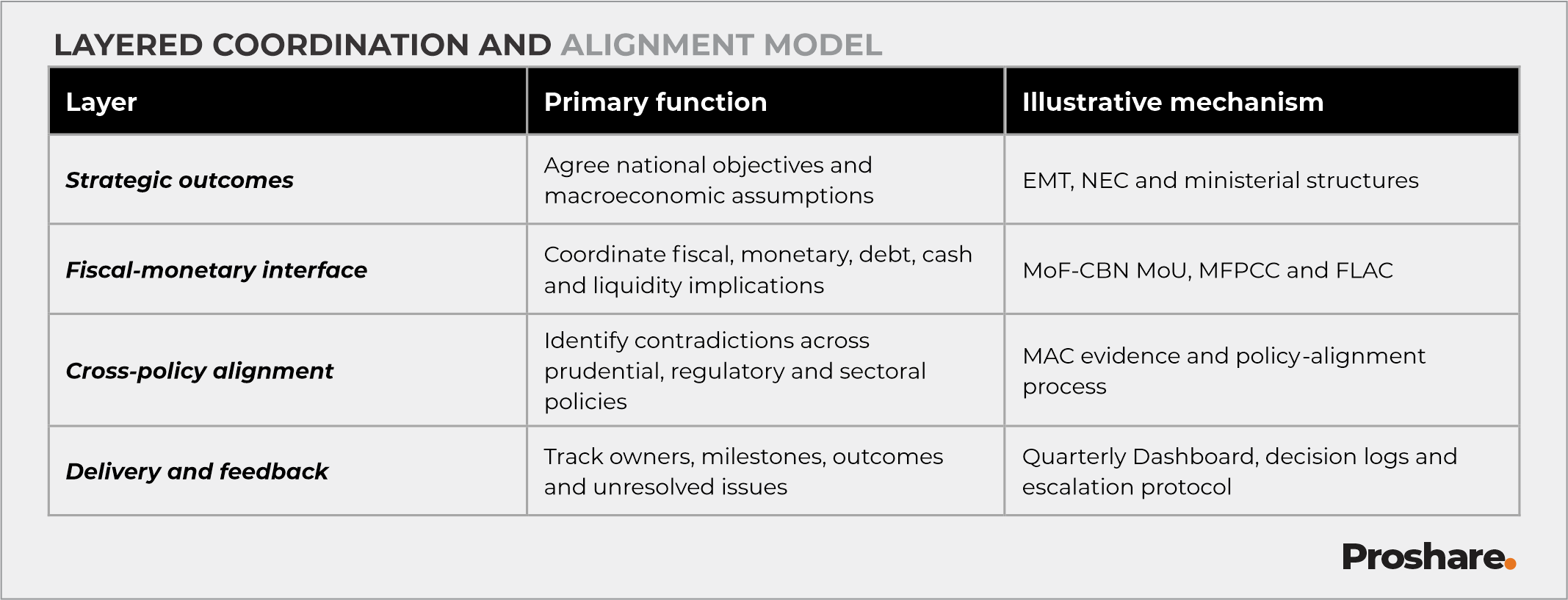
The model integrates the four contributions. Ndanusa’s need sits in the fiscal-monetary interface, Teriba’s scope in the cross-policy alignment layer, Awoyemi’s architecture in the mechanisms assigned to each layer, and Salaudeen’s evidence in the proposition that the layers operate together without any single forum carrying the full load.
Shared Macroeconomic Assumptions
The foundation of the framework is a common assumptions table covering growth, inflation, exchange-rate conditions, revenue, expenditure, domestic financing, external financing, liquidity, interest rates and other variables that materially affect policy design. The synthesis accepts that differences between institutions may remain, provided they are visible and explained. A budget built on one exchange-rate path and a monetary projection built on another would then be recognised as a reconciliation issue before either is relied upon.
Data, Forecasting and Cash-Liquidity Interfaces
Regular data exchange should connect budget execution, revenue, cash balances, borrowing, debt service, liquidity, banking conditions, credit and price developments. Material deviations from the shared baseline should be identified early enough for each authority’s response to be sequenced with the other’s.
The cash, debt and liquidity interface carries particular weight within this routine, because Government borrowing and cash management alter the liquidity conditions within which monetary operations are conducted. A predictable calendar of borrowing and cash flows, shared across the interface, allows each side to plan around the known movements of the other.
Contradiction Mapping, Decision Ownership and Feedback
Where policies or institutional actions offset one another, the synthesis proposes a structured contradiction record. For each material contradiction, the record identifies the national outcome affected, the evidence, the institutions involved, their current actions, the conflict or transmission failure, the corrective action required and the level at which the issue must be resolved.
Every material issue should then carry a named decision owner, a deadline, an evidence requirement and an escalation point. Closed-loop feedback completes the cycle by recording what was decided, what changed and whether the intended outcome followed. Table 3 sets out the full record.
Table 3: Contradiction Record and Decision Log
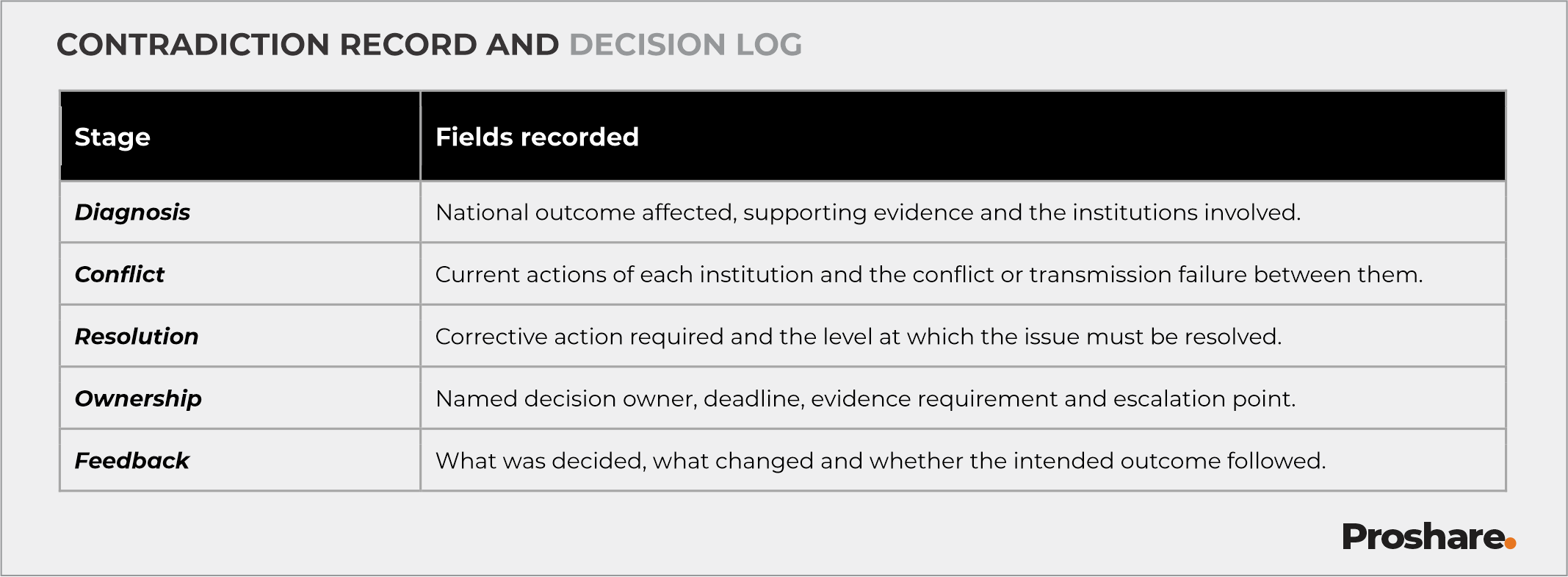
The synthesis measures coordination by implementation and feedback, and it treats meeting frequency as an inadequate measure of either.
The MAC Quarterly Dashboard as the Evidence Layer
MAC should use its existing Quarterly Dashboard as the evidence layer for this cross-cutting function. The synthesis rules out a parallel dashboard, which would split data and attention across two instruments. Policy-interface failures identified through the routines above should be harvested into the Monthly Report and the Quarterly Dashboard as evidence gaps, vulnerabilities and decision questions, so that contradictions surface in the instrument MAC already maintains.
Opportunities and Vulnerabilities
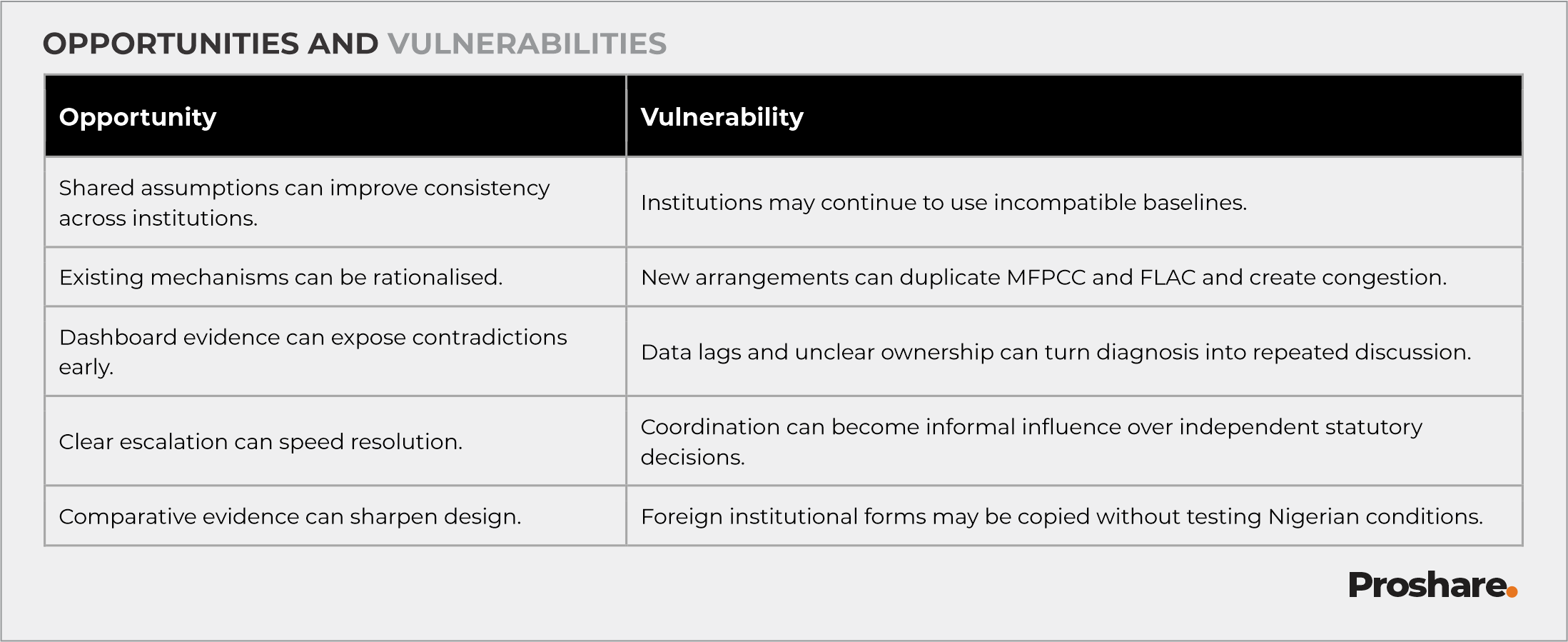
Each element of the framework carries an opportunity and a matching vulnerability, and the synthesis sets them side by side in Table 4. The vulnerability attached to escalation concerns independence. Clear escalation can speed resolution, but coordination must not become informal influence over independent statutory decisions, and the design must protect the operational independence of the CBN. The Minister of Finance and Coordinating Minister of the Economy, Taiwo Oyedele, set out the same principle at the MoU signing, stating that ‘the operational independence of the central bank remains sacrosanct’.
Table 4: Opportunities and Vulnerabilities
An Integrated Framework: Need, Scope, Architecture and Evidence
The consolidated framework connects the four contributions in sequence.
- Need. Coordinate the fiscal-monetary interface so that the two dominant macro policy hands do not work at cross-purposes, while each retains its mandate.
- Scope. Test policy coherence against national outcomes across fiscal, monetary, prudential, regulatory and sectoral policies.
- Architecture. Reconcile the MoF-CBN MoU with the EMT, the NEC, MFPCC, FLAC and other existing mechanisms before adding new forums.
- Evidence. Use comparative practice to design layered, mandate-preserving routines, tested against Nigerian conditions.
- Outcome. Shared assumptions, aligned forecasts, managed cash-liquidity interfaces, mapped contradictions, owned decisions, disciplined escalation and feedback that shows whether coordination produces results.
Suggestions for MAC Consideration
The synthesis offers six suggestions for MAC. MAC should first map the full existing coordination architecture before recommending new committees or workstreams. It should request a common macroeconomic-assumptions template and identify the institution responsible for maintaining it.
It should harvest policy-interface failures into the Monthly Report and the Quarterly Dashboard as evidence gaps, vulnerabilities and decision questions, and it should apply contradiction mapping across its workstreams wherever policies or institutional actions appear to offset one another.
MAC should also track implementation and feedback in preference to meeting frequency, and it should use Salaudeen’s comparator evidence to test Nigerian design choices while preserving statutory mandates and the operational independence of the CBN.
Issues for Ministerial Feedback and Guidance
Five issues require ministerial guidance. The first concerns structure, specifically whether the MoF-CBN MoU should operate through an updated MFPCC and FLAC architecture or as a distinct structure.
The second concerns ownership of the common assumptions and forecast-reconciliation process, which must rest with a named institution.
The third concerns the threshold for escalation, meaning the issues that should be referred to the EMT, the NEC or other economic-management forums. The fourth concerns the interface between MAC and the executive coordination machinery, which should be designed to avoid duplication. The fifth concerns the minimum reporting required to demonstrate that coordination is producing results.
Conclusion
Need, scope, architecture and operating evidence are distinct but complementary. Ndanusa explains why fiscal and monetary policy must coordinate. Teriba shows why the economy requires alignment across a wider set of policy hands. Awoyemi locates the machinery within Nigeria’s existing institutional architecture. Salaudeen demonstrates how comparable countries operationalise coordination in practice.
Together, the four contributions support a disciplined Nigerian framework built on shared assumptions, data, forecasting, cash-liquidity interfaces, contradiction mapping, ownership, escalation and feedback. The framework relies principally on disciplined use of existing economic-management structures, with new machinery added only where reconciliation with MFPCC, FLAC and other mechanisms reveals a function that no existing body performs.
Source Note
- Suleyman A. Ndanusa, PhD, OON, contribution on the need for fiscal and monetary policy coordination, prepared for the MAC discussion.
- Dr Ayo Teriba, contribution on outcome-based policy alignment across Nigeria’s policy hands, prepared for the MAC discussion.
- Olufemi Awoyemi, contribution on Nigeria’s existing economic-management and coordination architecture, prepared for the MAC discussion.
- Dimeji Salaudeen, standalone comparative paper on coordination arrangements in India, Tanzania, Kenya, South Africa, Indonesia, Brazil and Malaysia.
- Synthesis prepared by Economic Associates from the four contributions, September 2026. The synthesis preserves each contributor’s distinct argument, is presented as a MAC discussion synthesis and does not represent a jointly adopted Government position. Propositions on the design or legal status of the MoF-CBN MoU remain subject to validation against the signed MoU text, official documentation and existing Nigerian coordination mechanisms.