J.P. Morgan’s Merchant Bank Bet: Why Wall Street’s Biggest Bank Is Booking Risk Onshore in Nigeria

J.P. Morgan plans to open a merchant bank in Nigeria before the end of 2026, subject to regulatory approval from the Central Bank of Nigeria, a development disclosed this week by Dapo Olagunju, Managing Director of J.P. Morgan West Africa, at the Nigeria-Asia Financial Connectivity Dialogue in Singapore. The event, convened by the CBN alongside J.P. Morgan, NGX Group and FMDQ Group during Governor Olayemi Cardoso’s engagements ahead of the IMF-World Bank Annual Meetings in Bangkok, marks the most concrete step in a sequence that has been building for nearly two years and signals a material shift in how global capital views Nigeria.
The significance lies in what a licence changes. J.P. Morgan has maintained a representative office in Lagos since the 1980s, a presence that allows liaison and advisory but not deposit taking or direct lending. Converting that office into a licensed merchant bank fundamentally alters its operating model. Under the CBN’s 28 March 2024 recapitalisation circular, a merchant bank requires a minimum capital base of N50 billion, far lower than the N200 billion for a national commercial bank and N500 billion for an international commercial bank, but it is authorised to undertake high-end and structured transactions, dollar lending to large corporates, advisory and asset management. This is precisely the gap J.P. Morgan has sought to close since March 2025, when reports first emerged that it intended to convert its representative office into a fully fledged business. Until now, its Nigerian footprint has been transactional rather than balance sheet based, most visibly as joint bookrunner on the Federal Government’s US$2.35 billion Eurobond priced on 5 November 2025 alongside Goldman Sachs, Citigroup, Chapel Hill Denham and Standard Chartered, an issue split into US$1.25 billion 2036 notes at 8.6308% and US$1.10 billion 2046 notes at 9.1297%.
The timing of the announcement reflects conditions that have moved decisively in Nigeria’s favour over the past 18 months. The first is the completion of the banking recapitalisation. The CBN closed the programme on 1 April 2026 with 33 banks cleared and N4.65 trillion raised, after months of tracking where 30 banks had met the threshold. That outcome means J.P. Morgan will enter a market where its domestic counterparties and competitors operate on a recapitalised, stronger capital base, reducing systemic risk and improving the quality of potential syndication partners. It is a market structurally different from the one Nigeria presented during its period of exclusion from global indices.
The second condition is the restoration of Nigeria’s international market access and external buffers. The November 2025 Eurobond on which J.P. Morgan itself was a bookrunner drew a peak order book above US$13 billion, the largest the Republic has ever achieved, according to the Debt Management Office. That demand has been supported by a rise in gross external reserves from US$32 billion to US$49.4 billion, Nigeria’s exit from the FATF’s increased monitoring list in October 2025, and an S&P sovereign rating of B in May 2026. Crucially, the reforms that underpinned this, including the Electronic FX Matching System and the commitment to exchange rate unification welcomed by the IMF, have addressed the dollar liquidity concerns that led to Nigeria’s removal from J.P. Morgan’s local-currency government bond index about a decade ago. The return path is already visible, with J.P. Morgan including Nigeria in its GBI-EM Edge index of frontier-market local-currency bonds in September 2026, following talks confirmed by the DMO in April 2025 during the IMF and World Bank Spring Meetings.
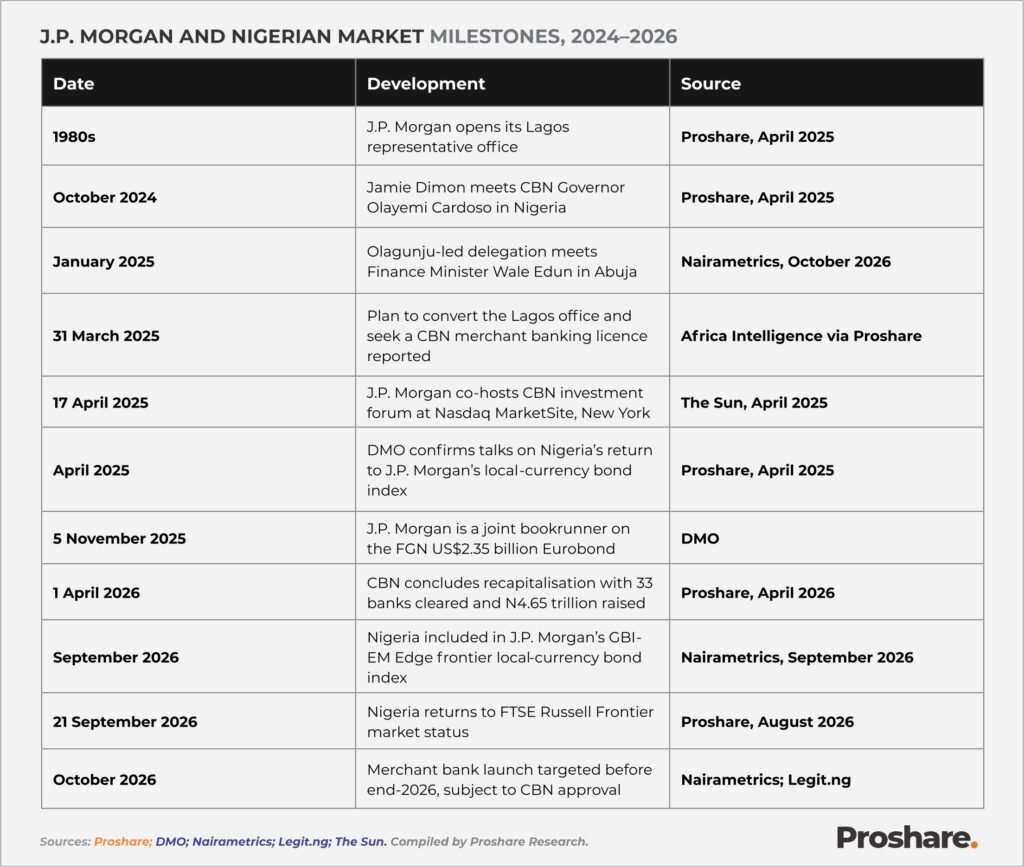
The third is market reclassification. On 21 September 2026, FTSE Russell returned Nigeria to Frontier market status after finding no material settlement, operational or funding issues since the T+1 migration, a decision detailed in the assessment that followed five benchmark reassessments since April 2025. That return made 10 Nigerian stocks, including Dangote Cement, FirstHoldCo, GTCO, MTN Nigeria and Zenith Bank, newly eligible for the FTSE index series. The sequence from Jamie Dimon’s meeting with Governor Cardoso in October 2024, to the Olagunju-led delegation meeting Finance Minister Wale Edun in Abuja in January 2025, to J.P. Morgan co-hosting the CBN investment forum at Nasdaq MarketSite on 17 April 2025, has therefore tracked closely with improvements in index eligibility.
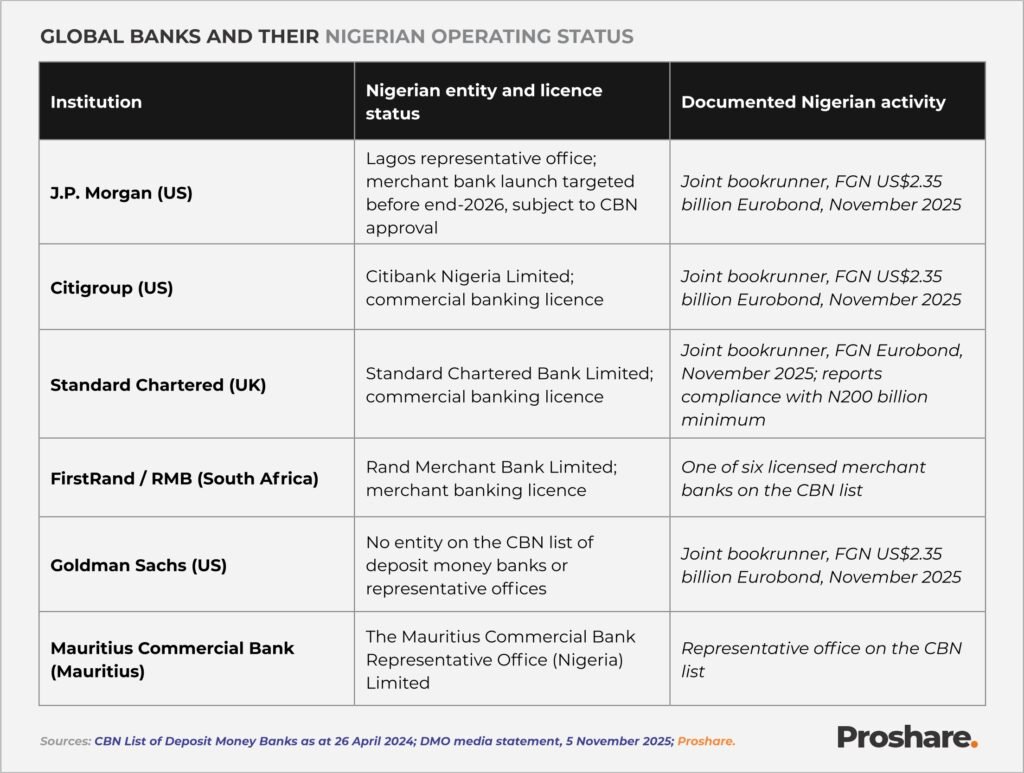
Competitively, a licensed J.P. Morgan merchant bank will sit in a small, defined peer group. The CBN’s list of deposit money banks as at 26 April 2024 names Citibank Nigeria and Standard Chartered Bank among commercial banks, and Rand Merchant Bank, part of South Africa’s FirstRand Group, among six licensed merchant banks alongside Coronation, FBN, FSDH, Greenwich and Nova. The Mauritius Commercial Bank remains as a representative office. Goldman Sachs, by contrast, does not appear on the CBN’s licensed list, and its documented role remains transactional as a Eurobond bookrunner. For J.P. Morgan, licensing creates separation from that cross-border model and places it in direct competition with RMB and the other merchant banks for corporate lending, capital market and advisory mandates, particularly dollar loans to large companies.
The outlook, however, is not without tempering factors. While FTSE has upgraded Nigeria, MSCI has classified Nigeria as a Standalone market since February 2024, a more cautious assessment. Analysts including CSL Research have cautioned that a prolonged downturn in oil prices could erode the dollar liquidity gains that have supported recent reforms and reduce appetite for local-currency securities. J.P. Morgan itself has not disclosed the capital it will commit beyond the regulatory minimum, nor the ownership structure of the entity, both of which will determine the scale at which it can compete.
What remains to be tracked is therefore regulatory and strategic. The CBN’s licensing decision, the eventual capitalisation against the N50 billion floor, the activities the licence authorises, and whether the launch meets the before year-end target set in Singapore will show the depth of J.P. Morgan’s commitment. If delivered, it will represent more than a new market entrant. It will be a confirmation that Nigeria’s reforms have restored enough confidence for the world’s largest bank to move from advising on Nigeria from offshore to booking risk onshore.