
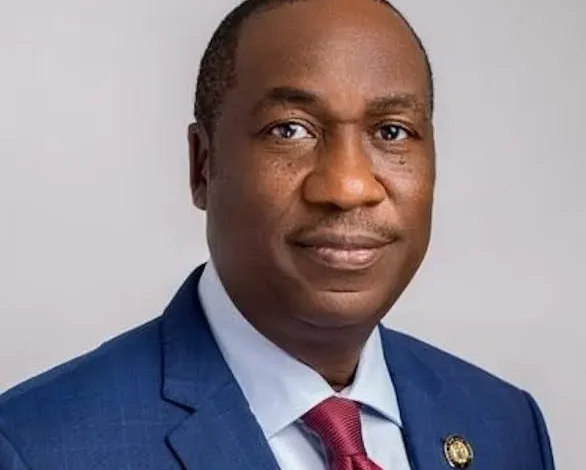
In Lagos politics, pedigree, competence and continuity win elections. As the 2027 governorship race approaches, Deputy Governor Dr. Kadri Obafemi Hamzat stands as the strongest brand extension of the All Progressives Congress because he owns the four things that win share of mind on the ballot. He is instantly recognized across 20 LGAs from 22 unbroken years in public service. He carries a reputation for delivering systems that work, from digitizing the civil service to delivering the Lekki-Ikoyi Link Bridge. He commands affinity on two streets at once, a prince from Iga Egbe in Mushin who inherited his father’s Lagos West grassroots machine and a Cranfield-trained PhD and former Merrill Lynch VP who mirrors the aspirations of the Island professional class. And his domain stretches credibly across the entire governance stack, from works and infrastructure to science, technology and process engineering. It is that combination of recall, trust, emotional connection and breadth that gives him dominance in the succession math for 2027.
Born on September 19, 1964 in Lagos to the late Oba Mufutau Olatunji Hamzat, former Commissioner for Transportation in the Second Republic, former Lagos West Senatorial District leader of Action Congress, and later Olu of Afowowa Sogaade, and the late Alhaja Kehinde Hamzat from Iga Egbe, Hamzat inherited both royalty and political structure. He began his education at Odu-Abore Memorial Primary School, Mushin, proceeded to Olivet Baptist High School, Oyo State, then to the University of Ibadan where he earned a B.Sc in Agricultural Engineering between 1981 and 1986 and an M.Sc in Crop Processing Engineering between 1986 and 1988, before earning a Ph.D in System Process Engineering from Cranfield University, England in 1992, with additional Executive Education from Harvard University. That academic journey from Mushin to Ibadan to Cranfield and Harvard is itself a brand story that resonates in a state that prides itself as the center of excellence. For an electorate that must choose among many new faces, this history means he does not need introduction. He has been Commissioner for Science and Technology from August 2005, appointed by Asiwaju Bola Ahmed Tinubu and retained by Babatunde Raji Fashola until 2011, Commissioner for Works and Infrastructure from 2011 to 2015, Special Adviser Technical to Honourable Minister Babatunde Fashola in the Federal Ministry of Power, Works and Housing between 2016 and 2018, and Deputy Governor since May 29, 2019, re-elected in 2023 on the APC ticket with Governor Babajide Sanwo-Olu. While a fresh opposition candidate will need to spend enormous resources to achieve recall across 20 LGAs and 37 LCDAs, Hamzat already enjoys near-universal recall, particularly in Lagos West, Alimosho, Mushin, Ojo, Badagry and Oshodi-Isolo, which collectively produce over 60 percent of Lagos votes. That instant recognition alone predisposes voters to consider him, because in low-attention elections, what is familiar is considered safe.
Reputation, which is the confidence that claims will be delivered, is his strongest multiplier and the core of his political brand equity. His reputation is not built on slogans but on verifiable delivery in both private and public sectors. In the private sector, he worked abroad and in Nigeria across financial and corporate organizations that demand precision, including Merrill Lynch Inc. in New York as Vice-President, Core Technology Support Group from 1999 to 2002, Morgan Stanley as Senior Associate, PC Engineering from 2002 to 2005, RTP Consulting Services as Desktop System Support, and Oando Plc in Lagos as Chief Information Officer and Group Head, IT Strategy in 2005, plus academic experience as Adjunct Professor at Columbia University CTA Programme from 1998 to 2000 and at the College of New Rochelle. That Wall Street and corporate technology background gave him a systems thinking approach that he transferred to government. As Commissioner for Science and Technology from 2005 to 2011, he is credited with enforcing the application of modern technology in all state ministries, changing the face of data and record keeping in Lagos, creating a unified Oracle-based staff database, and eliminating the entrenched trend of state ghost workers, which saved the state billions and restored credibility to the payroll. As Commissioner for Works and Infrastructure from 2011 to 2015, his reputation became physical. He oversaw the completion of the iconic Lekki-Ikoyi Link Bridge, the construction and expansion of the Lekki-Epe Expressway, and the complex expansion of the Lagos-Badagry Expressway with the Blue Line rail corridor, projects that Lagosians touch daily and that still define the state’s infrastructure signature. Between 2016 and 2018 as Special Adviser Technical, he served as consultant to Ministries, Departments and Agencies on public infrastructure such as architectural designs, structural designs, quantity surveying, and mechanical and engineering devices, giving him a federal network and a 360-degree view of project delivery. Since 2019 as Deputy Governor, he has been the core of the THEMES+ agenda implementation. This high reputation directly neutralizes the APC’s own weaknesses of youth apathy after the 2023 elections and the narrative of over-dominance, because it answers the critical voter question of whether promises will be kept. His recognition as Commissioner of the Year 2014 and Lagos State Man of the Year 2013 serves as independent social proof that his claims are credible, and for a party whose brand promise is continuity, infrastructure delivery and political stability, a candidate whose personal reputation is delivery is an invaluable asset.
Affinity, which is the strength of the emotional tie that connects a brand with its audience and whether the brand is an integral part of their lifestyle, aspirations and happy memories, is where many technocrats fail and where elections are often won or lost. A brand can have high recognition and high reputation but low affinity, like Xerox, Boeing or Rolls Royce jet engines, which are highly respected but not loved, and therefore struggle to predispose buyers to new offerings. High affinity brands like Harley-Davidson, which drew 75,000 bikers to its 75th anniversary and successfully launched clothing and a Manhattan eatery, or Disney, which turned its deep well of goodwill into retail shops in malls around the world, or Victorinox Swiss Army Knives, which turned its affinity from pocket knives into a hit line of watches, succeed because they go beyond respect to identity, spawning self-perpetuating user clubs where people see themselves in the brand. Hamzat’s perceived weakness as an elite technocrat disconnected from street politics is essentially an affinity deficit, and it could be compounded by sensitivities around being a Muslim from Lagos West at a time when religious and district balancing is carefully watched. He neutralizes this through a dual identity that gives him affinity across two distinct Lagos personas. For the aspirational middle class, the tech ecosystem in Yaba, the professionals in Lekki and Ikoyi, and the youth who want a smart city governor who understands digital governance, his story as an engineer, CIO, Merrill Lynch VP and Columbia professor encapsulates their own aspirations of global competence and upward mobility. They see their Lagos dream in him. For the grassroots in Mushin, Agege, Alimosho, Ojo and Badagry, his royal lineage as a prince from Iga Egbe and his father’s legacy as Lagos West political leader gives him authentic grassroots access, cultural legitimacy and traditional title connection that a pure technocrat could never buy. He is married to Oluremi Hamzat, a practicing Muslim family man, which reinforces cultural affinity. He is not just a technocrat parachuted in; he is from the most vote-rich base, and his political journey, including resigning in September 2018 to contest the gubernatorial election before withdrawing to support Babajide Sanwo-Olu as running mate, shows loyalty and party discipline that party members emotionally value. This dual affinity allows the APC to push a competence-plus-compassion narrative, using incumbency projects, enterprise development programs and tech hubs to re-engage youth while retaining traditional rulers, market associations, NURTW structures and ward executives that feel he is one of their own.
Domain, which is the breadth of a brand’s potential catchment area in terms of plausible product scope, determines how far a banner brand can credibly stretch, and this is where Hamzat’s value as a banner brand for the APC becomes decisive for 2027. Some brands become prisoners of a single product category, like Campbell’s being hostage to soup or Levi being hostage to jeans, making it hard to extend into other areas, as Levi discovered when its David Hunter slacks and blazers line failed because customers saw the tag line “classically tailored clothes, from Levi’s” as an oxymoron, and like Colgate, which may cover toothpaste, toothbrushes and mouthwash but can hardly stretch to foodstuffs. Other brands have a broad domain because they communicate a universal skill franchise, like Sony for portable entertainment and digital sound and video displays, or Honda whose skill franchise in gasoline engines allowed it to stretch credibly across lawn mowers, marine engines, motorcycles and automobiles where the engine is always prominent in advertising. Hamzat’s skill franchise is not narrow. It is system process engineering, a universal proposition that is far broader than “We make great chocolate” and closer to “We make first-class food products” like Nestlé, or like Sainsbury’s retailer franchise built around value not price that allowed it to stretch from grocery staples to luxury chocolates and even capture 30 percent of the UK detergent market in 1993 with its own brand ahead of Persil. He is not just a science and tech man or just a works man. His training allows voters to plausibly imagine him handling transportation gridlock, perennial flooding, housing deficits, power supply, revenue generation and digital governance. His consultancy to MDAs on structural and architectural designs proves that breadth. For the APC, which is not just a party but a 24-year governance continuum from Tinubu to Fashola to Ambode to Sanwo-Olu promising continuity, infrastructure delivery and political stability, and which controls the most formidable grassroots machinery in the South-West, Hamzat’s broad domain is invaluable. He can credibly cover the entire THEMES+ agenda and the next phase of Lagos as a smart city requiring maintenance, not just construction.
When these four attributes of instant recognition across all divisions, proven reputation for delivering systems that work, dual affinity that connects both the street and the boardroom, and broad domain that allows him to credibly promise solutions across all sectors are multiplied together, they determine share of mind, which is the predisposition to vote. The main threats to the APC in 2027 of a united opposition, economic hardship fueling anti-incumbency ahead of 2027, and internal APC contestation are directly addressed by this brand equation. As the endorsed consensus candidate ahead of 2027, his candidacy prevents a divisive primary that fractured the party in other states and that would have forced local managers to choose. His close alignment with President Tinubu, the architect of modern Lagos, and Governor Sanwo-Olu ensures there will be no power tussle at the top and allows the full propagation machinery of the party to be deployed rapidly to drive his message into every polling unit, much like P&G drove Pampers Phases into 90 countries in less than 12 months. Lagos now needs a technocratic governor for its next phase of smart city management, infrastructure maintenance and digital governance, a role Hamzat was literally built for, and 2027 offers the APC a chance to present a generational transition that still preserves loyalty to its founding leader while exploiting the electoral goldmine of Lagos West.