
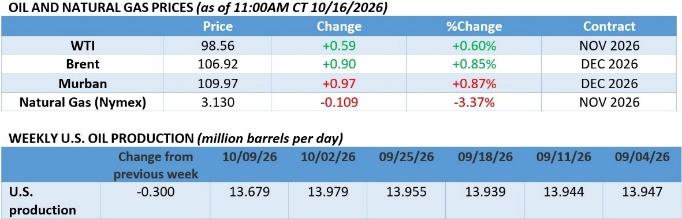
Brent crude traded within a narrow range around US$105 per barrel during the week ended 16 October 2026. In his latest OilPrice.com report, Tom Kool examines developments across the Strait of Hormuz, Saudi Arabia, Russia and the United States. He notes that market attention has returned to geopolitical conflict as hurricane disruption in the US Gulf of Mexico eases. Production shut in after Hurricane Isaias fell to about 200,000 barrels per day by Friday, and offshore output is expected to return to pre-storm levels over the coming week. Houthi drone strikes caused extensive damage to Saudi Aramco’s Dhahran headquarters. Ukraine resumed attacks on Russian refineries after a four-day energy truce. Shipping and intelligence data indicate that Iran has exported some LPG and jet fuel cargoes since the US Navy reinstated its blockade of the Gulf of Oman.
Read Economics
The International Energy Agency expects global diesel tightness to persist into 2027 and considers a stock rebuild unlikely before the third quarter of that year. Diesel production fell by 1.7 million barrels per day year on year to 27.2 million barrels per day. China’s refined product exports reached 1.88 million barrels per day in September, a four-year high and 39% above the level a year earlier, before falling to approximately 933,000 barrels per day in October to date. In Italy, ENI may be forced to shut its 84,000-barrel-per-day Taranto refinery as protesters continue to block chemical and gas deliveries to the plant.
In Nigeria, the Securities and Exchange Commission approved an extension of the Dangote Petroleum Refinery public offer, moving the subscription close from 13 October to 27 October 2026. The offer comprises 4.1 billion ordinary shares at N525 per share, valued at approximately N2.15trn. The company attributed the extension to strong investor interest across Africa and the time prospective investors need to open accounts and complete identity verification.
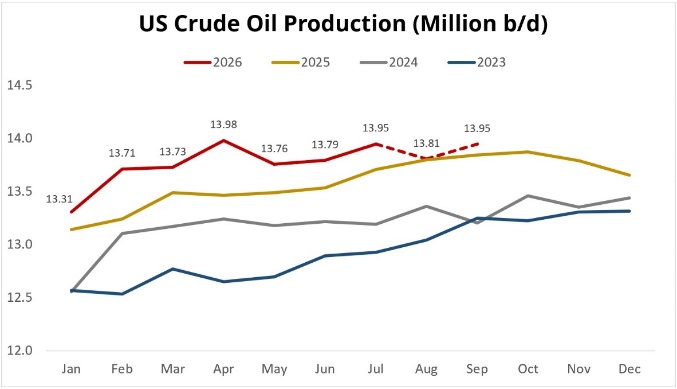
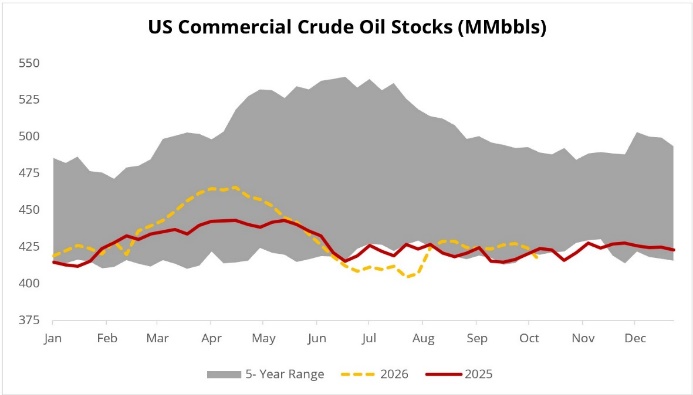
Over the coming week, Proshare will track Brent’s trading range, OPEC+ communication on supply policy, developments affecting Gulf shipping and Russian energy infrastructure, and global petroleum inventory data. It will also track Nigeria’s crude production volumes and export receipts. Further out, Proshare will follow the IEA’s diesel inventory outlook. It will also track the commissioning of the 300,000 barrels per day Panjin refinery in China, jointly owned by Saudi Aramco and Panjin Xincheng, scheduled for early 2027.

Brent holds near $105 as Iranian tanker attacks and multiple geopolitical conflicts keep oil markets on edge.
Start Investing
Friday, October 16, 2026
Oil prices have been rangebound this week as frequent Hormuz transits and Iranian drone attacks have settled around $105 per barrel for ICE Brent. Hurricane Isaias-triggered production shut-ins no longer provide bullish support, as total offline capacity in the US Gulf of Mexico dipped to 200,000 b/d by Friday, with offshore production returning to its pre-Isaias state at some point next week. Hence, oil markets are back to watching and analysing wars – be it US vs Iran, Russia vs Ukraine or Saudi Arabia vs Yemen’s Houthis.
Houthi Strikes Move Closer to Saudi Oil’s Nerve Centre. Houthi drone strikes caused extensive damage to Saudi Aramco’s Dhahran headquarters, as the Yemeni militia vowed further attacks on airports and oil facilities, widening risks to critical energy infrastructure amidst recovering Saudi oil export flows.
The Diesel Squeeze Is Becoming a 2027 Problem. The International Energy Agency warned that global diesel tightness would extend into 2027, with persistent supply shortages making it unlikely that stocks will rebuild before Q3 2027, as diesel production fell 1.7 million b/d year-on-year to 27.2 million b/d.
China Flooded Fuel Markets Before Policy Tightened. Chinese exports of refined products surged to a 4-year high of 1.88 million b/d in September, up 39% year-on-year, as refiners maximised exports of middle distillates amidst looser controls, only to see October exports halve to 933,000 b/d so far.
Trump Hypes Up a Greenland Resource Boom. US President Donald Trump said massive oil, gas, and mineral exploration would begin in Greenland soon, even though the island’s 2021 ban on new oil exploration remains in force and the US-Denmark security deal granted Washington no drilling rights.
Russia-Ukraine Energy Truce Collapses Again. Ukraine resumed attacks on Russian refineries after an awkward 4-day energy truce allegedly negotiated by US President Trump, striking Rosneft’s 340,000 b/d Ryazan plant as the public rift between Ukrainian President Zelenskiy and the White House escalates further.
Taiwan Raises Alaska LNG Hopes, Trump Declares Victory. Taiwan said it was making progress in talks to buy LNG from the $54 billion Alaska LNG project and would invest $4.4 billion, but US President Trump claimed Taipei would buy 30% of the liquefaction plant’s entire output.
Washington Seeks to Ease Sanctions on the Shadow Fleet. The Trump administration is considering removing sanctions from selected vessels, believed to be part of Russia’s so-called shadow fleet or previously linked to Venezuelan deliveries, so that they can carry oil, particularly from Gulf countries.
Taranto Labour Blockade Spreads into Southern Italy’s Fuel Supply. Italian oil major ENI (BIT: ENI) may be forced to shut its 84,000 b/d refinery in the southern city of Taranto as protesters keep blocking essential chemical and gas deliveries to the plant, with regional airports already declaring shortages.
China’s Solar Overcapacity Leads to Firing Spree. China’s largest solar manufacturers have jointly fired 21% of their staff in 2025, 40,589 positions, as the Chinese economy works to address structural overcapacity, with solar capacity still at twice global demand.
Venezuela’s Oil Recovery Barely Moves in September. Venezuela’s crude oil production boom is gradually hitting a capacity wall as September output edged up just 5,000 b/d to 1.22 million b/d, with prolonged power outages and delayed infrastructure upgrades continuing to constrain growth.
Pipeline Attacks Deepen Syria’s Energy Shortage. Syria’s national oil firm SPC reported two separate pipeline attacks this week, with explosions rocking the al-Jabsah gas pipeline and the Baniyas-Homs product pipe, compounding diesel shortages as Syrian retailers increasingly rely on imported fuels.
Trump Reaches for Wartime Powers to Expand Refineries. The White House is reportedly working with smaller refiners to award funds for capacity expansions under the 1950 Defence Production Act, tapping into $1 billion allocated by the Republican-led Congress, starting with Delek’s 74,000 b/d Tyler plant.
IEA Looks to Build LPG Strategic Stocks. The International Energy Agency is talking with member governments about developing an emergency reserve mechanism for liquefied petroleum gases (LPG), replicating its own model for crude SPRs and arguing that LPG is often overlooked in energy security.
Aramco’s Chinese Refining Megaproject Nears Start-Up. China’s newest refinery, the 300,000 b/d Panjin plant jointly owned by Saudi Aramco and Chinese conglomerate Panjin Xincheng, has received its first crude cargo from Saudi Arabia, bringing the refinery one step closer to commissioning in early 2027.
Iran Finds Cracks in the US Oil Blockade. Shipping and intelligence data suggest Iran has exported some LPG and jet fuel cargoes since the US Navy reinstated its maritime blockade of the Gulf of Oman, with at least 8 LPG carriers delivering an estimated 4.1 million barrels.
Credit:
The article “Oil Prices Are Stuck at $105 as Geopolitical Risks Mount” was initially published on OilPrice.com on October 16, 2026