Dangote Cement Plc H1 2026 Results: Record Profit, Higher Margins and a Swing to Positive Net Cash

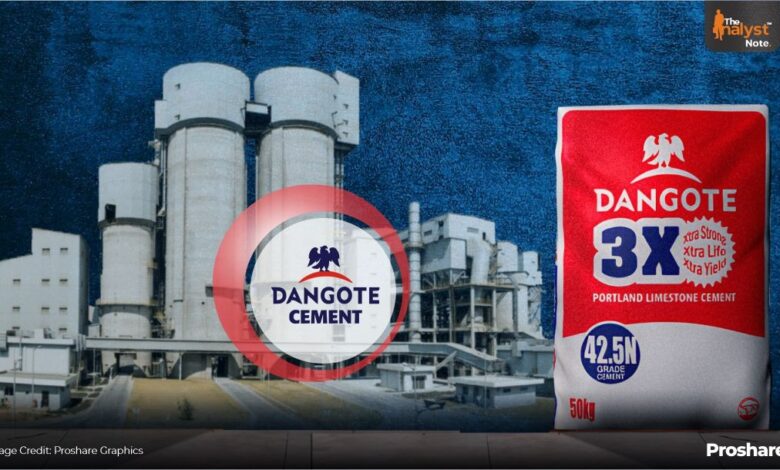
Dangote Cement closed the first half of 2026 with its strongest profit performance in company history, reporting profit after tax of ₦638.53 billion on revenue of ₦2.51 trillion. The 21.35% increase in revenue was supported by an 11.79% rise in sales volumes to 14.94 million tonnes, as well as stronger export activity out of Nigeria. Profitability also improved markedly. Gross margin expanded by 443 basis points to 63.23% and EBITDA margin rose 166 basis points to 47.27%, both reaching multi-year highs. The improvement came because cost of sales grew by only 8.29%, significantly slower than revenue, reflecting better operating leverage and cost discipline.
The most consequential development in the period, however, was the transformation of the balance sheet. Total borrowings were cut by almost half to ₦581.04 billion, while cash and bank balances doubled to ₦796.28 billion. This moved the Group from a net debt position of ₦682.92 billion at the end of 2025 to a net cash position of ₦215.24 billion in H1 2026, a swing of nearly ₦900 billion in just six months. Critically, this deleveraging was not achieved through new borrowing. The company drew zero new loans in H1 2026 compared to ₦763.43 billion in the prior year. Instead it was funded by operations, with net cash generated from operating activities rising 20.82% to ₦1.06 trillion, and with ₦500.29 billion in debt repaid during the period. Finance costs fell 48.14% to ₦112.11 billion and interest coverage improved sharply to 9.45 times from 3.75 times a year earlier.
Despite the strong headline numbers, the performance was not uniform across the business. Nigeria was the primary driver of growth. Revenue in Nigeria rose 25.17% to ₦1.81 trillion on 8.33% higher domestic volumes, but the standout was exports. Nigerian cement and clinker exports to Ghana, Cameroon and Cote d’Ivoire increased 62.30% following 20 shipments in the half. This, combined with a favourable energy mix and tight cost control, helped Nigeria EBITDA grow 28.43% to ₦1.09 trillion. The margin expanded 153 basis points to 60.14%, even in an environment where inflation reached 15.91% in June and the CBN maintained its benchmark rate at 26.50%.
Pan-Africa, in contrast, presented a mixed picture. Volumes recovered strongly, up 19.05% to 5.95 million tonnes, and revenue grew 13.67% to ₦775.35 billion. But profitability declined. Segment EBITDA fell 0.43% to ₦136.6 billion and the margin contracted 250 basis points to 17.61%. The weakness was concentrated in a few markets. Cameroon volumes dropped 13.10% due to post-election disruption to construction activity. Ghana volumes fell 18.50% as a result of government-imposed pricing controls and aggressive undercutting by competitors. Zambia also declined 5.90%. These were partly offset by strong growth in Ethiopia, up 30.40%, Tanzania up 26.10%, Senegal up 32.00% and South Africa up 1.70%. The newly commissioned grinding plant in Cote d’Ivoire also contributed 324,300 tonnes of incremental volume. The implication is that while demand is returning across Pan-Africa, pricing power and cost structures have not yet recovered in line with volumes, and Cameroon and Ghana will be key markets to watch in the second half.
At the Group level, the higher tax burden limited the translation of operating profit into bottom-line growth. Profit before tax rose 34.43%, but the effective tax rate increased 623 basis points to 34.94%. As a result, PAT grew by only 22.69% and earnings per share rose 24.33% to ₦38.22. Net margin was therefore largely flat, up just 28 basis points to 25.40%. CEO Arvind Pathak attributed the overall performance to higher volumes, disciplined execution and sustained demand, and noted that the Group ended the period with cash exceeding total debt.
Capital allocation also showed a shift in pattern. Capital expenditure on an accrued basis more than doubled to ₦354.17 billion, with ₦314.17 billion spent in Nigeria and ₦40 billion in Pan-Africa, indicating continued investment in capacity and efficiency. However, cash actually paid for property, plant and equipment fell 20.13% to ₦130.70 billion. The gap suggests a growing reliance on supplier credit to fund the investment programme, rather than direct cash outflow. Free cash flow dipped slightly by 0.83% to ₦702.04 billion. While this approach preserves liquidity in the short term, it introduces a financing risk that management itself has flagged for monitoring.
The balance sheet is materially stronger. Total assets grew 9.62% to ₦6.62 trillion, funded almost entirely by a 21% increase in equity to ₦3.17 trillion from retained earnings. Total liabilities were essentially flat at ₦3.45 trillion. As a result, borrowings now represent only 18.33% of equity, down from 41.24% at year-end 2025. Liquidity also improved, with the current ratio rising to 0.90x from 0.76x, though it remains below 1.0x. Contingent liabilities related to pending litigation stood at ₦464.80 billion, up 1.62% year-on-year, but management maintains that no material loss is expected.
In the market, investors have responded positively. The share price closed at ₦1,034 on August 6, 2026, up 69.79% year-to-date and close to its 52-week high. This gives the company a market capitalisation of ₦17.45 trillion, the largest on the Nigerian Exchange. The stock trades at 27.05 times unannualised H1 earnings, or 13.53 times if earnings are annualised, and at 5.50 times book value.
Compared to BUA Cement and HBM Nigeria, Dangote Cement continues to dominate on scale with the highest revenue, profit and equity in the sector. However, its growth rates lag. The 21.35% revenue growth and 22.69% PAT growth in H1 were the slowest among the three. Its gross margin of 63.23% remains competitive, but the reported operating margin of 42.15% is below peers and suggests there may be differences in cost classification or operating efficiency that warrant further review. The valuation also reflects this trade-off. Dangote’s P/E of 27.05x is below BUA’s 32.95x and in line with HBM’s 26.41x, indicating that while the market values Dangote’s size and balance-sheet strength, it is looking for faster earnings growth to justify a higher premium.
Looking ahead, four issues will determine whether H1 2026 represents a sustainable inflection. First is whether Pan-Africa can convert its volume recovery into margin recovery, particularly in Cameroon and Ghana where pricing and operating conditions remain challenging. Second is whether the effective tax rate normalises from the elevated 34.94% level, which would allow profit before tax growth to flow more fully to shareholders. Third is the timely commissioning of the Itori plant, which is important for future capacity and cost structure. Fourth is capital distribution. With no interim dividend declared and the company now in a net cash position, investors will be watching whether the Board revisits its capital return policy now that leverage is no longer a constraint.
In summary, Dangote Cement enters the second half of 2026 in its strongest financial position in years. The combination of record profit, multi-year high margins and a swing to net cash reflects the benefits of Nigeria’s export momentum, improved domestic cost management and lower interest expense. The challenges are equally clear: uneven performance in Pan-Africa, a higher tax burden, and an investment programme increasingly financed through suppliers. Whether the company can sustain this momentum will depend on execution in its regional markets and on how it chooses to deploy its newfound balance-sheet flexibility.