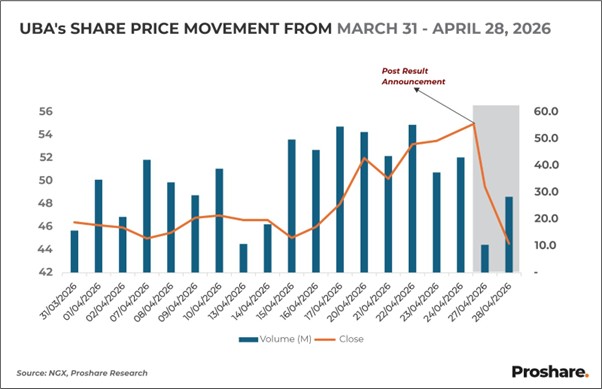
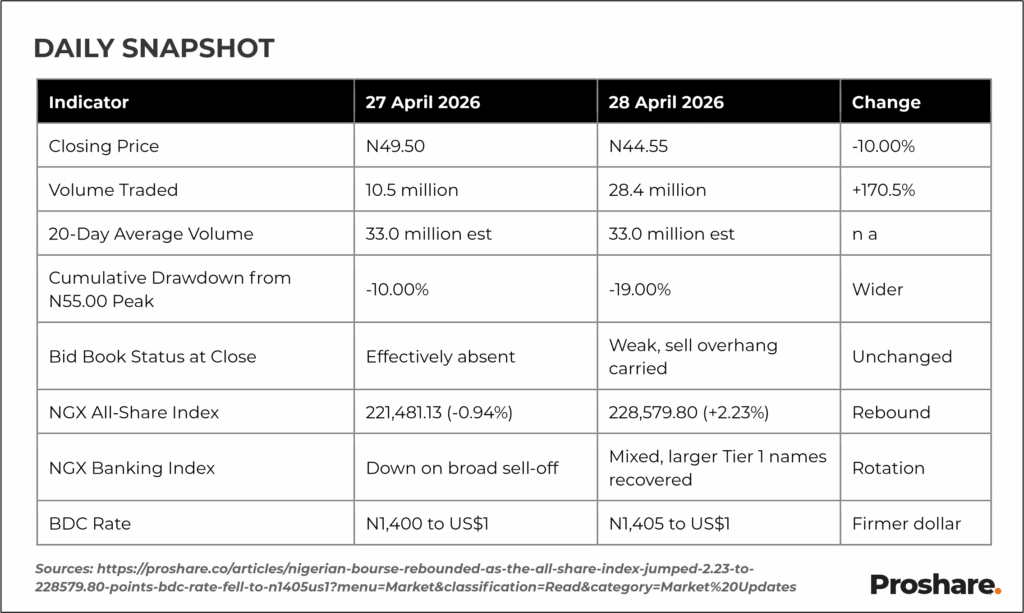
UBA’s shares are in free fall. After peaking at N55.00 on Friday, 24 April, the stock has shed 19% in less than 48 hours of trading, closing Tuesday at N44.55 following back-to-back declines of 10.0% each session. The two-day plunge erased a full two-week pre-earnings climb from N48.00, with Tuesday’s heavier volume of 28.4 million shares signaling institutional exits rather than retail panic. The downward spiral was even more stark against the market’s mood: the NGX All-Share Index added 2.23% and N3.21trn in value, while peers like Sterling, GTCO, Zenith, and First HoldCo all rallied. With no bid book left at the close and UBA alone in the red among Tier 1 banks, the stock is still hunting for a floor as the market continues to mark down what it now sees as two years of policy-inflated performance.
UBA’s market behavior in the last week of April 2026 reads like a textbook case of how quickly sentiment turns when a narrative built on momentum collides with hard numbers. After riding a speculative pre-earnings rally that took the stock to a peak of N55.00, the release of FY 2025 results triggered a brutal two-session unwind. The 19% drawdown to N44.55 in less than forty-eight hours was not collateral damage from a weak market — the NGX All-Share Index actually rebounded 2.23% over the same window, with peers like GTCO, Zenith, and First HoldCo all closing green. UBA stood alone as the sector’s outlier, signaling that investors were not punishing banks broadly but repricing one bank specifically.
The divergence is easy to explain yet difficult for management to spin: the market had been pricing a continuation of 2023–2024’s euphoria, but FY 2025 delivered the bill. Profit after tax nearly halved, driven by a heavy impairment charge tied to the CBN’s exit from regulatory forbearance. Earnings per share collapsed under the combined weight of lower net profit and the dilutive impact of a rights issue that had been pitched as growth capital. Worse, the final distribution disappointed shareholders who subscribed to that same rights issue at a premium to the current market, creating a classic value trap where fresh capital chases yesterday’s story. When those fundamentals hit the tape, the two-week pre-result rally from N48.00 to N55.00 evaporated in a single session, and the second day of selling began the more sobering work of fundamental repricing.
What makes the episode instructive is the quality of the selling. Monday’s 10.5 million shares reflected panicked retail exits; Tuesday’s 28.4 million, approaching the 20-day average, looked like institutional repositioning. There was no bid book at the close, meaning price discovery remained unfinished and the floor had not been found. At the same time, capital was not fleeing banking — it was rotating within it. Sterling Financial Holdings surged, Wema posted gains, and the Tier 1 names that avoided UBA’s level of forbearance exposure recovered. The market was selecting, not retreating, and UBA became the cleanest sell candidate because its FY 2025 reset was the most severe among its peers. That selectivity is healthy for the sector, but damning for a bank that had positioned itself as a continental champion.
The deeper criticism is not the 47% profit decline itself, but what it reveals about the quality of the 2023–2024 “turnaround.” For two years UBA traded as a growth stock, yet its earnings were flattered by currency devaluation gains and regulatory forbearance that deferred credit costs. When the CBN normalized policy, impairments surged and the cost of risk jumped, exposing how little operating leverage or risk-adjusted efficiency had actually improved. Management’s narrative of a transformed franchise now runs into a credibility gap: if the balance sheet was truly de-risked and the business model genuinely diversified across twenty countries, the forbearance exit should have been a manageable event, not a reset that wipes out half of earnings and forces investors to question the sustainability of dividends
.From here, the path is technical and psychological before it is fundamental. The speculative froth has been worked off, but institutional consensus has not formed. With one major house moving to Under Review and others staying neutral, the absence of new price targets prolongs uncertainty. The next confirmation point is H1 2026, which will test whether Q1’s reported recovery in core operating metrics was real or another head fake. Until then, the bid book, not the press release, will tell investors when the sell-order overhang has cleared. A stock that falls 19% while the market adds over three trillion naira in value is not being mispriced by irrational sellers; it is being rerated by a market that now distinguishes between motion and progress.
UBA’s medium-term thesis — continental footprint, post-recap capital, historically reliable dividends — is not invalidated, but it is no longer sufficient to command a premium. The FY 2025 results forced a distinction between size and strength, between expansion and execution. For two sessions in April 2026, UBA was a lesson in what happens when a treadmill bank dresses up as a growth story and the market calls the bluff. The recovery, if it comes, will have to be earned the hard way: normalizing provisions, restoring dividend confidence, and proving that earnings can grow without forbearance crutches. Until then, the market will keep doing what it did last Tuesday — pricing the information in front of it, and selecting elsewhere.
UBA Plc has now repriced 19% in two sessions following the release of its FY 2025 audited results. The broader market rebounded 2.23% that same day, and the rest of the Tier 1 banking universe largely participated in the recovery. The divergence is stock-specific and earnings-driven. The fundamentals that inform the medium-term case, including the 20-country African footprint, the post-recap capital position, the 123.57% NPL coverage, and the 23.20% capital adequacy ratio, remain intact. What has changed is the entry valuation and the institutional patience required to wait for the next confirmation point.