This week’s $15 surge to $105 Brent is less a price discovery than a stress test of the post-1970s energy security architecture, and the architecture is bending. Coordinated SPR releases from the US (79.7 million barrels), Japan (80 million, with a further 36 million pledged from 1 May), and IEA partners have failed to anchor expectations. What has capped the rally at $110 is not stockpile draws but a single diplomatic itinerary, with Iran’s Foreign Minister en route to Pakistan for indirect talks. When a travel calendar moves the curve more than the largest coordinated reserve drawdown of the cycle, policymakers are being told something uncomfortable about the marginal utility of their primary crisis instrument.
The supply-side evidence reinforces the asymmetry. Goldman Sachs places 14.5 million barrels per day of Gulf output offline, 57% of pre-war capacity, with recovery measured in months rather than weeks, even once the Strait of Hormuz reopens. The IRGC’s seizure of MSC Francesca and Epaminondas, in direct retaliation for the US interdiction of the Touska, confirms the chokepoint as an active theatre rather than a managed pause. Canada’s headline 23.6 million-barrel “release,” reclassified as pre-existing seasonal growth, illustrates the credibility deficit now emerging around emergency-response disclosures more broadly. The $110 threshold should be read as a diplomacy premium rather than a clearing price; downside risk to talks reprices in seconds, while supply normalisation will accrue over quarters.
For Nigeria, Proshare’s reading of the OilPrice report suggests that the constellation is unusually favourable on paper and unusually demanding in practice. With 14.5 mb/d of Gulf output offline, light sweet West African grades (Bonny Light, Forcados, Qua Iboe) are commanding structural premia that should translate into a material fiscal windfall against a 2026 budget built on far more conservative oil assumptions. The binding constraint is upstream deliverability: capturing the window requires sustained output above OPEC quota, which Nigeria has rarely achieved in recent cycles owing to pipeline vandalism, divestment overhang, and chronic underinvestment in mature acreage. The asymmetry is sharper still on the demand side.
Investing
Post-subsidy removal, pump prices now pass international crude price moves directly through to consumers, with second-round effects on transport, food inflation, and naira-denominated household budgets, even as Dangote’s 650,000 b/d refinery partially insulates the country from refined-product price spikes. The governance test is twofold: whether NNPC Ltd. and the Tinubu administration can lift production to monetise the premium, and whether the resulting receipts are channelled into rebuilding the Excess Crude Account and FX buffers rather than absorbed by recurrent expenditure. Past windfalls have been squandered.
The structural nature of this cycle, with prolonged tightness, slow normalisation, and sustained grade premia, makes the fiscal response a credibility marker that sovereign creditors, ratings agencies, and domestic institutional allocators will track closely. Boards and treasuries should plan against escalation as the base case rather than the tail, and treat the current ceiling as borrowed, not earned.
Friday, April 24, 2026
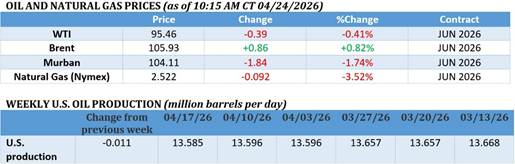
As crude oil prices are set for a hefty $15 per barrel weekly gain, seeing ICE Brent back at $105 per barrel, oil markets are nevertheless closing the week on a hopeful note, with Iran’s Foreign Minister believed to travel to Pakistan over the weekend. Even if through indirect talks, the fact that diplomacy is still an option between the US and Iran has largely prevented a Brent breakout above $110 per barrel this week, with WTI rolling over into its June contract $10 per barrel below the global benchmark.
Iran Seizes Container Tankers After Talks Fail. Iran’s Islamic Revolutionary Guard Corps seized two container ships – MSC Francesca and Epaminondas – following the US’ seizure of the Iranian cargo ship Touska, putting a drastic halt to attempts to pass through the Strait of Hormuz by non-oil tankers.
Ukraine Restarts Druzhba Flows to Europe. Ukraine has restarted Russian crude oil flows through the Druzhba pipeline after a three-month-long halt, immediately after Slovakia and Hungary lifted their vetoes on a $105 billion EU loan needed to cover Kyiv’s government expenses, easing oil shortages.
BP’s New Board Fails to Garner Support. BP’s new chief executive, Meg O’Neill, and board chair, Albert Manifold, failed to get shareholder backing for two proposed resolutions at Thursday’s annual general meeting, one of which sought to scrap previously adopted company-specific climate disclosures.
Brussels Adopts 20th Sanctions Package on Russia. The European Union has formally adopted its 20th package of sanctions against Russia, adding 46 tankers to its shadow fleet list, banning transactions with the ports of Murmansk and Tuapse and introducing a ‘no-Russia’ clause for upcoming tanker sales.
Golden Pass LNG Exports First Cargo. Golden Pass LNG, a joint venture between QatarEnergy and ExxonMobil (NYSE: XOM), has exported its first-ever cargo this week, with the Qatari-owned tanker Al Qaiyyahal departing for Belgium, delivering some of QE’s contracted volumes under term commitments.
Canada’s IEA Release Promise Falls Flat. Canada’s pledge to supply an additional 23.6 million barrels of crude oil, promised as part of Ottawa’s IEA strategic petroleum release, turned out to be natural output growth that was already anticipated for the summer of 2026, regardless of the US-Iran crisis.
European Refiners Mop Up US SPRs. With the US government having so far released 79.7 million barrels to 12 companies, at least 4 million barrels of crude are currently sailing from the Gulf Coast to Europe, including a giant VLCC carrying 2 million barrels of Bryan Mound medium-sour crude to Rotterdam.
Mexico Starts Sending Oil to Japan. Mexico’s President Claudia Sheinbaum announced that the country’s state oil company, Pemex, will begin exporting crude oil to energy-deprived Japan, starting with 1 million barrels after flows between the two countries ground to a halt in October 2023.
BP’s Whiting Refinery Lockout Continues. As contract talks between UK oil major BP (NYSE: BP) and workers at the 440,000 b/d Whiting refinery in Indiana hit an impasse, the Midwest’s largest refinery enters its second month of lockout, with output secured due to BP’s bringing in temporary workers.
Pakistan Returns to LNG Markets. Pakistan has issued its first spot LNG tender since December 2023, after the closure of the Strait of Hormuz blocked it from receiving Qatari supplies, seeking extremely prompt cargoes in late April and early May as JKM prices continue to trade around $17 per MMBtu.
Japan Plans Second Wave of SPR Releases. The world’s most import-dependent major consumer, Japan, plans to start the second round of its SPR releases from May 1, pledging to offer 36 million barrels to the country’s refiners after this month’s 80-million-barrel release, the largest SPR drawdown globally so far.
White House Extends Jones Act by 90 Days. The Trump administration has extended by 90 days a waiver of the Jones Act, allowing foreign-flagged ships to carry crude, products, and fertilisers between US ports through mid-August. It has already allowed shipments on 15 vessels since mid-March.
Gulf Production to Take Months to Recover. According to Goldman Sachs, production from Gulf countries will take several months to recover after the Strait of Hormuz is reopened, estimating that roughly 14.5 million b/d of the region’s oil production is currently offline, 57% of its pre-war supply.
Indonesia Locks in Giant Russian Supply Deal. Indonesia’s Energy Ministry announced a deal to import 150 million barrels of crude oil from Russia in 2026, equivalent to 600,000 b/d of supplies, even though the country’s refiners have so far bought only one cargo this year, aiming for a similar LPG deal soon.
US-EU Wrapping Up Strategic Minerals Partnership. The United States and the European Union will sign a memorandum of understanding on Friday to pursue a potential strategic partnership on critical minerals, agreeing to minimum price guarantees to compete with dominant Chinese suppliers.
Credit:
The article “Brent Holds at $105 as Iran Talks Temper Rally” was initially published on Oilprice.com on April 24th, 2026
ou.
Sunday, March 22nd at 10:39 PM
PROSHARE’S PICKS
Stock Recommendation for the Week of April 27, 2026
Market | Stock & Analyst Updates
The Proshare and Market Indexes @24Apr26: Float-Adjusted Index Crosses 1,000 as Capital Selectivity Redefines the April Rally
Market | Public & Private Offers
Nigeria’s Financial Market Offerings this Week from April 22, 2026
Stock Recommendation for the Week of April 20, 2026
Subscribe to our Newsletter