
Tell a young farmer in Imeko-Afon today that a wrong decision at the ballot on February 6, 2027 could mean his son will be eligible to run for governor before Yewa-Awori ever gets the chance to produce one, and it sounds like an exaggeration until the numbers are laid bare: if Ogun West bungles this ticket over paternity trials and manufactured internal crises, the gate to Oke Mosan will stay locked until 2043, a full 16 years away, which means a struggle that began at the creation of Ogun State in 1976 will be inherited by grandchildren, and that is not scare-mongering, it is the cold, unforgiving mathematics now staring Ogun West in the face .This is why 2027 is not just another election. It is a referendum on whether Ogun State truly believes in equity or merely recites it every four years.
Since February 1976 when Ogun was carved out of the old Western State, the state’s political architecture has rested on three tripods: Egba in Ogun Central, Ijebu and Remo in Ogun East, and Yewa-Awori in Ogun West. Power, however, has only rested on two. Chief Olabisi Onabanjo from Ijebu held it in the Second Republic. In this Fourth Republic, Olusegun Osoba from Egba from 1999 to 2003, Gbenga Daniel from Remo from 2003 to 2011, Ibikunle Amosun from Egba from 2011 to 2019, and Dapo Abiodun from Iperu-Remo from 2019 till date. Ogun West, with five local governments – Ado-Odo/Ota that warehouses over 60 percent of the state’s industries and Internally Generated Revenue, plus Ipokia, Yewa North, Yewa South and Imeko-Afon that hold the nation’s most strategic border economy – has never produced an elected governor. Not once in 50 years. For the farmer whose yams rot because the road to Ayetoro is gone, for the trader in Ota who pays tax but fetches water from a well, for the student in Ilaro who must cross to Benin Republic for better schooling, the governorship is not about bragging rights. It is about belonging.
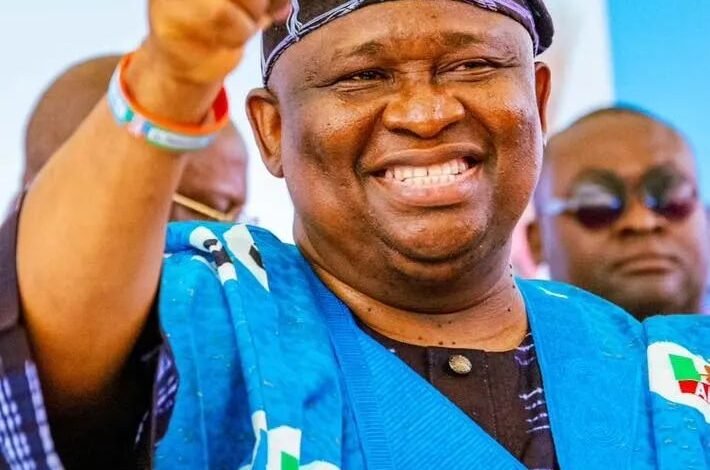
For decades that belonging was expressed as lamentation. Groups like the Ogun West Initiative, the Yewa Traditional Council, border community associations and market women cried marginalization every election cycle, then scattered. What makes 2027 different is that lamentation finally found structure. For the first time, the ruling All Progressives Congress, which controls the Presidency, the governorship, all 20 local councils and the most potent grassroots network in Ogun, settled for a consensus candidate from Ogun West. Senator Solomon Olamilekan Adeola, popularly known as Yayi, a chartered accountant who spent eight years in the Lagos State House of Assembly, four years in the House of Representatives for Alimosho where he chaired the Public Accounts Committee, eight years as Senator for Lagos West, and since 2023 as Senator for Ogun West where he chairs the Senate Committee on Appropriations. His team has built its pitch around what it calls FECSTEP – functional office, engagement, cooperation, scholarships, targeted legislation, empowerment and project facilitation – with a list of over 250 interventions: Bisi Popoola Street in Ayetoro, Obaladi Palace Road in Afon, the Moriwi-Oke Agbede-Iwoye road network, Ona Odo Road in Ilara, ultra-modern markets in Ayetoro, Iboro and Obada, 12-classroom blocks at Oke-Ore Grammar School and Ketu College, primary health centres in Ebute Igboro, Ijaka Oke, Atapele, Atan and Sango-Ota, police stations in Ayetoro and Idiroko and the Imeko-Afon Area Command, plus bursaries, ICT training and grants. Whether all of these deliver lasting economic value is a question for auditors and economists, but it is a record that can be debated. That debate is exactly what Ogun politics has refused to have.
Instead, the favorite pastime has returned: the culture of blackmail through bloodline. In Ogun, a brand of politics has been perfected where a man’s budget performance is not audited, his birth is audited. What he built is not interrogated, who gave birth to him is interrogated. The campaign against Yayi is the most sophisticated version of this. It started as a whisper that he is not truly Yewa, then became a shout that he is from Ekiti State, then became an inquisition that his name changed from Sulaiman Ogunleye to Solomon Adeola, then became a cultural trial that when he was hosted by his maternal family in Kemta, Abeokuta in a reception described as a glorious homecoming, he was not first presented to the Oluwo of Kemta and his maternal siblings were not displayed. Critics like Ibrahim Afolabi and PDP chieftains like Folake Marcus-Bello and spokesman Afolabi Orekoya have turned this into a demand for documentary proof of ancestry and source of wealth. This is not scrutiny, this is absurdity. The Constitution of the Federal Republic of Nigeria is very clear. Section 177 says to be governor a person must be a citizen of Nigeria by birth, must have attained 35 years, must be a member of a political party and sponsored by that party, and must have at least School Certificate or its equivalent. It does not say the person must produce a great-grandfather’s burial ground, it does not say the person must list a mother’s brothers. Rootedness matters in Ogun where town, clan and ancestry shape trust, and voters have every right to ask whether a candidate understands the history of Ilaro, the commerce of Ijebu-Ode, the politics of Abeokuta and the industry of Ota. But there is a difference between a legitimate political question about understanding and a false legal disqualification. Yayi’s supporters, including prominent Yewa Obas, insist his paternal root is Ago-Isaga in Ilaro and his maternal link to Kemta is authentic. Until a court of competent jurisdiction says otherwise, these remain what they are: political claims and counterclaims. George Orwell warned in Animal Farm that when slogans replace thought, repetition makes a lie sound like truth. In Ogun today the slogans are indigene, outsider, original son, stranger, Iperu to Iperu. Shouted long enough, they stop critical thinking.
And while that external blackmail rages, the enemy within has already picked up the knife. This is the tragic flaw of Ogun West. In 2011, the zone had its best chance with two heavyweights, Prince Gboyega Isiaka and General Adetunji Olurin, both insisting on running, splitting the Yewa vote and handing victory on a platter to Ibikunle Amosun from Ogun Central. In 2027, the ghost of 2011 has returned as Abayomi Hunye, another Yewa son who entered the APC governorship primary and was officially recorded to have scored zero votes. Zero. The Eselu of Iselu Kingdom in Yewa North, Oba Akintunde Akinyemi, speaking at his house-warming in Obada-Oko, Abeokuta, captured the national embarrassment: if Hunye participated in the primary, it is impossible for him to score zero because he would have at least voted for himself, so who stole his vote? The party says Hunye is suspended and should be investigated for impersonation, while Hunye says he is still in the race and has unveiled Otunba Abayomi Odunowo from Ijebu Ode as his running mate. Whether Hunye is a genuine aggrieved aspirant or a sponsored spoiler is immaterial. The effect is the same. It gives the rest of the state the perfect excuse to say Yewa cannot put its house in order even when handed a consensus candidate.
Now comes the most dangerous part, the danger of losing the seat to the same town and same senatorial district that currently holds it, on these frivolous excuses. Look at the other side of the ballot. The Peoples Democratic Party candidate is Hon. Oladipupo Adebutu, popularly called Lado. He is not a neophyte. He was in the National Assembly in the Third Republic in 1992 for Remo Federal Constituency on the Social Democratic Party platform, returned to the House of Representatives from 2015 to 2019, and contested the governorship in 2019 and 2023, losing narrowly in 2023. He is son of businessman and philanthropist Sir Kessington Adebutu, whose foundation has funded education and community projects. To balance geography he picked Dr. Yemi Sowunmi-Kolapo, an Egba woman from the respected Sowunmi family of Ijemo, Abeokuta and Iya Sunnah of Egbaland, just as Yayi picked Kudirat Adegunwa-Balogun from Ijebu Central, an accomplished accountant and daughter of industrialist Alhaji Adebola Adegunwa. Adebutu’s argument is that Ijebu is distinct from Remo and Ijebu has not produced governor in this republic, even though both sit in Ogun East.
But here is the contradiction that makes the 16-year danger real. Adebutu is from Iperu-Remo, the same town as Governor Dapo Abiodun. If Ogun West’s candidate is knocked out on ancestry grounds and Adebutu wins, power remains in Iperu from 2019 to 2031, twelve unbroken years in one town. Remo would have governed Ogun from 2003 to 2011 under Gbenga Daniel and from 2019 to 2031 under Abiodun and Adebutu, twenty years out of thirty-two years of the Fourth Republic. It is impossible to preach marginalization in Abuja and practice consolidation in Iperu. It is impossible to tell Yewa that they have been excluded for 50 years and then tell them their best chance is not Yewa enough, while asking them to accept another Iperu man as fairness. Adebutu’s camp, through Orekoya, correctly argues that there is no constitutional ban on Remo succeeding Remo and that Adebutu’s maternal root traces to Odogbolu via the Jaiyesimi royal family. Constitutionally permissible, yes. Politically just, no.
And that is where the queue resets. If Remo retains power beyond 2027, the moral argument for rotation will shift decisively to Ogun Central. The Egba Lokan Agenda 2027 is already gathering steam. Egba leaders argue, with justification, that since Remo would have done twelve years, power must return to Abeokuta. Egba is the largest voting bloc in Ogun. No one wins Ogun without significant Egba support. Every governor from Remo has relied on Egba votes to win. Egba will demand and will get 2031 to 2039. After Egba, Ijebu will say they have been out since Onabanjo in 1983. Yewa will be told to wait. By the time the rotation argument returns to the West, it will be 2039 at the earliest, and with the usual negotiations, litigations and realignments, 2043. Sixteen years after 2027. A child born in Ipokia today will be in university before his zone is considered again. Losing in 2027 is therefore not losing an election. It is postponing justice for a generation.
Is Ogun West jinxed? The question is being whispered in political circles, but a jinx is supernatural. What is happening to Ogun West is not supernatural, it is self-inflicted and externally engineered. A zone that generates the wealth, bears the border pain and has waited half a century is being asked to reject its most structurally prepared candidate because his political apprenticeship was in Lagos, while being asked to accept an Iperu-to-Iperu succession as equity. It is a political culture that prefers family trees to economic blueprints, that prefers to ask who a candidate’s mother is rather than what the candidate will build for Ogun’s manufacturing hubs in Ota and Agbara, its agrarian corridors in Yewa, its urban sprawl, its youth unemployment and its security. The February 6, 2027 ballot will carry many names, but for Ogun West it carries only one question: whether equity will finally be served, or whether through blackmail from outside and betrayal from inside, the West will once again surrender a seat it has waited 50 years to occupy, and then wait another 16 years to be remembered.