Rally With a Warning: Why the NGX Is Up 61% but the Real Story Is in Breadth, Rates, and Oil


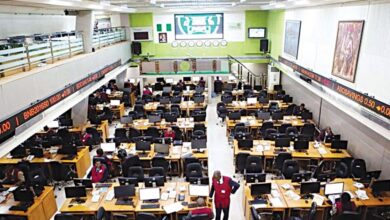
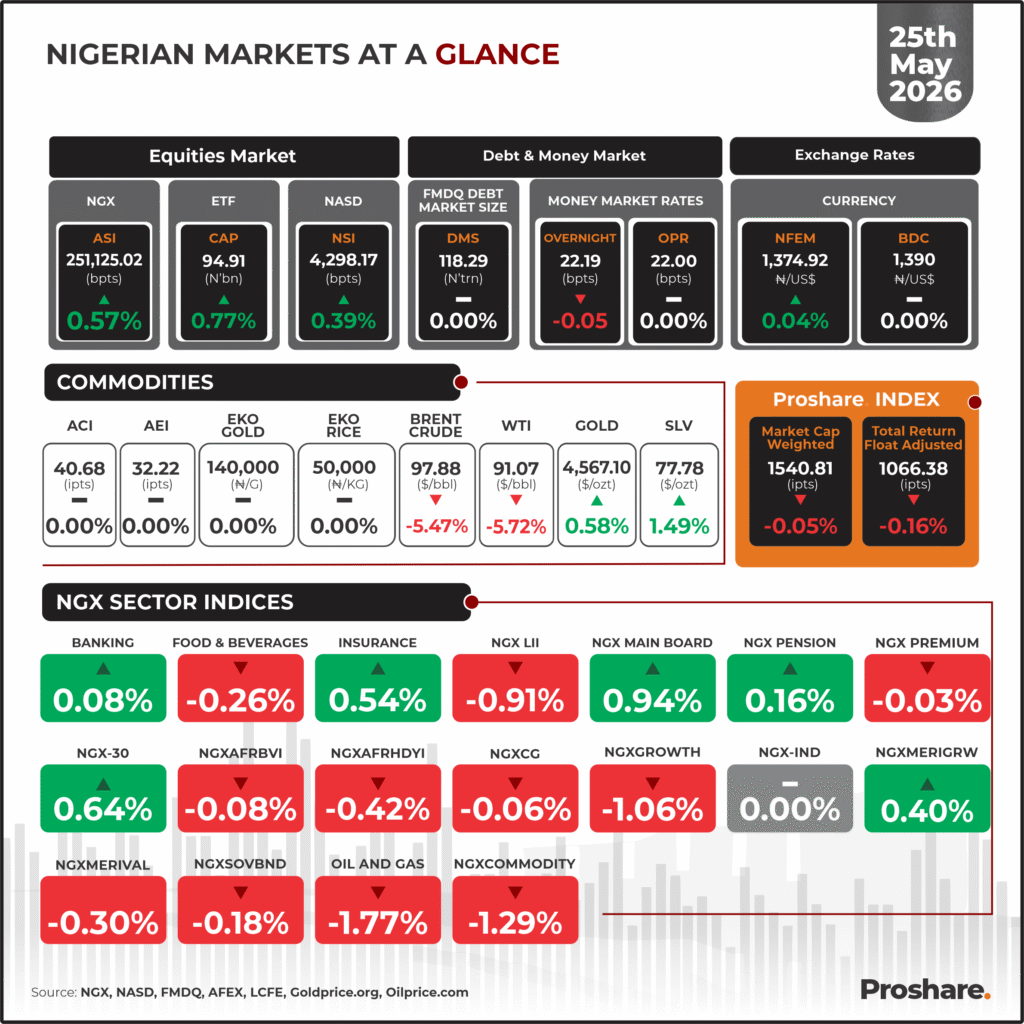
The Nigerian Exchange is not slowing down. On Monday, May 25, 2026, the All-Share Index pushed another 0.57% higher to close at 251,125.02 points, lifting the year to date return to 61.38%. Market capitalisation now sits at ₦905.57 billion after another day of large-cap buying. At first glance this looks like pure momentum. Look closer and the market is sending three different signals at once: selective risk appetite, cooling volumes, and a global backdrop that is no longer helping.
1. Breadth Is Positive but Thin
The ASI gain was powered by a familiar name. Airtel Africa hit its 10.00% daily limit and led 35 gainers against 31 decliners. Other movers included Red Star Express up 5.87%, Oando up 4.57%, Wema Bank up 1.65%, Fidelity Bank up 1.06%, and AccessCorp up 0.20%. With 27 other names also green, breadth closed positive. Yet the Proshare Memorandum Indexes told a different story. The market cap-weighted index slipped 0.05% to 1,540.81 points and the total return float-adjusted index fell 0.16% to 1,066.38 points.
When the ASI rises and the cap-weighted index falls, it means the rally is not broad based. A few heavyweights are doing the lifting while the average stock is flat or down. UnionDicon trading at a new 52-week high of ₦23.75 shows pockets of speculation, but the overall tape is narrowing. Bull markets need participation. This one is getting it from names, not from the whole market.
2. Volumes Are Cooling Even as Prices Rise
Total volume fell 11.58% to 629.42 million shares valued at ₦40.91 billion across 82,434 deals. AccessCorp led volume with 61.29 million units, 9.74% of the day. Aradel dominated value at ₦11.99 billion, 29.30% of turnover. Zenith Bank and Fidelity Bank followed in both volume and value.
Falling volume on rising prices is a classic caution flag. It means fewer investors are chasing the move. The buyers who are left are concentrated in banks and a few energy names. That can sustain an index for a while, especially when Airtel Africa gaps up, but it raises the risk of sharp pullbacks once those buyers pause. The NASD OTC market was more active, with volume up to 1.49 million units valued at ₦59.17 million and the NSI up 0.39% to 4,298.17 points. Unlisted names are still attracting interest, a sign that liquidity is rotating, not leaving.
3. Macro Crosswinds: FX Steady, Oil Down, Commodities Mixed
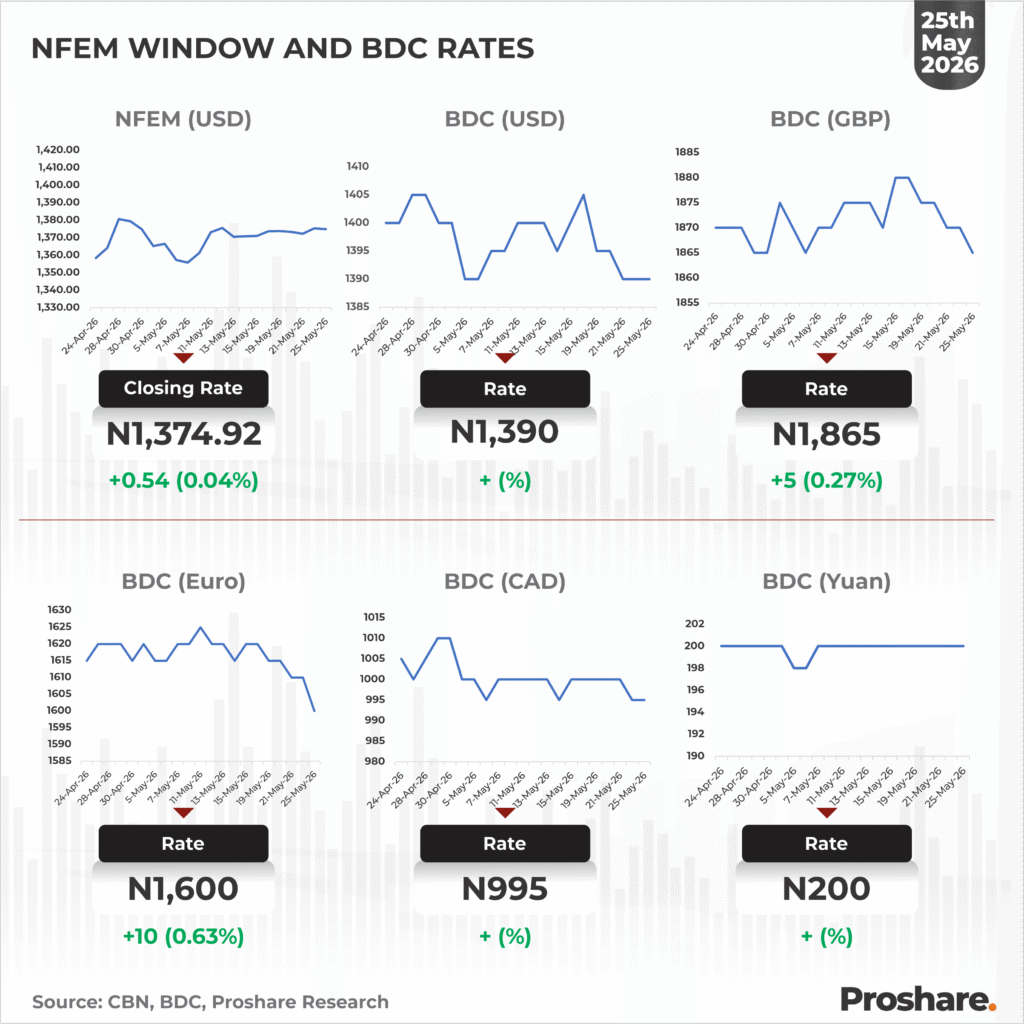
The BDC rate closed flat at ₦1,390 to the dollar while the NFEM rate appreciated 0.04% to ₦1,374.92. FX stability has been a tailwind for equities all year. With the spread between official and parallel rates narrow, foreign investors can enter and exit without a big haircut. That confidence is visible in the 61% YTD return.
Commodities are not helping though. Brent fell 5.47% to US$97.88 and WTI dropped 5.72% to US$91.07 on optimism that the United States and Iran are closer to a deal. For Nigeria, lower oil hurts fiscal receipts and dollar supply, even if it eases inflation. At the same time, gold rose 0.58% to US$4,567.10 and silver gained 1.49% to US$77.78, showing risk hedging is still alive globally. Locally, AFEX data showed maize up 15.00% to ₦258.22 and soybeans up 6.29% to ₦775.94, while paddy rice fell 14.37% to ₦380.00. Food inflation pressure is not uniform, but it is not gone.
4. What the Corporate Flow Says
No financial statements hit the NGX on Monday, but the corporate news tape was busy. Multiverse Mining released a corporate action, AIICO announced director appointments, Meyer filed its 2025 AGM report, and directors at McNichols, NAHCO, VFD Group, and NGX Group all disclosed dealings. VFD Group is pushing Pan-African expansion after a ₦50.67 billion rights issue. That is the kind of capital raising that happens in bull markets. Companies are using high prices to fund growth.
Director dealings cut both ways. Some are buying, some are selling. The net signal is that insiders are active while the index is near all-time highs. That is normal, but it is worth watching if selling picks up.
The Interpretation: A Rally Running on Selectivity and Stability
Three forces explain the 61.38% YTD return. First, FX reforms and a narrower exchange rate gap brought foreign and local money back to equities. Second, banks have re-rated on higher rates, better liquidity, and the sovereign upgrade to ‘B’ that lifted names like AccessCorp, Zenith, and GTCO. Third, telecoms and energy have provided index ballast, with Airtel Africa’s 10% move on Monday as the clearest example.
The risks are just as clear. Oil is falling, which can pressure the naira and government spending later in the year. Volumes are thinning, which makes the index vulnerable to profit taking. Breadth is narrowing, which means the rally depends on a handful of stocks. The flat BDC rate is good for now, but if oil stays under US$100 and external reserves dip, the FX calm will be tested.
For investors, the playbook has not changed. The NGX is still a momentum market, but it is no longer a broad one. The winners are banks with strong capital and trading income, telcos with dollar-linked cash flow, and energy names tied to production or deregulation. The losers will be illiquid mid-caps without a catalyst.
The bullish acceleration is real. The ASI at 251,125 proves it. But the fact that a 0.57% index gain came with an 11.58% drop in volume and a downtick in the cap-weighted index says the market is getting pickier. At 61% YTD, the easy money has been made. The next leg needs earnings, not just flows. Without it, the rally can hold, but it will not run as fast.