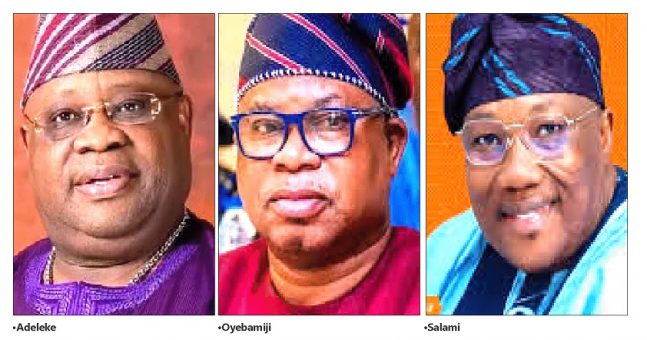
The August 2026 Osun governorship race has effectively narrowed to two contenders: Governor Ademola Adeleke of the PDP and APC’s Kunle Oyebamiji. Najeem Salaam, despite his legislative history and Aregbesola’s backing, enters as the weakest of the three. The deciding factors will be money, federal might, incumbency, and how much voters hold each candidate responsible for their political family’s record.
Ademola Adeleke – Incumbency and FAAC, but Family Politics as a Liability
Adeleke holds the state treasury and the visibility advantage. FAAC inflows of ₦6bn-₦8bn monthly since 2023 have let him pay salaries, clear arrears, hire teachers, and push the “Infra Plan” across Osogbo, Ilesa, Ede, and Iwo. The civil service is cooperative because the wage bill is being met, and rural voters see roads and flyovers they can point to.
The problem is that the campaign is personalizing into a referendum on the Adeleke family. Allegations of family-dominated appointments, contracts tied to the family circle, and delayed financial disclosures feed the perception that “Imole” is a family project, not a state project. His late brother’s poor performance in office and questions around Adeleke’s own educational background are being used by opponents to attack his depth and credibility.
Federal might is not on his side. Abuja has approved major road projects in Osun, but APC is positioning them as federal achievements, not PDP state achievements. That lets Oyebamiji claim credit for infrastructure even while Adeleke spends state money.
Chance: Strong if FAAC holds and the civil service stays loyal. Weakened if voters decide the election is about ending family politics and lack of transparency.
Kunle Oyebamiji – Abuja Money and Federal Projects as Leverage
Oyebamiji is the candidate with the financial backing and federal linkage to compete with incumbency. Oyetola’s support gives him access to APC’s financial base, and the federal government’s approval of major road projects in Osun gives him a ready-made campaign asset. He can argue that only an APC government linked to Abuja can bring consistent federal investment without relying solely on volatile FAAC.
This is why Oyebamiji, not Salaam, is the real threat to Adeleke. He has the money to match PDP’s incumbency spend, and he can sell himself as the bridge to federal resources without the baggage of Oyetola’s tenure dominating the message.
His liability is identity. He’s still seen as “Oyetola’s candidate,” which limits his ability to present himself as a clean break. If APC’s national economic record worsens by August, he inherits that burden. But if FG delivers visible road works before the election, he turns federal might into votes.
Chance: Strong if APC unifies and delivers visible projects before August. He has the money and Abuja backing to make incumbency beatable.
Najeem Salaam – Weakened by Aregbesola’s Record and Party Weakness
Salaam enters with the weakest hand. His backing comes from Aregbesola, whose second term is remembered for half-salary, arrears, and the collapse of public trust. In Osun, that record still matters. It makes it hard for Salaam to sell himself as the candidate of stability when his backer is associated with the state’s worst wage crisis.
The party structure behind him is new and financially weak. Party credibility is questionable because many of its members lack a track record or are seen as political nomads. Without state resources or federal might, Salaam is relying on structure and personal reputation, both of which are insufficient against an incumbent spending FAAC money and a challenger with Abuja backing.
His path to relevance is narrow: he needs FAAC to collapse and the election to become a referendum on competence and institutional memory. Neither looks likely four months out.
Chance: Low. He lacks money, federal backing, and a clean record to sell. Aregbesola’s association hurts more than it helps in 2026.
What Decides It
- Money: Adeleke controls state funds. Oyebamiji has Abuja-backed financing. Salaam has neither.
- Federal Might: FG road projects give APC a counter-narrative. If delivered before August, they shift credit away from Adeleke.
- Family and Record Politics: Adeleke is weighed down by family politics and his brother’s legacy. Aregbesola’s record weakens Salaam. Oyebamiji has the cleanest slate.
- Civil Service: As long as salaries are paid, the bureaucracy stays neutral. If FAAC dips, loyalty shifts.
Bottom Line
This is a two-horse race. Adeleke leads on incumbency and state resources but is vulnerable on credibility and family politics. Oyebamiji has the money and federal backing to make it competitive, and he’s positioned as the candidate who can bring Abuja’s projects without Adeleke’s baggage. Salaam is structurally and financially outmatched, and Aregbesola’s record makes his ceiling low. Unless FAAC collapses before August, the contest will be decided by whether Oyebamiji can turn Abuja money and projects into a credible alternative to Adeleke’s incumbency.