Dangote Cement FY 2025: Debt Halved, Profit Doubled as Deleveraging Delivers Nigeria’s First Trillion-Naira Cement Earnings

Dangote Cement’s FY 2025 result is not principally an earnings story, but a capital structure story. The doubling of after-tax profit to N1.01 trillion is the visible outcome; the underlying mechanism is a deliberate and disciplined reduction in borrowings by 55.94%, from N2.63 trillion in FY 2024 to N1.16 trillion, which nearly halved finance costs and released earnings potential previously absorbed by debt service.
Revenue growth of 20.28% to N4.31 trillion was achieved despite declining sales volumes, from 27.71 million tonnes to 27.47 million tonnes in the prior year, confirming that pricing execution, not volume recovery, is the engine of this result.
The N348.8 billion reduction in finance costs (from N700.30 billion to N351.50 billion) is larger in absolute naira terms than the approximately N730 billion increase in revenue, which contributed to the improvement in PBT. This demonstrates that FY 2025’s profitability was as much a financial engineering achievement as an operational one.
The gross margin of 62.05%, EBITDA margin of 46.00%, and return on equity of 42.33% place Dangote Cement in a different profitability tier from its Nigerian peers. The proposed final dividend of N45.00 per share, a 50% increase on FY 2024, signals management’s confidence in the sustainability of the cash generation profile.
For investors, there is no doubt that Dangote Cement is profitable because it demonstrably is. The focus must be on whether the current valuation at 13.53x P/E and a P/B of 5.18x adequately prices in the next phase of the investment case for the capacity expansion toward 80 MTPA (Dangote Cement’s production volume in 2025 is approximately 27 MTPA off a 55 MTPA installed capacity), Pan-African revenue scale, and the Lekki Deep Sea Port export corridor as a structural growth lever.
Fundamentals
Dangote Cement Plc remains the largest cement producer in Sub-Saharan Africa, with an installed capacity of 55 million tonnes per annum (MTPA) across more than 10 African countries. The company benefits from strong vertical integration, including captive power plants, limestone reserves, and logistics infrastructure, which provide cost advantages relative to its regional peers.
Industry dynamics continue to favour dominant players like Dangote Cement. Nigeria’s infrastructure deficit, rapid urbanisation, and government-led road and housing projects sustain structural demand for cement. In addition, the company’s export strategy through the Lekki Deep Sea Port corridor has strengthened clinker exports across West and Central Africa. The cement producer’s revenue base is dependent on Nigeria, as Nigeria contributed approximately 67% of total revenue (N2.96trn) while Pan-African operations accounted for c.33% (N1.46trn) in FY 2025. This geographic diversification partially mitigates domestic economic volatility, although Nigerian macroeconomic conditions still drive earnings performance.
In a recent collaboration with Sinoma International Engineering, Dangote Cement announced that its installed capacity is projected to reach 80 million tonnes annually by 2030, aiming for US$100bn in revenue. It is noteworthy that the volume sold reached approximately 27 million tonnes off the current installed capacity of 55 million tonnes per year.
Dangote Cement’s revenue rose by +20.28% to N4.31trn in FY 2025, and profit after tax more than doubled to N1.01trn in FY 2025 from N503.25bn in FY 2024. The board has proposed a final dividend of N45.00 for FY 2025 (up by +50.00% from N30.00 in FY 2024), reflecting solid cash generation and capital allocation to shareholders. Strategically, the company has also focused on deleveraging and operational efficiency, which significantly improved profitability in FY 2025.
Stock Performance and Market Position
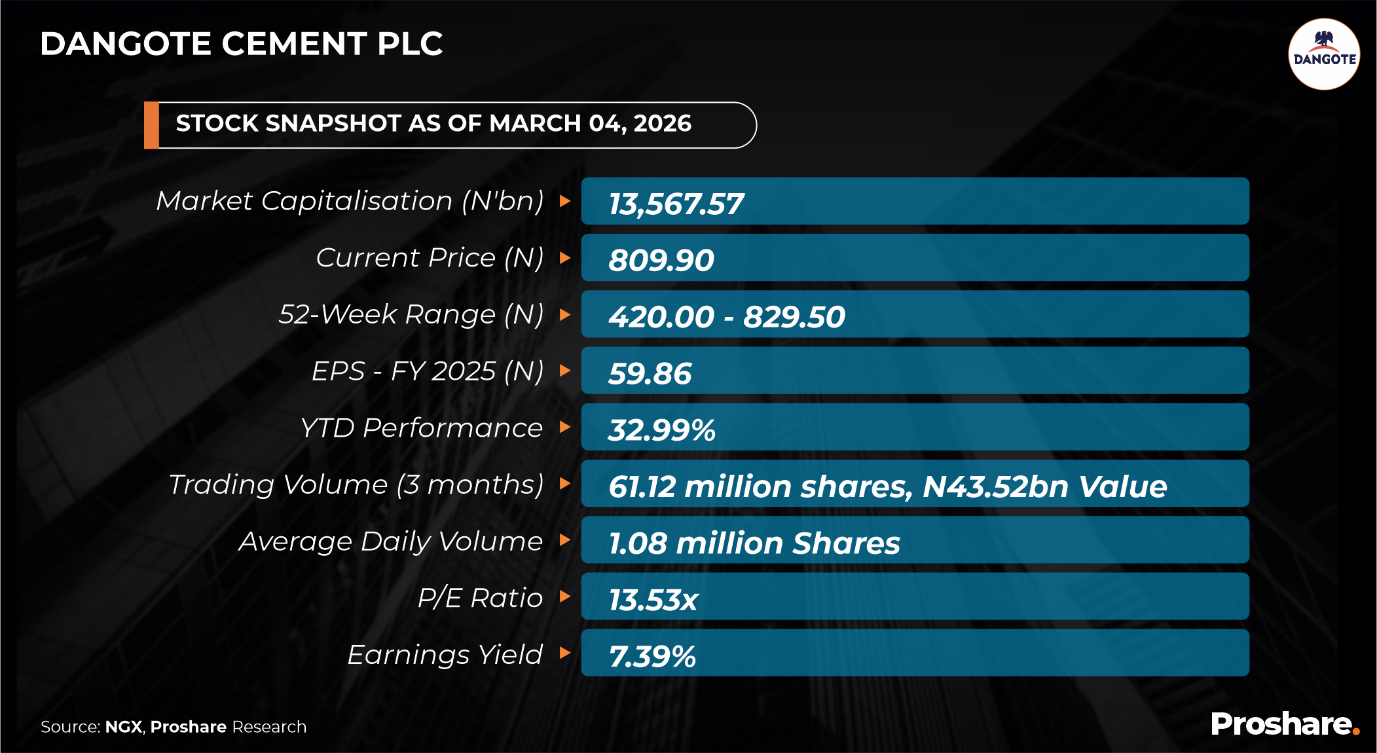
- Market capitalisation stood at N13.57trn, positioning Dangote Cement as one of the most capitalized companies on the NGX.
- The YTD performance of Dangote Cement stood at +32.99%, reflecting positive price momentum in early 2026, suggesting renewed accumulation after the November 2025 low.
- As of March 04, 2026, Dangote Cement Plc traded at N809.90/share, close to the upper bound of its 52-week range of N420.00 to N829.50. This indicates solid market demand for Dangote Cement stock over the past year.
- Trading activity remained robust, with average daily volume of c.1.08 million shares and total three-month turnover of 61.12 million shares valued at N43.52bn.
- This highlights deep market participation, as the stock maintains active institutional participation.
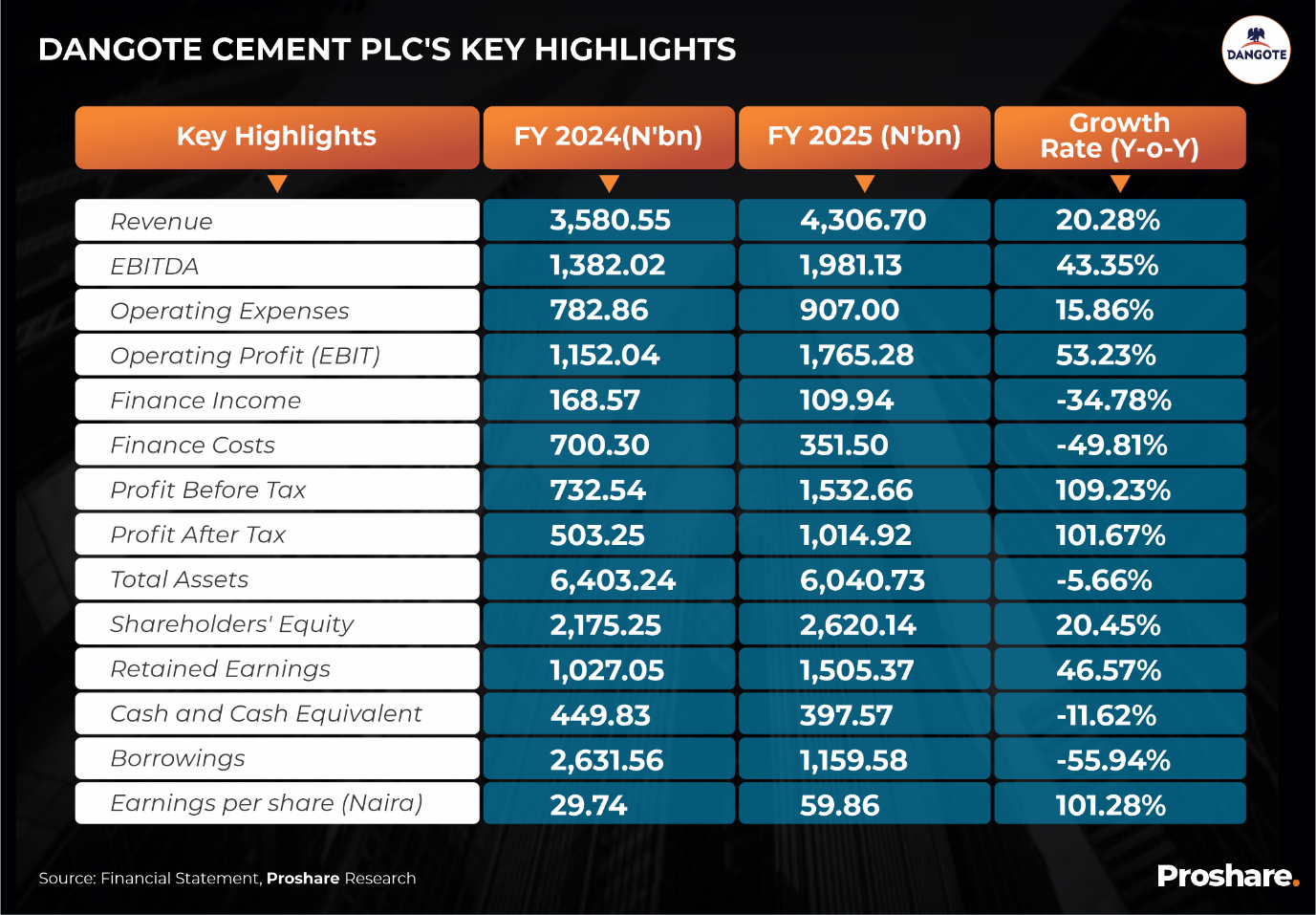
- With a price-to-earnings ratio of 13.53x and an earnings yield of 7.39%, the stock suggests investors are willing to pay a moderate premium for the company’s earnings (see table 1 below).
Table 1:
Key Highlights in FY 2025
- Dangote Cement revenue grew by +20.28% to N4.32trn in FY 2025 from N3.58trn in FY 2024.
- EBITDA grew by +43.35% from N1.38trn in FY 2024 to N1.98trn in FY 2025.
- Operating profit (EBIT) increased by +53.23% from N1.15trn in FY 2024 to N1.77trn in FY 2025.
- Finance income dipped by -34.78% to N109.94bn in FY 2025 from N168.57bn in FY 2024, and finance costs declined by -49.81% from N700.30bn in FY 2024 to N351.50bn in FY 2025.
- Profit before tax (PBT) increased by +109.23% to N1.53trn in FY 2025 from N732.54bn in FY 2024.
- Profit after tax (PAT) rose by +101.67% from N503.25bn in FY 2024 to N1.01trn in FY 2025.
- Total assets dipped by -5.66% from N6.40trn in FY 2024 to N6.04trn in FY 2025.
- Shareholders’ equity rose by +20.45% to N2.62trn in FY 2025 from N2.18trn in FY 2024, reflecting a +46.57% year-on-year growth in retained earnings.
- Cash and cash equivalents decreased by -11.62% from N449.83bn in FY 2024 to N397.57bn in FY 2025.
- Earnings per share (EPS) increased by +101.28% in FY 2025 to N59.86 from N29.74 in FY 2024 (see Table 2 below).
Table 2:
Financial Performance Review
- Revenue Performance and Operating Scale
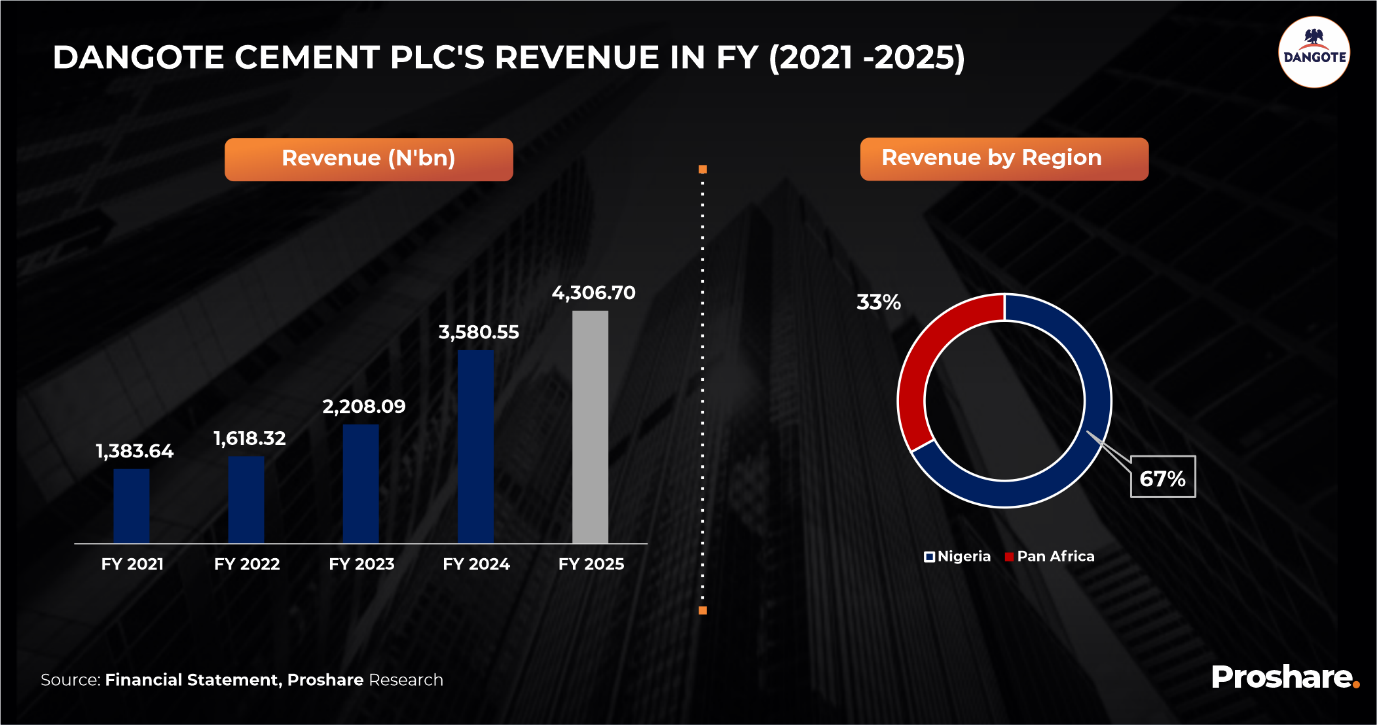
The cement producer recorded substantial revenue growth between FY 2021 and FY 2025, reflecting price adjustments despite a decline in sold volume from 27.71 million tonnes in FY 2024 to 27.47 million tonnes in FY 2025. Revenue increased from N1.38trn in FY 2021 to N4.31trn in FY 2025, representing an above threefold expansion over the five years. Growth accelerated in FY 2024, rising by +62.16%, followed by a +20.28% increase in FY 2025. This growth in revenue is driven by:
- Increase in sales of cement and clinker by +20.27% from N3.58trn in FY 2024 to N4.31trn in FY 2025, contributing 99.99% to total revenue.
- Based on revenue generated by region, Nigeria accounted for 67% of the revenue generated (from N2.19trn in FY 2024 to N2.96trn in FY 2025), while the Pan-Africa regions contributed 33% of FY 2025 revenue (a drop from N1.48trn in FY 2024 to N1.46trn in FY 2025). We are unable to determine whether this is a genuine volume decline, a currency translation effect across the Pan-African portfolio, or both.
This trajectory reflects sustained pricing power despite a decline in sales volume and Nigeria’s inflationary environment (see Chart 1 below).
Chart 1:
- Profitability and Earnings Quality
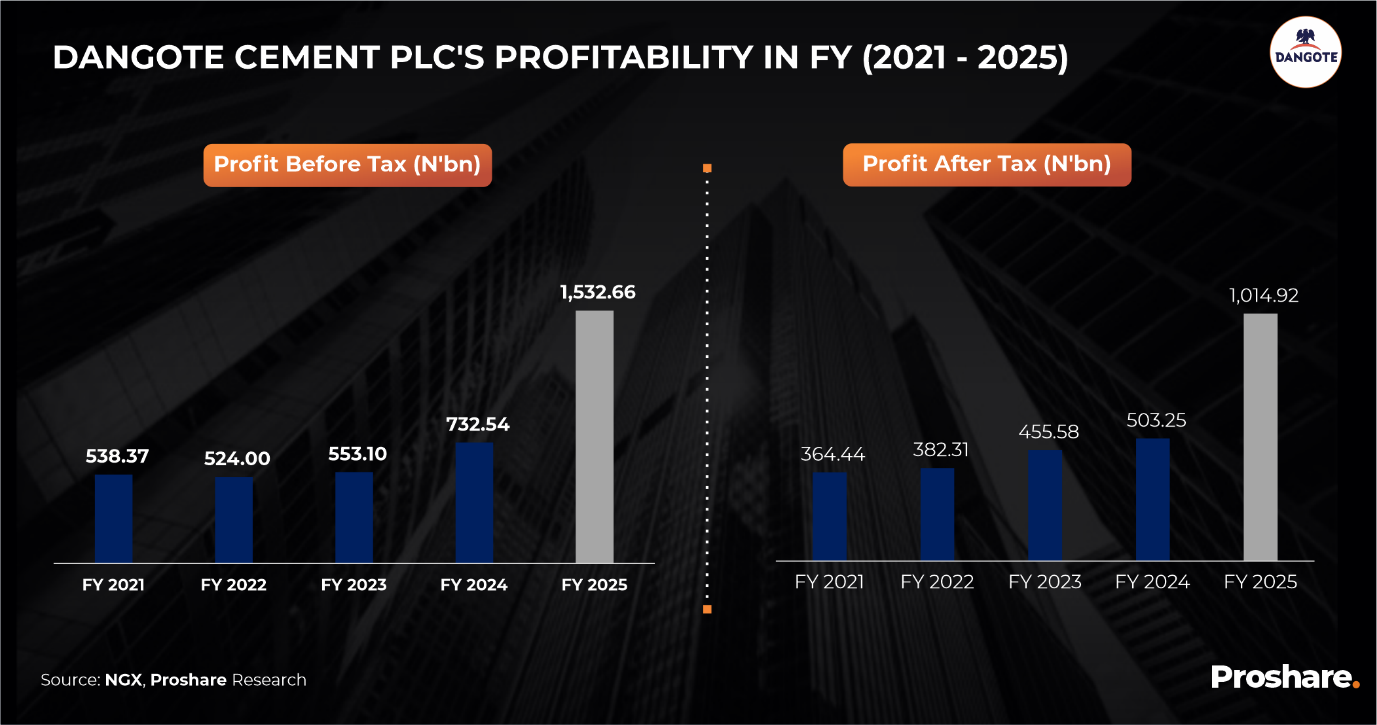
Profit before tax more than doubled, rising by +109.23% to N1.53trn in FY 2025 from N732.54bn in FY 2024, while profit after tax climbed by +101.67% to N1.01trn in FY 2025 from N503.25bn in FY 2024.
Key Earnings Drivers
- Operating expenses rose by +15.86% to N907bn in FY 2025 from N782.86bn in FY 2024.
- Finance income declined by -34.78% in FY 2025 to N109.94bn from N168.57bn in FY 2024.
- Finance costs declined by -49.81% to N351.50bn in FY 2025 from N700.30bn in FY 2024, driven by a -55.94% drop in borrowing.
The N348.8 billion reduction in finance costs (from N700.30 billion to N351.50 billion) is larger in absolute naira terms than the approximately N730 billion revenue increase, which contributes to the PBT improvement. This demonstrates that FY 2025’s profitability was as much a financial engineering achievement as an operational one. (see Chart 2 below).
Chart 2:
- Balance Sheet Growth and Capital Structure
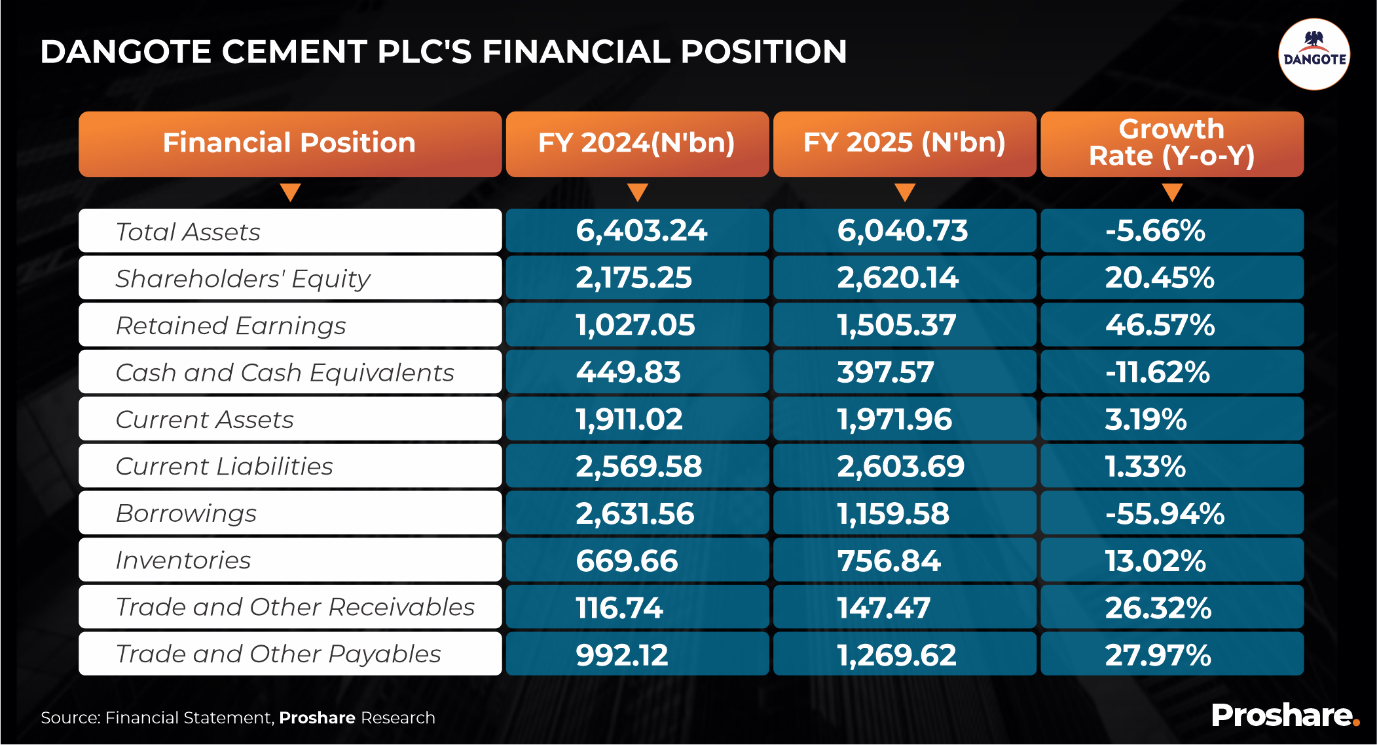
Dangote Cement’s FY 2025 balance sheet improved as borrowing dropped by -55.94% to N1.16trn from N2.63trn in FY 2024, indicating deleveraging and financial discipline. Shareholders’ equity grew by +20.45% to N2.62trn in FY 2025 from N2.18trn in FY 2024, supported by +46.57% increase in retained earnings. Although total assets declined by -5.66% to N6.04trn in FY 2025 from N6.40trn in FY 2024, this reflects debt reduction and asset optimisation (see Table 3 below).
Table 3:
- Ratio Dynamics and Cost Pressure
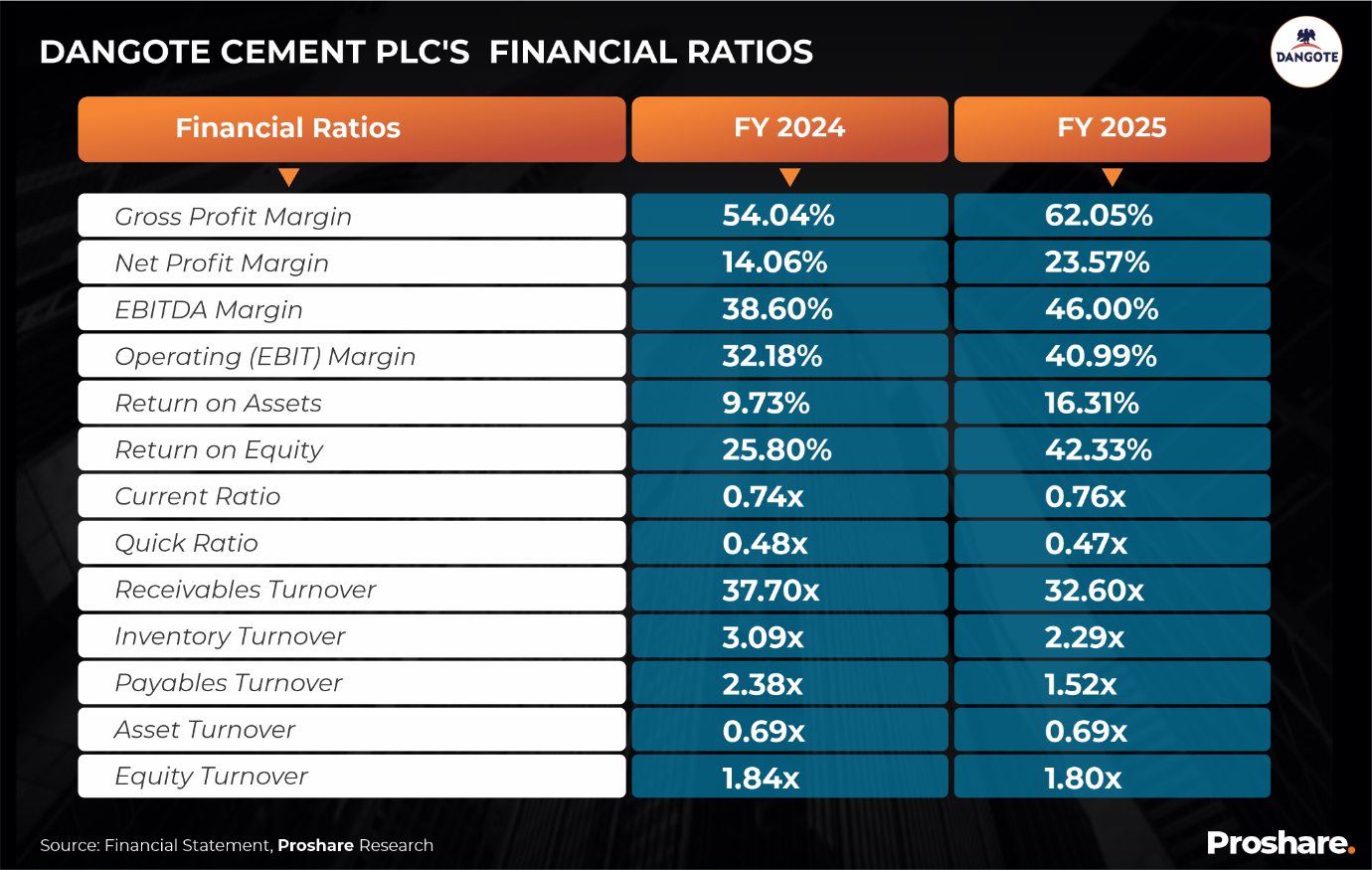
Dangote Cement experienced margin expansion across all profit layers in FY 2025.
- Gross margin improved from 54.04% in FY 2024 to 62.05% in FY 2025.
- EBITDA margin rose from 38.60% in FY 2024 to 46.00% in FY 2025.
- Net profit margin increased from 14.06% in FY 2024 to 23.57% in FY 2025, indicating improved cost efficiency and pricing power.
- Return on equity climbed to 42.33%, while return on assets rose to 16.31%.
- current ratio rose from 0.74x in FY 2024 to 0.76x in FY 2025.
- Quick ratio dipped to 0.47x in FY 2025 from 0.48x in FY 2024, attributable to a 13.02% rise in inventories.
These improvements rank Dangote Cement among the most profitable cement companies on the continent and highlight its cost leadership (see Table 4 below).
Table 4:
- Cash Flow Dynamics
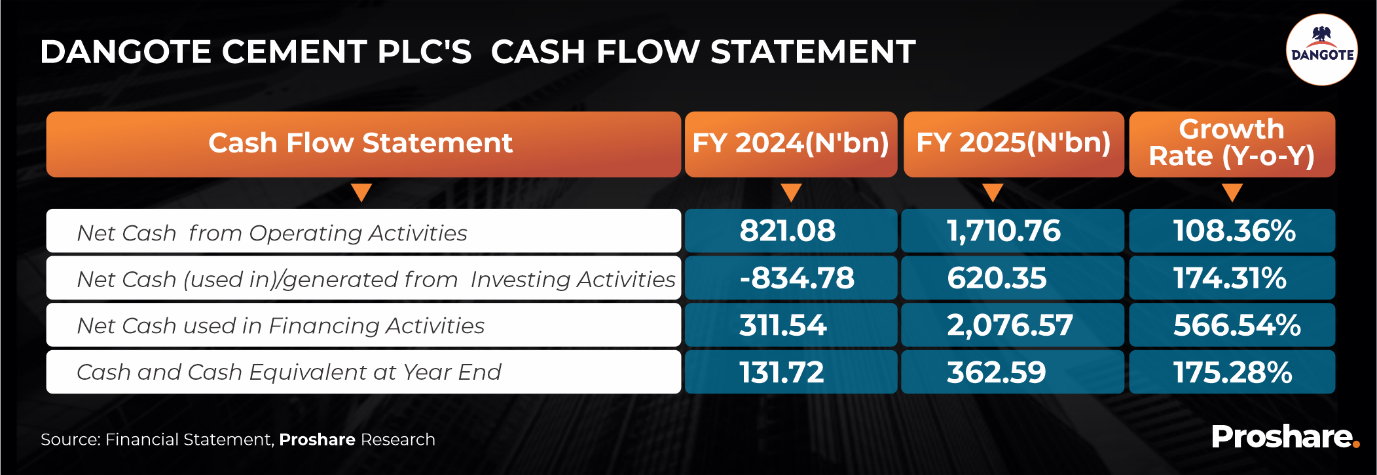
Dangote Cement’s cash flow dynamics in FY 2025 showed the following dynamics:
- Net operating cash flow increased by +108.36% to N1.71trn in FY 2025, suggesting improved working capital management and higher sales.
- Investing activities generated N620.35bn in FY 2025 from an outflow of N834.78bn in FY 2024, up by +174.31%.
- Net cash used in financing activities grew by +24.58% to N2.08trn in FY 2025 from N311,54bn in FY 2024, driven by +77.11% increase in debt repayment from N1.28trn in FY 2024 to N2.27trn in FY 2025.
- The cash and cash equivalents at year’s end posted N362.59bn in FY 2025 balance sheet, up by +175.28% from N131.72bn in FY 2024, strengthening liquidity.
Dangote Cement’s cash flow showed accelerating operating cash, rising debt service, and stronger liquidity (see Table 5 below).
Table 5:
- Valuation and Market Performance
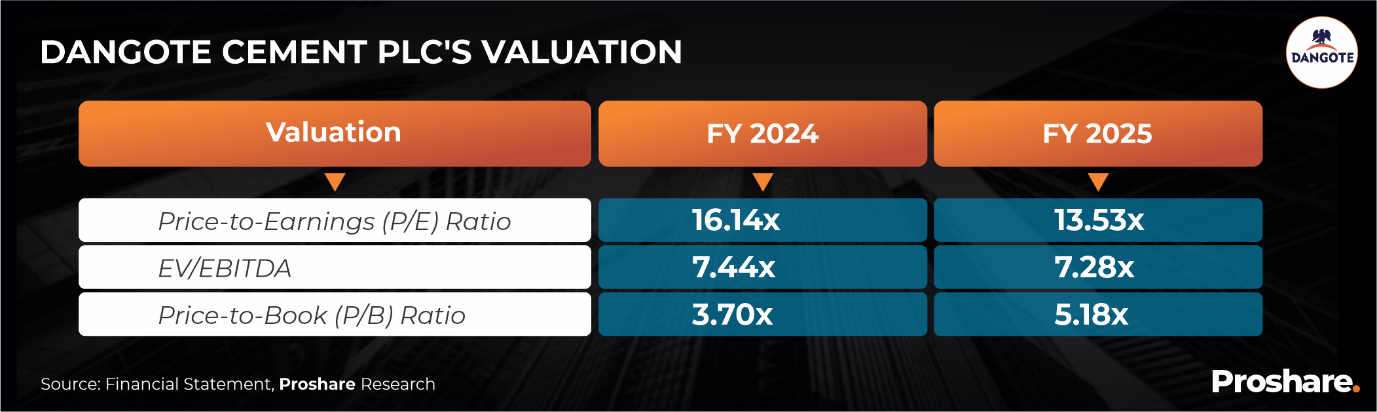
As of March 04, 2026, Dangote Cement’s stock price was N809.90, with FY 2025 EPS of N59.86, resulting in a P/E ratio of 13.53x, down from 16.14x in FY 2024, indicating that earnings growth has outpaced share price appreciation. Similarly, EV/EBITDA declined from 7.44x in FY 2024 to 7.24x in FY 2025. However, the P/B ratio increased from 3.70x in FY 2024 to 5.18x in FY 2025, reflecting the market’s recognition of Dangote Cement’s improved profitability and capital efficiency (see Table 6 below).
Table 6:
Technical Analysis
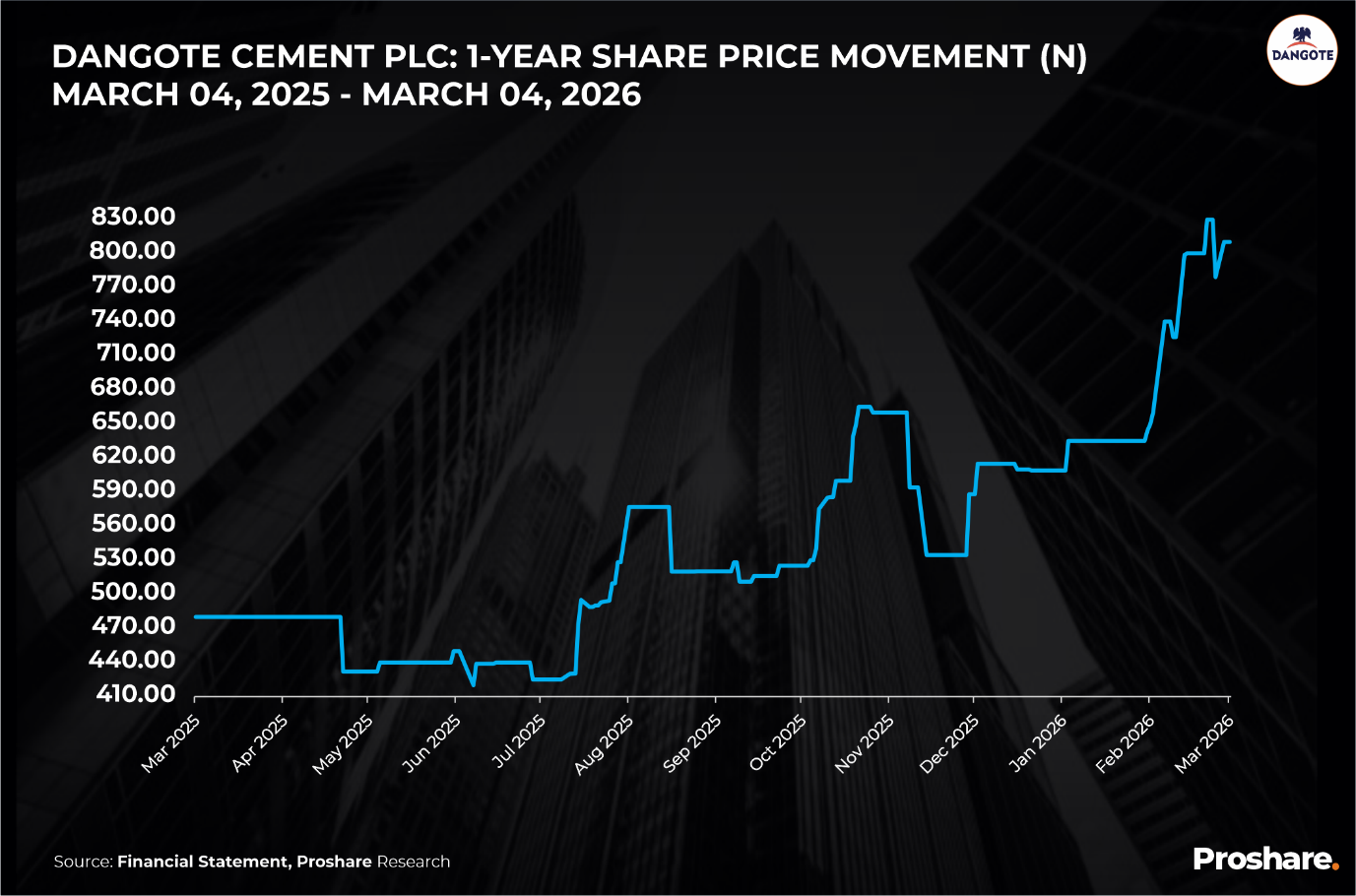
Dangote Cement’s share price has shown a robust upward movement over the past year. It slid to a 52-week low of N420.00 on June 10, 2025, and levelled off at a 52-week high of N829.50 on February 24, 2026. As of March 04, 2026, the share price was N809.90, reflecting a year-to-date (YTD) price return of 32.99%.
The cement maker’s upward price gains became evident in the second half of 2025, with the stock price rising from around N425.00 to over N800.00. The rise showed renewed investor confidence, driven by strong operating fundamentals and improved profitability. The stock broke through a major resistance level of N739.00 on February 10, 2026, suggesting bullish momentum. Technical support appears to be between N740.00 and N750.00, while the next significant resistance is expected between N830.00 and N850.00. Furthermore, trading volumes exceeded 61 million shares in the last three months, highlighting strong market participation and resilient investor interest. (see Chart 3 below).
Chart 3:
Dangote Cement Outpaces Peers on Scale and Cost Efficiency
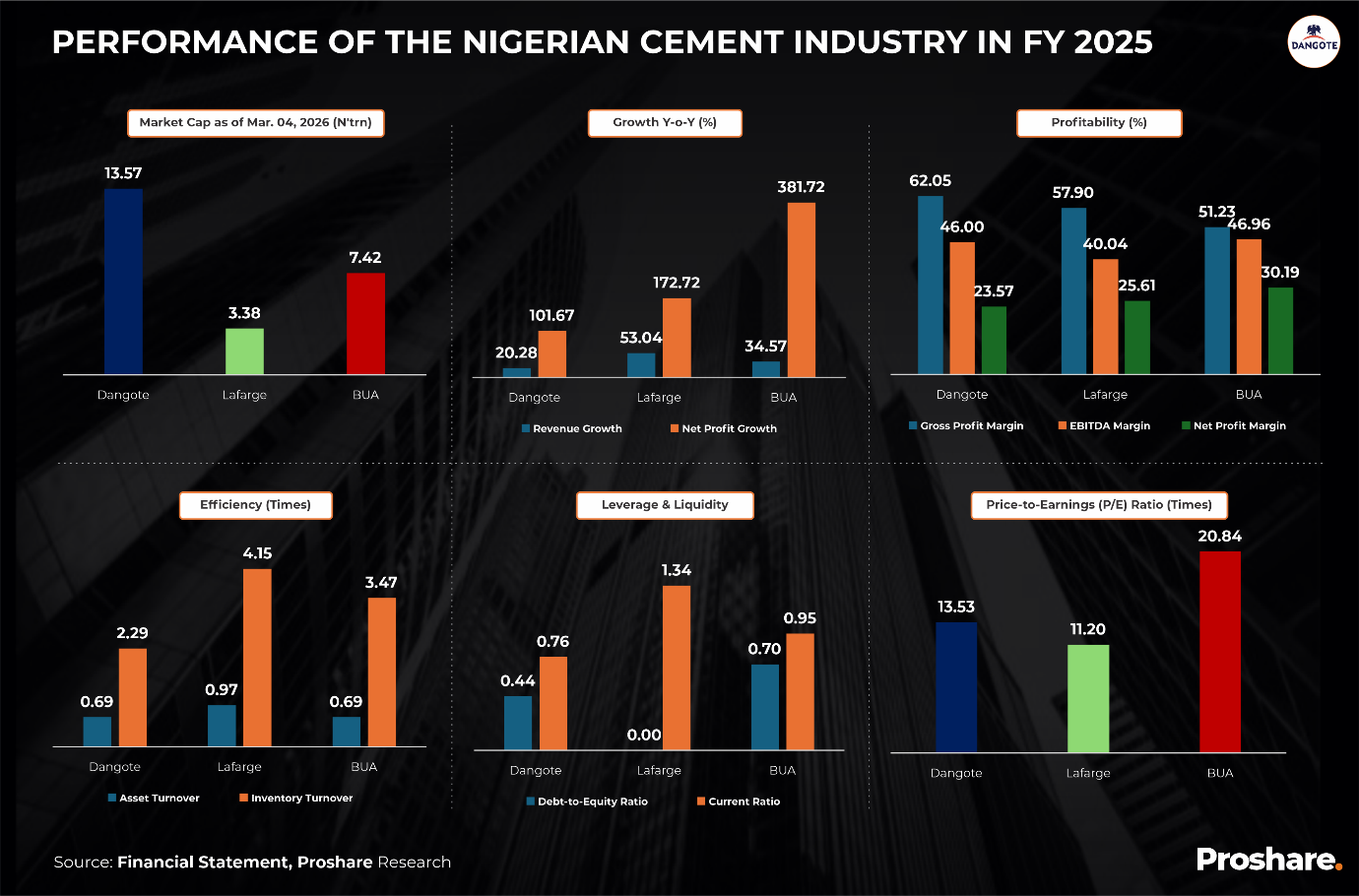
A peer review highlights Dangote Cement’s structural dominance within Nigeria’s cement industry. Dangote Cement led in gross profitability (62.05%) and maintained a strong EBITDA margin (46.0%), with a market capitalisation of N13.57trn, thereby exceeding its peers and reflecting investor confidence in its market leadership. Although Lafarge Africa and BUA Cement recorded stronger short-term growth and higher net profit margins, Dangote’s balanced leverage profile, cost leadership, and scale advantage position it as the most resilient and strategically dominant player in the sector, offering investors a combination of stable profitability and long-term market strength (see Illustration 1 below).
Illustration 1:
Opinion and Outlook
Dangote Cement’s FY 2025 performance reflects a structural strengthening of its financial and operational position. The cement producer’s ability to generate over N1.00trn in net profit highlights its dominant position within the African cement industry. This improvement in profitability is driven by operational efficiency, debt reduction, and pricing power.
Despite the improvement in Dangote Cement’s FY 2025 performance, risks include exposure to Nigerian macroeconomic volatility, fluctuations in energy and logistics costs, and currency risk across Pan-African markets, which affect both the revenue translation and the borrowing profile of subsidiary operations and deserve attention. Infrastructure demand cycles could also influence future cement consumption trends. Despite these risks, the company’s scale, integrated production model, and regional diversification provide strong defensive characteristics.
Analysts’ recommendation as of March 02, 2026, had Capital Bancorp upgrading DANGCEM from “Hold” to “Buy,” anticipating a downside of 27.31%, amid attractive earnings, improved leverage, and projected expansion.