
In Lagos, they are called trillion-naira banks. In Africa, they barely make the list.
Analysts ranking of Africa’s 20 largest banks by assets as of 30 June 2026 turns Nigeria’s balance sheet boom into a humbling conversion exercise. Standard Bank Group remains Africa’s largest at R3.81 trillion, equivalent to US$232.07bn. South Africa’s five largest groups together control US$721.21bn. Morocco’s three lenders control US$198.86bn. Nigeria, the continent’s most populous economy, places four lenders in the Top 20 but not one in the Top 10. Access Holdings leads at rank 12 with N53.44 trillion or US$38.84bn at 31 March 2026, then UBA at rank 18 with N33.13 trillion or US$24.08bn, Zenith Bank at rank 19 with N32.01 trillion or US$23.26bn, and First HoldCo at rank 20 with N30.65 trillion or US$22.27bn at 30 June 2026. Together they hold N149.23 trillion or US$108.45bn, just 46.73% of Standard Bank alone.
The ranking is built on group total assets converted with central bank exchange rates at 30 June 2026. Sixteen positions are backed by verifiable exchange or regulatory filings. Four North African state banks are included from secondary sources and remain unverified, National Bank of Egypt at rank 2 and Banque Misr at rank 6 from a regional ranking, Banque Nationale d’Algérie at rank 11 and Banque Extérieure d’Algérie at rank 13 from a press compilation. Their values are excluded from aggregates, which ironically makes Nigeria’s low ranking more credible than Egypt and Algeria where disclosure is opaque.
Verified scale shows where power sits. Standard Bank US$232.07bn, FirstRand US$167.17bn, Absa Group US$139.11bn, Nedbank Group US$98.13bn and Investec US$84.73bn lock the top. Morocco follows with Attijariwafa Bank US$87.84bn, Banque Centrale Populaire US$62.11bn and Bank of Africa US$48.91bn. Around Nigeria’s slots, Commercial International Bank Egypt at US$34.33bn, Ecobank Transnational at US$35.64bn, MCB Group Mauritius at US$27.19bn and Credit Populaire d’Algérie at US$25.47bn are all within one deal of overtaking the bottom three.
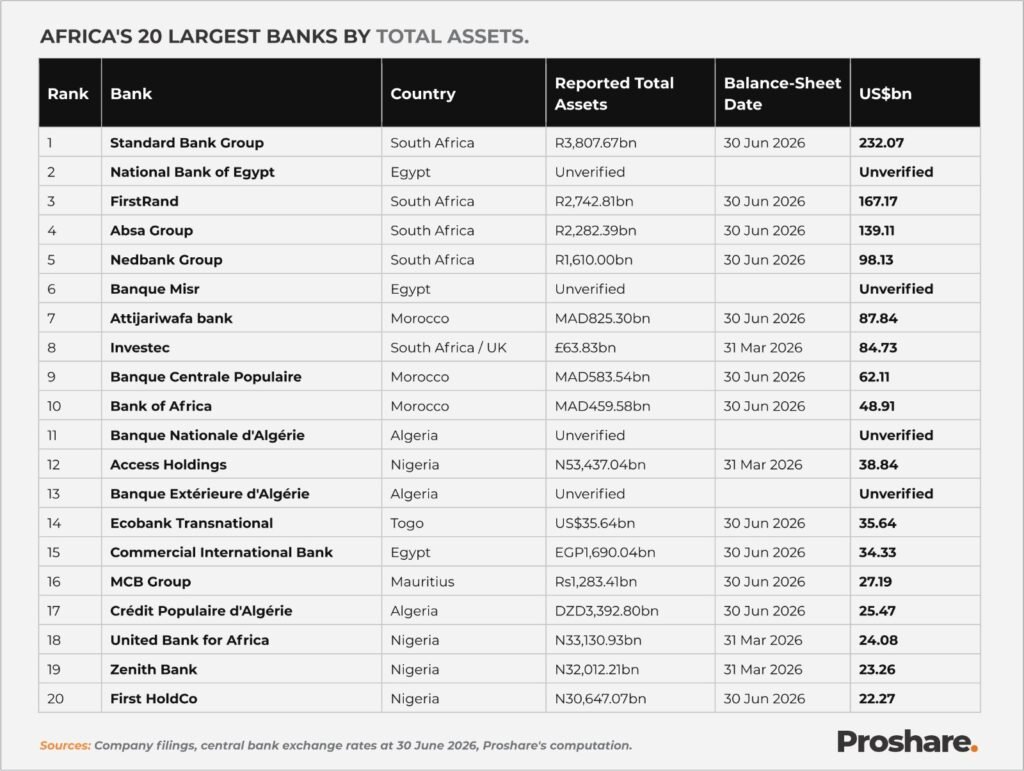
That bottom is razor thin. First HoldCo at US$22.27bn is the threshold for rank 20. QNB Egypt is US$0.35bn below at US$21.92bn. GTCO reported N18.62 trillion at 30 June 2026 or US$13.53bn, N12.03 trillion short of making the table. Analysts computation also shows currency alone moves Nigeria’s global weight, the same N149.23 trillion was US$104.43bn at N1,429.00 per dollar in December 2025, US$4.02bn less than US$108.45bn at June 2026 rates. In six months Nigerian banks gained US$4bn in global rank without adding a naira of assets. Access, UBA and Zenith are still ranked on Q1 2026 accounts while First HoldCo and GTCO are on Q2, so half-year filings will reshuffle the bottom.
This is the strategic trap. Nigerian banks expanded 20 times in naira since 2014 but barely doubled in dollars because naira moved from N160 to N1,376 for conversion, while South African and Moroccan peers preserved dollar scale. The result is a set of lenders that are systemically huge locally, funded locally, resilient to global wholesale shocks, but too small in dollars to lead syndication for refinery, power, telecoms and AfCFTA trade that is priced in dollars. Recapitalization to N500bn strengthens naira capital, it does not create dollar scale. Until naira stabilizes below N1,000 or consolidation creates a US$70bn plus champion, Nigeria’s biggest banks will stay what this ranking says they are, giants at home, lilliputians in Africa, four names clinging to the bottom of the Top 20, together less than half of one South African bank.