ETI Q1 2026: N48.83trn in Assets, N1.92trn in Market Capitalisation, and the Valuation Discount That Remains


ETI’s Q1 2026 results revisit a question that institutional investors have circled around for the better part of a decade, and the evidence this quarter sits firmly on the structural side of the cyclical-versus-structural divide. Pre-provision profit grew by 17.76% in constant-currency terms, the cost-to-income ratio compressed by 260bps to 49.02%, net interest income rose by 19.73%, and the CASA deposit mix at 88.27% has driven funding costs down to 2.35%, a margin endowment few peers can replicate at ETI’s scale. Digital transaction values rose by 54% to N35.70trn, payment revenues grew by 18%, and the primary customer base expanded by 13% in a single quarter, evidence that the pan-African platform is monetising as designed.
Set against this is a credit cost line that rose by 56.80% year-on-year to N179.24bn, almost entirely a Nigerian story shaped by post-CBN forbearance reclassifications and a centralised ECL reserve build of N900.72bn. The result is the familiar ETI tension.
A balance sheet of N48.83trn, the largest among Nigerian-listed peers, capitalised at just N1.92trn, with a price-to-book of 0.41x and an annualised price-to-earnings of approximately 2.2x in naira terms. Analyst posture has split accordingly. Lead Capital and Apel have upgraded to Buy, Capital Bancorp and PAC Research have stepped back to Hold, and Futureview has issued a Sell, a spread that captures both the 232% trough-to-peak re-rating since May 2025 and the unresolved Nigerian NPL position.
The investor task is therefore narrower than the headline volatility suggests. It is to judge whether credit costs normalise toward the 2.5% to 3.0% range that management has implicitly underwritten for H2 2026, and whether a structural earnings engine, now visibly leaner, is finally permitted to translate into the multiple expansion that book value, scale, and franchise depth would ordinarily command.
Q1 2026 Results Overview
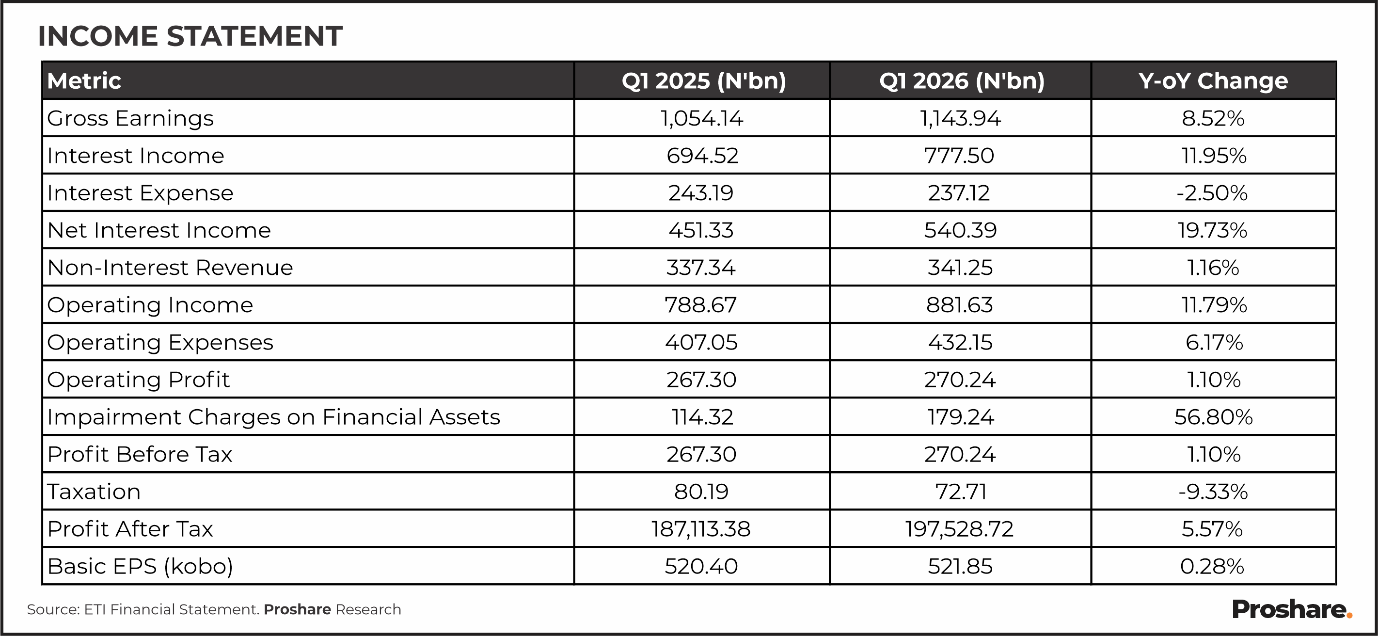
Ecobank Transnational Incorporated (ETI) delivered a strong first quarter for FY 2026. In naira terms, gross earnings reached N1.14trn (+8.52% Y-o-Y), operating income increased to N881.63bn (+11.79% Y-o-Y), and profit before tax rose to N270.24bn (+1.10% Y-o-Y). The PBT growth of +1.10% year-on-year appears modest relative to the +11.45% reported in USD. This divergence is principally a reflection of the Naira’s depreciation base effect in Q1 2025; the Naira was weaker vs the USD, inflating the USD-denominated Q1 2025 base. In constant-currency NGN terms, the group’s pre-provision profit grew 17.76%, the cost-to-income ratio improved to 49.02% (from 51.61%), and net interest income rose 19.73% as the CASA deposit strategy, with CASA deposits now at 88.27% of total customer deposits, compressed average funding costs by 47bps to 2.35%.
Material downside risks remain centred on Nigeria, where the NPL ratio has risen to 9.49% following post-CBN forbearance reclassifications, and impairment charges surged to N179.24bn (+56.80% Y-o-Y). The group has responded proactively, building a N900.72bn centralised ECL reserve. CESA (the group’s best-performing region) generated N175.43bn in PBT at a 33.80% ROE. At an estimated P/B of 0.41x and P/E of approximately 2.2x (annualised Q1 2026-naira earnings), the stock is deeply undervalued relative to its earnings capacity and pan-African franchise value.
Financial Performance Overview
The following table presents a comprehensive summary of Ecobank Transnational Incorporated Plc’s key financial metrics for Q1 2026 (see Table 1 below).
Table 1:
Revenue Quality
Net interest income of N540.39bn (+19.73% Y-o-Y in NGN) constituted 61.29% of total operating income, up from 57.23% in Q1 2025. Non-interest revenue of N341.25bn grew by 1.16% Y-o-Y, with net fee and commission income of N212.60bn partly offset by a decline in trading and FX income due to UEMOA regulatory FX constraints. Payment revenues grew by 18% to an equivalent of N108.34bn (US$78m at N1,389/US$ rate), and digital transaction values surged by 54% to approximately N35.70trn.
Cost Dynamics
Operating expenses of N432.15bn grew by 6.17% Y-o-Y, below the operating income growth rate of 11.79%, generating positive operating leverage for the third consecutive quarter. Staff costs of N183.80bn and other operating expenses of N221.58bn were the primary drivers.
Credit Costs
Impairment charges of N179.24bn rose by 56.80% Y-o-Y, driven by N241.28bn gross charges on loans, partially offset by N86.41bn in recoveries. This represents the primary drag on PBT growth, which was limited to +1.10% despite a 17.78% rise in pre-provision profit.
Segmental Performance Analysis
Regional Performance
Ecobank’s Q1 2026 performance was driven mainly by Anglophone West Africa (AWA) and CESA, with strong revenue growth (+12.79% and +15.90% Y-o-Y) and PBT increases, highlighting their role as key profit generators with high efficiency (CIR: 36.52% and 42.57%) and returns (ROE: 29.10% and 33.80%). Nigeria saw the fastest revenue rise (+32.22%) but a PBT decline (-9.32%), indicating margin pressure and weak profitability (ROE: 3.70%, CIR: 55.99%). UEMOA, though a major contributor, saw revenue (-3.10%) and PBT (-15.81%) fall, signalling softness in Francophone markets. The group’s performance was resilient (revenue +11.79%, PBT +1.10%), but gross earnings growth lagged operating revenue, suggesting rising costs and uneven regional profitability (see Table 2 below).
Table 2:

Business Line Performance
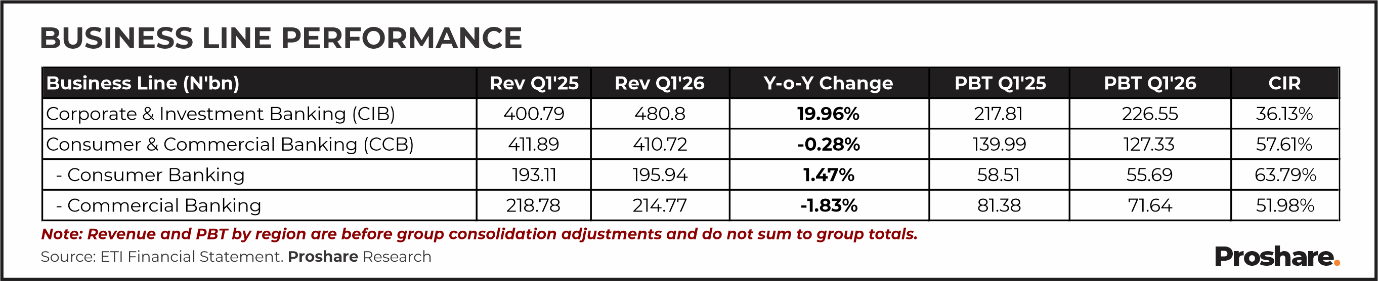
Ecobank’s Q1 2026 performance showed a clear split: Corporate & Investment Banking (CIB) led growth, with revenue up by 19.96% Y-o-Y and PBT up by 4.01%, maintaining a CIR of 36.13%. In contrast, revenue from Consumer & Commercial Banking (CCB) declined by 0.28%, and PBT dipped by 9.04%, with a CIR of 57.61%. Within CCB, Consumer Banking was resilient but inefficient (CIR: 63.79%), while Commercial Banking declined in revenue and PBT, indicating softer activity and margin compression. Reliance on CIB increases as the retail and commercial segments underperform in terms of growth and efficiency (see Table 3 below).
Table 3:
Balance Sheet and Asset Quality Review
Deposit Franchise
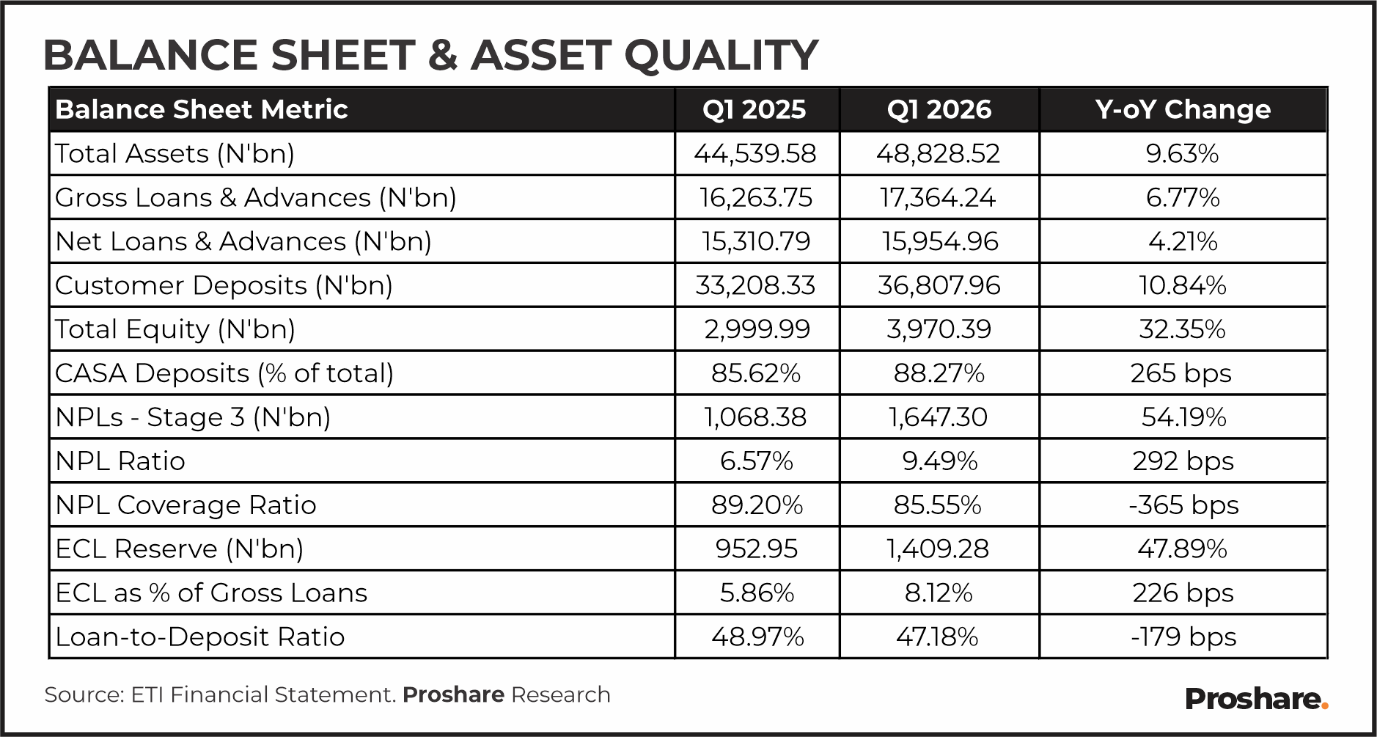
Customer deposits reached N36.81trn in Q1 2026, a 10.84% year-on-year growth from Q1 2025. Current accounts of N26.15trn and savings deposits of N6.34trn (represent 88.27% of total deposits) support the cost of funding reduction to 2.26%.
Asset Quality
The group NPL ratio of 9.49% is concentrated in Nigeria (43.70%). The ECL reserve increased to N1.41trn, equivalent to 8.12% of gross loans. The group holds an N901bn centralised ECL buffer (the naira equivalent of the US$649m figure at the closing rate of N1,389/US$) as a specific reserve against emerging portfolio risks (see Table 4 below).
Table 4:
Efficiency and profitability Metrics
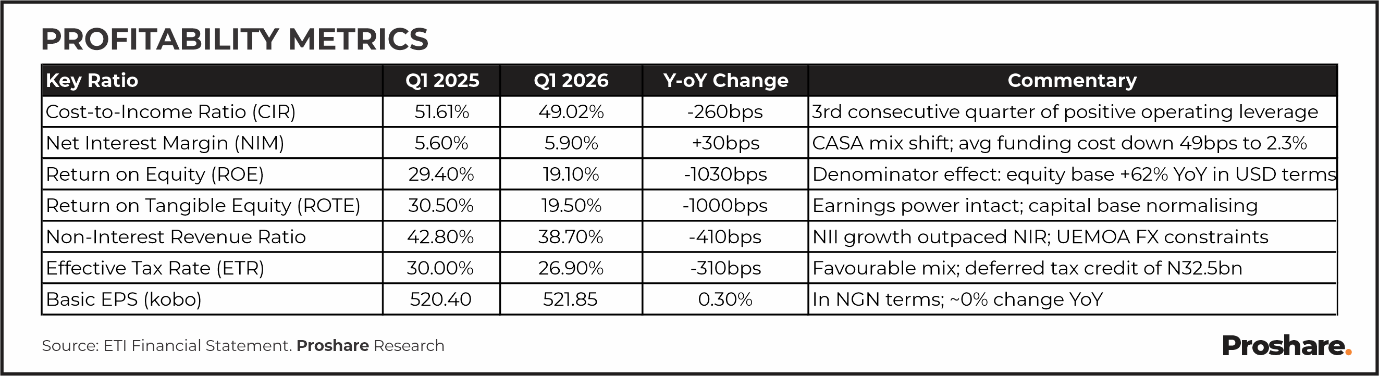
Ecobank’s Q1 2026 profitability profile shows improved operating efficiency but lower returns. The cost-to-income ratio decreased to 49.02% (-260bps), indicating sustained operating leverage, while the net interest margin rose to 5.90% (+30bps) due to a stronger CASA mix and reduced funding costs. Nonetheless, headline returns declined, with ROE and ROTE falling to 19.10% and 19.50%, mainly due to a 62% YoY increase in equity rather than weaker core earnings. The revenue mix shifted toward interest income, as non-interest revenue decreased to 38.70% (-410bps), driven by robust NII growth and FX constraints in UEMOA. Effective tax rate dropped to 26.90% due to favourable tax adjustments, while EPS remained largely unchanged, reflecting stable earnings despite balance sheet expansion (see Table 5 below).
Table 5:
Share Price Performance and Market Sentiment
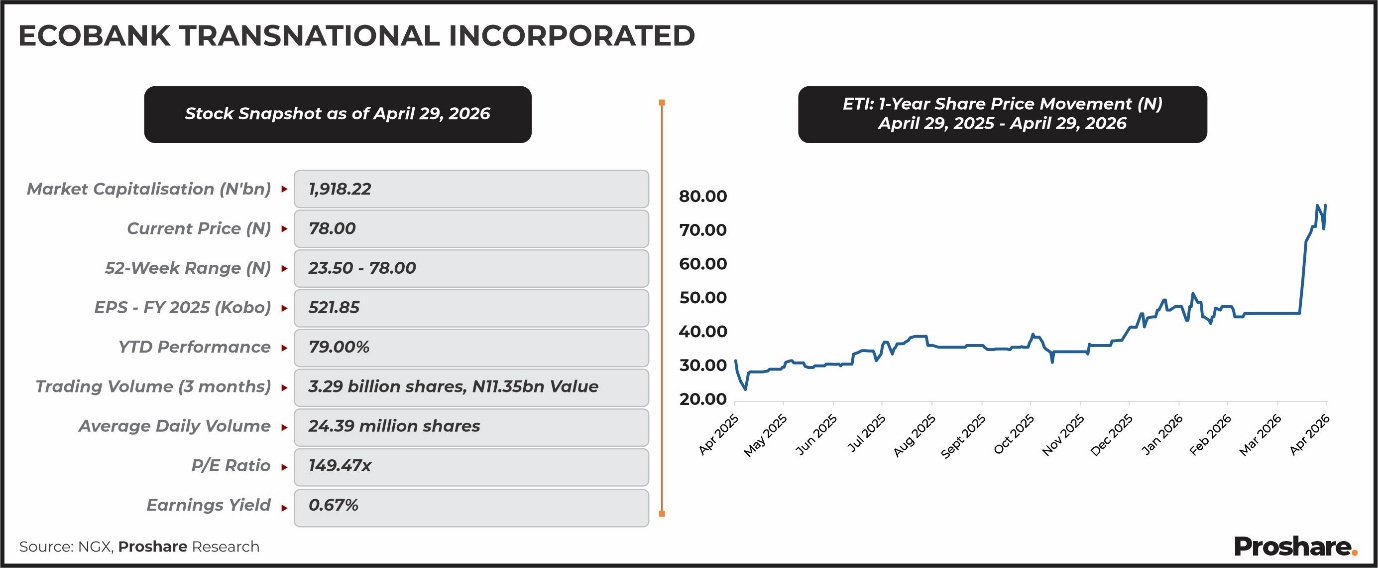
ETI’s share price delivered a strong re-rating from N23.50 (May 5, 2025, low) to N78.00 (April 24, 2026, high), representing a capital appreciation of 232% from trough levels and a YTD 2026 return of 79% (from N41.90 at year-end 2025 to N78.00 as of April 29, 2026). The stock has emerged as one of the better-performing banking names on the NGX, supported by improving investor sentiment and earnings momentum.
The price trajectory reflects an initial correction in early May 2025, followed by an extended consolidation phase within the N30-N36 band for most of mid-2025. Momentum began to build towards year-end, with a decisive breakout above N40 in December 2025, and accelerated further in Q1 2026, with the stock rallying from N45.90 in early January to N78.00 by late April. The recent peak at N78.00 (on April 29, 2026) marked a key resistance level, with trading activity characterised by notable volume increases during major price advances, indicating strong institutional participation. The implied trading range of N23.50-N78.00 over the period underscores the re-rating and shift in market positioning (see Table 6 below).
Table 6:
Strategic Developments and Outlook
Digital Banking Acceleration
Digital transaction values rose by 54% to an equivalent of N35.70trn (US$25.70bn at a rate of N1,389/US$) during Q1 2026, driven by an 18% increase in wholesale payment disbursements, a 64% rise in merchant solutions fees, and 5% growth in new card issuances. The primary customer base grew by 13% year-on-year.
Pan-African Franchise Depth
ETI operates across 39 countries, employing 14,108 people in 660 branches and offices, the widest footprint of any pan-African bank. This geographic diversity generates N881.63bn in quarterly operating income, with diversification benefits that are structurally resilient to single-country shocks (Nigeria, for example, contributed 7.91% of the group’s operating income in Q1 2026).
FY 2026 Outlook
In Naira terms, FY 2026 revenue is projected in the range of N3.4trn–N3.6trn and PBT in the range of N1.05trn–N1.13trn (annualised Q1 2026 rate: N1.08tn), subject to Naira stability, credit cost trajectory, and the pace of Nigeria’s NPL resolution. NIM is expected to expand further by 15–25bps. The primary upside catalyst remains a normalisation of credit costs from 3.54% toward 2.5–3.0% cost of risk in H2 2026.
Peer Comparison in Q1 2026
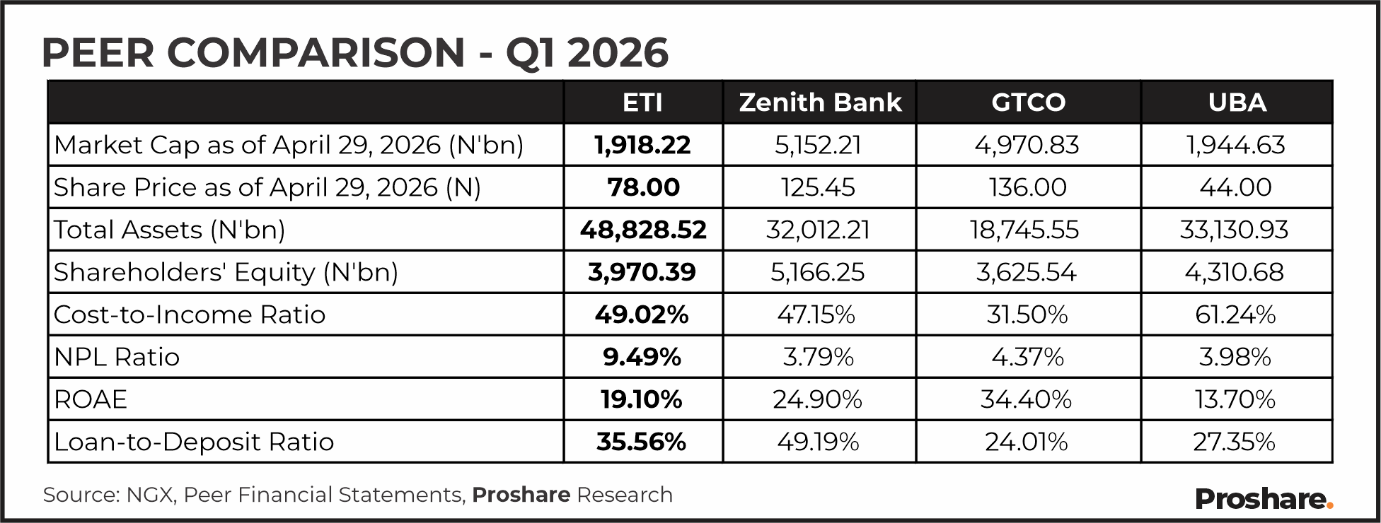
Ecobank Transnational Incorporated (ETI) compares favourably among peers, driven by its unmatched scale and rising profitability, making it a strong pan-African player. With N48.83trn in assets, larger than those of Zenith, UBA, and GTCO, ETI has the largest balance sheet but trades at a modest N1.92trn market cap, similar to UBA despite its larger assets, suggesting a valuation discount and re-rating potential.
Its cost-to-income ratio (49.02%) is slightly above Zenith’s and higher than GTCO’s, indicating ongoing efficiency gains, but remains below UBA’s, showing improving cost discipline.
ROAE of 19.10% exceeds UBA and nears Tier-1 levels, reflecting resilient earnings despite recent equity expansion. Its conservative loan-to-deposit ratio (35.56%) offers flexibility and liquidity for growth. While asset quality (NPL: 9.49%) is higher due to broader exposure, diversification benefits and earnings resilience offset this.
Overall, ETI is a scale-driven, undervalued franchise with improving efficiency and strong upside potential (see Table 7 below).
Table 7:
Valuation Analysis
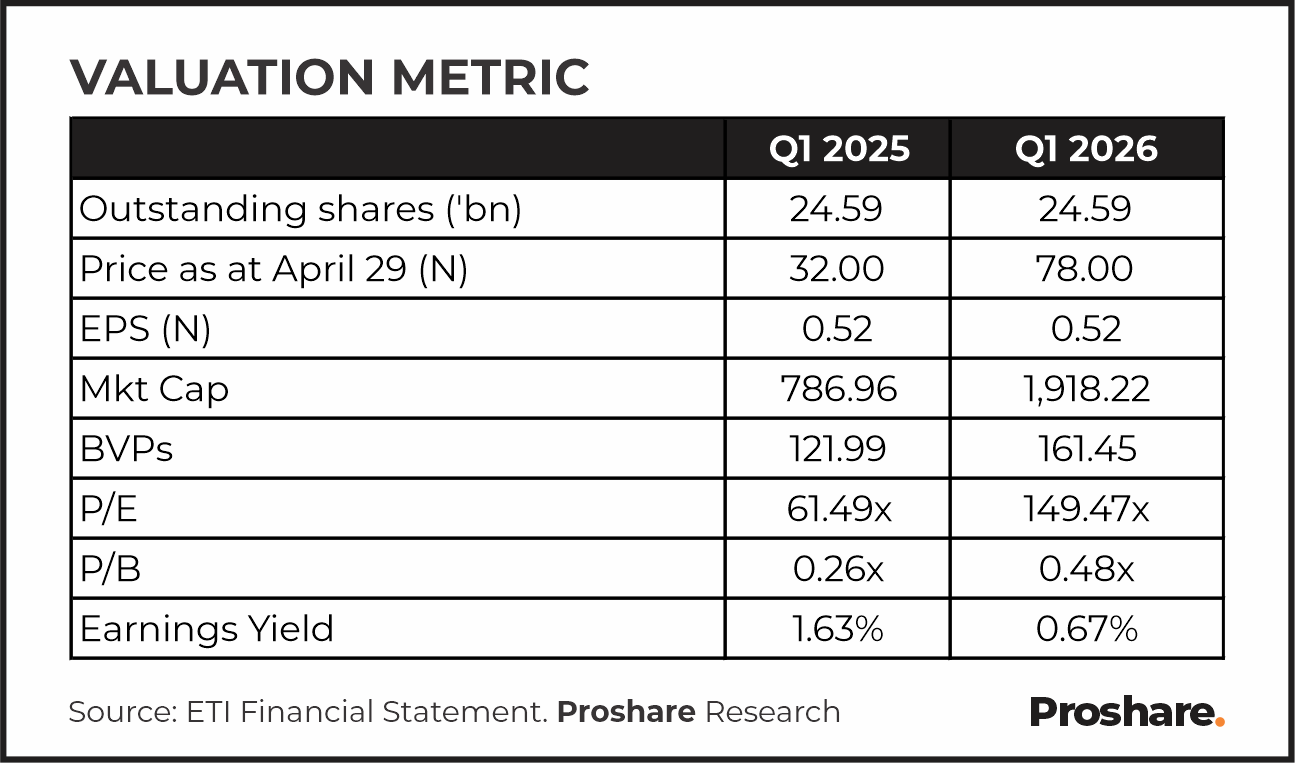
ETI’s Q1 2026 valuation shows a market-driven re-rating, with multiples rising despite stable EPS at N0.52 and a share price of N78.00. The P/E ratio increased to 149.47x from 61.49x, while the earnings yield decreased to 0.67%. This suggests the rally is mainly sentiment-driven rather than earnings-driven. On the balance sheet, ETI appears undervalued, with a P/B of 0.48x and a book value per share of N161.45, indicating that the market has yet to fully recognise its true value and scale. Its market cap of N1.92trn reflects growing investor confidence, but the gap between earnings and the share price suggests that sustained earnings growth and stronger returns will be essential to justify the high multiples going forward (see Table 8 below).
Table 8:
Analyst’s Position
ETI’s Q1 2026 results highlight the robust fundamentals of its pan-African network. Gross earnings reached N1.14trn, an 8.52% increase year-over-year, with an improved cost-to-income ratio at 49.02% and net interest income up by 19.73%. This growth was supported by an 88.27% CASA deposit mix, which reduced funding costs by 47bps to 2.35%, indicating stronger earnings quality. CESA’s 33.80% ROE and CIB’s 19.96% revenue growth demonstrate the group’s ability to deliver strong returns beyond its most challenging markets. Additionally, a 54% increase in digital transaction value to N35.70trn, along with a 13% growth in the primary customer base, suggests the platform’s long-term monetisation prospects remain promising.
The principal near-term overhang is Nigeria, where the NPL ratio has climbed to 9.49% following CBN forbearance reclassifications, and impairment charges rose by 56.80% Y-o-Y to N179.24bn (the single biggest drag on PBT growth). However, management’s proactive build-up of an N900.72bn centralised ECL reserve provides a credible buffer, and a normalisation of credit costs from 3.54% to 2.5–3.0% in H2 2026 remains the key re-rating catalyst.
At current prices, ETI offers a compelling entry point in the Pan-African banking space. It is a structurally advantaged franchise trading at a meaningful discount to intrinsic value, one suited to investors with the appropriate risk appetite and a medium-to-long-term investment horizon.
Analyst sentiment on ETI is mixed. Lead Capital and Apel both upgraded their coverage from Hold to Buy, citing a projected upside of 11.97%. Taking a more cautious stance, Capital Bancorp and PAC Research each downgraded ETI from Buy to Hold, citing an expected return of 2.64% and signalling that earlier bullish momentum may have peaked. Futureview, meanwhile, issued a Sell recommendation on the stock.
ADAPTED FROM THE PROSHARE