Elumelu, Wigwe: Their stupendous wealth, many controversies

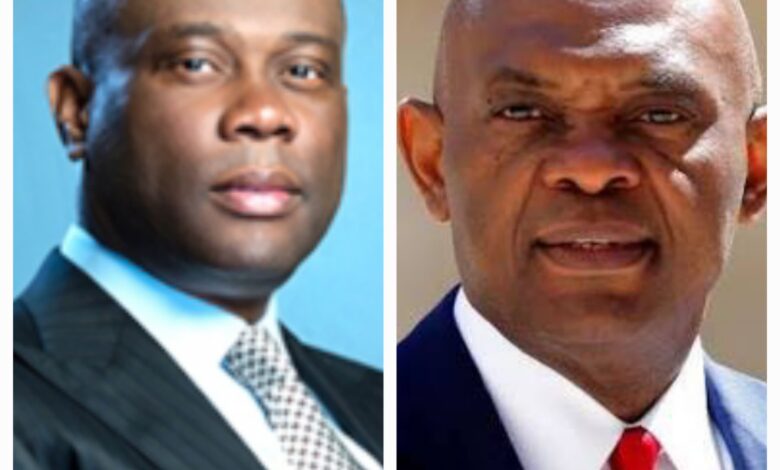
They arrived on the Nigerian financial stage not with a whimper but a bang. They dress like men who have outrun gravity. They did not merely rise—they arrived, with the velocity of men who understood that in Nigeria, timing can be as valuable as talent. And they made use of both.
The first, Tony Elumelu, moves like a man who understands both the poetry and the power of capital—measured, polished, always leaning slightly into the future. There is a deliberate calm about him, the kind that suggests strategy is his second nature. Beside him, in memory and myth, stands Herbert Wigwe —restless, audacious, a dealmaker with the instincts of a streetwise visionary and the appetite of a global titan.
While Elumelu carries wealth the way old aristocrats wore power—quietly, confidently, almost as if it were inevitable. Tailored suits, measured speech, the polished ease of a man who has sat in too many boardrooms to be hurried, Wigwe, by contrast, was kinetic—sharp, ambitious, restless; a banker who moved like a deal was always about to happen.
Yet despite their dissimilarity, both lead actors on the Nigerian banking scene are two sides of the same coin. They share so many things in common that are just beyond surfaces appearances and go deeper into how they see business, what they achieved in the banking industry, how they made stupendous wealth, which they unavoidably flaunt and the many controversies which seemed to trail their business transactions.
And not only did they speak the language of finance, their stupendous wealth is represented by private jets. global portfolios, power dinners in Lagos, London, and beyond. Their lives read like glossy magazine spreads—success distilled into symbols. Together, they came to embody a certain idea: that African capital could be bold, global, and unapologetically powerful.
This is the story of Elumelu and Wigwe, two financial gladiators who did not only turn the banking industry around in different ways but also, like King Midas, turned everything their calculative hands touched into gold. And they gained both financial and social capital from their first into the banking business.
Together, they did more than build banks, they built narratives—of ambition, of disruption, of African possibility. And, inevitably, of controversy, for behind close doors and in hushed tones, people cast doubts on the success they recorded and their stupendous wealth .
However, to understand the scrutiny surrounding both men, one must first understand the system that produced them. Nigeria’s banking sector—particularly in the years surrounding the 2004–2005 consolidation led by the Central Bank of Nigeria—was less a marketplace than a high-speed sorting mechanism. Institutions collapsed, merged, or were quietly absorbed. Fortunes were lost. Others were made. In this crucible, Elumelu and Wigwe did not merely survive; they expanded.
Elumelu’s Standard Trust Bank emerged from the ruins of a distressed institution, before playing a decisive role in reshaping the United Bank for Africa into a continental giant. Wigwe, through Access Bank, executed one of the most aggressive expansion strategies in African banking, absorbing rivals and extending reach across borders. From a strictly analytical standpoint, their success reflects strategic clarity, risk appetite, and execution discipline .From a more sceptical perspective, it raises a harder question: Who, in such a system, gets to see the future before it arrives?

The Billionaire Playbook
In the ledger of African capitalism, Elumelu’s name is etched in bold. From the ashes of a struggling Crystal Bank, he engineered a financial phoenix—Standard Trust Bank—which would later fuse into the sprawling empire of the United Bank for Africa. Today, his influence stretches far beyond banking: power plants that hum with electricity, oil blocks that pulse with crude, and hospitality icons like Transcorp Hilton that shimmer in Abuja’s skyline.
Tony Elumelu is indeed a force to be reckoned with. He’s the founder of The Tony Elumelu Foundation, empowering over 24,000 young African entrepreneurs and creating a digital ecosystem of 2.5 million Africans. Through this, he’s funded thousands of entrepreneurs, promoting Africapitalism – the idea that private enterprise can drive Africa’s transformation. His philosophy emphasizes the private sector’s role in Africa’s growth. He’s been globally recognized, including Time’s 100 Most Influential People in 2020
“Through his visionary Africapitalism philosophy, Tony Elumelu has meticulously crafted a diversified portfolio that not only dominates Nigeria’s energy landscape but also exemplifies his commitment to creating long-term economic value; with strategic investments in oil production, gas-fired power plants, and luxury hospitality, Elumelu’s Heirs Holdings and Transcorp have emerged as behemoths in their respective domains, underpinned by savvy acquisitions such as the $1.1 billion stake in OML 17 and a $496 million stake in Seplat Energy PLC, propelling him to the forefront of Nigeria’s oil and gas sector while powering over 350MW of electricity and boasting a hotel empire that includes the iconic Transcorp Hilton Hotel in Abuja, a testament to Elumelu’s unwavering dedication to driving sustainable growth and transforming Africa’s economic landscape.”
Wigwe, on the other hand, was the kinetic force behind Access Bank. Where Elumelu strategized, Wigwe executed. Together with his partners, he transformed Access Bank from a modest institution into a continental powerhouse, stitching together acquisitions and expansions with almost surgical precision . Herbert Wigwe’s net worth is estimated to be around $1 billion, primarily amassed through his successful banking career, particularly his leadership role at Access Bank, which he co-founded in 2002. Under his guidance, Access Bank grew to become one of Nigeria’s largest financial institutions, with operations across Africa and beyond. He also had investments in tech, energy, and real estate, including luxury properties in London, contributing to his significant wealth .By the time of his tragic death, Wigwe’s wealth—spanning banking, real estate, and global investments—had grown into something both impressive and, to some, unsettlingly opaque.
Their Controversies
Great fortunes rarely travel quietly. In Nigeria, they roar. The scale of these men’s wealth—private jets, global assets, sprawling portfolios—has provoked both admiration and suspicion. To admirers, they are proof that African excellence can compete anywhere. To critics, they are symbols of a system where proximity to power can accelerate wealth at dizzying speed.
However, the wealth of these two financial gladiators has continued to spark intense debate. While some regard astonishingly rich profile as evidence of diligence and intelligence,others see it as a product of cunning or corrupt practices.
The Lamentation of Bode George
This controversy was largely dismissed as mere barroom chatter for years.However, Chief Bode George, an elder statesman and chieftain of the Peoples Democratic Party, PDP, recently stirred the hornet’s nest and raised some questions when the staggering wealth of Herbert Wigwe was revealed posthumously, following his tragic death in a plane crash in the US. Irked and dumfounded by the stupendous wealth of the former Managing Director of Access Holding, George bared his fangs on Elumelu and the likes in the banking sector with similar dumfounding wealth.
The debate sharpened when George publicly questioned the origins of such vast fortunes, alleging that the banking elite exploited policy loopholes and foreign exchange systems. His accusations—fiery, unfiltered—ignited a national conversation: are these fortunes purely earned, or partly engineered? No definitive legal findings have substantiated such claims. Yet, in the absence of closure, speculation thrives.
George ignited a firestorm, accusing the duo of accumulating billions through shady deals. He alleged they exploited dollar subsidies and played the forex market to their advantage, leaving Nigeria’s economy in a tail spin.
George slammed their lavish lifestyles – private jets, luxury properties, as he questioned the legitimacy of their wealth. He ripped into Wigwe’s “great banker” image, saying his rise was fueled by a rotten system. He also blasted Wigwe’s university, demanding answers, and pressed Elumelu on how he transformed from bank staffer into a billionaire UBA boss.
The allegations sparked a national conversation, with many backing George’s call for probe and transparency. The debate raised concerns about Nigeria’s banking sector and wealth disparity. While some defended the bankers, others cheered George’s push for accountability. The controversy left many wondering whether the elite will ever be held accountable.
George, while trying to drive home his points, raised some question concerning their ascendancy, as he thundered: “Who the hell is Elumelu? What did he do? Where is his factory?” He slammed Elumelu as a “flopped bank man” who somehow got a license alongside Fola Adeola, and both are now “stupidly wealthy”.
He also questioned the university Wigwe established, asking “Where is his factory?” George alleged their wealth stems from “round tripping” – exploiting dollar subsidies meant for commercial activities, selling at black market rates, and pocketing the profit.
George did not mince words. “They realigned dollars to them on monthly basis; they used the dollars. If it’s 1 to 100, they’ll give it to the Mallams say 1 to 200, you see that profit?” he said. He demanded accountability, insisting “the ruthlessness starts from that and it has been going on for years; it has now exploded now on our faces,” .he submitted.
How George May Be Justified
None of those who invested their hard earned earnings in UBA 2007 initial Public Offer and right issues under Elumelu leadership would forget in a hurry the huge misfortune that befell them . United Bank for Africa, Nigeria’s biggest bank then , created excitements in the capital market with the launch of its N54 billion hybrid offer. The bank’s Executive Director, Victor Osadolor, defended the offer price, citing the bank’s robust size, assets, and maintainable earnings, making the N35 and N34 share prices for public offer and rights issue, respectively, a good deal, especially considering the N37.99 premium in the secondary market. With plans to boost Nigeria’s economy and expand its banking services, UBA’s offer is poised to drive growth and cement its market presence
That offer remains a disastrous decision till today for those who bought the share at N34 per share . Since 2008 , the price of UBA’s stock per share failed to hit close to that peak for years until 2023 when this jinx was broken . The 2008 global financial crisis took a heavy toll on UBA’s share price, which plummeted to around ₦5 by November 2008. The bank’s share price continued to adjust downwards in the early 2010s, reflecting the lingering impact of the crash on Nigeria’s banking sector.UBA’s share price spent most of the 2011-2020 decade in consolidation mode, fluctuating between ₦2 and ₦10.UBA’s share price showed signs of life in 2021-2022, climbing steadily to close out 2022 at around N7.60. The ugly scenario above may be the reason why Bode George was annoyed with the likes of Elumelu in a well trended video
The controversy on Wigwe got heated up again when The Londoner, a British magazine, exposed him recently. An investigation by the magazine has linked Wigwe to 106 properties in London, one of the most expensive real estate markets on earth. Based on newly released data compiled by Tax Policy Associates’ Dan Neidle, and made possible by a 2022 UK law compelling overseas entities to declare their beneficial owners, the report places Wigwe seventh among London’s biggest overseas property owners. He ranks above royals, industrialists, and foreign oligarchs.
The investigation linking Wigwe to 106 London properties worth millions, has exposed the staggering scale of his wealth hidden behind Shell companies and offshore accounts . Critics argue this is a clear case of wealth laundering, with Wigwe facilitating the flow of illicit funds for Nigeria’s powerful.
Wigwe’s rise to prominence was marked by controversy, earning him the nickname “King of Round Tripping” for his aggressive banking tactics. His acquisition of Intercontinental Bank and subsequent alleged sacking of top Yoruba officials sparked accusations of tribalism. Now, his vast wealth and alleged financial opacity have reignited debates about Nigeria’s corrupt elite and their global enablers.
The London Question
Even in death, Wigwe’s name refused to settle. Reports linking him to an extraordinary number of high-value properties in London added a new layer to the intrigue. The suggestion of wealth routed through complex structures—legal, perhaps, but labyrinthine—rekindled long-standing anxieties about transparency among Africa’s elite.
To critics, it was confirmation of their fears. To defenders, it was the mark of a sophisticated global investor operating within the rules of international finance.
The truth, as often, lies buried beneath documents, disclosures, and interpretations.
Tales of Two Controversial Acquisitions
The question remains: is there any concrete evidence against the duo ? For some people, , there is one common denominator that continues to raise doubt around the wealth of the two bankers: The genesis of their wealth which is believed to be directly linked to the success of both Access Bank and UBA, their cash cow .
The controversial manner Wigwe acquired Intercontinental Bank, which involved many heavyweights in the Nigerian banking industry at the time, shows he could do anything to get what he wanted. Reports had it that Sanusi Lamido Sanusi, then Governor of the Central Bank of Nigeria (CBN), played a crucial role in the takeover, and this was allegedly done in tandem with Dr. Bukola Saraki, a powerful politician and former Senate president . Sanusi’s swift move to declare Intercontinental Bank “non-performing” two weeks into his tenure raised eyebrows, given the bank’s previously clean bill of health.
The deal saw Access Bank, which was already indebted to Intercontinental Bank to the tune of N16 billion, acquire the bank for a paltry N50 billion, which was allegedly funded by the Bank of Industry, where Evelyn Oputu the mother-in-law of Aigboje Aig- Imoukhuede, former Group Managing Director and CEO of Access Bank, was the CEO. The money was reportedly transferred to Intercontinental Bank’s account in the evening, only for it to be transferred back to the Bank of Industry immediately after the acquisition was announced.
This brazen, Machiavellian move has sparked accusations of money laundering and corruption. The CBN’s role in the acquisition has also come under scrutiny, with allegations that Sanusi Lamido Sanusi facilitated the deal to benefit his friend, Bukola Saraki, who had taken a N11 billion loan from Intercontinental Bank. The loan was allegedly written off by the new management, led by Lai Mahmoud Alabi, a Saraki loyalist. The entire episode has raised questions about the integrity of Nigeria’s banking sector and the complicity of its regulators.
The fact that Wigwe’s wealth was largely hidden from public view, using complex financial structures, underscores the need for greater transparency and accountability. As Nigeria grapples with economic hardship, Wigwe’s legacy serves as a stark reminder of the country’s entrenched corruption and inequality. The revelations have sparked calls for investigation and accountability, but many question whether justice will be served.
For Elumelu , the suspicion around his success could be traced to the controversy over Crystal Bank he acquired long time ago . Specifically, the controversy revolves around the sale and health of that bank when Elumelu and his team took over .
His takeover of Crystal Bank—at a moment of institutional weakness—has long been cited as a textbook case of buying low in a distressed market. Admirers call it vision. Detractors call it access.
The same Crystal Bank that he translated to STB, which eventually announced him to the corporate world still stirred heated debates and arguments. . For instance, some people in the banking world alleged that there were not too ethical transactions in the acquisition of Crystal Bank. According to sources close to Crystal Bank – though it remains an allegation till today – Elumelu and his team took over a cheaply valued bank, which they believe was deliberate done to favour him.
In this reading, the acquisition of distressed banks at low valuations was not merely opportunistic—it was system-enabled. Those with the right networks could identify undervalued institutions, secure regulatory approval, and recapitalise them before competitors could react.
As a matter of fact, there are instances and reports that showed that the group of young men led by Elumelu that took over the rested Crystal Bank bought deposits as low as between 30 kobo to N1. In 1998 , a year after the bank was taken over and was converted to Standard Trust Bank , STB , it surprisingly recorded a five-fold growth to further confirm this allegation .
Then , what is the magic? Some analysts, indeed, became restless . Reacting to the impressive performance of STB then , Victor Ogiemwonyin, CEO, Partnership Investments Co Ltd noted : “the five-fold growth can partly be explained, first because the old Crystal Bank which Standard Trust Bank took over was cheaply valued. In some cases they bought deposits at 30kobo to N1 –mainly because of the fear that Crystal Bank was going under .
He further explained that “Crystal Bank was an example of how short term liquidity problems was mis-interpreted for solvency problems by both the NDIC and CBN. If the CBN had taken on its role as the bank of last resort as the new CBN now realizes , we probably would not have had as many banks respond to the induced distress the way they did”. He alleged that “NDIC was definitely on a different mission, which had nothing to do with saving banks or depositors money”.
However, despite this suspicion , Elumelu could not be pinned down to an y c rime or be held responsible for the alleged negligence of the regulatory authorities .Nevertheless , this is the reason why some critics of Elumelu believed he is just very lucky and not in anyway fantastic.
Builders or Beneficiaries?
At this point, the narrative splits cleanly in two. On one side are those who see Elumelu and Wigwe as products of a flawed system—men who mastered its loopholes, navigated its opacity, and emerged with outsized rewards. On the other are those who see them as architects of modern African finance—figures who took risks others avoided, built institutions at scale, and expanded the boundaries of what Nigerian capital could achieve.
Tony Elumelu and Wigwe are regarded as T-shaped individuals with depth in one area and breadth in many; they are megaminds who set hubristic goals for themselves, like “putting a ding in the universe”. Their capabilities for associating, questioning, observing, networking, and experimenting make them unique. These are the habits of mind that characterize disruptive innovators
Elumelu and Wigwe, they argue, are not products of a broken system—they are architects of a new one. They saw what others did not: the potential of scale, the power of networks, the urgency of innovation. They questioned old models, experimented boldly, and built institutions that now employ thousands and serve millions. In this telling, their wealth is not mysterious—it is the logical outcome of vision meeting execution.
The Counter Attacks
With no controversy about Wigwe’s academic background, his critics couldn’t dispute his intellectual depth – if classroom performance were the sole measure of success. The same can’t be said for Elumelu, though . Against the above complementary views , the opponents stilled tendered some exhibits against Elumelu . Most of his critics would not believe the tag of a disruptive innovator inscribed on him by his admirers as a critical factor behind his success and stupendous wealth . They perhaps find it difficult to align his past academic records with his present success ;their argument is that if Tony was not one of those considered or rated academically intelligent, how did he achieve his towering figure in the corporate world where deep intellectual base is imperative . And their reference point remains his class of degree at an equally relatively low rated Ambrose Ali University, Ekpoma in those days .
In fact , there is always a heated controversy over his class of his degree anytime his success becomes a subject of discussion .And his detractors are usually quick to point to this whenever they want to justify their belief that he is neither a genius or fantastic by any means . There are even some mischievous reporters who know that another way to exacerbate the situation and keep the Corporate Affairs Department of his bank perpetually on the receiving end is to mention his class of degree. It was gathered that his handlers are equally always quick to dismiss Ekpoma anytime there is a request for his academic laurels by journalists covering business and the economy. His media aides would rather send photos and information on the prestigious foreign institutions and business schools he attended abroad, a situation that usually compounds the suspicion that they have something to hide .
Many people in the corporate world insist that he made a Third Class Degree , though Elumelu and his handlers have refused to either agree or refute this position even as important as it is. For the above reason , this important banker, like his certificates have remained a subject of speculation and controversies.
But not everyone is mischievous . Some either out of curiosity want to know whether with the high degree of intelligence displayed by Elumelu and success achieved by him it is feasible for him to have graduated with a Third Class Degree. The same curiosity took our reporter to Ambrose Ali University, Ekpoma which is his alma mater recently to ascertain the veracity of the claim of his critics .
To our amazement ,many people in that school and the department of Economics as well as in the corporate world insisted that he made a Third Class Degree . In fact , some alleged he did not graduate at the normal time with his classmates . However , none of critics has shown us a copy of that degree for confirmation
. The above observation by his critics is corroborated by the less inspiring state Elumelu left UBA when he and others were forced to step down by CBN . He left in 2010 and the bank’s profit after tax fell below N1biion at N598m against N2.4 b 2009 ,N40.8b 2008 and N21 b in 2007 .
The most controversial tissue was the bank’s 2011 results as it recorded a loss of N8.7b . a year after left the bank as GMD .Then what makes Elumelu a genius , when a bank’s fortunes under his watch cascaded ? . Although some attributed UBA’s uninspiring performance to the global financial crisis of 2007–08, despite this ugly circumstance, some corporate leaders were not so badly hit as UBA in the last few years of Elumelu as GMD of UBA.
The huge loss that hit UBA in 2011 and the subsequent venture of Elumelu in virtually all other sectors of the economy after he was removed raised suspicion over his stupendous wealth and the less impressive performance of UBA since he left the position of GMD . More so, this is mostly attributed to bad loans. Were these bad loans artificially created as some leadership of some banks in the past were suspected to be doing in those days of repeated banking sector collapse ? This remains a speculation and a suspicion that needed facts and figures . But there is none yet .
Our position on the above controversies is that success in life could not be pinned down to the classroom while either of the two has been officially indicted . What could not be disputed is that in the pursuit of industry foresight, intellectual leaders are forged by their ability to challenge assumptions, embrace ambiguity, and envision multiple scenarios, leveraging a unique blend of curiosity, creativity, and analytical rigor acquired through a perpetual commitment to learning, exploration, and experimentation
The success of leaders like Wiggwe and Elumelu could be attributed to their prescient foresight, which enabled them to anticipate and shape the trajectory of the banking industry; by leveraging their deep understanding of emerging trends, technological advancements, and shifting consumer behaviors, they were able to position themselves at the forefront of innovation, disrupt traditional business models, and capture significant market share, ultimately redefining the rules of the game and setting new standards for industry excellence.”
Their exceptional experience, honed over years of navigating the complexities of the banking industry, has equipped them with a unique design lens that enables them to reimagine traditional business models and craft innovative solutions. This, coupled with their idea lens, has allowed them to identify and capitalize on emerging opportunities, leveraging their expertise to develop game-changing products and services that have disrupted the status quo and set new benchmarks for in ndustry excellence. Through their visionary leadership, they have demonstrated an uncanny ability to distill complex market trends into actionable insights, driving growth, profitability, and sustained success in an ever-evolving landscape
What, then, can be said with certainty?
Elumelu and Wigwe stand at the intersection of capital, policy, and perception. They are not merely businessmen. They are symbols—of possibility, of inequality, of a system still negotiating its own rules.Their stories resist neat conclusions.
There is no definitive scandal. No clean exoneration.No final verdict.Only a lingering, uncomfortable question—one that extends far beyond two men. Still, it leaves a lingering question. In an economy where the rules are still evolving, what does it truly mean to earn a fortune?
In the end, the story of Elumelu and Wigwe is not just about money. It is about perception. About the uneasy marriage between wealth and legitimacy. About a society still negotiating what success should look like—and how it should be earned.There is, as yet, no final verdict.