
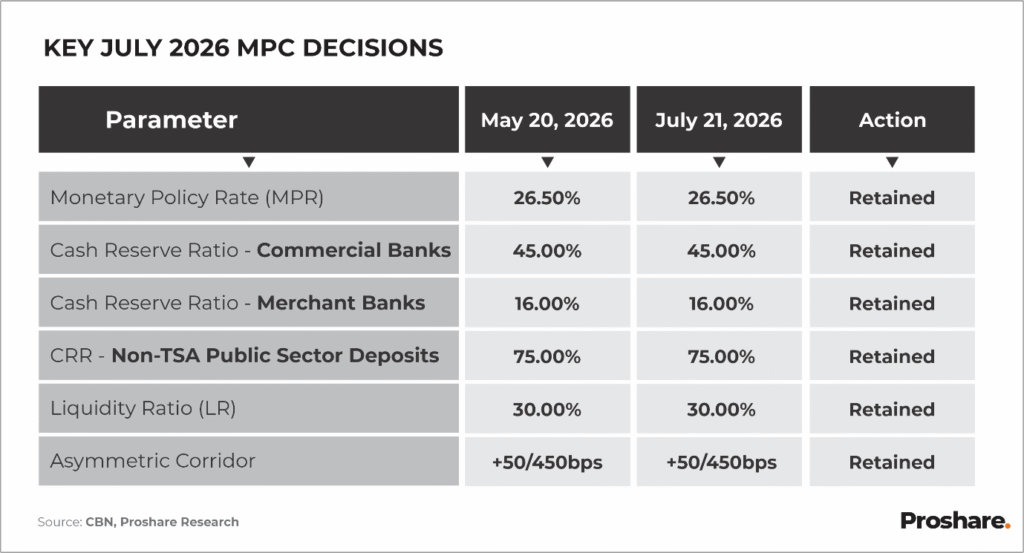
For a second straight meeting the Central Bank of Nigeria’s Monetary Policy Committee has kept the Monetary Policy Rate at 26.50%, and in doing so it has chosen credibility over comfort. The decision was widely expected, but the reasoning behind it matters more than the headline hold. Headline inflation did ease marginally in June 2026 to 15.91% from 15.93% in May, driven by a softer core print that fell 90 basis points to 15.92%, and the 12-month average has now moderated for six consecutive months. On the surface that looks like progress. Yet the improvement is fragile. Food inflation accelerated for a fifth straight month to 17.52%, reflecting supply constraints and high transport costs, while renewed hostilities in the Middle East have raised the spectre of energy-price pass-through. The Committee is treating June’s dip as potentially transitory rather than the start of a durable trend, and that caution explains why every other lever — the asymmetric corridor at +50/-450bps, the CRR at 45% for commercial banks, and the 30% liquidity ratio — was also left untouched.
The hold is made possible by a domestic economy that, so far, has absorbed external shocks without cracking. Real GDP grew 3.89% in Q1 2026, anchored by non-oil sectors like telecoms, financial services and trade, while the PMI returned to expansion at 50.1 points in June. External buffers look solid: gross reserves rose to $52.52 billion by mid-July, covering roughly 11 months of imports, and net reserves are above $40 billion. The naira has also found some stability, with the official rate at ₦1,375.31/$ and the BDC at ₦1,410/$, both stronger than at the end of 2025. That exchange-rate stability was central to June’s softer core inflation in housing, transport and services, and the MPC explicitly credited prior fiscal and monetary reforms for it. Add to that a stock market that has gained ₦59.74 trillion in market cap since December and a banking sector that has just completed recapitalisation with stronger prudential indicators, and you have an economy with enough breathing room to wait.
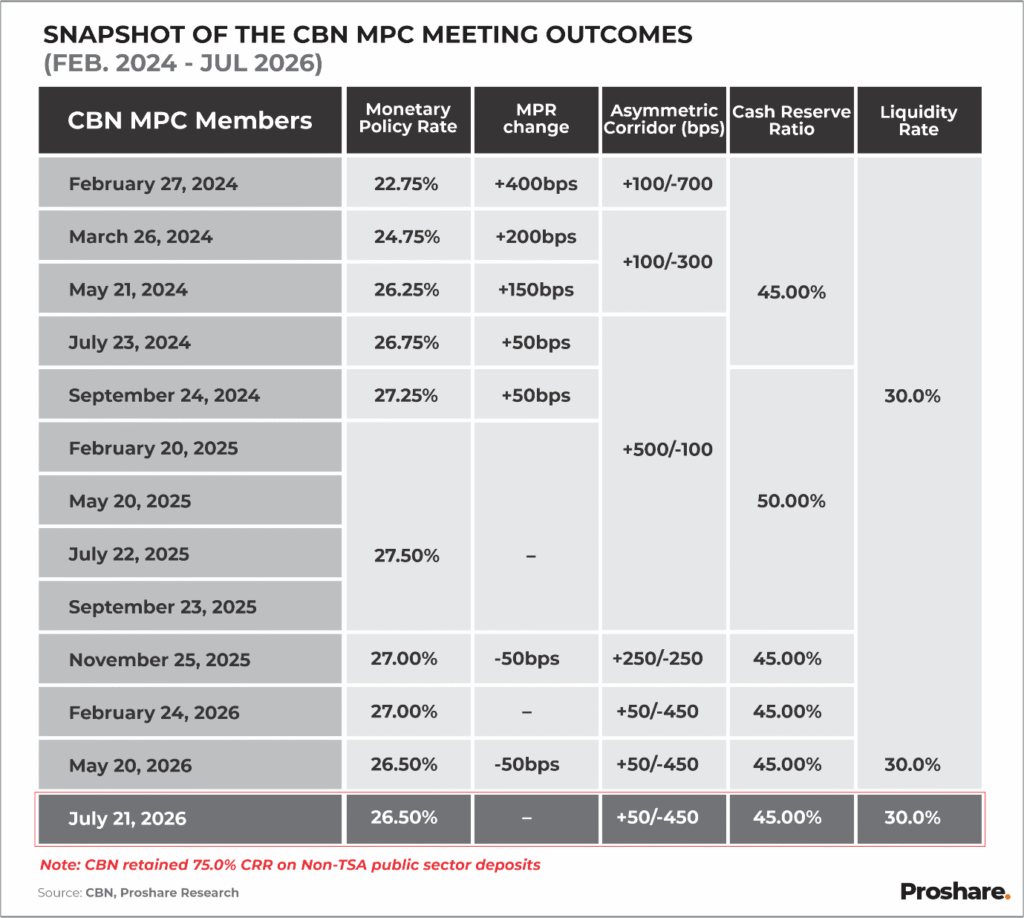
What the Committee is really buying is time to test whether disinflation is real. With a policy rate of 26.50% sitting more than 10 percentage points above headline inflation, the real rate remains strongly positive, giving the CBN space to hold without tightening further. The risk calculus is clear: cut too early and food supply shocks or a spike in global oil prices could undo the gains; wait too long and growth could be unnecessarily choked. For now the MPC has sided with waiting. It flagged energy-price pass-through as the principal risk, and it reiterated the need for fiscal-monetary coordination — more crude output, implementation of Executive Order 9, and a push into solid minerals — to broaden government revenues and ease supply-side pressure.
The implication for markets and households is that rates will likely stay high through the third quarter. Borrowing costs remain elevated, which keeps pressure on manufacturers and consumers, but it also helps anchor expectations and protect the naira. EA-Proshare’s read is that a cut is not off the table, but it is conditional. If July and August CPI data confirm that June’s moderation holds, and if the Middle East conflict does not escalate into a full-blown energy shock, the September 21-22 meeting could see the first easing. Until then, the CBN is signaling that it would rather be late to cut than early to regret it. In an environment where inflation is falling by basis points, not percentage points, that patience is the policy.