CBN Holds Firm at 26.5%: Patience Over a Cut as Inflation Eases but Risks Linger


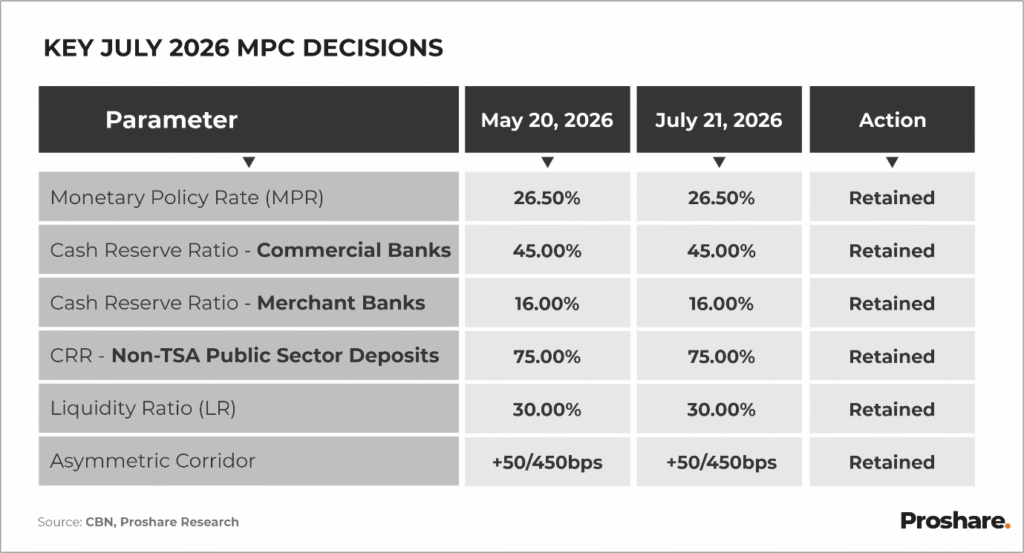
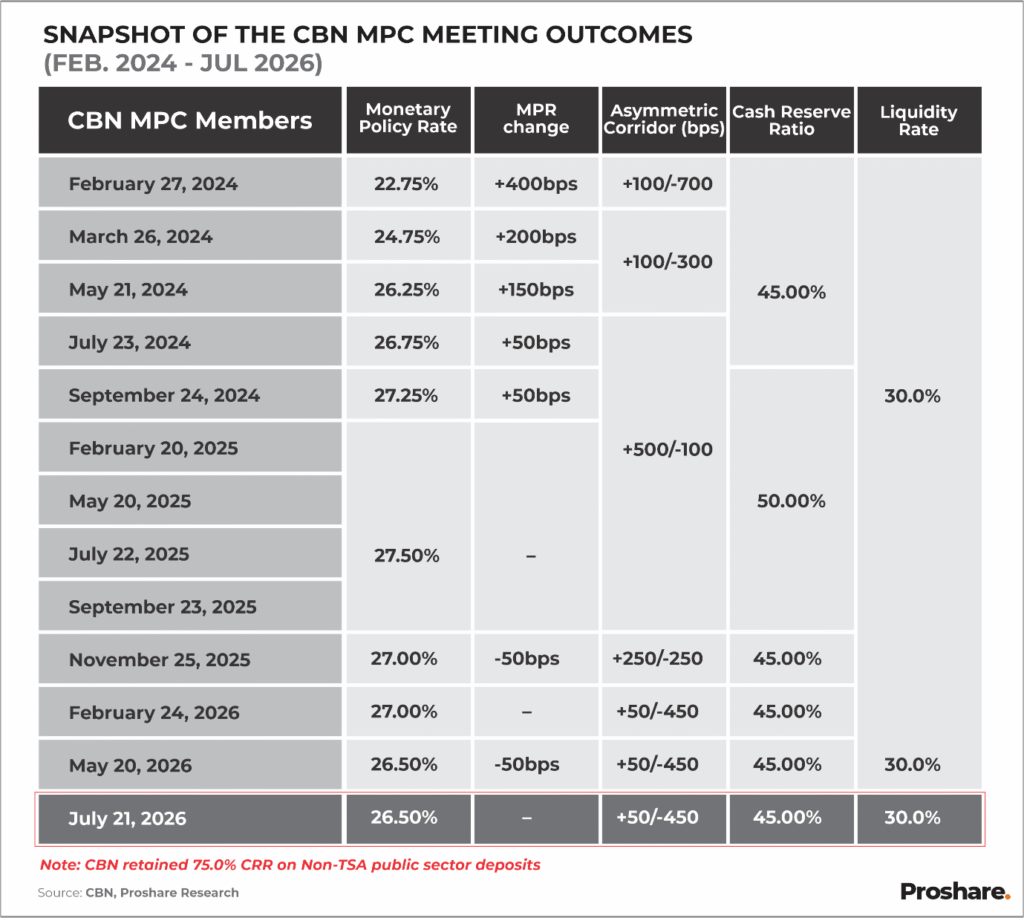
The Central Bank of Nigeria has kept the Monetary Policy Rate at 26.5% for the second straight meeting, a decision taken at the 306th MPC meeting on July 20-21, 2026, with 11 of 12 members in attendance. Alongside the rate hold, the Committee also retained the asymmetric Standing Facilities Corridor at +50/-450 basis points, the Cash Reserve Requirement at 45% for deposit money banks, 16% for merchant banks and 75% for non-TSA public sector deposits, and the Liquidity Ratio at 30%. The package is unchanged, and that was deliberate. The MPC’s message is that it will not move on rates until it is sure that June’s marginal disinflation is not a blip.
That caution is rooted in the balance of risks the Committee weighed. Headline inflation did ease slightly in June to 15.91% year-on-year from 15.93% in May, ending three months of mild acceleration. The improvement came from the non-food side, with core inflation dropping 90 basis points to 15.92%, largely thanks to exchange rate stability across housing, transport, health and education. The 12-month average also fell for a sixth consecutive month to 17.63%, and month-on-month headline inflation slowed to 1.66%. But the good news is incomplete. Food inflation climbed for a fifth month to 17.52%, reflecting supply constraints and high transport costs. And globally, renewed hostilities in the Middle East have heightened uncertainty around energy prices. The MPC is explicitly worried about pass-through from higher global oil and commodity prices into domestic costs, and it sees that external shock as reason enough to stay on hold rather than ease prematurely.
Domestically, the economy has given the Committee room to wait. Real GDP grew 3.89% in Q1 2026, down from 4.07% in Q4 2025 but still anchored by a resilient non-oil sector that expanded 3.94%. Telecoms, financial services, trade and transport carried the growth, while oil output slipped to 2.57% due to facility maintenance. Business activity picked up too, with the PMI returning to expansion at 50.1 points in June. External buffers look strong: gross reserves rose to $52.52 billion by July 17, enough for about 11 months of imports, and net reserves are above $40 billion. The naira has also stabilized, with the official rate at ₦1,375.31/$ and the parallel at ₦1,410/$, both stronger than at end-2025. The MPC credited prior fiscal and monetary reforms for that stability and welcomed the successful banking sector recapitalisation, noting improvements in prudential indicators while urging continued surveillance to guard financial stability.
The global backdrop, however, is less forgiving. The Committee noted that world growth is projected to slow to 3.0% in 2026 from 3.5% in 2025, weighed down by geopolitical tensions, trade policy uncertainty and tight fiscal conditions. Upside risks to inflation remain, driven by crude and commodity prices, supply chain disruptions, and climate shocks to food production. For emerging markets like Nigeria, exchange rate volatility and fiscal constraints add further pressure. In that context, holding rates high helps anchor expectations and protect the naira, even if it keeps borrowing costs elevated for businesses and households.
Looking ahead, the MPC’s outlook is cautiously optimistic but conditional. Output growth is expected to remain resilient in 2026, supported by improving crude oil production, an expansionary PMI, and the lagged impact of reforms. Inflation is projected to moderate further in the medium term on the back of FX stability, the delayed effects of previous tightening, and better food supply as the harvest season approaches. The key threat remains a severe and prolonged escalation of the Middle East conflict.
The implication is clear: a rate cut is not off the table, but it is data-dependent. With a policy rate more than 10 percentage points above headline inflation, the CBN has a wide real-rate buffer and no urgency to ease. The next test will be the July and August CPI prints. If they confirm that June’s moderation is durable and energy prices do not spike, the September 21-22 meeting could open the door to easing. Until then, the MPC is choosing credibility over comfort, betting that patience now will prevent a policy reversal later. For markets, that means high rates persist through Q3, and for government, it means fiscal-monetary coordination — including better crude output, implementation of Executive Order 9, and growth in solid minerals — must do more of the heavy lifting on supply-side inflation.