The CBN MPC Holds MPR at 26.50% for a Second Straight Meeting: Implications and Key Takeaways

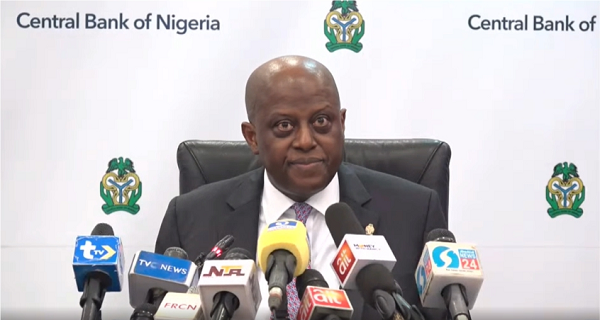
For a second straight meeting, the CBN’s Monetary Policy Committee has kept the MPR at 26.50% and held all other parameters steady. The decision met a broadly unanimous market consensus, and the reasoning behind it repays close attention.
June’s two-basis-point easing in headline inflation to 15.91%, a softer core print, and a sixth consecutive month of moderation in the 12-month average all point in the right direction. Yet a fifth straight month of food-price acceleration keeps the disinflation trend fragile and firmly supply-driven, while renewed Middle East hostilities sharpen the risk of energy-price pass-through.
Against a resilient domestic backdrop, non-oil growth, a PMI back in expansion, and reserves covering roughly 11 months of imports, the Committee has bought itself room to wait. The wide margin between the 26.50% policy rate and 15.91% inflation leaves easing firmly on the table for September, but only if the July and August prints confirm that June’s turn is durable.
This EA-Proshare Research analysis unpacks what the hold signals, and the conditions that would finally shift the Committee toward a cut.
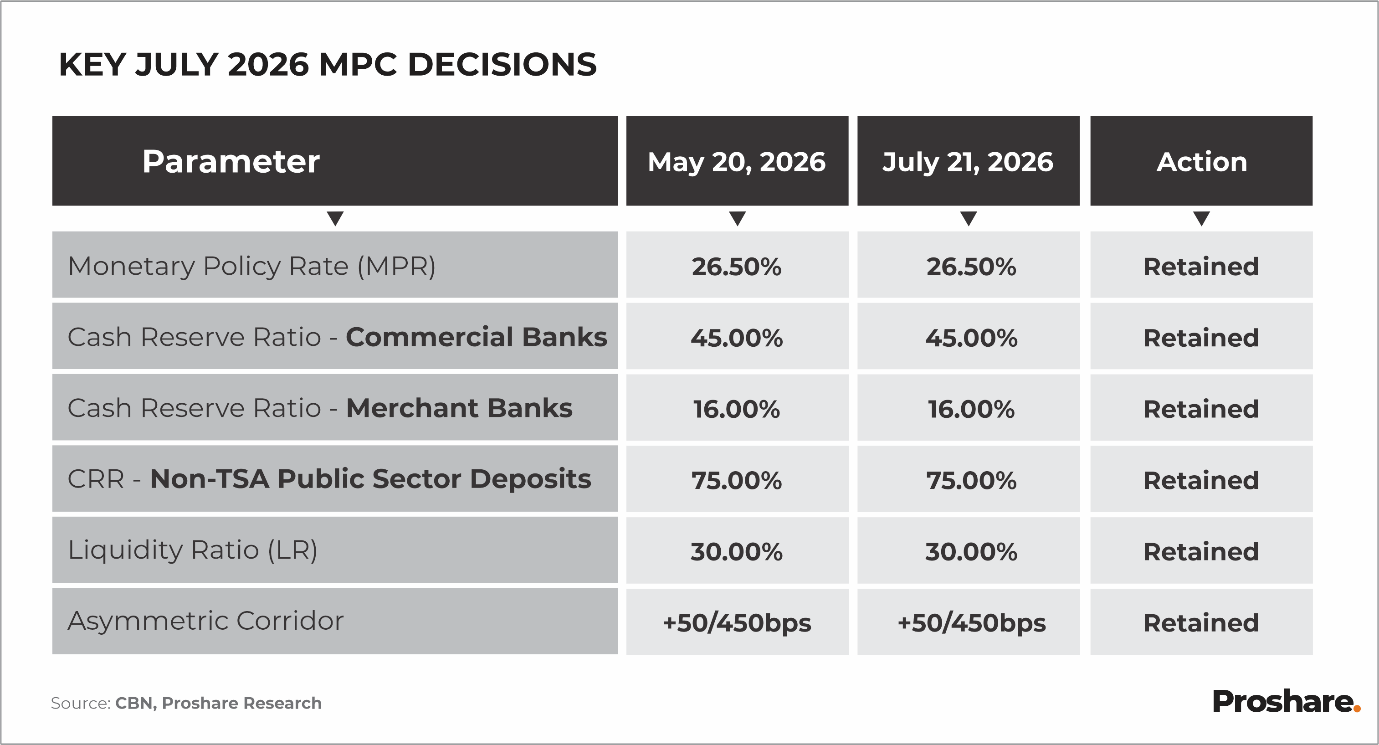
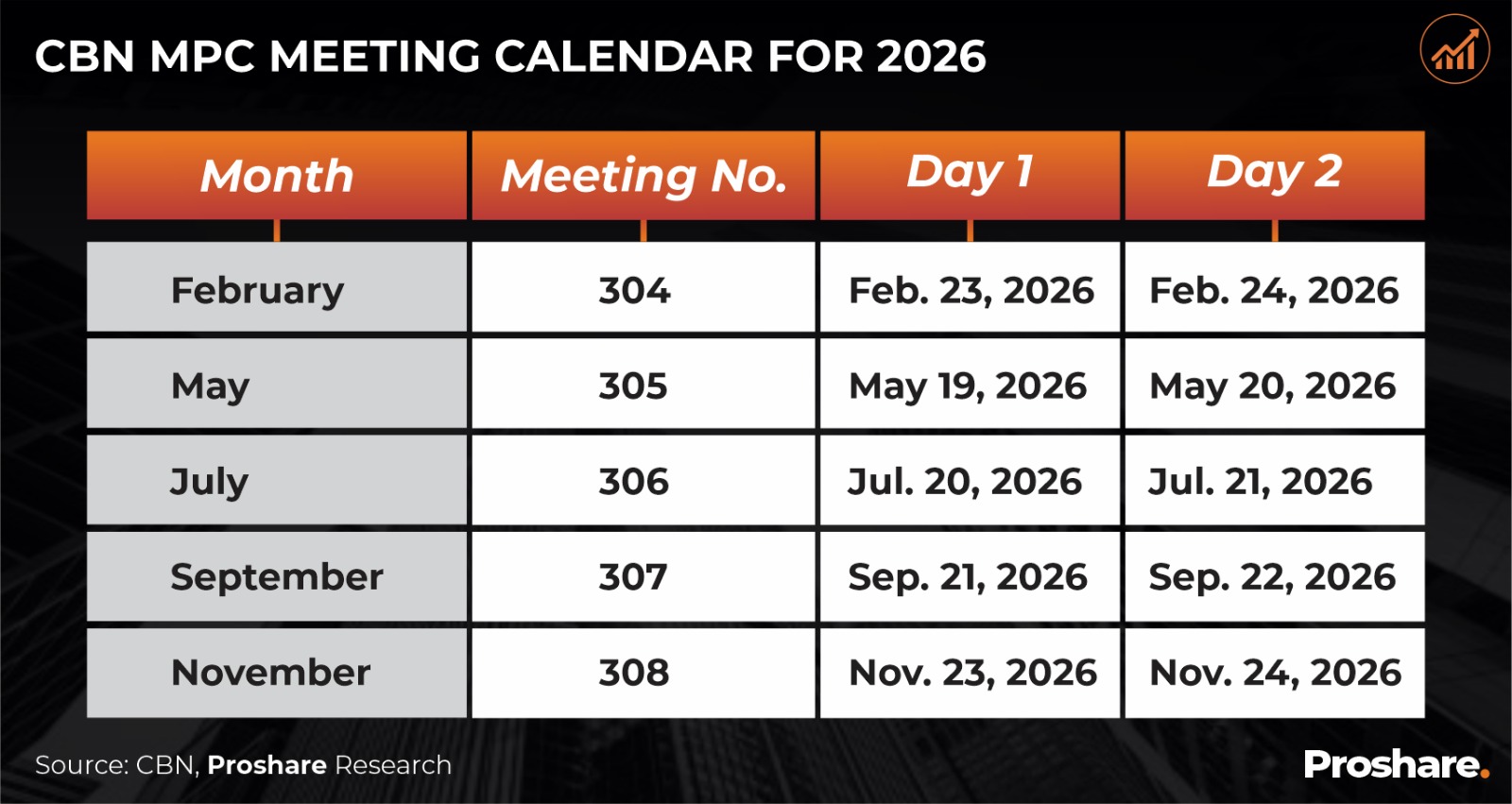
At the end of the 306th CBN MPC meeting on July 20-21, 2026, MPC members voted to:
- Retain the Monetary Policy Rate (MPR) at 26.50%
- Retain the Standing Facilities Corridor around the MPR at +50/-450bps.
- Retain the Cash Reserve Requirement (CRR) for commercial banks at 45.00%, Merchant Banks at 16.00%, and 75.00% for non-TSA public sector deposits.
- Retain the Liquidity Ratio at 30.00% (see Table 1 below).
Table 1: Summary of the CBN’s 306th MPC Decisions.
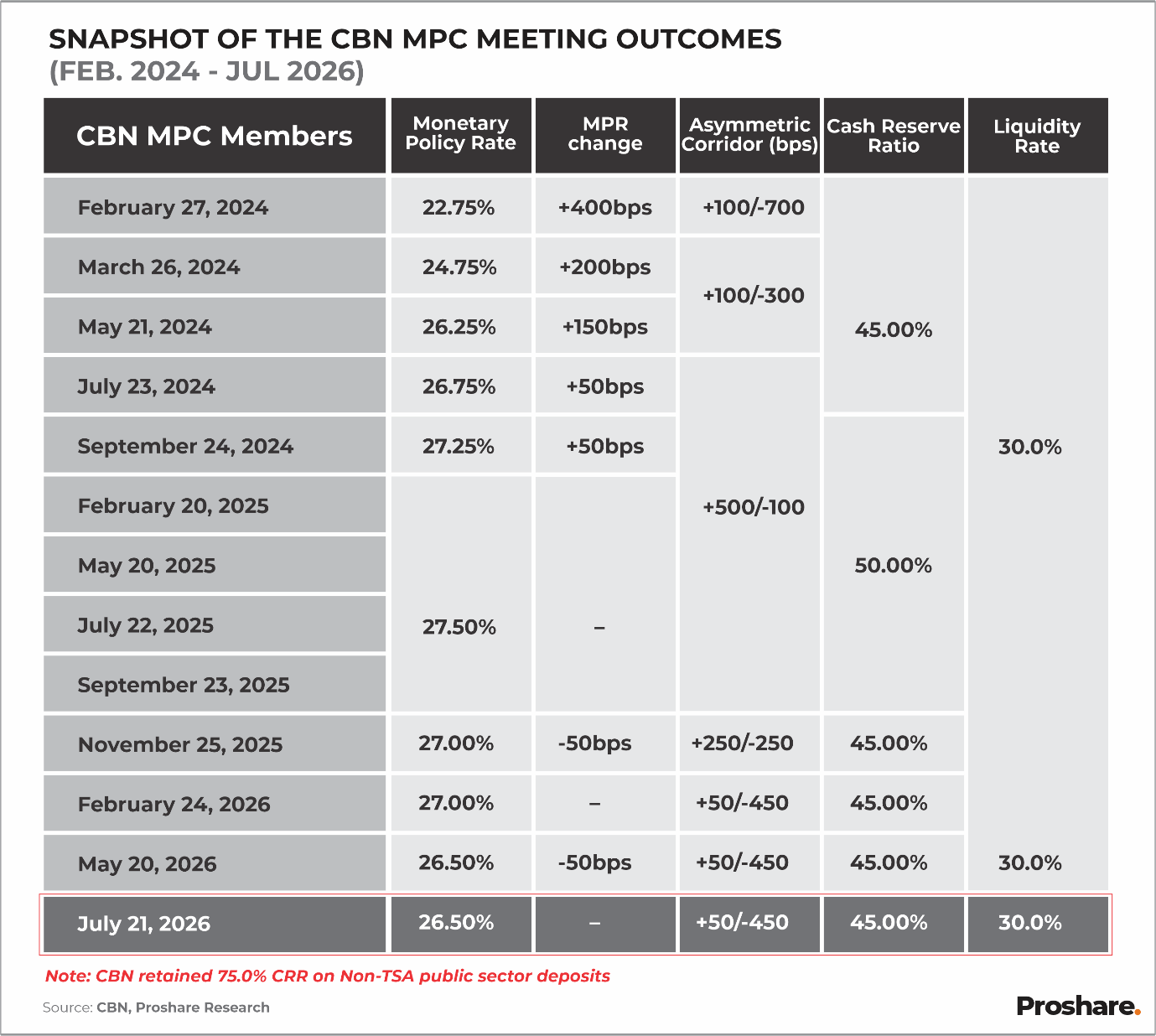
Eleven of twelve CBN MPC members were present at the second MPC meeting of 2026, consistent with attendance at the last two meetings. These outcomes align with the broadly unanimous market consensus for a hold that EA-Proshare canvassed ahead of the meeting, where every analyst polled, from Afrinvest and CPPE to FDC, PAC Research and Capital Bancorp, expected the Committee to stand pat. By holding all parameters for a second consecutive meeting, the CBN MPC has chosen to remain cautious while it confirms whether June’s marginal disinflation hardens into a trend rather than a one-off print (see Table 2 below).
Table 2: A Timeline of Recent CBN MPC Policy Decisions, 2024-2026.
According to the CBN, although headline inflation moderated marginally in June 2026, global uncertainties have heightened, driven mainly by the renewed hostilities in the Middle East, making a cautious monetary policy stance appropriate. The Committee flagged the pass-through of higher global energy prices to domestic inflation as the key risk it is now watching, even as it judged the Nigerian economy to have remained largely resilient to the external shock on the back of prior reforms. Most recent NBS data revealed that:
Made in Nigeria
- Headline inflation eased by two basis points to 15.91% year-on-year in June 2026, from 15.93% in May, ending three consecutive months of mild acceleration. The decline was driven by a softer non-food component, which offset acceleration across the food, housing & energy, education service, and health service readings. “The yet elevated June headline inflation of 15.91% does introduce a new consideration, but it is relatively modest when viewed against the broader inflation trajectory”, according to Prof Uche Uwaleke, President, Capital Market Academics of Nigeria, who also anticipated a cautious stance by the CBN MPC.
- Food inflation reaccelerated for a fifth straight month to 17.52% in June 2026, up from 16.96% in May, reflecting supply constraints in major food-producing areas and elevated transportation costs.
- Core inflation decelerated by 90 bps to 15.92% in June 2026, from 16.82% in May, largely on the back of exchange rate stability across housing, transport, health and education services.
- On a month-on-month basis, headline inflation slowed for a third consecutive month to 1.66% in June 2026, from 1.75% in May, driven by a slowdown in core inflation. The 12-month average moderated to 17.63% from 18.36%, its sixth successive month of decline.
This framing extends the interpretation Governor Olayemi Cardoso set out in May 2026, where the Committee read the earlier inflation uptick as a temporary, externally induced response to the energy-price shock rather than evidence of excess domestic demand. As EA-Proshare analysts flagged in our pre-MPC commentary, that transitory reading always pointed to a hold rather than a cut at this meeting, and the July outcome confirms it.
Market News Updates
A Resilient Domestic Backdrop
The decision to hold rested on an economy that has, so far, absorbed the external shock without visible strain across the real and financial sectors.
- Real GDP expanded by 3.89% in Q1 2026, moderating from 4.07% in the preceding quarter but still anchored by a resilient non-oil sector, which grew 3.94% on gains in telecommunications, financial services, trade and transportation. Oil-sector growth slowed to 2.57% from 6.79% in Q4 2025, weighed down by facility maintenance.
- The composite Purchasing Managers’ Index (PMI) returned to expansion, rising to 50.1 index points in June 2026 from 49.6 in May, signalling a pick-up in business activity.
- Gross external reserves rose to $52.52bn as of July 17, 2026, from $50.47bn at end-May, supported by crude-oil-related tax receipts and third-party inflows. This covers approximately 11 months of imports, comfortably above the three-month international benchmark.
- Net foreign reserves have climbed above $40bn (according to Governor Olayemi Cardoso, speaking at the BusinessDay CEO Forum in Lagos), from $34.80bn at the end of 2025.
- Official and parallel FX rates remain stable at N1,375.31/$ and N1,410/$ respectively, as of July 21, 2026, both appreciated from N1,436/$ and N1,470/$ at the end of 2025.
- Stock market capitalisation has risen to N159.12trn as of July 21, 2026, from N99.38trn in December 2025, an increase of N59.74trn.
Exchange-rate stability remains the linchpin of the disinflation case. It was the anchor behind June’s softer core reading, and the Committee explicitly tied the resilience of the naira and the moderation in core prices to the gains from prior fiscal and monetary reforms. The MPC also welcomed the positive outcome of the banking-sector recapitalisation exercise, noting improvements in key prudential and financial soundness indicators, while urging continued surveillance of financial-stability risks.
Key Takeaways from the CBN MPC July 2026 Policy Rate Decision
Stock Picks Subscription
- Credibility Over Comfort. With inflation barely moving and hostilities in the Middle East reigniting, the MPC held rates steady and stopped short of an early cut, extending its hold streak to a second straight meeting and reinforcing a data-dependent, credibility-first posture.
- Disinflation Intact but Fragile. June’s two-basis-point easing, the softer core print and the sixth month of moderation in the 12-month average all point in the right direction, but a fifth straight month of food-price acceleration keeps the trend fragile and firmly supply-driven.
- Nigeria Remains Insulated from Global Commodity Price Shocks. Resilient non-oil growth, a PMI back in expansion and reserves covering roughly 11 months of imports suggest the economy has weathered the energy shock so far, but the Committee is explicit that energy-price pass-through is the principal risk to the outlook.
- Inflation-MPR Margin Remains Wide. At 26.50% against 15.91% headline inflation, the positive real-rate premium leaves the monetary authorities in a strong position to hold at current levels while they wait for broader, more durable disinflation.
- Fiscal-Monetary Coordination in Focus. The Committee again underscored the value of closer fiscal-monetary alignment, welcoming renewed efforts on crude-oil production, Executive Order 9, and the push into solid minerals to broaden government earnings.
- A Cut Is Not Off the Table. Our pre-MPC view that easing would require confirmed disinflation and steady liquidity remains the operative test. We expect the MPC could move at its September 21-22, 2026, meeting, but only if the July and August CPI prints confirm that June’s turn is durable and the Middle East conflict does not escalate further.
The next meeting of the Committee is scheduled for Monday, September 21, and Tuesday, September 22, 2026.
Subscribe to the EA-Proshare Country Watch Service and gain access to our Reports, Updates and Conferences. Thank you