UBA’s FY 2025 and Q1 2026 Trajectory: Normalisation of Earnings and the Reset Beyond the Headlines on Provisioning, FX, Costs, Distributions & Stock Price
Apr 26, 2026 • by Proshare EMIU • Source: Proshare Research •  1796 views
United Bank for Africa (UBA) Plc’s FY 2025 audited results, released after market closed on Friday, 25 April 2026, together with the Q1 2026 unaudited disclosures, have prompted robust market debate. Read in isolation, FY 2025 invites a sceptical first reading: profit after tax fell 47.21% to N404.70bn, the cost of risk rose to 4.17% on a N331.07bn impairment charge, the cost-to-income ratio climbed to 59.39%, and the proposed final distribution to shareholders is materially lighter than a year in which a N395bn rights issue was placed at a premium to market would have led some to expect.
However, read alongside the Q1 2026 release and the disclosure envelope around the Central Bank of Nigeria (CBN) forbearance exit, a different picture emerges: a balance sheet reset that has been governed deliberately within a single reporting cycle, supported by N4.31trn in shareholders’ funds, capital adequacy of 23.20%, and non-performing loan (NPL) coverage of 123.57%.
The first independent validation of the reset already appears in the Q1 2026 print, with cost of risk at 2.02%, annualised return on average equity at 13.70%, and customer-loan growth of 2.10% in a single quarter, compared with 1.00% for the whole of FY 2025.
This technical note rigorously works through both readings and addresses the structural concerns that the FY 2025 release legitimately raises, i.e., the foreign-exchange revenue swing, the trajectory of operating costs, the credit quality concentration in the Nigeria book, the 67% expansion of risk-weighted assets, and the appropriately sensitive question of the dividend.
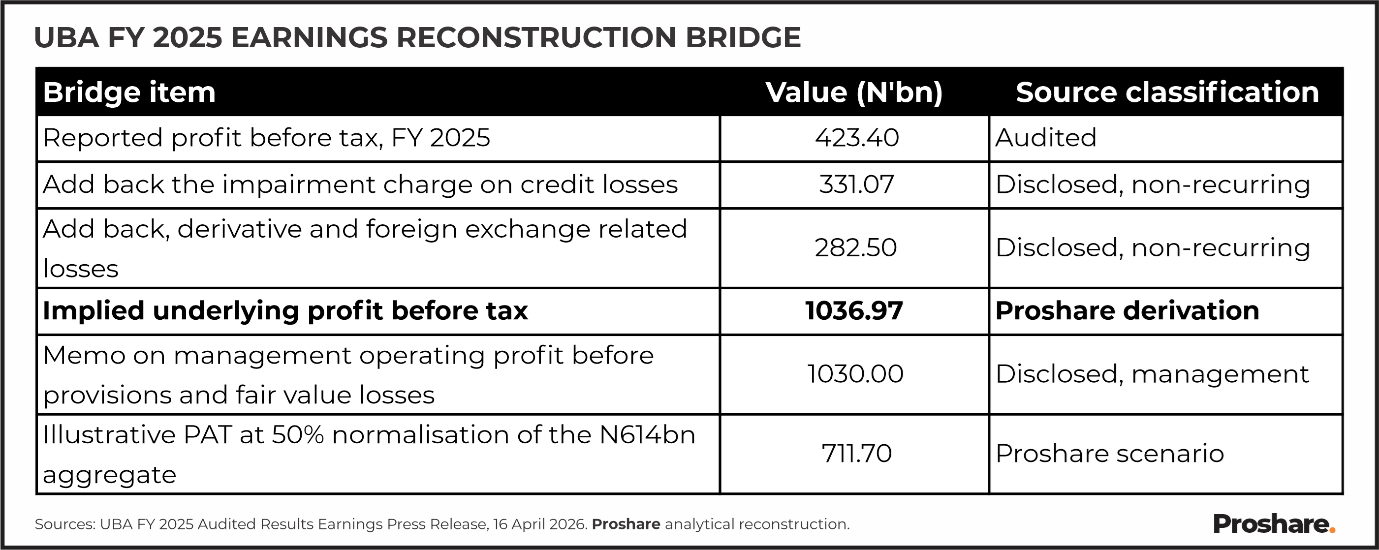
Stripping out two identifiable items, namely the N331.07bn impairment charge and the N282.50bn aggregate derivative and FX-related reversal, yields an implied underlying profit before tax of approximately N1.04trn, which converges with management’s own disclosed operating profit before these items. Pan-African subsidiaries continue to contribute more than 50% of Group revenue, assets, and profit.
This analyst note, stripped of the drama that usually attends such reporting, recognises that what matters is not the fall in earnings but the quality of recognition, the sufficiency of capital, and the early signals from Q1 2026 on whether the reset has been effectively executed. The transition from capital adequacy to capital quality now defines the investment case, and UBA’s disclosures provide a structured basis to assess this shift.
The principal open question now must be the pace of recoveries against the provisioned book and the speed at which the cost base normalises. The Proshare analytical call is HOLD with a positive bias, conditional on H1 2026 confirming the Q1 2026 trajectory. We await the CMO’s response on Monday for directional intelligence, further to what is provided here.
Financial Markets News
1. FY 2025 Results Overview
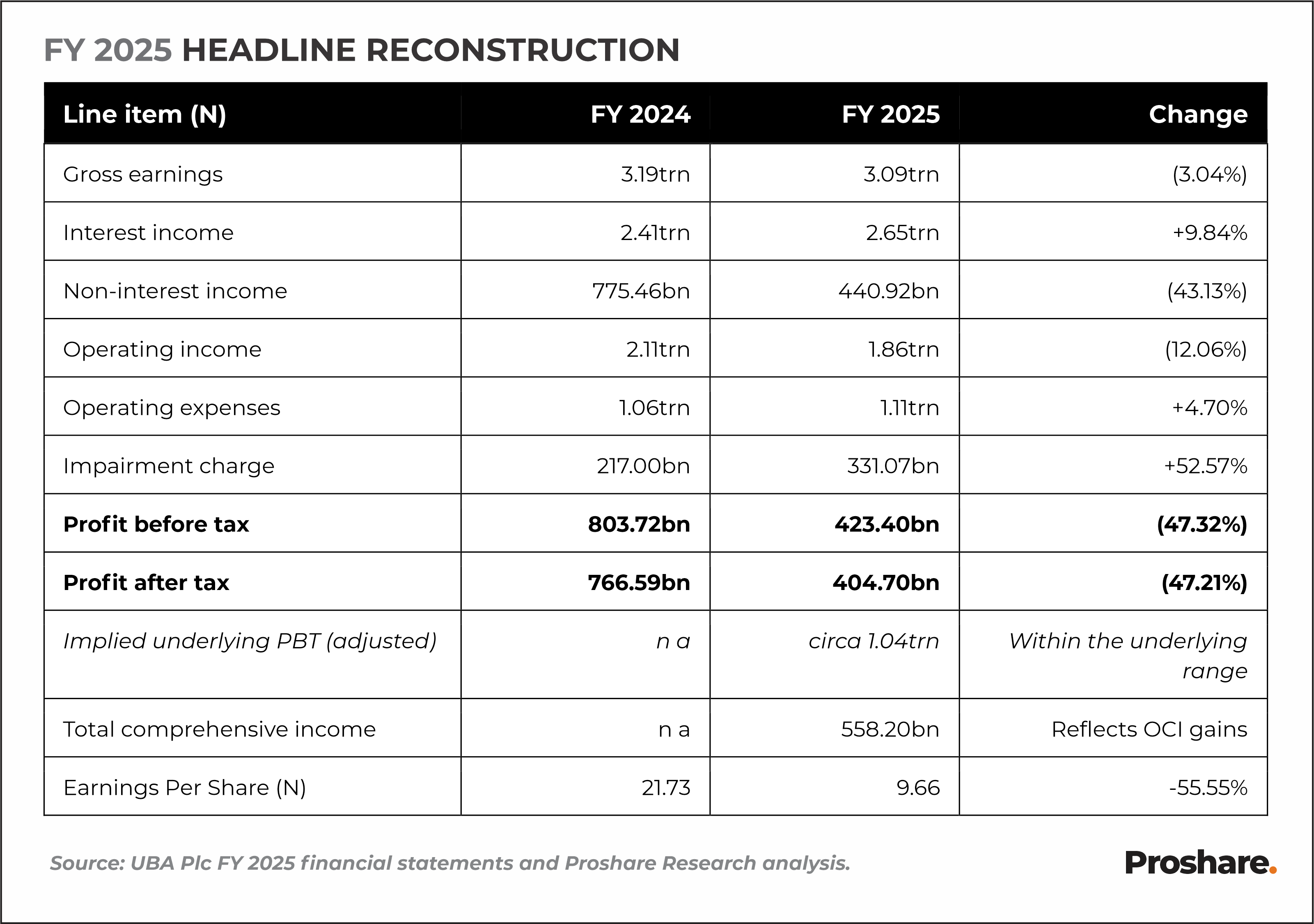
United Bank for Africa (UBA) Plc closed FY 2025 with gross earnings of N3.09trn, a 3.04% decline from N3.19trn in FY 2024. The composition matters more than the aggregate. Interest income expanded 9.84% to N2.65trn, reflecting the repricing of the loan book and the treasury portfolio into the elevated policy rate environment. Non-interest income fell 43.13% to N440.92bn because the derivative gains and foreign exchange revaluation surpluses that flattered the FY 2024 comparator did not repeat, and the residual book was reversed at a N282.50bn aggregate loss through the income statement. Operating income contracted 12.06% to N1.86trn on that non-interest income reversal, while operating expenses rose a disciplined 4.70% to N1.11trn.
The gap between revenue contraction and expense growth, rather than an absolute breakdown in cost discipline, is the arithmetic driver of the cost-to-income ratio moving from 49.50% to 59.39%.
Profit before tax of N423.40bn and profit after tax of N404.70bn absorbed both the derivative reversal and the N331.07bn impairment charge in a single reporting cycle.
Basic earnings per share fell to N9.66 from N21.73, reflecting the combined effect of earnings compression and dilution from the rights issue. Total assets grew 9.40% to N33.17trn, customer deposits grew 11.84% to N27.21trn, and shareholders’ funds grew 24.40% to N4.25trn. The divergence between balance sheet expansion and earnings compression is the principal structural observation from the FY 2025 disclosure.
The franchise has broadened, the deposit base has continued to expand on competitively priced current and savings accounts, earnings have been reset, and the capital base has been strengthened. Total comprehensive income of N558.20bn, which captures the OCI translation effects on the African subsidiaries, indicates that the Pan-African portfolio continues to contribute even where its share of headline earnings is partly obscured at the Group level by the FX line dynamics described in Section 3.
Table 1. FY 2025 headline reconstruction
2. Earnings Quality and Reconstruction
The Proshare earnings reconstruction adds back the N331.07bn impairment charge and the N282.50bn derivative and foreign-exchange-related loss, both identifiable and non-recurring, to arrive at an implied underlying profit before tax of approximately N1.04trn, a figure that converges with management’s own disclosed operating profit of N1.03trn before these items. The convergence is meaningful because it reframes the headline, as the reported compression is primarily the result of two identifiable factors rather than a structural impairment of the franchise.
Financial Markets News
The banking franchise delivered 9.84% interest income growth, funding costs declined by 8 basis points to 3.83%, and the net interest margin compression of 172 basis points to 7.30% principally reflects the normalisation of the post-devaluation 2024 yield spike rather than competitive erosion of the spread. Net interest income grew 4.20% in an environment where the FX windfall has receded, creditable for a balance sheet of this scale.
The cost-to-income ratio rising to 59.39% is an arithmetic consequence of the N322.40bn reversal in the FX and derivative line and the timing of technology and distribution investments, rather than a failure of cost discipline at the absolute level. The same denominator stress will subside as the FX line normalises in FY 2026, as evidenced by the Q1 2026 disclosures already emerging.
Table 2.
3. The FX and Derivative Line
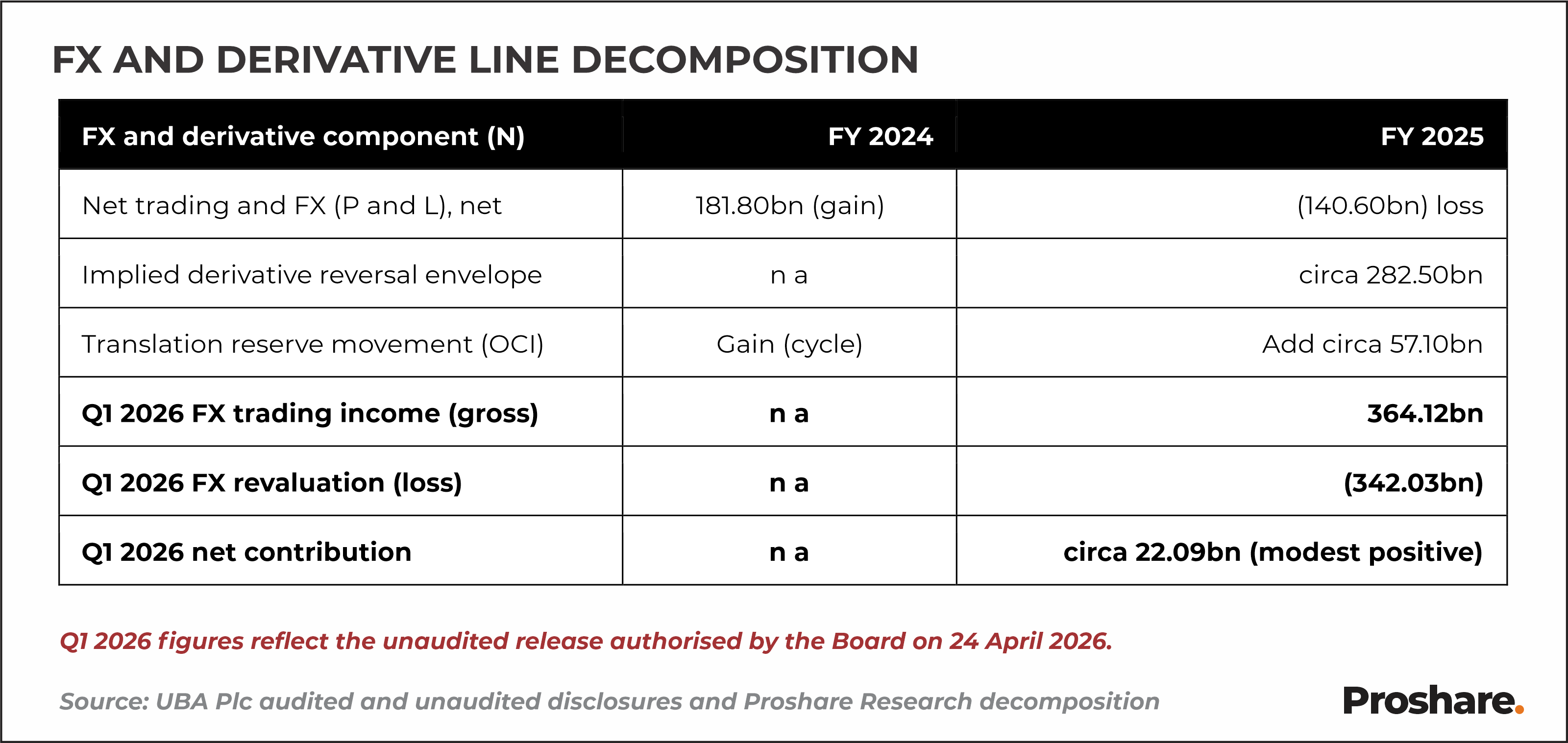
The single largest source of the FY 2025 earnings compression is the swing in net trading and foreign exchange income from a gain of N181.80bn in FY 2024 to a loss of N140.60bn in FY 2025, a reversal of approximately N322.40bn in a single line, equivalent in scale to the entire employee cost base of the Group for the year. A clean read of this line requires its decomposition into three distinct components, because each carries different implications for earnings quality.
The first component is client-driven trading flow, the genuine and repeatable revenue earned from customer FX execution. The Pan African corporate franchise consistently generates this flow, and the Q1 2026 disclosure of N364.12bn in foreign exchange trading income, even before netting, confirms that the underlying client engine is intact. The second component is the revaluation of open trading positions and treasury balances at the prevailing exchange rate as of the reporting date. In FY 2024, the naira devaluation cycle drove an outsized revaluation gain on these balances. In FY 2025, as the exchange rate stabilised, those revaluation gains evaporated and, in some cases, were reversed for positions carried over into a more stable rate environment. The third component is the translation effect on non-Naira subsidiary income and balance sheets, which flows partly through OCI rather than the income statement, adding approximately N57.10bn to the FY 2025 translation reserve movement and contributing to total comprehensive income of N558.20bn.
The Q1 2026 numbers are particularly instructive regarding the gross-against-net dynamic. Gross FX trading income of N364.12bn was offset by an N342.03bn foreign currency revaluation loss, resulting in a modest net positive of approximately N22.09bn. The volume of activity is large.
The net contribution is modest. This is consistent with a franchise running a substantial, continuously revalued FX book against a stabilising rate. The forward implication is that the FY 2026 net contribution from this line should be closer to a small structural positive, anchored on client flow, than to the swing-driven readings of either FY 2024 or FY 2025.
Cleaner disclosure of the three components in subsequent interim releases would materially improve the ability to forecast earnings and is a disclosure improvement that the analytical community is entitled to expect at this stage of the franchise.
Table 3. FX and derivative line decomposition
4. Provisioning Strategy and the CBN Forbearance Exit
The N331.07bn impairment charge is the decision point around which the FY 2025 narrative turns. Three readings are available. The first treats the charge as a forward-looking buffer taken proactively under the CBN forbearance exit programme and the stress testing directive of 1 April 2026. The second treats it as the recognition of latent credit deterioration that the forbearance regime had previously obscured. The third treats it as a combination weighted toward the first. The Proshare reading is the third, weighted toward the proactive classification.
Financial Markets News
Three lines of evidence support that weighting. First, NPL coverage has been lifted to 123.57% from 80.85%, a buffer that only makes sense under a forward-looking recognition framework. A pure catch-up provisioning cycle would typically bring coverage to parity or slightly above, not to a level that implies more than full cover in the recognised book.
Second, loan growth of 1.00% for the full FY 2025 is consistent with a bank pausing new risk asset formation while the recognition cycle completes, rather than with a deteriorating franchise attempting to outgrow its credit issues.
Third, the N395bn rights issue was concluded within the year and oversubscribed, indicating that the provisioning decision was anticipated by the equity market and pre-funded rather than forced after the fact. The accompanying N420.30bn transfer between reserves, capturing the move into statutory and credit risk reserves under regulatory requirement, is the structural reflection of that provisioning posture in the equity statement and is consistent with the prudential framework rather than a discretionary adjustment to retained earnings.
The CBN stress testing directive of 1 April 2026 has reframed supervisory attention from capital adequacy to capital quality. Under that framework, a bank reporting 7.67% NPL at 123.57% coverage is more conservatively positioned than a bank reporting 5.00% NPL at 80.00% coverage, even though the headline adequacy comparison would superficially favour the latter. The Q1 2026 cost of risk at 2.02%, measured against the FY 2025 ratio of 4.17%, is the first independent confirmation that the FY 2025 recognition intensity is not a rolling feature of the earnings engine. Sustained validation will depend on the FY 2026 full-year impairment trajectory and the pace of recoveries flowing against the provisioned book.
5. Nigeria Specific Credit Dynamics
A close reading of the bank’s only Nigeria impairment charge is essential because it explains why the Group cost of risk ratio sits where it does. The Nigeria entity recorded an impairment charge of approximately N300.80bn against a Nigeria gross loan book of approximately N3.82trn, implying a Nigerian-only cost of risk of approximately 7.90%, materially above the consolidated Group ratio.
Against the same book, Nigeria’s net loans contracted from N3.92trn to approximately N3.51trn year-on-year, evidence of a deliberate de-risking posture rather than franchise weakness. Read in this frame, the cost of risk concentration in Nigeria is the expected mechanical consequence of two simultaneous dynamics. The forbearance exit triggers recognition principally on Nigerian originated exposures because those are the assets that benefited from the forbearance regime, and the Nigeria entity has chosen to compress the gross book rather than refinance into the new prudential cycle.
The sectoral composition of the recognition is consistent with the cluster identified in the Proshare Five-Front Recapitalisation commentary of 10 April 2026. Oil and gas exposures are repriced under a normalised crude trajectory. Real estate exposures are running through a recalibration of valuation and serviceability assumptions. The consumer credit segment is absorbing the residual stress from the inflation cycle.
None of these clusters reflect an idiosyncratic UBA exposure. They are the systemic clusters that any tier-one Nigerian bank with a representative loan book would have absorbed within the same window. The key concern is whether the Nigeria entity returns to growth on a cleaner book once the forbearance exit is complete or continues to run a smaller book with higher coverage. The Q1 2026 loan growth of 2.10% Group wide suggests the former, but the Nigeria-specific trajectory through H1 2026 will be the cleaner test.
6. Capital Adequacy and Risk-Weighted Asset Expansion
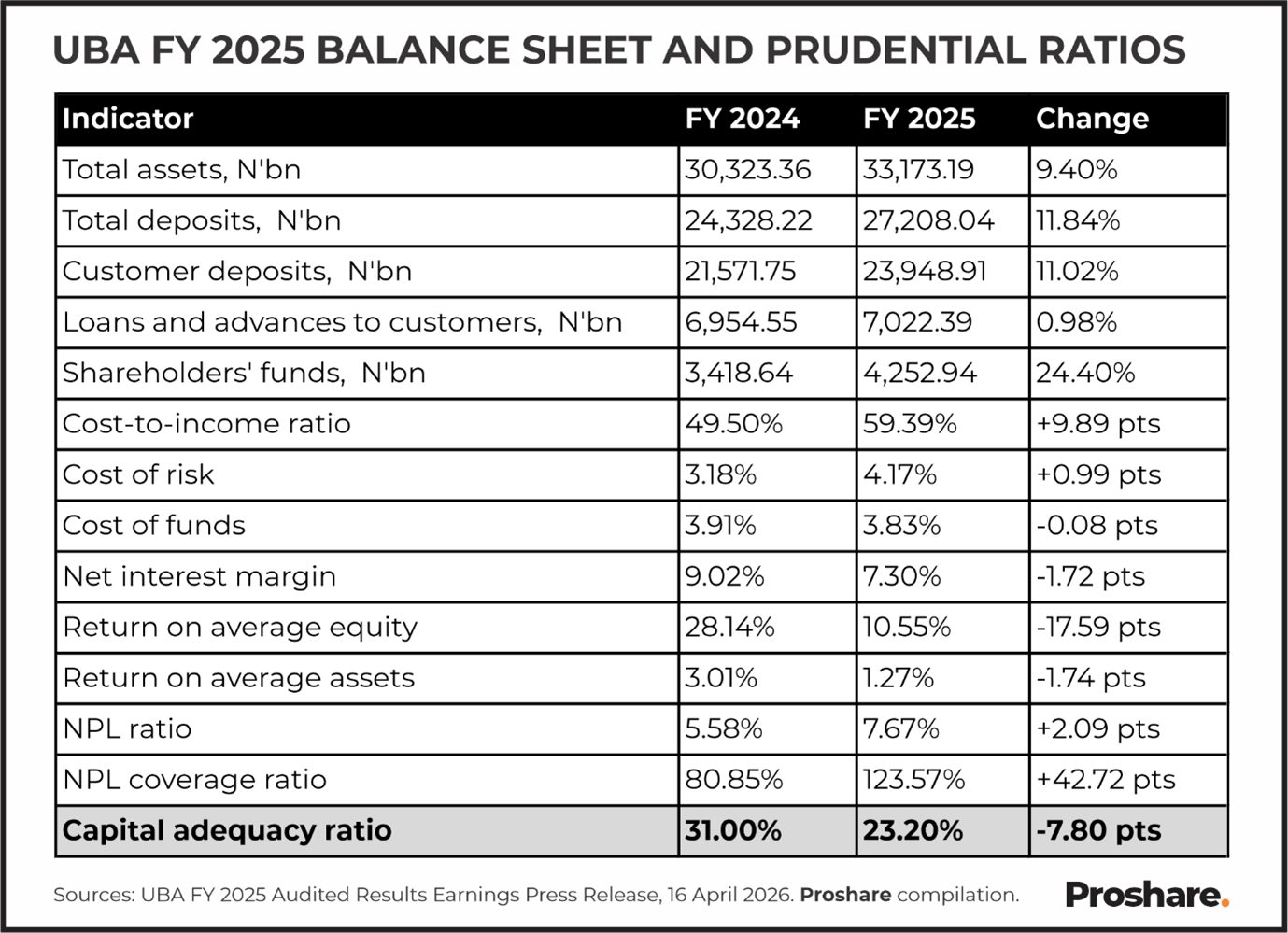
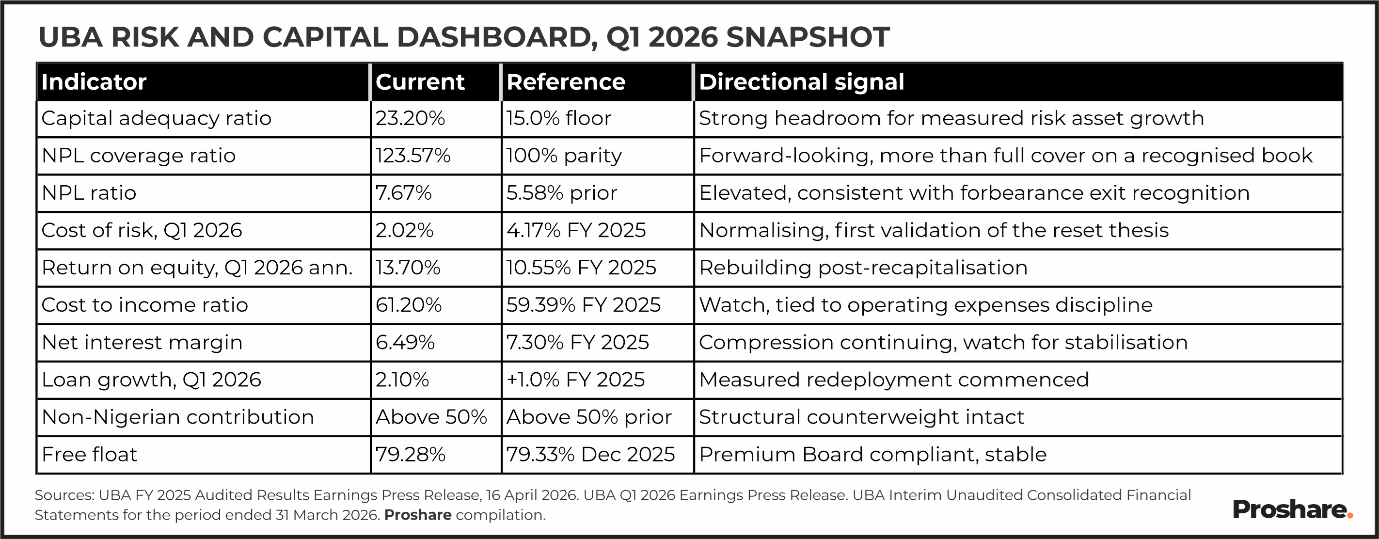
Capital adequacy at 23.20% sits 820 basis points above the 15.00% regulatory floor for international authorisation banks. Shareholders’ funds of N4.25trn at FY 2025 and N4.31trn at Q1 2026 place the Group among the most well-capitalised institutions in the Nigerian tier one segment post-recapitalisation. The N395bn rights issue concluded within FY 2025 was oversubscribed, a market validation of both the strategy and the timing. The most material capital observation, however, is the expansion of risk-weighted assets from approximately N8.30trn at FY 2024 to approximately N13.90trn at FY 2025, a 67% increase that materially outpaced the 9.40% growth in total assets. The drivers of that move warrant a granular reading.
Three forces sit behind the RWA expansion. The first is the deepening of the CBN’s Basel III implementation through FY 2025, which has revised risk weights for several asset classes, most notably sovereign exposures held in the trading book, certain off-balance-sheet contingencies, and operational risk capital under the Standardised Approach. The second is the natural risk-weight uplift on the customer loan book, as the forbearance exit reclassifies a portion of previously concessionally weighted exposures into standard or higher risk-weight bands. The third is the growth of the African subsidiary balance sheets in Naira-translated terms, where local-currency-denominated risk exposures translate into higher Naira-equivalent RWA at prevailing rates. Methodological recalibration accounts for a meaningful share of the increase.
Underlying risk increase accounts for a smaller share. The headline implication is that the same 23.20% capital adequacy ratio is now defended against a materially larger denominator, which both validates the recapitalisation and rationalises a measured pace of risk asset deployment in FY 2026 rather than an aggressive book expansion.
Three tests can therefore be applied to capital quality. The quality test, combining a 23.20% capital adequacy ratio, NPL coverage of 123.57%, and a shareholders’ funds base that has grown 24.40% year on year, supports a positive reading. The efficiency test, with Q1 2026 annualised return on average equity at 13.70%, lifted from the FY 2025 ratio of 10.55%, indicates that recapitalisation dilution is beginning to be offset by earnings normalisation. The deployment test, with Q1 2026 loan growth of 2.10% quarter-on-quarter, is the first sign that the post-capital-raise buffer is being allocated to risk assets rather than warehoused in low-yielding securities. A sustained loan growth rate in the mid-teens through FY 2026, supported by a 23.20% capital adequacy ratio, would translate capital efficiency into a discernible uplift in net interest income.
Table 4a. Capital, RWA and coverage metrics
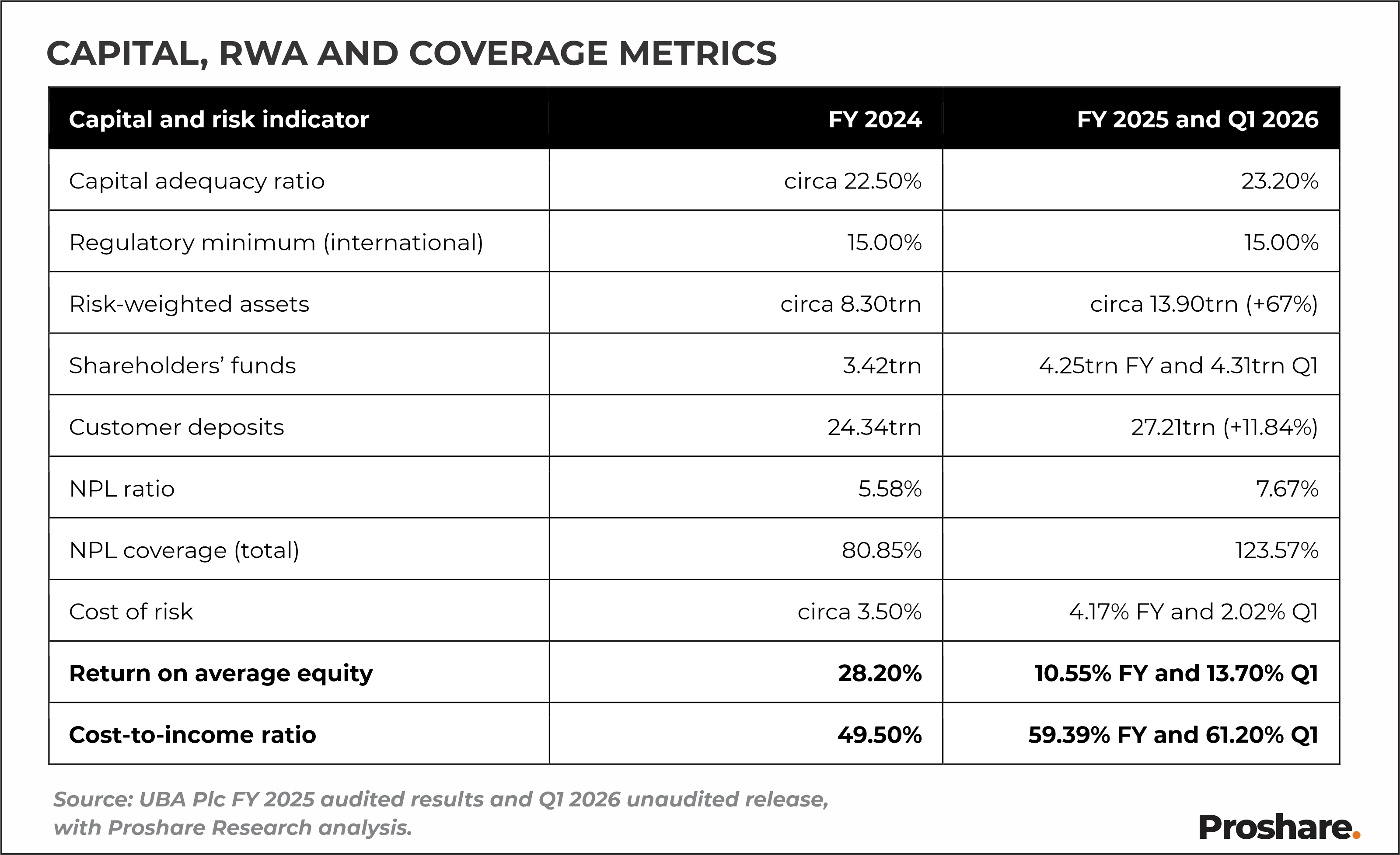
Table 4b. UBA FY 2025 Balance sheet and Prudential Ratios
7. Cost Trajectory and the Path to a Lower Cost-to-Income Ratio
The FY 2025 cost-to-income ratio of 59.39%, compared with 49.50% in FY 2024, is above the level appropriate for UBA’s Group scale and Pan-African footprint. The diagnostic question is whether this is a denominator effect, a numerator effect, or both.
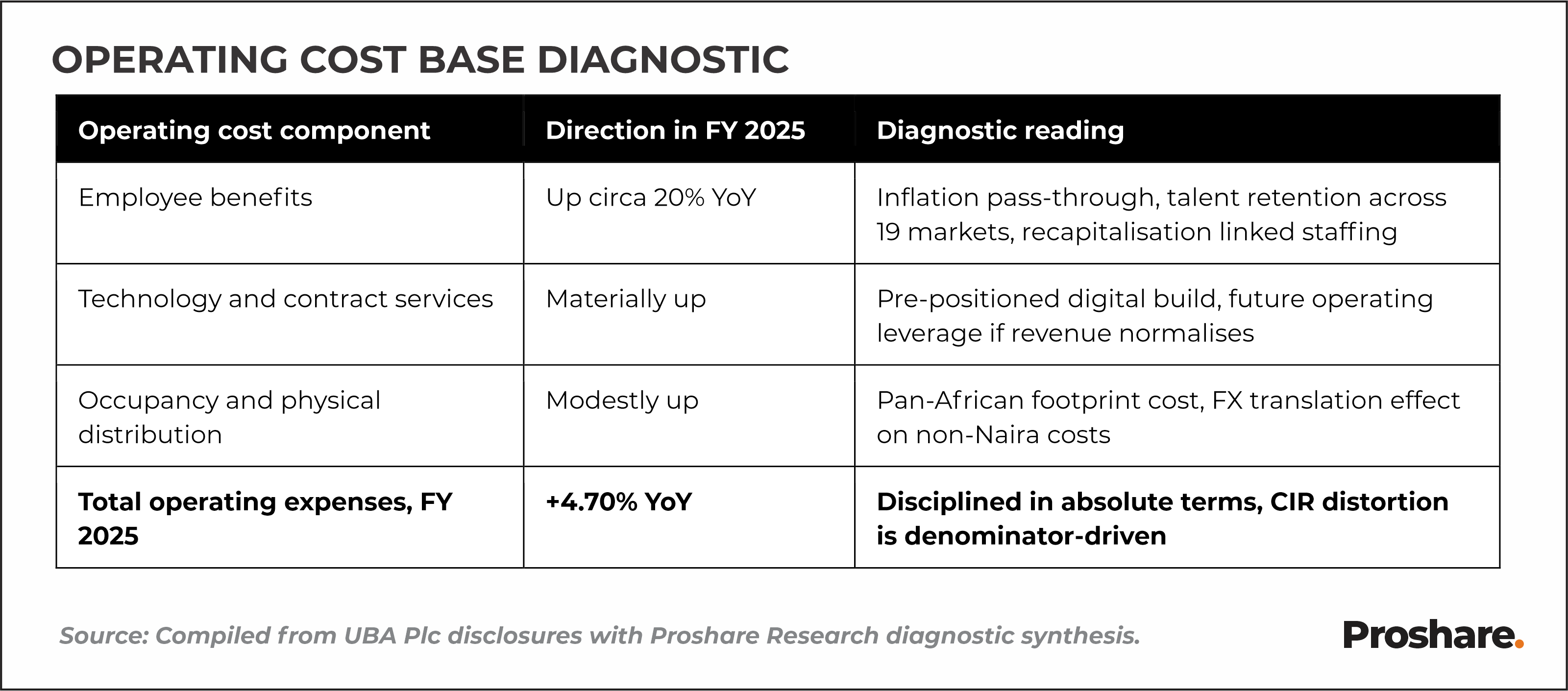
The total operating expense growth of 4.70% in FY 2025 is, in absolute terms, disciplined, well below the prevailing inflation rate and well below the rate at which similarly placed peers have allowed their cost bases to expand in this cycle.
The CIR move is therefore principally a denominator effect, driven by the 12.06% contraction in operating income that itself reflects the FX and derivative line reversal addressed in Section 3.
Within the cost base, the line that warrants closer examination is employee benefits, which expanded by approximately 20% year on year. Three structural drivers explain that increase. The first is inflation pass-through across 19 African operating markets, where local-currency staff costs are necessarily indexed to prevailing inflation and translated back into Naira at a stabilised exchange rate. The second is the talent retention cost associated with maintaining capability across Nigeria, West Africa, East Africa, Central Africa, and Southern Africa subsidiary clusters at a time when peer competition for senior banking talent has intensified post-recapitalisation. The third is the recapitalisation-linked staffing build to support the deployment of fresh equity into commercial origination and treasury capabilities. None of these drivers signals indiscipline. Each, however, signals a forward operating cost level that will require revenue normalisation to absorb without further CIR drift.
The forward path to a CIR in the mid-50s rests on three levers. The first is revenue normalisation as the FX line stabilises and net interest income grows on a deployed loan book. This is the primary lever and is largely arithmetic. The second is operating leverage in the technology investment cycle, where the FY 2025 build delivers cost-per-transaction efficiency from FY 2026 onward as digital channels absorb a larger share of customer volume. The third is the selective rationalisation of the physical distribution footprint in markets where digital adoption has reached an inflexion. The FY 2026 CIR target in the 55%-57% range is achievable through these levers. A return to the sub-50 % level seen in FY 2024 will require the FX windfall conditions of that year and is therefore not the appropriate target for a steady-state assessment.
Table 5. Operating cost base diagnostic
8. Q1 2026 Transition Signals
The Q1 2026 unaudited financial statements, authorised by the Board of Directors on 24 April 2026, carry three first-order signals.
The first is the normalisation of the cost of risk to 2.02%, against the FY 2025 ratio of 4.17%. The second is the step up in annualised return on average equity to 13.70%, from 10.55% at FY 2025. The third is the loan book growth of 2.10% in a single quarter, against 1.00% for the whole of FY 2025, indicating that measured capital deployment into risk assets has commenced. Taken together, these signals describe an earnings engine returning to a normalised operating status compared with what the FY 2025 results alone would have suggested.
The signals carry qualifications. Gross earnings grew 4.86% year on year, a moderate increase relative to a high Q1 2025 comparator that included meaningful foreign exchange trading income. Non-interest income grew 17.25%, supported by N364.12bn in FX trading income offset by an N342.03bn revaluation loss, resulting in a modest positive net contribution.
Operating expenses grew 29.77% year on year to N318.95bn, driven by employee benefits, occupancy, contract services, and technology investment, lifting the cost-to-income ratio to 61.20% from 59.39% at FY 2025. The operating expense trajectory is the principal monitoring focus for H1 2026 confirmation. Cost discipline must normalise alongside provisioning normalisation for the earnings quality thesis to translate into reported profit recovery rather than remain anchored on the underlying PBT reconciliation.
Profit before tax of N160.66bn for Q1 2026 is 21.35% lower than the Q1 2025 comparator of N204.27bn, and profit after tax of N146.62bn is 22.77% lower than N189.84bn. This reads as a soft headline at face value, but warrants a considered interpretation. The Q1 2025 comparator carried approximately N18.70bn in net foreign exchange-related gains that flattered the base period, and the Q1 2026 impairment charge of N38.21bn is more than three times the Q1 2025 charge of N11.12bn in absolute terms. Adjusting both quarters for non-recurring items reveals an underlying trajectory that is broadly flat to modestly up, consistent with a normalising earnings environment post recapitalisation. Basic earnings per share at N3.11, down from N5.35 in Q1 2025, also reflect the enlarged share count following the rights issue.
9. Distribution Policy and the Logic of Restraint
The most sensitive element of the FY 2025 release for participating shareholders, particularly those who subscribed to the rights issue at a premium to market, is the absence of a meaningful final dividend. This is the question on which the market is entitled to a clear analytical reading, because it sits at the intersection of regulatory discipline, capital efficiency, and shareholder fairness; even as the market has a precedent for such.
Three considerations frame the position.
The first consideration is regulatory. The CBN forbearance exit programme, the 1 April 2026 stress testing directive, and the Basel III implementation cycle have collectively compelled Nigerian banks to fortify reserves and constrain payout ratios in the FY 2025 cycle. The N420.30bn transfer between reserves disclosed in the FY 2025 statement of changes in equity reflects that fortification. Regulatory reserves and statutory reserves have absorbed retained earnings that, in a different regulatory cycle, would have been distributable. A meaningful dividend declared against this regulatory backdrop would have signaled either misalignment with supervisory expectations or a shorter orientation than the franchise warrants.
The second consideration is capital efficiency. With a 23.20% capital adequacy ratio against a 15.00% floor, the Group does, on a stand-alone capital test, have headroom to distribute. That headroom is, however, most efficiently deployed in FY 2026 against the disciplined loan growth opportunity that a recapitalised tier-one franchise can capture, where each unit of retained capital is deployed at a target risk-adjusted return materially above the prevailing cost of equity. Distributing capital that could earn a normalising RoE above the cost of equity is, by capital allocation logic, an inferior outcome for the long-term shareholder.
The third consideration is shareholder fairness, specifically toward those who participated in the rights issue. This is the legitimate concern. A token distribution against a near halving of EPS appears asymmetric for an investor who funded the recapitalisation in cash and now holds an enlarged share count against a compressed earnings base. The appropriate management response is not retrospective. The rights issue was based on a forward-franchise thesis that the market accepted at the time. The appropriate response is forward-looking.
The board commitment that should crystallise during the FY 2025 results presentation cycle is a clear, dated framework for the resumption of meaningful distributions. That framework should set out an explicit FY 2026 interim dividend policy linked to H1 2026 earnings normalisation, a target payout ratio that accommodates both regulatory reserve building and shareholder return, and an indicative final dividend trajectory for FY 2026 conditional on the cost of risk and CIR signals holding through the year. A clear distribution framework would substantively address legitimate market concerns without compromising the prudential discipline established by the FY 2025 reset.
10. Asset Quality and Risk Posture
The NPL ratio rose to 7.67% in FY 2025 from 5.58% at FY 2024, an increase of 209 basis points. In isolation, this is material deterioration. In the context of the forbearance exit, it is the expected consequence of the recognition regime returning to normal prudential standards. NPL coverage at 123.57% against the enlarged book provides the analytical counterweight, reflecting a forward-looking recognition posture rather than a deteriorating credit franchise.
Risk recognition appears substantially advanced. The Q1 2026 stage three loan allowance of N305.00bn, against a customer loan book of N7.65trn, remains meaningful, and the quarterly impairment charge of N38.21bn, while above the pre forbearance exit run rate, is consistent with a tail of remaining recognition rather than a fresh wave. The monitoring focus for H1 2026 is whether the cost of risk continues to moderate toward a sustainable 1.50%-2.00% range, and whether the NPL stock stabilises at or below the 7.67% print rather than rising further. Recoveries against the provisioned book will become a more visible driver from H2 2026 onward, and a realistic 20% to 30% recovery rate over an 18-month horizon would imply an N66bn to N99bn earnings uplift through the write-back mechanism alone.
11. Pan-African Diversification as a Structural Counterweight
Management has consistently disclosed that operations in the 19 African countries outside Nigeria account for more than 50% of the Group’s assets, revenue, and profit. This diversification weakens the Nigerian-specific credit exposure cycle, particularly in the oil and gas, real estate, and high-inflation-sensitive consumer lending sectors that the Proshare Five Front Recapitalisation commentary of 10 April 2026 identified as the principal forbearance-exit risk clusters. The translation reserve of N965.05bn at Q1 2026, against N1.09trn at FY 2025, reflects foreign currency translation dynamics during the quarter and illustrates the scale of the non-Nigerian footprint.
Financial Markets News
The diversification thesis is further reinforced by the Group management of Ghana and Sierra Leone under IAS 29 hyperinflationary accounting in 2025, with Ghana subsequently exiting that designation. This demonstrates both material operating exposures in challenging economies and the IFRS discipline to manage them. The forward question is whether the non-Nigerian contribution can absorb incremental volatility in the Nigerian credit cycle without itself becoming the source of earnings variance.
12. Disclosure Quality and the Case for Geographic Disaggregation
The FY 2025 cycle has surfaced a structural disclosure question that the analytical community is entitled to raise. At the materiality threshold Nigeria’s earnings differential against the rest of Africa has now reached, the case for an interim geographic profit-and-loss disaggregation has strengthened. The mechanical demonstration of the differential, with Nigeria-specific cost of risk in the order of 7.90% against a Group ratio of 4.17%, Nigeria net loans contracting against subsidiary loan growth, and Nigeria contributing a smaller proportional share of profit than its share of the Group balance sheet, is sufficient to justify a presentational change.
The peer reference on this front is Ecobank Transnational Incorporated (ETI), which discloses a fully disaggregated geographic income statement for the interim and full-year cycles, thereby allowing the analytical community to model each cluster on its own merits. The existing UBA disclosure cadence, which includes pre-result advisories where appropriate and the Q1 2026 release within 8 trading days of the FY 2025 audit, is materially stronger than that of several peers in the same window.
The geographic profit and loss step is the natural next disclosure improvement and would reduce the residual market discount that opaque earnings composition tends to attract. The Q1 2026 release, issued with detailed disclosures, signals that management is front-loading interim validation evidence and clarifying the drivers of earnings compression and the non-recurring nature of key adjustments. Building on that posture with Nigeria against the rest of Africa, a split would close one of the principal remaining transparency gaps.
13. Multi-Year Trajectory and Peer Context
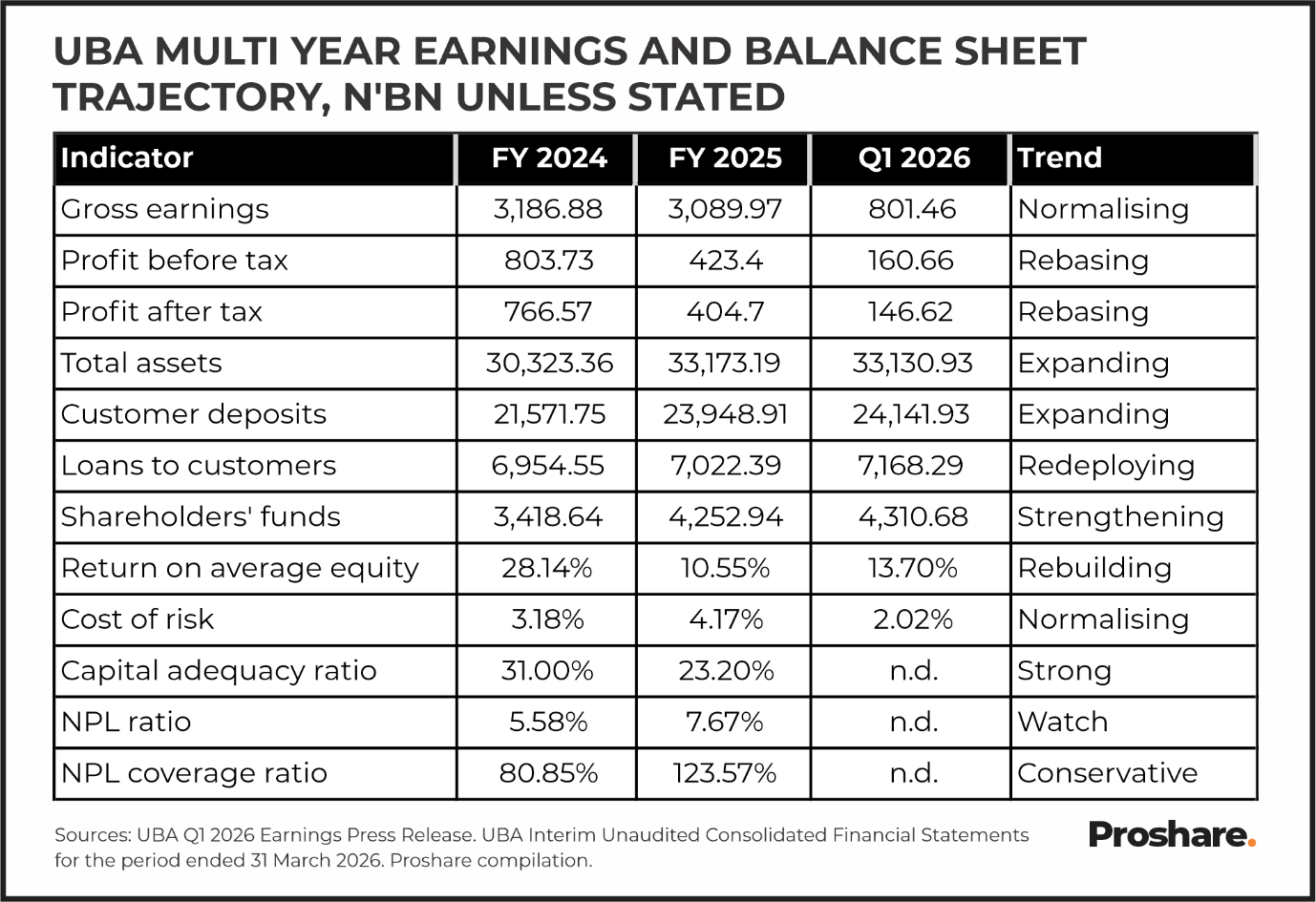
The FY 2025 results can be read in the context of the recent multi-year earnings trajectory. FY 2023 marked the first post-devaluation year, with the naira repricing effect driving an outsized earnings lift. FY 2024 consolidated that gain and delivered the highest headline return profile in recent UBA history. FY 2025 represents the recognition and reset year in which the cumulative post-devaluation mark-to-market cycle was unwound, and the forbearance exit provisioning was absorbed. Seen in that 3-year frame, FY 2025 is the inflexion year rather than the peak or trough. Q1 2026 begins the normalisation.
The nearest cycle peer comparator for the FY 2025 event is First HoldCo, which reported an N748bn impairment charge for FY 2025 under the same forbearance exit dynamic. The comparison is instructive but not symmetrical. First HoldCo absorbed the impairment against a capital base and coverage profile that was still being fortified at the point of release. UBA has absorbed the N331.07bn impairment against a capital base already recapitalised at N395bn, a coverage ratio already lifted to 123.57%, and a loan book already restrained at 1.00% growth. The disclosure envelope on the UBA release is materially stronger at the outset, and the expected repricing pathway should therefore be shorter and more linear, conditional on the Q1 2026 signals holding through to H1 2026.

14. Market Interpretation and Sentiment Pathway
The Q1 2026 release arrived 8 trading days after the audited results and confirmed the cost-of-risk normalisation, providing an early counter-signal that dampens the magnitude and duration of any initial sell-off. Given current NGX liquidity conditions and the analyst recommendation landscape, the sequencing of the two releases is materially more supportive than the FY 2025 release alone would have been.
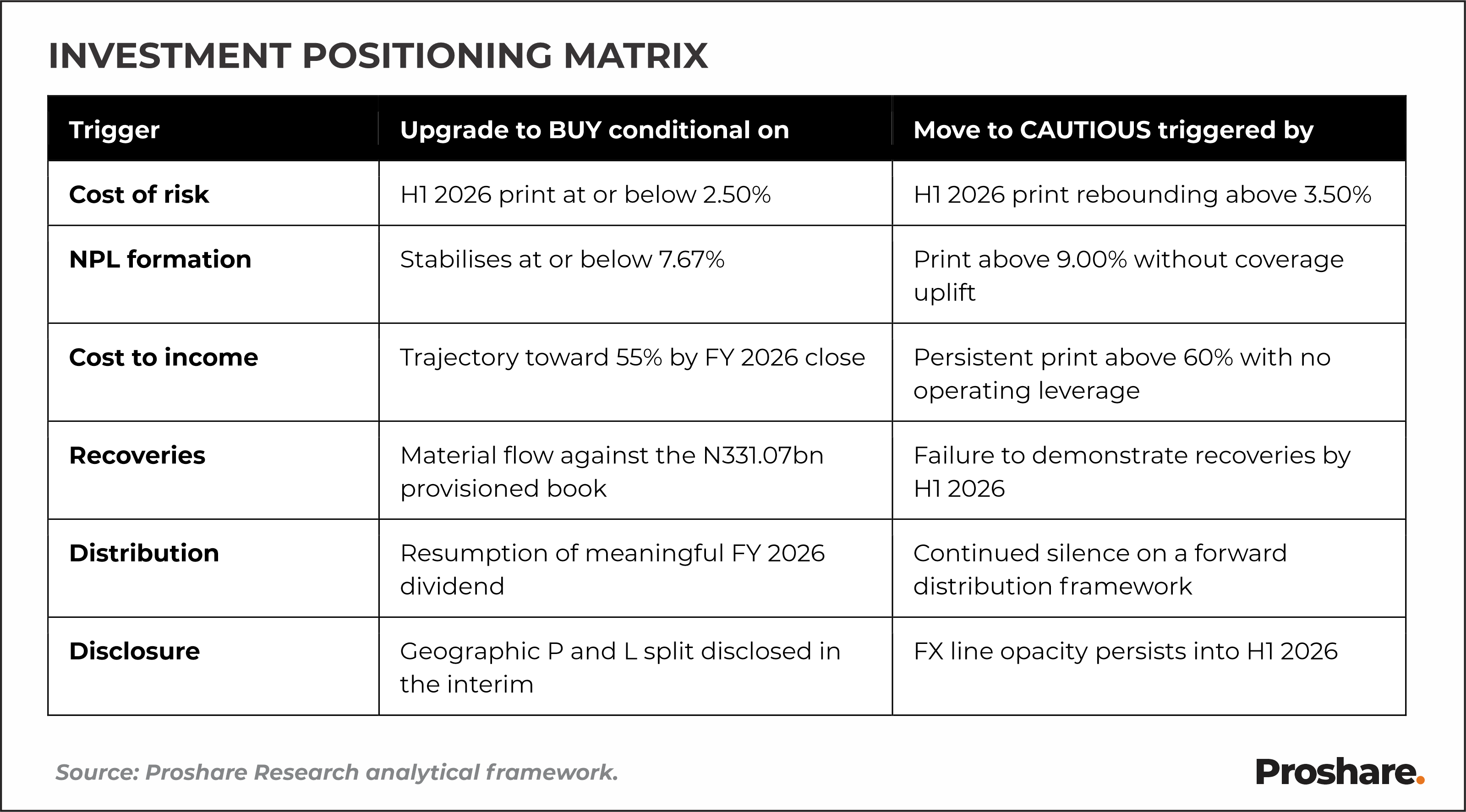
The medium-term repricing is supported by four specific drivers that the Proshare market intelligence unit is monitoring. The first is the cost-of-risk trajectory through H1 2026 and FY 2026, with a sustained print below 2.50% required to validate the reset. The second is the recoveries pipeline against the N331.07bn provisioned book, where a realistic 20% to 30% recovery rate over eighteen months would imply an N66bn to N99bn earnings uplift through the write-back mechanism alone. The third is the cost-to-income ratio trajectory, where a move from the Q1 2026 ratio of 61.20% back toward 55% or below would confirm that FY 2025 cost pressure was cyclical rather than structural. The fourth is the pace of risk asset redeployment, where sustained double-digit loan growth through FY 2026 against the 23.20% capital adequacy headroom would translate balance sheet capacity into net interest income uplift.
Financial Markets News
Table 6.
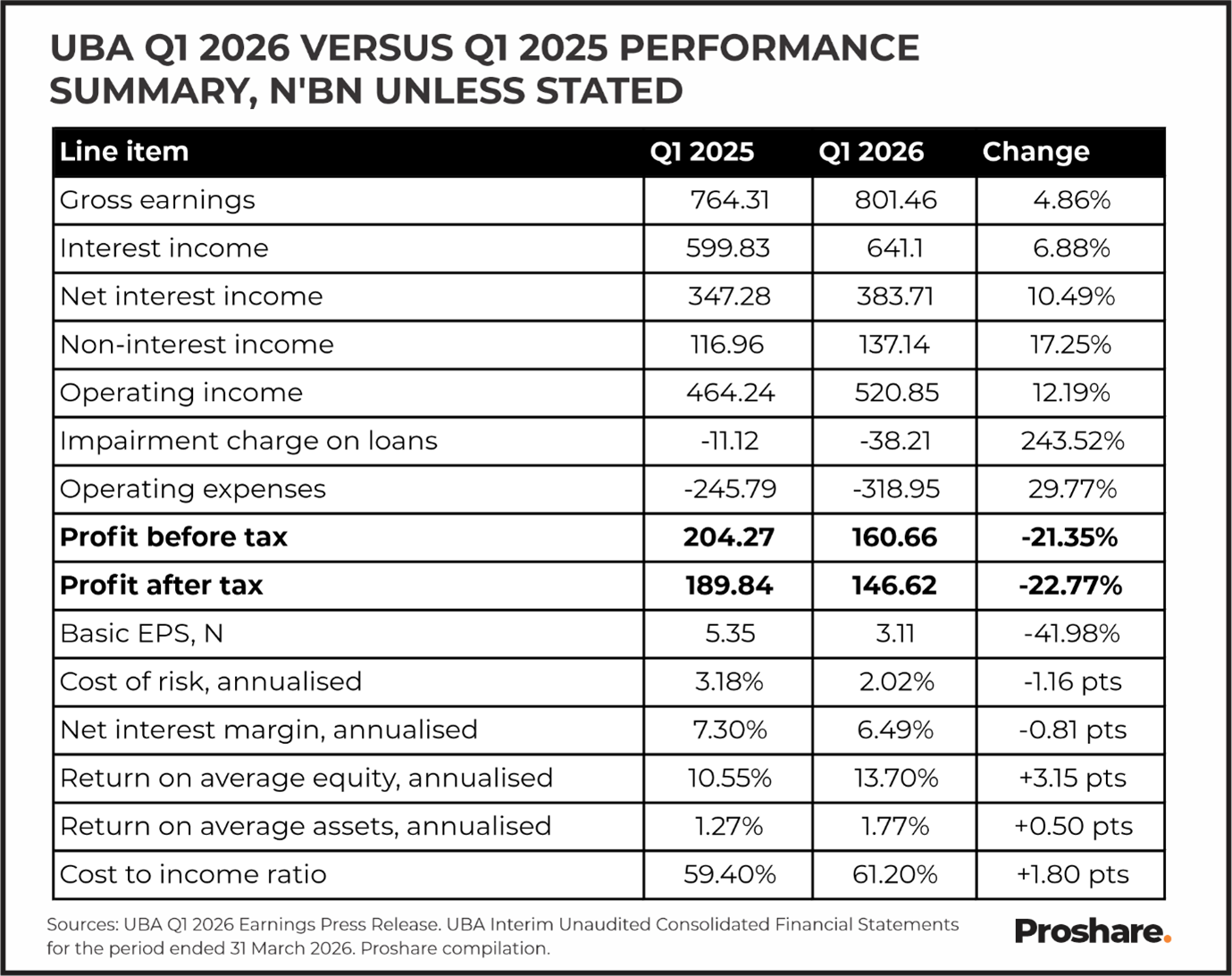
Table 7.
15. Key Risk and Capital Indicators
Table 8.
16. Investment Positioning and Monitoring Triggers
The short window, defined as the 30-to-60 trading-day period following the two disclosure events, is expected to absorb the decline in FY 2025 earnings and the disappointment around the distribution. The medium window, defined as the next two reporting cycles through H1 2026 and Q3 2026, is where the repricing thesis will be tested against the validation signals already present in Q1 2026. The twelve-month window is supported by the capital base, the coverage profile, the Pan African contribution, and the recovery optionality embedded in the provisioned book.
Table 9. Investment positioning matrix
17. Concluding Thoughts
The FY 2025 and Q1 2026 disclosures, taken together, indicate a banking franchise in managed reset rather than deterioration. The two identifiable items that have driven the headline compression, the N331.07bn impairment charge under the CBN forbearance exit and the N282.50bn aggregate derivative and FX-related reversal, are non-recurring in their composition, even where the FX line will continue to carry residual gross volatility. The capital base is fortified. The coverage profile is forward-looking. The deposit franchise has continued to broaden. Q1 2026 signals on cost of risk, return on equity, and loan growth describe an earnings engine returning to normalised operating status. The recovery pathway is plausible on the numbers. Execution discipline and disclosure consistency will determine the trajectory of any repricing.
The FY 2026 cycle will include three defining issues for UBA specifically and for the tier one cohort more generally.
The first is whether the forbearance exit provisioning was calibrated correctly. The second is whether the capital deployed through the recapitalisation programme is generating commensurate risk-adjusted returns. The third is whether the disclosure cadence, including a forward dividend framework, a cleaner FX line decomposition, and a Nigeria against the rest of Africa profit and loss split, is sufficient to rebuild the credibility that a material earnings deviation places under temporary review.
On each of those issues, the current signal set is constructive, and the analytical case now shifts from the balance sheet to the income statement through the next two reporting cycles.
For investors, regulators and policy-aware market participants, the appropriate posture is attentive patience. The reset is holding, and the subsequent execution will determine the repricing.