
By Our Correspondent — Uyo, Akwa Ibom State
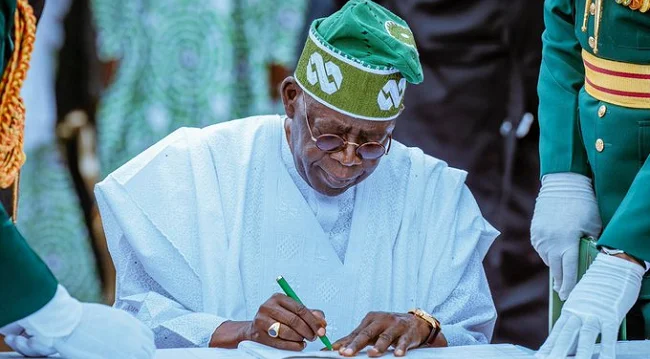
President Bola Ahmed Tinubu on Sunday declared that Nigeria has come out of its worst economic despair and will never return to fuel subsidy, insisting that the painful reforms of his administration saved the country from bankruptcy and from a naira so valueless that Nigerians would have needed wheelbarrows to carry it to market.
Speaking at a State Reception held in his honour in Akwa Ibom State, hosted by Governor Umo Eno, Tinubu said 27 out of 36 governors could not pay salaries when he took office in May 2023, and that the country was in what he called a dark tunnel of possible bankruptcy.
“27 governors of this country were unable to pay salary obligation. Not to talk of pension and gratuity,” Tinubu told the audience of dignitaries at the podium bearing the Seal of the President. “Today, I stand before you to say we are out of that tunnel. I can beat my chest to say we are out of the greatest despair.”
He said the reforms were hard, even for him, and that he shares the pain of ordinary Nigerians.
“That is the truth. It is difficult. It was hard. It was hard for me too,” he said. “And I could say with my history that I’m a comfortable man. I don’t know the pain of the market, but I share your pain. I share the difficulty.”
The President warned that without the decisions taken on the day he took over, the naira would have collapsed completely.
“For certain man, the certainty and the kilometers are possible bankruptcy. By now if we didn’t take actions the day we took over, we will use wheelbarrows to move our naira. Because it would have become valueless. It will have been valueless. Nothing. We are talking of 1,300 now, to a dollar,” he said.
His remarks in Uyo echoed the detailed defence given two weeks earlier in Abuja by his Minister of Finance and Coordinating Minister of the Economy, Taiwo Oyedele, who briefed State House correspondents after the Federal Executive Council meeting on 28 October 2026.
Oyedele had said inflation was at 22.41 per cent in May 2023, usable foreign reserves were only $859 million, not enough to cover one month of imports, the gap between the official and parallel exchange rates was over 60 per cent, debt service was consuming 97 per cent of revenue, and about 27 states could no longer reliably pay salaries. He also said over N30 trillion had been printed through Ways and Means, worth more than $20 billion at the time, and Nigeria is still absorbing its inflationary impact.
In Abuja, Oyedele defended the government’s $21.7 billion supplementary external borrowing plan submitted to the National Assembly, describing it not as borrowing but as investment. The plan comprises $20.52 billion and €1.045 billion, covering 46 projects across 11 sectors over five years.
About $10.6 billion is for transportation infrastructure, including the Lagos-Calabar and Sokoto-Badagry highways and the Kano-Kaduna Metro Rail, with ten flagship projects accounting for 58 per cent at $12.5 billion. Another $4 billion is for social sectors, agriculture, energy, social protection, climate and education, funded entirely on concessional terms. About $7.9 billion will come from multilateral and bilateral partners, led by the World Bank with $5 billion at an average rate of 2.1 per cent, while the commercial component averages 7.8 per cent, below Nigeria’s November 2025 Eurobond yield of 9.1 to 9.6 per cent.
Oyedele stressed that $4.8 billion of the total is for states, the FCT and agencies, with $3.3 billion going directly to states and $1.45 billion through the Bank of Industry, Development Bank of Nigeria, Transmission Company of Nigeria and electricity distribution companies.
“This does not qualify as borrowing. This qualifies as investment,” Oyedele said. “First and foremost, this is a plan. It doesn’t even mean that we borrow all of it.”
He used the Dangote Refinery as an analogy, saying if Aliko Dangote had tried to save to build his refinery it would not have been built in his lifetime, and that to the extent you borrow one naira to create value of more than one naira, you should borrow more.
The borrowing plan has drawn strong criticism from opposition leaders. Former Vice President Atiku Abubakar, presidential candidate of the African Democratic Congress, urged the Senate to suspend consideration until the government publishes a project-by-project breakdown of costs, locations, contractors, loan conditions and repayment obligations. Critics argue total public debt, already at N166.79 trillion as of 30 June 2026, up from N159.35 trillion in March, with external debt at $54.5 billion, could rise further, adding about $1.2 billion to annual external interest.
In Uyo, Tinubu did not address the borrowing figures directly. Instead, he turned to education as the replacement for subsidy, saying he had decided to take the burden of tuition fears away from parents.
“That’s why I decided to take away the responsibility of tuition fears away from parents. Equal opportunity for everybody. You want to read, taking education as the greatest weapon against poverty and creating opportunity for those who are still coming behind,” he said.
He pledged that all money recovered by the Economic and Financial Crimes Commission would go into education.
“From today on, as we are fighting corruption, any money recovered from EFCC, dump it on that education program. It will be, no one can reverse it,” he said.
That pledge aligns with Oyedele’s claim that N372.6 billion has been disbursed through NELFUND to more than 1.5 million students, and that more than N600 billion in cash transfers has reached more than 10 million households, with a target of at least 15 million. Oyedele also cited over 800,000 small businesses receiving single-digit loans, and tax exemptions for low-income earners up to N100,000 per month and for small businesses with turnover up to N100 million.
Tinubu then used a biblical analogy to frame the reforms as irreversible, comparing Nigeria’s journey to Moses leading the Israelites out of Egypt.
“I think, and I believe and speaking in the majority of the Christians. It taught me, my wife is a pastor who taught me once in the Bible that once upon a time there was Moses and Pharaoh. He was in Egypt where he was a magician, he did everything. He won’t let the believer go. They had to leave anyway. They were chasing them towards the Red Sea. The Red Sea parted. I give Moses and these people opening to pass. Those who were chasing them, as across there, they were perishable in the ocean,” Tinubu said.
“So know what, no way you will take back Moses. You won’t go back to Egypt. You must go forward. We go forward and is going forward. Nigeria will never go back to subsidy unless there is a common-sense president.”
He also attacked the opposition, questioning the leadership qualities of his critics and comparing Akwa Ibom’s development, including a resort reclaimed from erosion, to what he described as the failure of opponents to tackle erosion in their own states.
“Here we are on a resort claimed from erosion and we are going to enjoy the one. Would it compare the brain of this man to that of Ob? He ran away from erosion. He ran away from Arizona in Edinburgh and he would now want to be president. President of where?” Tinubu said, in an apparent reference to Peter Obi.
“Keep your promise, I will keep mine. There will be Akwa Ibom deep seaport. God bless you. Thank you very much. Please protect it,” he concluded.
Oyedele, in his earlier briefings on 8 October and 28 October, had also defended subsidy removal on fiscal grounds, warning that returning to subsidy would cost over N20 trillion yearly at 50 million litres daily, and even fixing petrol at N500 per litre would cost over N16 trillion annually. He estimated the exchange rate could approach N3,000 to the dollar within months, and subsidised petrol would cost at least N2,000 per litre.
“A subsidy does not lower the cost of fuel. It only changes how it is paid, and when,” Oyedele said.
He said growth had accelerated from 2.74 per cent in May 2023 to 4.43 per cent in the second quarter of 2026, inflation had fallen from a peak of about 34 per cent to 14.63 per cent in September 2026, from 20.98 per cent a year earlier, and foreign reserves had risen to an 18-year high of over $55 billion, with net reserves exceeding $45 billion.
On food prices, Oyedele said the Federal Executive Council adopted a 90-day action plan to ensure prices of rice, yam, beans and maize remain stable or come down by the end of the year, by importing only unprocessed brown rice to protect local milling jobs, expanding irrigation, improving yields and cutting post-harvest losses.
“We will not only be food sufficient; prices will be stable and affordable, and we will export, and a lot of it will be processed before we export. There is nothing that says people cannot be rich doing farming,” he said.
In Uyo, the audience, including Governor Eno and other officials, listened attentively, but online reaction to the video has been sharply divided. Supporters praised Tinubu as a genius and defended subsidy removal and salary payments as success, while critics mocked the speech, argued paying salaries is a basic duty not an achievement, and raised concerns about inflation and purchasing power, invoking opposition figures in the debate.
The reception ended with Tinubu reiterating his promise of an Akwa Ibom deep seaport, a project he presented as proof that the reforms, however painful, are meant to deliver lasting infrastructure and not just temporary relief.