Lagos Assembly Passes Harmonised Taxes and Levies Bill as JRB Hails Subnational Tax Reform Milestone

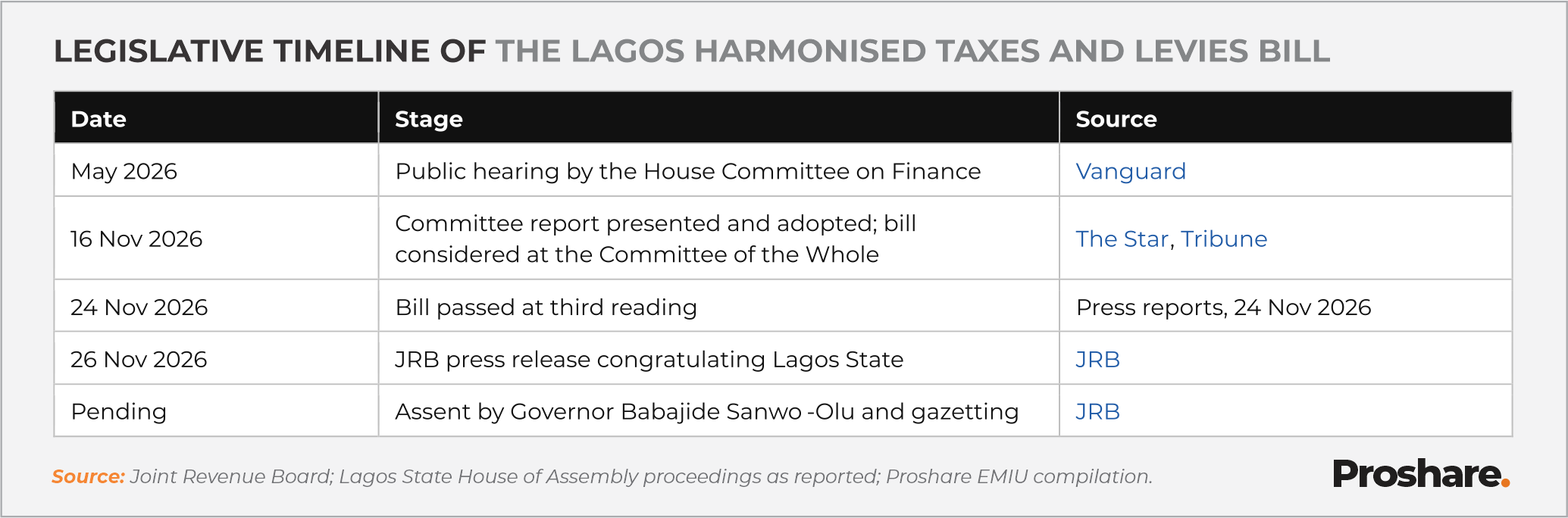
Lagos State has moved its subnational tax harmonisation framework through the State House of Assembly. The Lagos State Harmonised Taxes and Levies (Approved List for Collection) Bill passed third reading on 24 November 2026, and the Joint Revenue Board (JRB) welcomed the passage in a press release dated 26 November 2026. The bill now awaits Governor Babajide Sanwo-Olu’s assent.
Lagos joins a domestication drive the JRB has tracked since the four federal tax laws took effect on 1 January 2026. The Board reported 18 domesticating states at its 160th meeting in Kaduna in September 2026 and 21 states in late October 2026. Lagos was absent from the October list, which places the country’s commercial centre among the later adopters of the model law.
As reported at the public-hearing and committee stages, the bill restricts assessment and collection to authorised tax authorities, prohibits roadblocks for revenue collection, including roadblocks mounted by tax authorities, and provides for electronic payment. The public-hearing draft was reported to consolidate more than 60 levies into nine categories. The text as passed and its schedules have not been published, so the charges retained, the division of collection rights between the state and its local government councils, and the final penalty provisions remain unconfirmed.
Proshare will track the Governor’s assent, the gazetted law and its schedules, the implementation notices the Lagos State Internal Revenue Service issues, and the evidence on whether duplicate demands on traders, transport operators and businesses decline in practice.
Joint Revenue Board Commends the Lagos Assembly
The Joint Revenue Board (JRB) has congratulated the Government and people of Lagos State on the passage of the Lagos State Harmonised Taxes and Levies (Approved List for Collection) Bill by the Lagos State House of Assembly. In a press release dated 26 November 2026, the Board described the passage as a significant milestone in implementing Nigeria’s tax reforms, particularly the harmonisation of taxes and levies at the subnational level, and commended the House for the legislative step.
Buy Maps
According to the JRB, the enactment of the law will strengthen the State’s tax administration framework by promoting transparency, reducing multiple taxation, improving voluntary compliance, and creating a more predictable, business-friendly tax environment. The Board stated that the bill now awaits the assent of the Executive Governor of Lagos State, Mr Babajide Sanwo-Olu.
The Board operates under the Joint Revenue Board of Nigeria (Establishment) Act, 2025, one of the four federal tax laws that commenced on 1 January 2026. JRB Executive Secretary Olusegun Adesokan has said the Act expanded the Board’s mandate to include promoting the harmonisation of taxes, levies, rates, charges and other payments.
From Public Hearing to Third Reading
The bill is titled “A Bill to Enact the Lagos State Harmonised Taxes and Levies (Approved List for Collection) Law, to Provide for the Collection of Taxes and Levies by the State and its Local Government Councils and for Related Matters.” The House Committee on Finance held a public hearing on the bill in May 2026, at which the Speaker, Rt. Hon. Mudashiru Obasa, was represented by the Deputy Speaker, Rt. Hon. Mojisola Meranda.
On 16 November 2026, the Chairman of the House Committee on Finance, Hon. Obafemi Saheed (Kosofe Constituency II), presented the committee’s report at plenary. Saheed said the proposed law would establish a uniform revenue collection framework, eliminate multiple taxation, check the activities of unauthorised revenue collectors and clearly define the collection responsibilities of the state government and local government councils. The House adopted the report and considered the bill at the Committee of the Whole, and passed the bill at third reading on 24 November 2026.
Table 1: Legislative Timeline of the Lagos Harmonised Taxes and Levies Bill
What the Bill Covers
Reports of the bill describe a framework that settles three matters, namely which taxes and levies may be collected in Lagos, whether the state or a local government council may collect each charge, and how payment may be made. Radio Nigeria reported that the legislation targets overlapping demands, arbitrary charges and unauthorised collection affecting residents, traders, transport operators and business owners. Table 2 sets out the provisions as reported at the public-hearing and committee stages.
Buy Maps
Table 2: Reported Provisions of the Lagos Harmonised Taxes and Levies Bill
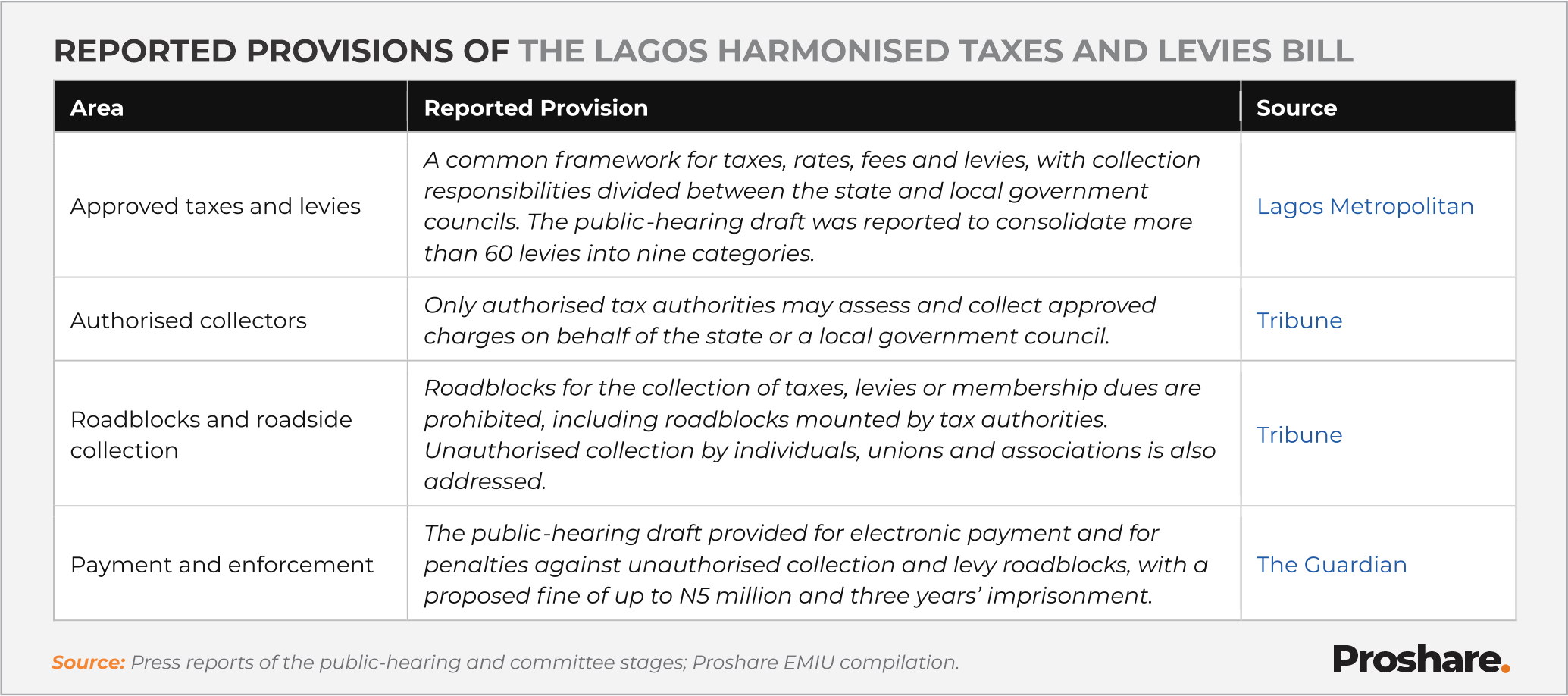
The text as passed and its schedules have not been published. The gazetted law will confirm the specific charges retained, how each charge is allocated between the state and the councils, and whether the electronic payment requirement and the proposed penalties survived unchanged.
Lawmakers Flag Boreholes, Broadcast Licences and Remittance Leakages
During debate on the committee report, Hon. Adebola Shabi called for a review of the proposed borehole charges, particularly on industrial boreholes, noting that government is not the main provider of water. Hon. Bonu Solomon said the state had a proliferation of tax collectors, many of whom allegedly failed to remit collections, and urged measures to regulate them and prevent revenue leakages. The Speaker cautioned against the indiscriminate sinking of multiple boreholes in communities and called for the regularisation of radio and television licence fees, with a review of the relevant provisions.
Lagos and the National Harmonisation Drive
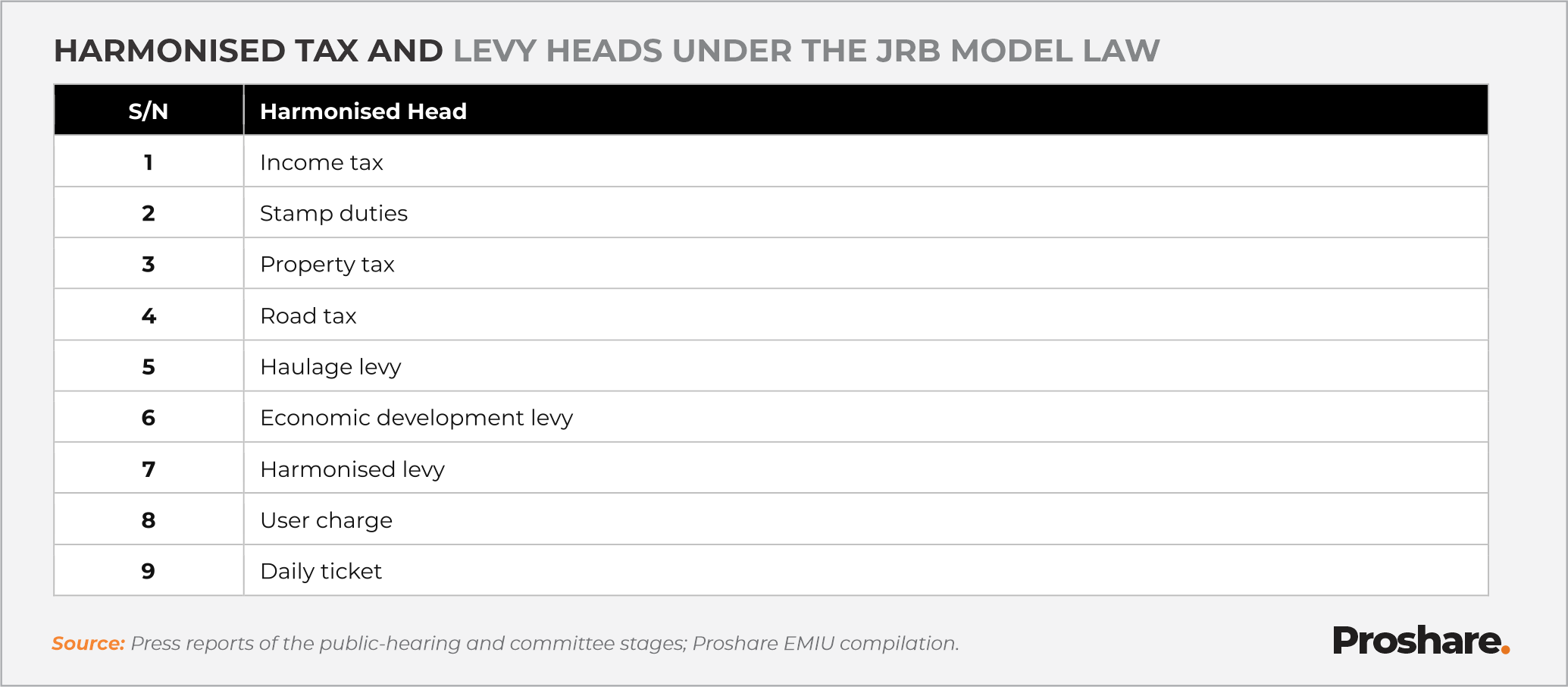
The JRB reported at its 160th meeting, held in Kaduna on 1 and 2 September 2026, that 18 State Houses of Assembly had domesticated the Model Harmonised Taxes and Levies Law and that the levies administered by states and local governments had fallen from more than 50 items to nine. At a press briefing reported by Nairametrics on 29 October 2026, Adesokan put the number of states at 21 and said the harmonised heads were replacing more than 100 fragmented taxes and levies at the subnational level. Lagos did not appear on that list. Adesokan also announced zero tolerance for roadblocks erected to facilitate cash collection, a position he said is supported by the model law and the Presumptive Tax Regulations, 2026.
Table 3: Harmonised Tax and Levy Heads Under the JRB Model Law
LIRS and the Implementation Layer
The Lagos State Internal Revenue Service (LIRS) describes itself as the operational arm of the Lagos State Government responsible for the collection of taxes and other revenues. In the bill as presented at the public hearing, LIRS was named as the collecting authority, with revenue shared between the state government and local government councils, according to Vanguard.
LIRS carries on its publications page the communiqué issued at the end of the 159th meeting of the JRB, held from 20 to 22 April 2026 at Eko Hotels & Suites, Victoria Island, Lagos. In the LIRS summary, the Board deliberated at that meeting on strategies to strengthen tax administration and promote fiscal coherence across all levels of government. The state-level harmonisation sits alongside the federal administrative framework in the Nigeria Tax Administration Act, 2025 and the General Transition Guidelines for the Tax Acts 2025, and alongside the federal revenue performance Proshare has tracked through H1 2026.
Financial news subscription
Highlights
First, the Lagos State House of Assembly passed the Harmonised Taxes and Levies (Approved List for Collection) Bill at third reading on 24 November 2026, and the JRB welcomed the passage on 26 November 2026.
Second, the bill awaits the assent of Governor Babajide Sanwo-Olu, and no gazetted copy has been published.
Third, the bill as reported restricts collection to authorised tax authorities, prohibits revenue roadblocks, including roadblocks mounted by tax authorities, and provides for electronic payment.
Fourth, Lagos was not among the 21 states the JRB listed in October 2026 as having passed the model law, which consolidates subnational levies into nine harmonised heads.
Closing Thoughts and Forward Outlook
Lagos will complete its domestication of the model law once the Governor assents and the law is gazetted. The schedules will show how the reported consolidation of more than 60 levies into nine categories translates into specific charges for traders, transport operators and businesses, and how collection rights are divided between LIRS and the local government councils. Proshare will track the assent, the gazetted text and schedules, the implementation notices LIRS issues, and the JRB’s next update on the national domestication count.