
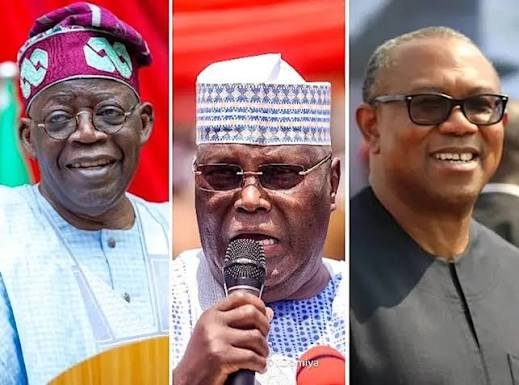
The 2027 presidential election will not be won in the South-West, where Bola Tinubu is strongest, nor in the South-East and South-South, where Peter Obi holds sway, nor in the North-East and North-West, where Atiku Abubakar is strongest. It will be won, or lost, in the Middle Belt, and that single fact changes how the whole contest should be read. The Middle Belt, also known as the North Central, comprises Benue, Plateau, Nasarawa, Kogi, Kwara, Niger and the Federal Capital Territory and, in its wider cultural sense, Southern Kaduna, Southern Taraba and parts of Adamawa, Bauchi and Gombe. It is the only place in Nigeria where no one owns the votes, where all three leading men can win and all three can lose, and where Nigeria still looks like Nigeria: mixed and divided, Traditionalist, Christian and Muslim, farmer and herder, Igala, Tiv, Idoma, Berom, Nupe and Gbagyi, all living side by side and all voting differently. That is why 2027, a contest sadly deeply divided along ethnic lines, will be decided by the people who refuse to be owned by any ethnic line, not least the restless, informed young voters of the third force.
Let us look at 2023 not through sentiment but through numbers, because numbers do not lie, even when politicians do. In 2023, in the North Central, Tinubu polled 1,760,993 votes, representing 41.3 percent, Obi polled 1,415,557 votes, representing 33.2 percent, and Atiku polled 1,025,178 votes, representing 24.1 percent. No one dominated. No one swept the zone. It was a three-way fight, and the margins reveal just how fragile any claim of ownership really is. Tinubu won Benue by a mere 2,096 votes, 310,468 to Obi’s 308,372, a sliver in a state of millions. That is not a victory; it is a coin toss. Obi won Plateau by 159,077 votes, 466,272 to Tinubu’s 307,195, and Nasarawa by 18,439 votes. Tinubu won Kogi, Kwara and Niger, while the FCT went to Obi. That is the definition of a battleground: every state is winnable, every state is losable, and every vote counts. Contrast this with the other zones, and the interpretation becomes sharper. In the South-East, Obi took 88 percent. That is not an election; it is a coronation. In the South-West, Tinubu took 54 percent. That is a home base. In the core North, across the North-West and North-East, Atiku and Tinubu split the Hausa-Fulani bloc, while Obi managed only about 6 percent in the 10 core Hausa-Fulani states. That is a wall. The Middle Belt has no wall and no coronation; it has a contest. Since 1999, no Southern presidential candidate has been elected or re-elected without winning, or performing strongly, in the North Central. Obasanjo knew it. Jonathan knew it. Buhari knew it. Tinubu knew it. That rule has not changed. Whoever wins the Middle Belt in 2027 wins Nigeria; whoever loses it, loses Nigeria.
2027 is deeply divided along ethnic lines, and to pretend otherwise is to lie, but the way that division plays out in the Middle Belt is different from anywhere else. Tinubu comes to the Middle Belt with incumbency: the APC controls all six North Central states, with their governors and federal appointments, and he argues, “I have been fair to you.” He has defused the anger over the Muslim-Muslim ticket through appointments and patronage, bringing Middle Belt elites into his government. He has won over Southern Kaduna with the appointment of Defence Minister Chris Musa, and he has brought Plateau’s Governor Mutfwang and his rival Yilwatda into the same APC tent. His message is, “Stay with power. Power is already in your hands.” Interpreted critically, incumbency is both his weapon and his burden. He controls the structures, but he also owns the record on insecurity, hunger, and the killings in Benue and Plateau. The Middle Belt will ask the question his campaign would prefer to avoid: if power was already in our hands, why did the farms remain empty, why did the IDP camps remain full, and why did the killings continue? Patronage to elites does not answer that question for the woman in the market, and in 2027, that gap between elite inclusion and mass protection may be the decisive crack in the incumbency argument.
Atiku comes to the Middle Belt with the old PDP machine, now rebranded as the ADC, and the narrative that “the North must reclaim power.” He banks on the North’s numbers and on anger over insecurity, herder-farmer killings and hunger. His message is, “The South has had its turn. Return power to the North, and the North will protect you.” But the Middle Belt remembers: when Atiku was powerful, did the killings in Benue stop? Did the killings in Plateau stop? The Middle Belt is Northern in geography but not in loyalty; it has always felt like the North’s forgotten child. Interpreted fully, Atiku’s appeal rests on a dangerous assumption, that geography equals loyalty. The Middle Belt’s history contradicts that assumption. It has been used as a buffer, a battleground, and a bargaining chip by the core North, but rarely protected as a priority. To ask the Middle Belt to vote for a return to the North is to ask it to return to an arrangement in which it was marginal, and that is why Atiku’s Northern arithmetic may collapse the moment it meets Middle Belt memory.
Obi comes to the Middle Belt with the youth, the Obidient movement, a moral argument for competence, and the memory of 2023, when he won Plateau and Nasarawa not because he is Igbo, but because he was seen as a candidate who would not kill for politics. His message is, “I am not your tribesman, but I am your brother in suffering.” His weakness is the core North wall; his strength is that in the Middle Belt, no such wall exists. In Benue, Plateau and Nasarawa, a Southern candidate can win because the Middle Belt sees itself in him, not ethnically, but experientially. Interpreted critically, Obi’s strength is also his test. Sympathy is not organisation, and moral clarity is not a security plan. His challenge in 2027 is to convert the feeling that he understands suffering into a concrete, credible programme that can hold Kogi, Kwara, Niger and the FCT, where he lost in 2023, and to prove that competence can protect a farmer in Benue as surely as it can balance a budget in Anambra.
Three armies. One battlefield. No majority for anyone. Yet there is another bloc that all three campaigns ignore at their peril: the third force. It is made up of restless, informed youths and young adults who do not regard political party or ethno-religious sentiment, and by this account they constitute over 70 percent of voters. They are not Tinubu’s, Atiku’s or Obi’s by birth or by habit; they read the figures, weigh promises against records, and judge candidates on performance rather than on tribe, tongue or creed. In the Middle Belt, where no one owns the votes, this bloc matters most, and any candidate who ignores the social media community will regret it. This is the critical shift of 2027. The old politics assumed voters were inherited. The new politics, driven by phones, data, and lived hardship, assumes voters must be earned. The Middle Belt youth do not ask “Where are you from?” first. They ask “What did you do when you had power?” To treat them as a hashtag, a crowd for a rally, or a target for a cash handout is to misunderstand them completely. They are not a swing vote in the old sense; they are a judgment vote, and judgment is harsher than loyalty.
Go to Makurdi market and talk to a woman selling yams. Ask her, “Who will you vote for?” She will not immediately say “Tinubu,” “Atiku” or “Obi.” She will say: “Who will stop the killings? Who will let my husband go to farm? Who will let my children go to school without fear?” She does not care about the South-West, the North-East or the South-East. She cares about survival. She is the Middle Belt. She is the battleground. In Lagos, people vote for tribe. In Kano, they vote for religion. In Enugu, they vote for identity. In Makurdi, they vote for life. That is why the Middle Belt is different: it is not voting for who is from where, but for who will protect where. The candidate who understands that woman will win the Middle Belt. The candidate who treats her as a statistic, a “bloc,” a “religion vote” or a “Northern vote,” will lose her. Her question reframes the entire election. It is not a question about rotation, or about which zone deserves power, or about which candidate is the most nationalist in theory. It is a question about protection in practice. Any candidate who cannot answer it with dates, numbers, troops, ranching, justice, roads and markets, has not understood the assignment.
Let us be honest: 2027 is dangerously divided along ethnic lines, and nowhere will that division be more dangerous than in the Middle Belt. The three campaigns will come to the Middle Belt and try to divide it. Tinubu’s people will say: “Obi is Igbo. Atiku is Fulani. Only Tinubu is a nationalist.” Atiku’s people will say: “Tinubu is Yoruba. Obi is Igbo. Only Atiku is a Northerner like you.” Obi’s people will say: “Tinubu is Muslim-Muslim. Atiku is Fulani. Only Obi will protect Christians.” All three will be lying, and all three will use the Middle Belt as a pawn in a chess game played in Lagos, Abuja and Anambra. If the Middle Belt falls for that trap, it will lose. It will be divided, Igala against Tiv against Idoma, Berom against Hausa, Christian against Muslim, farmer against herder, and while it fights itself, the winner will take the presidency and forget it again. But if the Middle Belt refuses the trap, it will win. It will become the kingmaker, not the pawn. How? By voting on issues, not ethnicity, and by asking every candidate the same four questions. What is your plan to end the killings in Benue, Plateau, Southern Kaduna, and Taraba? Not promises. Plans. Dates. Numbers. Troops. Ranching. Justice. What is your plan to return our farms, our schools, our IDP camps to life? Not rice palliatives. Production. Roads. Markets. What is your plan to make us owners, not tenants, in Nigeria? Not appointments for two elites. Ownership for millions. What is your plan to engage young, informed voters and the social media community? Not hashtags. Substance. Listening. Answers. The candidate who answers these questions with specifics, not slogans, deserves the Middle Belt. The candidate who answers “I am your brother” deserves nothing. These four questions are not a wish list; they are a test of whether a candidate sees the Middle Belt as a people to be protected or a territory to be won.
The Middle Belt is Nigeria in miniature. It is the only place where a Hausa Muslim and a Berom Christian share the same street, where a Yoruba trader and an Igala farmer share the same market, and where a Fulani herder and a Tiv farmer share the same land, and sometimes fight over it. If Nigeria can work in the Middle Belt, it can work anywhere. If Nigeria fails in the Middle Belt, it fails everywhere. In 2027, the Middle Belt has a historic opportunity: to stop being the battleground where others fight and become the referee who decides. The referee fights for no team. The referee blows the whistle and declares: “This is foul. This is fair.” The Middle Belt must blow the whistle on ethnic politics. It must say to Tinubu: “We will not vote for you because you are Yoruba; we will vote for you if you protect us.” It must say to Atiku: “We will not vote for you because you are Northern; we will vote for you if you protect us.” It must say to Obi: “We will not vote for you because you are Christian; we will vote for you if you protect us.” That is power. That is ownership. That is maturity. That is also the only way the Middle Belt stops being a prize and becomes a power.
In 2027, the South-West will vote for its son, the South-East will vote for its son, and the North-West and North-East will vote for theirs. The Middle Belt will vote for its survival, and because it votes for survival, it will decide who becomes president. The third force will vote for performance, and no candidate can afford to ignore it. To the candidates: Do not come to the Middle Belt with ethnic arithmetic; come with a plan for life. To the people of the Middle Belt: do not sell your votes for wrappers, for rice, for ₦5,000. Your vote is the most valuable thing you own. It is the price of your farm and of your child’s life. Do not sell it cheap. To Nigeria: Watch the Middle Belt. If it votes in peace, Nigeria will have peace; if it is divided by blood, Nigeria will bleed. The Middle Belt is the battleground, but it need not be a battlefield. It can be a bridge. In 2027, let the Middle Belt be the bridge that carries Nigeria from ethnic division to national ownership. Whoever wins the bridge, wins Nigeria. Whoever burns the bridge, burns Nigeria.