
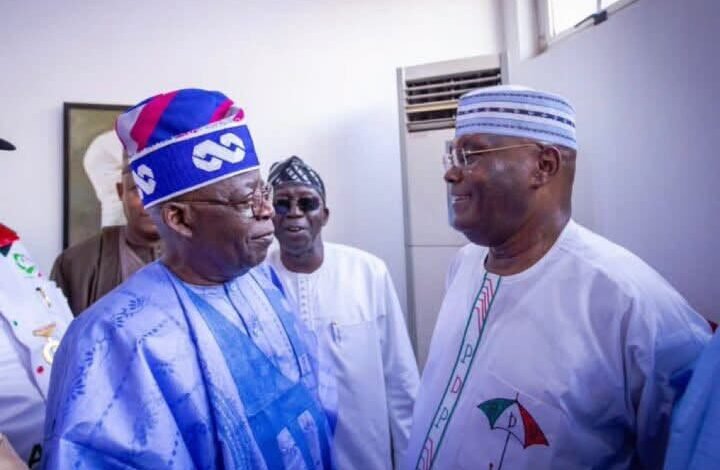
When President Bola Tinubu extended his warmest congratulations to former Vice President and African Democratic Congress Presidential Candidate, Alhaji Atiku Abubakar, on his 80th birthday on November 25, 2026, he did more than observe a courtesy. He offered the country a lesson in what politics without bitterness looks like when it is practised by the man at the top. In a political culture where birthdays of opponents are often ignored, mocked, or turned into occasions for veiled attacks, Tinubu chose celebration. He chose to honour a man who is not his ally, not his party member, and not his supporter, but his rival. That choice is the message.
The President’s commendation of Atiku’s contributions to national progress and development over the years is significant because it does not qualify the praise. He does not say Atiku contributed despite being in opposition. He does not say Atiku contributed in the past but not now. He simply acknowledges a lifetime of service. That is politics without bitterness in its simplest form: the ability to recognise merit even when it belongs to someone on the other side. It is the refusal to erase a rival’s record because the rival is still contesting for power.
Tinubu goes further by recalling a history that many politicians would prefer to forget. He notes the many years of political engagement and undying commitment to democratic pluralism that he shares with Atiku, including his support for Atiku’s 2007 presidential bid under the defunct Action Congress platform. That memory is not nostalgia. It is evidence. In 2007, Tinubu put his political weight behind Atiku when it would have been easier to stand aside. That support reflected his conviction, as he now states, that democracy thrives when political actors can participate freely, present alternative visions, and contribute to the national conversation on leadership and governance. A man who truly believes in politics without bitterness does not only preach it when he is in power. He practised it when he was building power, and he remembers it when he has power.
The philosophy Tinubu articulates in the message is consistent and deliberate. His political philosophy has consistently emphasised the need to deepen democracy, strengthen political institutions, respect divergent opinions and sustain an environment where political competition serves the larger interests of Nigerians. That is not the language of a winner-takes-all politician. It is the language of a democrat who understands that institutions outlast individuals, and that democracy is weakened when every election becomes a war and every opponent becomes an enemy. By insisting that political competition must serve the larger interests of Nigerians, Tinubu reframes rivalry itself. Opponents are not obstacles to be destroyed. They are participants in a shared project, even when they disagree sharply on how to run it.
That reframing is made explicit in his most important line: he has always advocated politics without bitterness and leaving room for reconciliation after differences or disagreements with political opponents. Leaving room is the key phrase. Bitterness closes room. It makes reconciliation impossible. It makes every disagreement permanent. It turns politics into a cycle of revenge. Tinubu is saying that he has always left that room open, and that he continues to leave it open, even with a man who is now the presidential candidate of another party and who holds contrasting views on national issues. Despite different political affiliations and occasional disagreements, he insists, Nigeria’s democracy must continue to benefit from citizens who remain committed to democratic engagement, national development, and the rule of law. That is a president telling his supporters that disagreement is not disloyalty, and telling his opponent that opposition is not enmity.
Tinubu’s recognition of Atiku’s contributions beyond politics deepens the portrait. He notes Atiku’s contributions to education, entrepreneurship and the private sector. He notes his involvement in business development and investments that have created economic opportunities and jobs for our people. Of particular significance, he says, is Atiku’s establishment of the American University of Nigeria, Yola, which has expanded access to quality higher education and strengthened human capital development. A bitter politician would not praise an opponent’s university. A bitter politician would ignore it, or diminish it, or suggest it was built for personal gain. Tinubu praises it as a national asset. He treats Atiku’s private success as public good. That is the generosity that politics without bitterness requires: the ability to see a rival’s achievement as Nigeria’s achievement.
The closing of the message is where the embodiment becomes complete. Although the former number two citizen and he now travel different paths and hold contrasting views on national issues, Tinubu says, their shared commitment to Nigeria’s unity and democratic stability must remain paramount. He does not pretend the differences do not exist. He does not pretend they are on the same path. He acknowledges the distance, and then he places something above it: unity and democratic stability. That is the hierarchy of a statesman. Party is below country. Ambition is below stability. Rivalry is below unity. And as the former vice president joins the Octogenarian Club, Tinubu wishes him good health, renewed strength and many more years of service to the nation and humanity. He wishes a rival more years, not fewer. He wishes him strength, not weakness. He wishes him continued service, not retirement.
In that wish is the whole meaning of politics without bitterness. It is not the absence of competition. Tinubu and Atiku have competed, and they will compete again. It is not the absence of disagreement. Tinubu says they hold contrasting views. It is the presence of respect inside competition, and reconciliation inside disagreement. By felicitating Atiku at 80, Tinubu has shown that a president can be firm in his own convictions, loyal to his own party, and still honour his opponent. He has shown that power does not need to be bitter to be strong. He has shown, in word and in deed, what it means to be an embodiment of politics without bitterness.