


Nigeria’s headline inflation rose 31.61bps to 15.38% in March 2026 from 15.06% in February, the first monthly acceleration in eleven months. Food inflation climbed 218.8bps to 14.31%, and core inflation rose to 16.21%. The attribution is external and identifiable. The US and Israel strike on Iran on 28 February 2026 produced a Middle East war through March that drove Brent above $109 per barrel from $60.85 on 31 December 2025, and WTI above $102 from $57.95, with Hormuz disrupted.
The transmission to Nigeria ran through energy, transport, and hospitality channels, accompanied by a 1.68% depreciation of the naira at the NFEM window to N1,386.72 and a 1.41% depreciation in the parallel market to N1,420.
The signal is more subtle than the headline. Monthly headline inflation at 4.18% and monthly core at 4.03%, both accelerating for a second consecutive month, indicate that macroeconomic stability remains fragile even when the external driver is identifiable. EA-Proshare economic analysts read the pause in disinflation as temporary and externally attributable, with the forward path dependent less on oil price volatility and more on market liquidity, security, and domestic policy coherence.

Nigeria’s headline inflation rose for the first time in eleven months, marking a pause in the disinflation trend. Headline inflation rose by 31.61 bps to 15.38% in March 2026 from 15.06% in February, confirming our February 2026 projection of renewed but temporary price pressures.
The NBS data reveal that the impact on overall price conditions was broad-based. Food inflation rose by 218.8bps to 14.31% in March 2026 from 12.12% in February, while core inflation grew by 33.25bps to 16.21% from 15.88%.
Of the 13 CPI Categories monitored by the NBS in March 2026, consumer prices decelerated (Y-o-Y) across 9 categories/divisions and accelerated (Y-o-Y) across 4, including food and non-alcoholic beverages (14.09%), Transport (16.89%), Hospitality (25.17%), and Personal care (24.48%). The aggregated weight of the 4 accelerating CPI categories accounted for 66.89 points out of 100 in the entire CPI basket, compared with 33.12 points for the 9 decelerators.
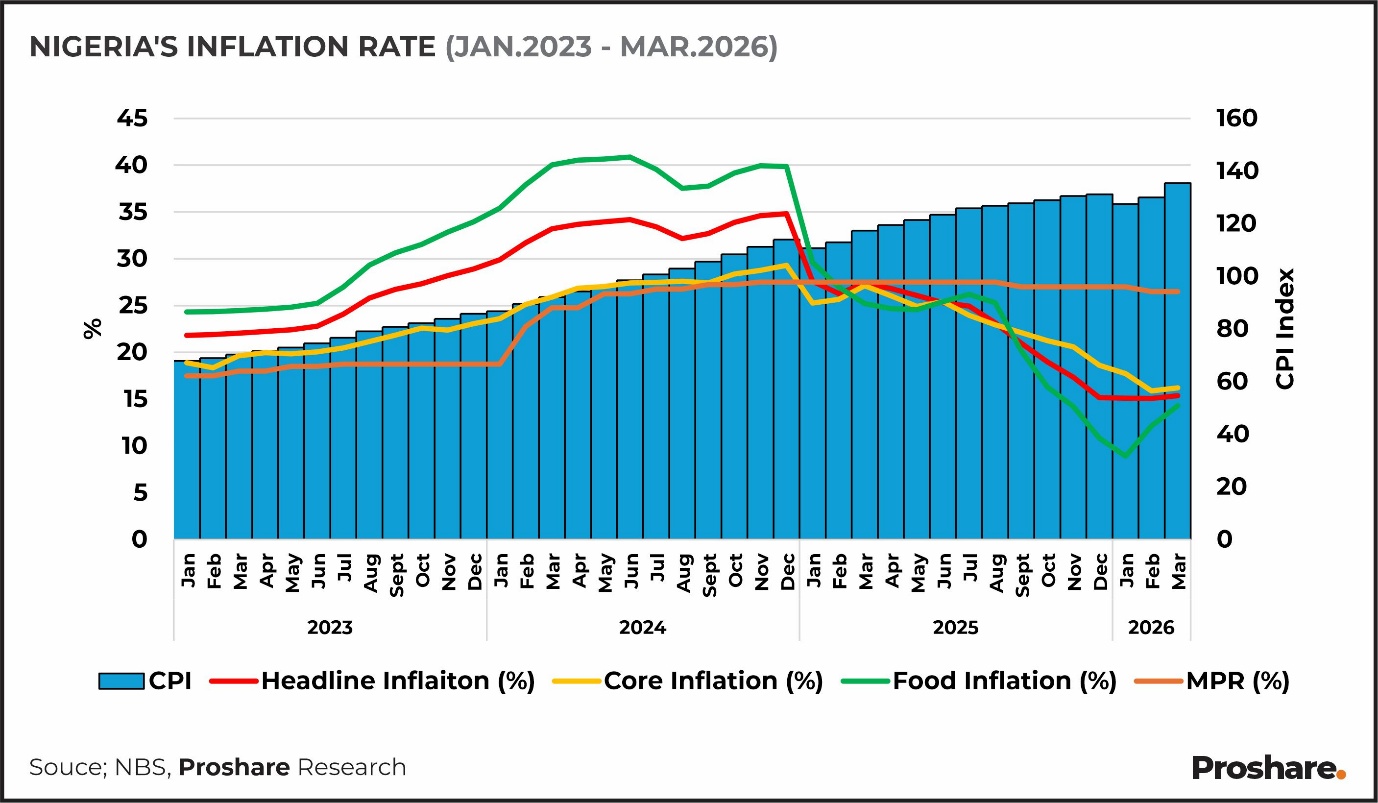
The departure from the deceleration trend mirrors similar, albeit more subtle, conditions in March 2025, when headline inflation accelerated for the first time in three months but by just 10.76 bps before decelerating through the rest of the year. This may therefore be a peculiarity of March. Mr Samuel Sule, CFA, CEO, Renaissance Capital Africa, notes that, “March was a month of volatility driven by the Middle East crisis. The result was higher oil prices, which are having an impact on transport and food basket prices.”
Similarly, stronger price pressures in March closely align with the prevailing global energy/commodity price shock driven by instability in the Middle East. Conflict emerged in the Middle East on February 28, 2026, following the US and Israel’s strike on Iran. The war intensified and lasted throughout March 2026, significantly impacting energy commodity prices and supply chains. Brent crude prices rose by over 70%, crossing $109/barrel as of March 31, 2026, from $60.85/barrel on December 31, 2025, while WTI touched $102.88/barrel, rising by over 90% from $57.95/barrel at the end of 2025 amid a prolonged disruption at the Strait of Hormuz.
Sticky headline prices in March were also accompanied by a slight depreciation of the naira, which fell by 1.68% month-on-month to N1,386.72/$ in the official market and by 1.41% to N1,420/$ in the parallel market, from N1,363.72/$ and N1,400/$, respectively. Liquidity conditions across the equities and bond markets remained stable in the month. “Ordinarily, financial assets ought to commence migration to debt due to the above factors, but market reforms have strengthened equities market resiliency,” according to David Adonri of Highcap Securities.
On a monthly basis, headline inflation accelerated for a second consecutive month by 217.25bps to 4.18% in March 2026 from 2.01% in February. Similarly, core inflation rose for the second consecutive month, by 313.83 bps to 4.03% in March 2026, up from 0.89%. According to Dr Muda Yusuf, CEO, CPPE, “…the resurgence of monthly inflation pressures signals that macroeconomic stability is still fragile.”
Food prices remained sticky at around 4.17% in March, down from 4.69% the previous month; however, the largest increases came from the energy, transport, and hospitality consumer divisions.
Of the 13 CPI Categories monitored by the NBS in March 2026, monthly consumer price inflation accelerated in 12 CPI Categories with a total weight of 97.06 points, with deceleration in only 1 (Furnishing and Household Equipment category at 0.81% in March 2026 from 0.12% the previous month). Categories with major price increases include
- Food and non-alcoholic beverage CPI inflation accelerated to 5.12% in March 2026 from 5.08% in February 2026, amid higher costs for farm produce (4.60% from 3.74%) and energy (6.62% from -0.12%).
- Transport service inflation accelerated to 3.98% in March 2026 from -1.02% in February
- Housing, water, electricity, and other fuels CPI inflation climbed 4.07% in March 2026, from -0.45% in February 2026
- Hospitality (Restaurant and Accommodation) services inflation rose to 6.92% from -0.08%.
Rural and Urban Inflation Dynamics in March
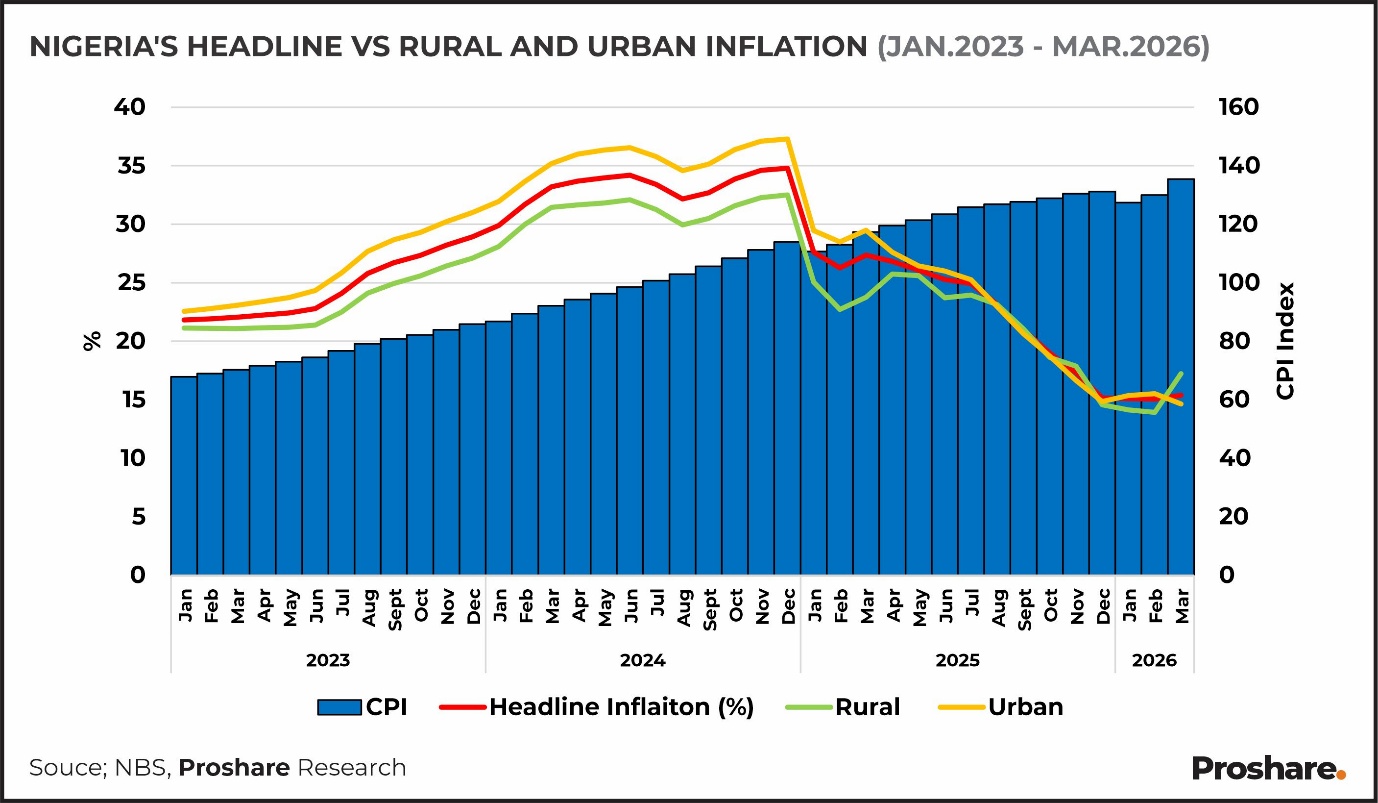
Rural inflation jumped to 17.22% in March 2026 from 13.9% the previous month amid rising food costs, while urban inflation eased to 14.64% in March from 15.53%, reflecting more diversified consumption patterns and a base-year effect across urban and rural price dynamics.
M-o-M, Price pressures were higher but varied widely across rural and urban settlements. Urban inflation rose by 61.13bps to 3.16% in March 2026 from 2.55% in February 2026, while rural inflation jumped significantly by 601.27bps to 6.73% in March 2026, from 0.71% in February. Prof. Frances Obafemi of the University of Calabar notes that “purchasing power will weaken” across urban and rural settlements as price pressures persist.
Profiling Inflation Across States in February 2026
Year-on-Year, 24 of 36 states, including the FCT, have consumer price levels higher than the national headline inflation average of 15.38%, while only 12 states have inflation below that average. Bayelsa (27.37%), Sokoto (26.03%), Bauchi (23.67%), Cross River (23.59%), and Kwara (22.86%) ranked as the top five states with the highest headline inflation in March 2026 amid higher energy and transportation costs.
Higher logistics costs and insecurity amplified food price pressures in March. Consequently, 22 of 36 states and the FCT reported food inflation above the national average of 14.31% in March 2026, while 14 states reported food inflation below it. Food price pressures were highest in Bayelsa (33.35%), Sokoto (28.02), Adamawa (21.67%), Kwara (21.66%), and Delta (21.57%) in March 2026. Conversely, Kano (4.29%), Oyo (4.86%), Katsina (7.48%), Lagos (9.63%), and Jigawa (9.99%) recorded the lowest food inflation rates in March 2026.
Month-on-Month, 19 of 36 states, including FCT, have consumer price levels higher than the headline inflation, while the remaining 17 states have inflation below the national headline average of 4.18%. Zamfara (10.77%), Bauchi (9.37%), Sokoto (9.05%), Niger (8.40%), and Bayelsa (8.39%) rank as the top five states with the highest headline inflation in March 2026. 21 states reported food inflation above the national average of 4.17% in February 2026, while 17 states reported inflation below it. Sokoto (11.78%), Niger (8.59%), Gombe (8.10%), Bauchi (7.81%), and Kwara (7.49%) rank as states with the highest monthly food prices in the second month of the year.
Concluding Thoughts
The inflation outcome in March aligns with our previous expectations that the global energy sector shock stemming from the US-Israel-Iran war will pose a temporary, distortionary threat to the domestic disinflation trend. With the two-week truce between the US and Iran set to expire by April 21-22, Iran’s conditional reopening of the Strait of Hormuz, alongside ongoing talks toward a permanent Middle East ceasefire, has provided some tentative easing of risks to energy commodity prices, although conditions remain fragile.
For Nigeria, geopolitical disruptions have mainly been transmitted through commodity and energy price channels, with impacts likely to persist into April. The near-term outlook for stability and overall macroeconomic conditions is expected to depend less on external commodity price shocks and more on market liquidity, improved security, and greater coherence in domestic reforms/policy.