The Nigerian National Petroleum Company (NNPC) reported Revenue of N2.7trn in February 2026, representing a 4.2% month-on-month (MoM) increase from the N2.6trn recorded in January. Despite the top-line growth, Profit After Tax fell sharply by 64.7% to N136.0bn, down from N385.0bn in the preceding month. This significant drop in profitability was primarily driven by a presidential directive that ended the company’s prior 30% profit-retention arrangement. As a result, statutory remittances to the federation account rose markedly by about 148.5% to N1.8trn in February. While this development has compressed NNPC’s bottom line, it highlights the Federal Government’s push to strengthen fiscal revenues by increasing oil-related remittances amid ongoing budgetary pressures.
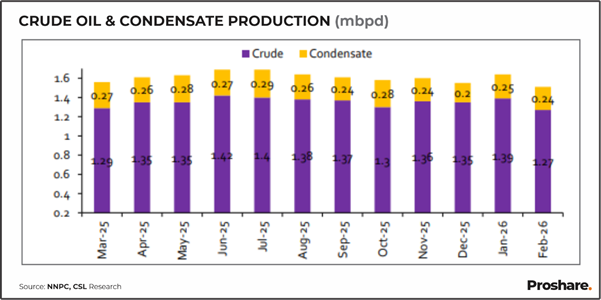
The revenue growth recorded in February came despite a decline in crude oil production, which fell from 1.6 million barrels per day (mbpd) in January to 1.5 mbpd. The Nigerian National Petroleum Company attributed the drop in output to a series of operational disruptions, including an outage on the Trans Forcados Pipeline caused by integrity issues, start-up challenges at the Agbami GTC facilities following turnaround maintenance, and sludge management constraints at the Enyie wells. These issues highlight persistent structural vulnerabilities in Nigeria’s oil production system. In particular, the Trans Forcados Pipeline has long been one of the country’s most exposed crude evacuation routes, with recurring outages undermining production stability.
While stronger remittances to the Federal Government of Nigeria provide short-term fiscal relief, the sharp compression in retained earnings may limit the Nigerian National Petroleum Company’s ability to reinvest in critical upstream infrastructure and resolve recurring production bottlenecks. At the same time, persistent disruptions, particularly along key assets such as the Trans Forcados Pipeline, highlight the structural fragility of Nigeria’s oil production system. Taken together, these dynamics suggest that prioritising near-term fiscal flows could come at the expense of longer-term production resilience and revenue growth if not balanced with sustained investment and operational stability. Encouragingly, progress on major gas infrastructure projects, such as the Ajaokuta-Kaduna-Kano Gas Pipeline and the Obiafu-Obrikom-Oben Gas Pipeline, which are now nearing completion, provides a degree of medium-term optimism. However, lasting improvements in pipeline security and asset reliability will be critical to stabilising upstream output and strengthening Nigeria’s broader energy supply outlook (see chart below)