
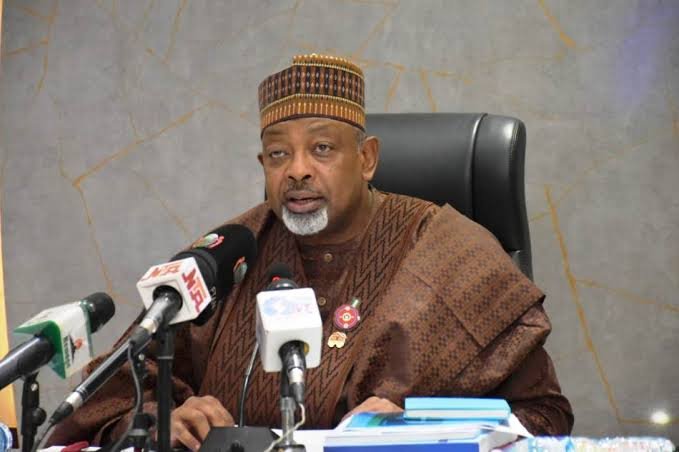
Senator Abubakar Kyari came into the Ministry of Agriculture and Food Security in August 2023 with what many considered the most coherent diagnosis in years, that Nigeria with over 240 million people heading to 400 million by 2050 cannot feed itself by simply expanding farmland but must raise productivity per hectare through knowledge, technology and infrastructure, and from that thesis he crafted a five-point vision for 2025 that promised enhanced support for smallholders through funding and training, promotion of eco-friendly farming practices to combat climate change, improvement of food distribution systems to reach vulnerable communities, nationwide deployment of tractors and heavy-duty equipment, and a new smart agriculture initiative built around greenhouse farming and family garden projects, all to be driven by a private sector-led model where banks finally begin to fund agriculture, a vision he later expanded into a 10-year National Agrifood System Strategy from 2026 to 2035 aimed at mobilizing 100 billion dollars, increasing agrifood output by 45 percent, tripling intra-African trade and halving post-harvest losses.
The reality on the ground, however, has exposed the gap between vision and execution, particularly in his promise to support smallholders where he claims to have distributed 1.9 million bags of fertilizer to nearly one million farmers and deployed over 1,000 digital extension agents equipped with tablets plus 774 desk officers across local governments with SMS advisories in Hausa, Igbo, Yoruba and Pidgin, yet field reports from Kano, Niger and Oyo show fertilizer still arrives late after planting season and is diverted to political associates who resell at 45,000 naira instead of the subsidized 25,000 naira, while the extension ratio has barely moved from one agent to 10,000 farmers to about one to 8,500 because retirements have wiped out new recruitments, leaving 40 million smallholders still without meaningful advisory, and his digital leapfrogging covering only 100,000 farmers represents just 0.25 percent of the farming population, meaning the same fragmentation he warned against is now reproducing itself digitally with NAFD, ADP, ARCN and private platforms like Iroko AI sending competing messages.
His promise on food distribution and price stability has been his most painful shortfall, because in July 2024 Kyari assured Nigerians that food prices would stabilize within six months, but from that date till January 2026 the opposite happened as a 50kg bag of rice moved from 55,000 naira to between 95,000 and 110,000 naira in Port Harcourt and Lagos, beans from 70,000 to 140,000 naira, and food inflation which was 32 percent when he assumed office peaked at 40.9 percent in late 2024 and still hovers around 28 to 32 percent, driven by his emergency 150-day duty-free import window for maize, rice, wheat and cowpeas which crashed prices for two months but disincentivized local farmers and millers who had borrowed to produce, leading to a sharper rebound after the window closed, while the mass deployment of 2,000 tractors under the Renewed Hope Mechanization Programme has seen less than 300 physically delivered with most parked in state capitals awaiting flag-off ceremonies, and the Bank of Agriculture he restructured with a new board remains undercapitalized with less than 50 billion naira against a need of over one trillion, so banks still commit less than 4.8 percent of total credit to agriculture down from 5.1 percent in 2023, and foreign direct investment into agriculture actually fell by 12 percent in 2025.
These failures are not entirely of his making because he faces structural challenges bigger than his Ministry, including insecurity that has displaced farmers in Niger, Zamfara, Benue, Kebbi and Jigawa where no tractor can be deployed if farmers cannot access farms, a fiscal constraint where his capital budget is less than 200 billion naira annually against the 100 billion dollars he needs for his 10-year plan, institutional rivalry where federal and state ministries run parallel programs, and a deep trust deficit where farmers who have heard visions for 20 years now only believe what enters their farm gate, leaving Kyari as a minister with a clear compass and the right map but whose tractor is stuck in the mud, as his elegant strategy documents, summits, steering committees and MoUs with FAO have yet to translate into more food in the market, cheaper food in the pot, or a measurable lift in agricultural GDP which remains flat at 1.5 to 2 percent growth, meaning the average Nigerian household still spends more to eat less than it did when he took over.