
Higher Revenue Collection Lifts FAAC Distribution to N2.6trn in June 2026: Reforms Begin to Show in Federation Accounts


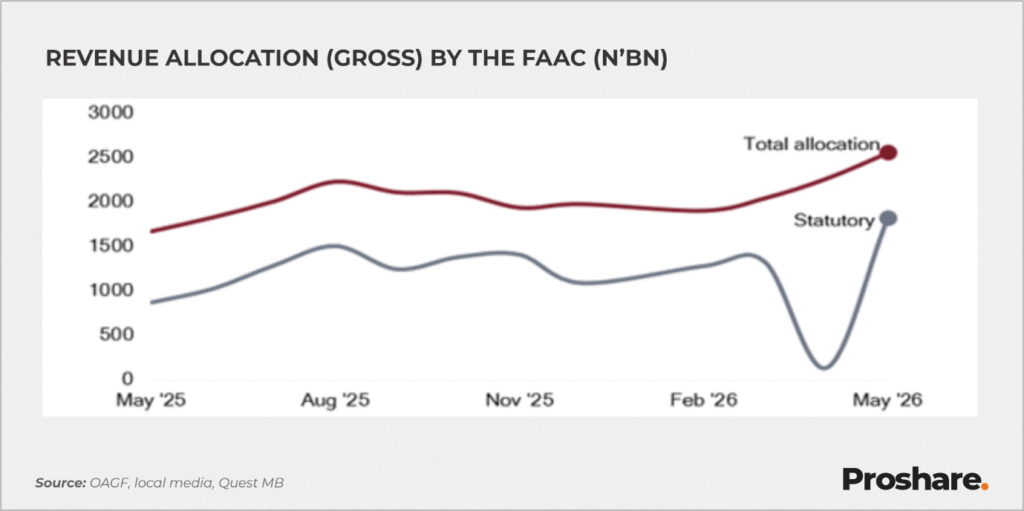
The Federation Account Allocation Committee closed June 2026 with its largest monthly distribution so far this year. A total of N2.6 trillion was shared among the federal, state and local governments, up from N2.3 trillion in May. The N300 billion month-on-month jump extends a clear upward trend in federally collected revenue and suggests that the combined effect of tax reform, digital collection and higher oil prices is finally feeding through to government coffers.
Statutory Revenue Drives the Surge
The headline increase was powered almost entirely by statutory revenue. According to the FAAC communiqué, statutory receipts rose by N550 billion MoM to N1.8 trillion, compared with N1.3 trillion in May.
That leap explains why every tier of government saw bigger allocations. Statutory revenue is where crude oil proceeds, company income tax and other direct levies sit. Its strong performance indicates that both oil and non-oil direct taxes are responding to policy changes. In an economy that has struggled for years with narrow revenue bases, a half-trillion-naira jump in one month is significant. It signals that the administration’s focus on plugging leakages and broadening the tax net is yielding measurable results.
VAT Slips Slightly, But Non-Oil Revenue Still Strong
Not every line item moved up. VAT revenue dipped marginally by 1% MoM to N740.7 billion. The decline is small, but it is worth noting because VAT has been one of the most consistent growth engines since the 2020 tax adjustments.
The slip likely reflects weaker consumer spending in June and the lag effect of inflation on consumption. Even so, VAT remains close to the N750 billion mark, which is far above pre-reform levels. Combined with stronger company tax and customs receipts, it confirms that non-oil revenue mobilisation is holding up. The government’s push for greater digitalisation of collections and improved taxpayer compliance appears to be cushioning the impact of softer household demand.
Oil Prices Cushion Weak Production
The oil sector remains central to the story, even as volumes lag. Crude production is still below the 2026 budget benchmark of 1.84 million barrels per day. Pipeline vandalism, underinvestment and operational issues continue to constrain output.
What has saved the budget is price. Crude has been trading consistently above the US$64.85/b benchmark. That premium has offset the shortfall in barrels and kept oil receipts robust. It also explains why the derivation pool grew sharply.
For oil-producing states, 13% derivation rose 26% MoM to N198 billion. While higher prices help, they also expose a vulnerability: Nigeria’s fiscal health is still tied to a commodity it cannot consistently pump at planned levels. Sustained revenue growth will require both price support and a real fix to production.
All Tiers Get a Bigger Share
The larger pool translated directly into higher disbursements.
- Federal Government: N923 billion, up 17% MoM
- State Governments: N838 billion, up from N772 billion
- Local Governments: N591 billion, up from N549 billion
For states and LGAs, the extra funds come at a critical time. Inflation is easing but still high, and sub-national governments are under pressure to pay wages, service debt and fund infrastructure. The increase gives governors more fiscal room, but it also raises expectations. Citizens will be watching whether the additional N66 billion to states and N42 billion to LGAs translates into visible projects, not just recurrent spending.
Reforms Are Beginning to Institutionalise Revenue Gains
FAAC’s commentary directly credits the uptick to ongoing reforms. Three factors stand out: tax reforms, greater digitalisation of collection, and stronger taxpayer compliance.
The tax reform agenda has broadened the base without necessarily raising headline rates. Digital platforms have reduced leakages in customs, FIRS and NNPC remittances. And compliance is improving as businesses adjust to e-invoicing and tighter audit trails.
This is the part of the reform story that markets and citizens can actually feel. Macroeconomic adjustments like subsidy removal were painful upfront. Revenue growth is the payoff. If collections can stay on this trajectory, the government will have more room to fund capital projects without borrowing excessively.
Outlook: Can the Momentum Hold?
Analysts at FBNQuest expect federally collected revenues to keep expanding. Their view rests on two pillars: elevated crude oil prices and a gradual recovery in production volumes. If output moves closer to the 1.84 mb/d target, oil revenue could get another lift.
On the non-oil side, the expectation is that reform initiatives will continue to deepen. Better compliance systems, automation, and enforcement should sustain growth in CIT, VAT and customs.
The risk is policy reversal and external shocks. Oil prices are volatile, and any sharp drop would erase the cushion that has protected revenues this year. Domestically, inflation and weak consumption could further pressure VAT.
What This Means
June’s N2.6 trillion distribution is more than a monthly record. It is evidence that Nigeria’s revenue architecture is changing. For years, FAAC numbers were flat or erratic because the system leaked and the base was narrow. Now, statutory revenue is rising sharply, non-oil receipts are stabilising near record levels, and even a VAT dip does not derail the trend.
The challenge ahead is conversion. Bigger allocations must translate into better services, infrastructure and job creation. Otherwise, the public will see the N2.6 trillion as just another accounting entry.
For now, the numbers validate the reform bet. Revenue mobilisation is improving. The test in the second half of 2026 will be whether government can turn that revenue into results.