Higher Revenue Collection Lifts FAAC Distribution to N2.6trn in June 2026


Higher Revenue Collection Lifts FAAC Distribution to N2.6trn in June 2026
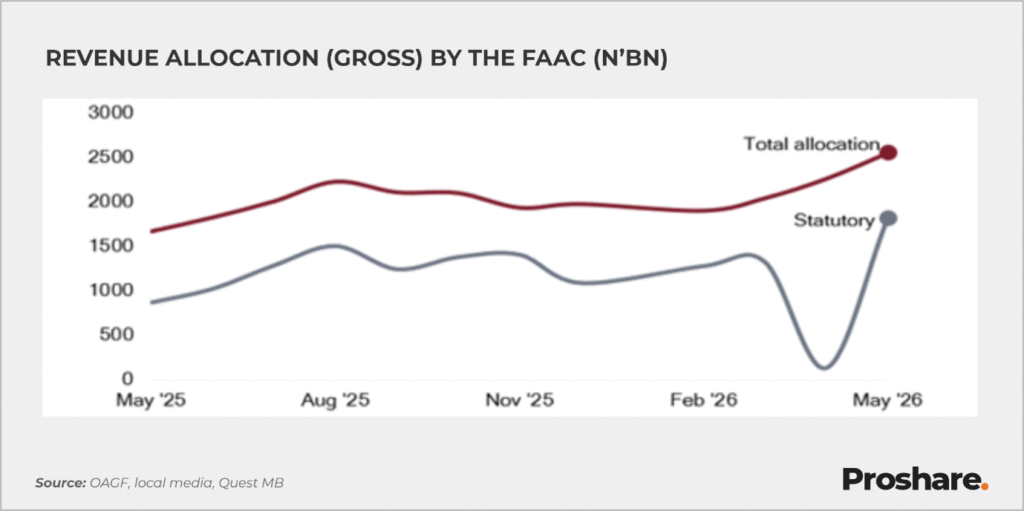
The Federation Account Allocation Committee shared N2.6 trillion among the federal, state and local governments in June 2026, up from N2.3 trillion the previous month. The N300 billion increase extends an upward trend in federally collected revenue this year and points to the early payoff from tax reforms, greater digitalisation of collection, and improved taxpayer compliance.
The surge was driven almost entirely by statutory revenue, which jumped by N550 billion month-on-month to N1.8 trillion, compared with N1.3 trillion in May. Statutory receipts cover crude oil proceeds, company income tax and other direct levies, so a rise of this magnitude signals that both the oil and non-oil sides of the economy are responding to policy changes. For years, leakages and a narrow tax base kept this line flat. The sharp increase suggests that efforts to broaden the net and tighten remittances are beginning to stick.
Value-added tax told a slightly different story. VAT revenue dipped marginally by 1% MoM to N740.7 billion. The decline is small, but it likely reflects softer consumer spending and the lagged impact of inflation on household demand. Even with the dip, VAT remains close to N750 billion, well above pre-reform levels, and when combined with stronger company tax and customs receipts it confirms that non-oil revenue mobilisation is holding firm. Digital collection platforms and tighter audits appear to be cushioning what would otherwise be a bigger fall in consumption-based taxes.
Oil is still central to the federation account, even as production lags. Crude output remains below the 2026 budget benchmark of 1.84 million barrels per day due to operational and security challenges. What has kept oil revenue strong is price. Crude has been trading consistently above the US$64.85 per barrel benchmark, and that premium has offset the shortfall in volumes. The effect was most visible in the derivation pool. Allocations to oil-producing states through the 13% derivation fund rose 26% MoM to N198 billion. The reliance on price rather than production remains a vulnerability, however. Until output moves closer to target, Nigeria’s fiscal performance will stay exposed to swings in the global oil market.
The larger revenue pool meant bigger disbursements to all tiers. The Federal Government received N923 billion, up 17% MoM. States got N838 billion, up from N772 billion, while Local Governments received N591 billion, up from N549 billion. For sub-national governments, the extra N108 billion combined comes at a crucial time. Inflation is still high, wage pressures persist, and there is growing demand for infrastructure and social spending. The additional funds give governors and council chairmen more room, but they also raise the bar for accountability. Citizens will expect to see the money reflected in projects and services, not just in recurrent bills.
Looking ahead, analysts expect federally collected revenues to keep expanding. The base case rests on elevated crude oil prices and a gradual recovery in production volumes, which should support oil receipts. On the non-oil side, ongoing reforms, better compliance and improvements in collection systems are expected to sustain growth in CIT, VAT and customs. If that holds, the government will have more fiscal space to fund capital projects without leaning as heavily on borrowing.
June’s distribution is more than a monthly high. It is evidence that the revenue architecture is changing. Statutory revenue is climbing, non-oil receipts are stabilising near record levels, and even a soft month for VAT does not break the trend. The challenge now is conversion. A N2.6 trillion FAAC pool only matters if it translates into roads, power, health and jobs. For the first time in a while, the numbers suggest the reforms are working. The test in the second half of 2026 will be whether that revenue turns into results people can feel.