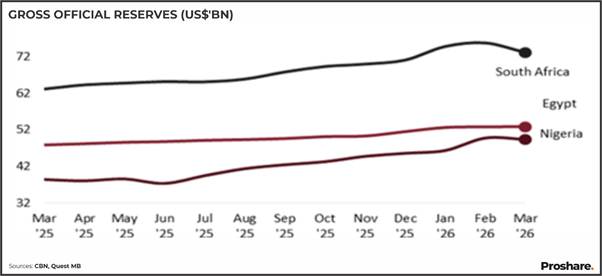

Central Bank of Nigeria (CBN) latest data on Nigeria’s external reserves, shows that gross external reserves declined modestly by US$398m to US$49.3bn as at end‑March 2026. This represents the first month-on-month (MoM) decline following eight consecutive months of reserve accretion since Jun ‘2025, during which the reserves increased cumulatively by US$12.5bn. The recent moderation appears largely attributable to seasonally stronger FX demand associated with import‑related activities. Notwithstanding this adjustment, the preceding build‑up, and the still‑robust level of reserves reflect the impact of ongoing FX reforms implemented by the CBN, which have supported improved market transparency and liquidity, contributing to a more effective and orderly FX market with better price discovery.
- Despite global risk-off sentiment amid heightened US–Iran tensions, FX inflows from FPIs eased only marginally by 2% m/m to USD1.9bn in March, reflecting sustained investor engagement supported by market reforms.
- A further signal reflecting recent market developments is the FTSE Russell’s reclassification of Nigeria into its Frontier Market Index, effective Sep ’2026, from a previously unclassified status.
- The total reserves covered around 14.7 months of merchandise imports and 9.9 months when we include imported services, based on balance of payment data for the 12-month period leading to Sep ’25.
- Following the slight demand pressure, the naira exchange rate depreciated by -1.3% during the month to N1,387/USD on the official FX market, and by around 4.0% to N1,426/USD on the parallel market.
- Outside Nigeria, South Africa’s international liquidity position-a better measure of reserves-declined by US$2.6bn to US$73.2bn, largely reflecting a US$2.4bn fall in gold reserve valuations following a 13% MoM decrease in gold prices.
- In contrast, Egypt’s net external reserves bucked the trend, as it increased by US$85m, due largely to a US$197m increase in its foreign currency reserves, which more than offset a US$112m decline in the value of its gold reserves.
- Looking ahead, elevated oil prices may offer some support to Nigeria’s external balance and fiscal position. However, these gains remain constrained by suboptimal production (see chart below)