From Stabilisation to Transformation: An Adebayo Adedeji Lens on Nigeria’s Reform Execution Test

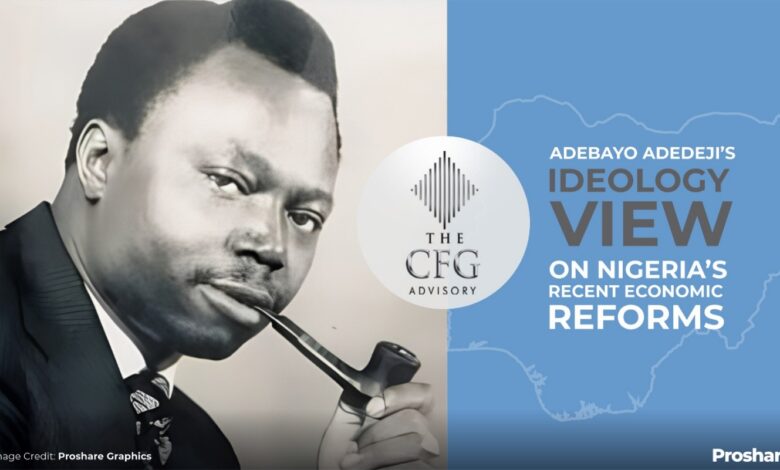
The June 2026 CFG Advisory paper by Tilewa Adebajo does more than invoke a name. It returns Professor Adebayo Adedeji to the centre of Nigeria’s reform debate at the precise moment when headlines are mistaking correction for completion. Adedeji’s relevance is not nostalgia for 1970s planning. It is method. His lifelong argument, honed at the Economic Commission for Africa, was that macroeconomic stabilisation un-joined to industrialisation, social protection, and regional integration would balance the books without changing the economy beneath them. Read against Nigeria’s reform cycle since 2023, that contention becomes less a citation and more a stress test.
Proshare’s review of the CFG paper sets the terms plainly. The question is not whether foreign-exchange unification, subsidy removal, or fiscal consolidation were necessary. The evidence that reforms reduced distortions is reasonably clear. The harder question is whether price correction is being translated into competitiveness, exports, jobs, and bankable projects. In Adedeji’s language, stabilisation restores balance to prices, the exchange rate, and the fiscal accounts. Transformation changes what an economy produces, how competitively it produces, and how widely the gains are shared. The first can be achieved within a budget cycle. The second demands capacity, institutions, and markets built over years.
The reform record so far fits that split. Nigeria’s move to a more unified, market-reflective exchange rate narrowed the gap between official and parallel pricing and improved external perception. Yet it arrived with sharp depreciation and inflationary pass-through in an economy still reliant on imported fuel, machinery, and intermediates. In Adedeji’s framing, the test is not the necessity of the move but the presence of a production strategy capable of converting a weaker currency into export competitiveness. Without reliable power, efficient ports, predictable logistics, accessible finance, and policy stability, devaluation functions as a cost shock rather than a catalyst. Exports expand because firms can produce tradable goods at scale and move them to market at competitive cost, not because a country wishes them to.
The same logic governs subsidy removal. The 2023 exit eased a costly and regressive system and, per World Bank assessments cited in the CFG report, supported fiscal adjustment and stronger reserve buffers. Households, however, carried the immediate pressure. The decisive variable is the use of the created fiscal space. Savings channelled into infrastructure, social protection, agriculture, and human capital align with a developmental purpose. Savings dissipated through recurrent spending, weak targeting, and debt service reproduce the adjustment pattern Adedeji spent a career criticising. Fiscal consolidation that restores macroeconomic balance while transferring disproportionate costs to lower-income households risks forfeiting the legitimacy on which its own durability depends.
This is why the CFG paper treats industrial strategy, energy and logistics reform, and directed development finance as the missing complements to macroeconomic correction. Price signals alone do not build factories. They do not lay gas pipelines or de-congest ports. They do not turn pension and insurance pools into long-term project finance. Adedeji’s African Alternative Framework, published in 1989, and the African Charter for Popular Participation, 1990, were not anti-market. They were anti-abstraction. They insisted that devaluation, liberalisation, and austerity, pursued without attention to employment, industrialisation, and social welfare, would leave African economies externally vulnerable and structurally narrow. Applied today, that is a discipline: growth with equity, and solutions that are homegrown because only homegrown solutions internalise political economy.
Converting reform credibility into transformation therefore becomes a problem of execution architecture. First, institutional design. The programme needs clear ownership, functioning coordination between ministries, and a credible relationship between federal direction and subnational delivery, the precise machinery Adedeji built and the report identifies as decisive. Second, incentive architecture. Firms, lenders, and investors must face incentives that reward production, local value addition, and long-term capital formation rather than rent and arbitrage. Third, financing mechanisms. Bankable transformation requires project-preparation facilities, risk allocation, guarantees, and the mobilisation of pension, insurance, and capital-market funding alongside bank credit and development finance. Nigerian banks, now recapitalising, must convert larger balance sheets into productive credit rather than holding capital idle. Fourth, sector prioritisation. A realistic pipeline focuses where comparative advantage and domestic demand align: gas and petrochemicals, fertiliser, agro-processing, light manufacturing, logistics, and digital and financial services.
The regional dimension closes the loop and is where Adedeji’s legacy bites hardest. ECOWAS and the African Continental Free Trade Area are not only trade agreements but platforms for scale, supply chains, and market access that Nigerian industry needs. Adedeji was the principal Nigerian voice behind the Treaty of Lagos in 1975 and laid the institutional groundwork that later informed continental trade integration. Without that dimension, the economy can stabilise while remaining trapped in crude exports and import dependence. Transformation, in his terms, is impossible in autarky.
Over the next 24 to 36 months, the Adedeji test will be visible in outcomes citizens, firms, lenders, investors, and regional partners can verify. Less import dependence. Measurable export complexity. More reliable energy. Lower logistics costs. Rising industrial capacity utilisation. Credible social protection. Investment that converts into operating assets. Reserves, deficits, and rating actions will continue to matter, but they describe the platform. Transformation will be judged by what Nigeria builds on top of it.
Adedeji’s framework offers the right test precisely because it is conditional. It neither endorses nor rejects the present programme. It asks what the programme is being converted into. If stabilisation remains an end in itself, Nigeria will have achieved balance without breadth, and correction without creation. If, however, price correction is matched with the machinery of production, finance, and regional scale that Adedeji spent his career designing, then reform becomes more than an adjustment. It becomes a transition. And that, not the removal of a distortion, is the real execution test.