
Fidelity Bank In the Throe of Valuation Discount

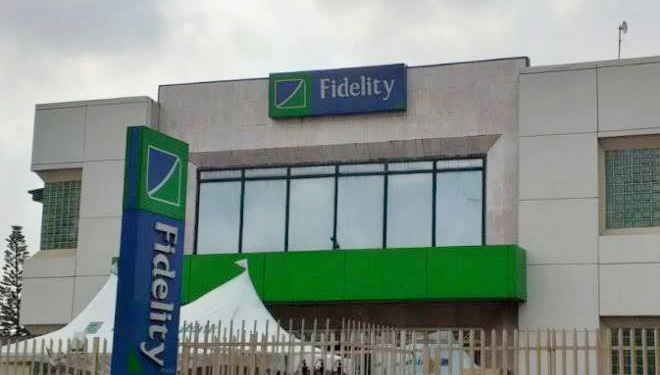
Fidelity Bank Plc entered 2026 with among the strongest operating metrics in the Nigerian banking sector. FY 2024 audited results recorded profit after tax of N278.11bn, earnings growth of 87.72%, and a net interest margin of 12.00% that was the highest among listed deposit money banks, alongside a non-performing loan ratio of 3.10%. Against this, the shares delivered a year-to-date return of 1.1% to 14 April 2026, compared with 36.11% for the NGX Banking Index.
The disconnect and gap between operating performance and market pricing is the subject of this note. The durable drivers of the discount lie in the leadership transition timetable, governance composition, and earnings-quality signals, particularly digital income.
Proshare Research assigns Fidelity Bank a HOLD with a positive bias at N19.20, with a 12-month fair value range of N22 to N27 and a BUY conversion conditional on triggers set out in the outlook.
Diagnosis of Price Stagnation
Fidelity Bank Plc entered 2026 with credible forward momentum across most of its core operating metrics. Its FY 2024 audited results confirmed earnings growth of 87.72%, a net interest margin of 12.00%, the highest among all listed deposit money banks measured under the Proshare Bank Strength Index (PBSI), and a profit after tax of N278.11bn, representing growth of 179.65% year-on-year. The capital adequacy ratio of 23.50% placed the bank third in the sector, ahead of several Tier 1 peers, and its non-performing loan ratio of 3.10% was among the most disciplined in the industry.
Yet between January and April 2026, the share price has moved in a range of N19.1 to N20.9, effectively delivering no net return to investors over a four-month period in which the broader banking sector has experienced a decisive re-rating.
The stagnation is not attributable to earnings weakness. It reflects a convergence of factors that have combined to suppress the re-rating that the fundamental data would otherwise support.
The Performance to Price Disconnect
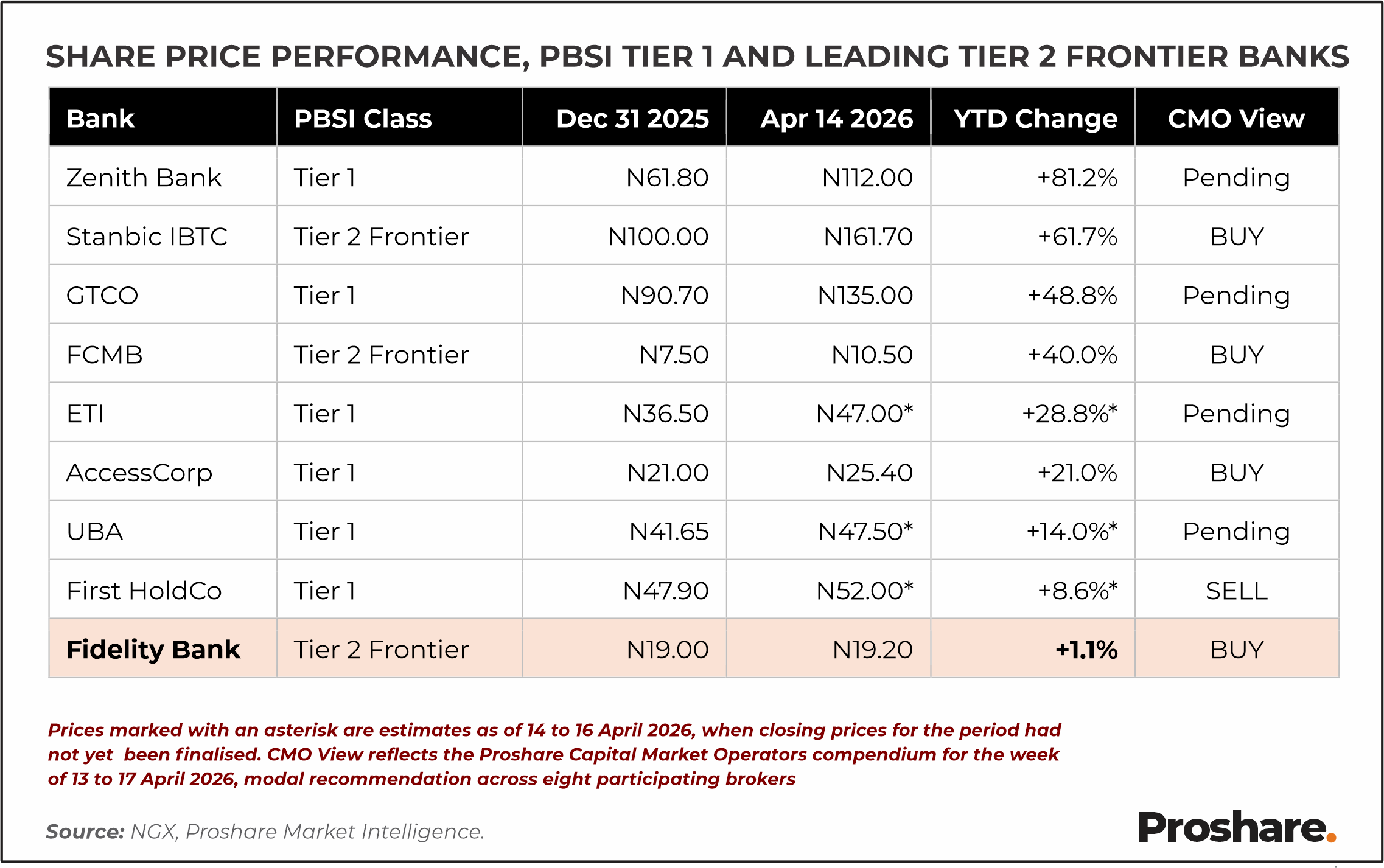
Between 31 December 2025 and 14 April 2026 the stock traded in a narrow band of N19.10 to N20.90, effectively flat while Zenith gained 81.2%, Stanbic IBTC 61.7%, GTCO 48.8%, and FCMB 40.0%. The divergence warrants a structural explanation, as reflected in how the market is pricing four qualitative, forward-looking considerations alongside the bank’s reported fundamentals.
Table 1: Share Price Performance, PBSI Tier 1 and Leading Tier 2 Frontier Banks
Structural Drivers of the Valuation Discount
There are both financial and non-financial risk premiums attached to Fidelity Bank’s share price read.
The first is the association of a significant shareholder with active national political ambitions. Investors with fiduciary mandates are sensitive to the governance implications of concentrated politically exposed shareholdings in a financial institution, particularly in the period leading up to the 2027 general elections. The concern is not specific to any wrongdoing but reflects a standard institutional risk premium applied globally to banks where ownership concentration intersects with political exposure.
The second is the leadership transition risk, which remains both imminent and material. The current Managing Director’s tenure concludes in December 2026, and no successor has been publicly confirmed. An unannounced transition within a twelve-month horizon, in a context where post-recapitalisation capital deployment is the dominant strategic question, introduces a premium that institutional investors apply almost mechanically. The transition is not, on current evidence, contested or disorderly. The market is awaiting a public signal of continuity or change.
The third is governance composition. The proportion of independent non-executive directors on the board, at 16.67%, sits at the lower end of the peer distribution. The elevation of Amaka Onwughalu to the Chairmanship on 1 January 2026, following Mustafa Chike-Obi’s tenure completion, was a continuity transition with board committee depth. The market has not yet repriced on this transition, consistent with the pattern in which governance changes are priced alongside a visible strategic milestone.
The fourth is earnings quality, expressed through digital income. E-banking income accounted for approximately 1.82% of gross earnings in FY 2024, below FCMB (12.83%), ETI (9.40%), and UBA (7.42%). With investor attention shifting from capital adequacy to capital productivity, the digital income ratio is read as a proxy for the sustainability of non-interest earnings. A margin-led profile commands a lower multiple than a margin-plus-fee profile.
Peer Benchmarking
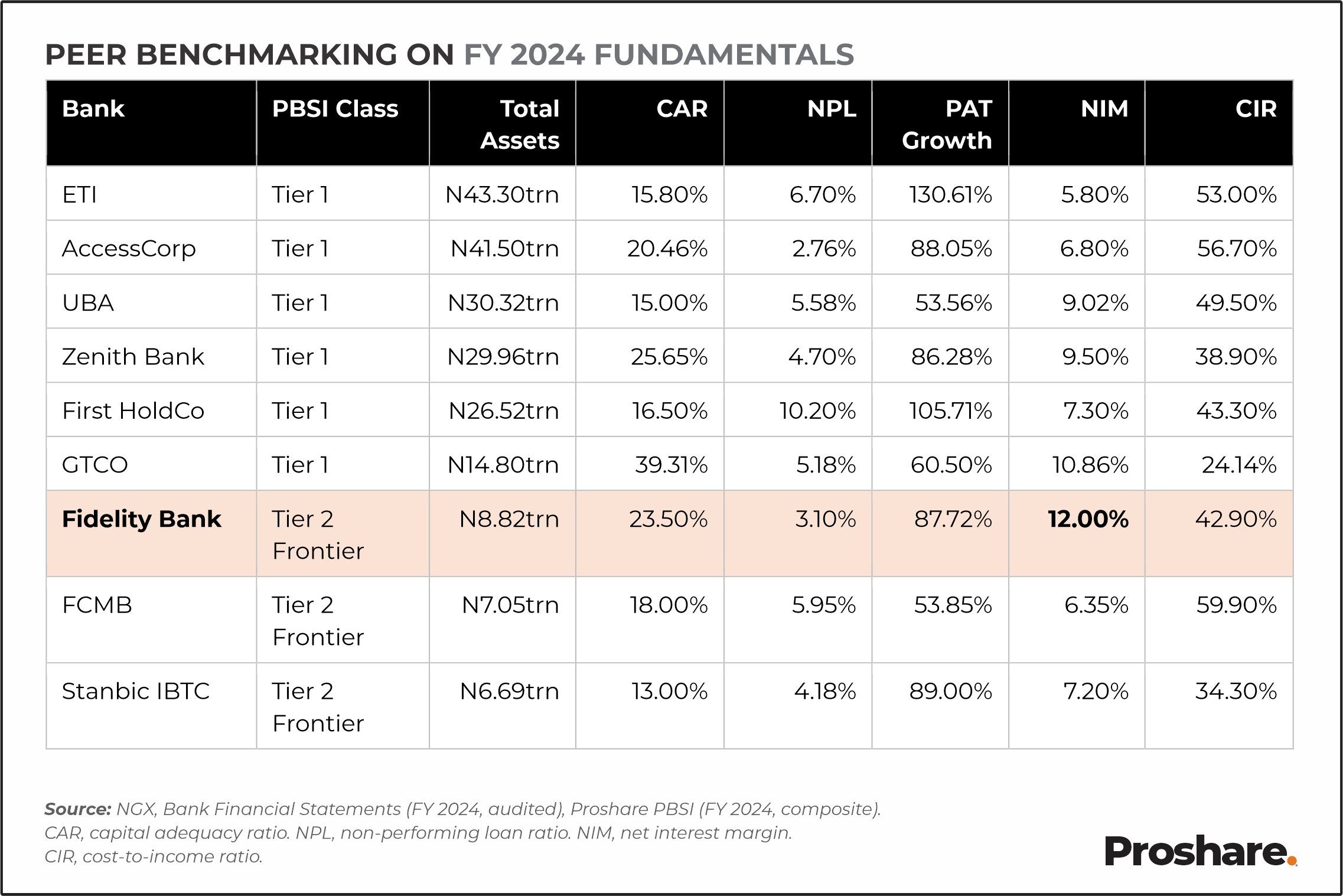
Table 2 positions Fidelity Bank against the six PBSI Tier 1 constituents and the two leading Tier 2 frontier contenders on the metrics driving sector re-ratings in Q1 2026. The pattern is one of strength in profitability and risk, and constraint on scale.
Table 2: Peer Benchmarking on FY 2024 Fundamentals
Technical and Sector Re-rating Context
The NGX Banking Index re-rating through Q1 2026 has been driven by specific, dated, and visible catalysts, confirmed recapitalisation for Zenith, parent capital backing for Stanbic IBTC, capital adequacy leadership for GTCO, and institutional participation in the capital program at FCMB. Fidelity Bank has not yet presented the market with a comparable catalyst within the Q1 to Q2 2026 window. The re-rating is therefore pending rather than rejected.
Valuation Framework
The 12-month fair value framework is constructed from three methods, weighted equally, with scenario gradations that reflect residual governance and execution risk. Key inputs are FY 2024 earnings per share of N6.65, book value per share of approximately N17.89, shareholders’ equity of N897.87bn, and shares outstanding of approximately 50.2bn.
Table 3. 12 Month Fair Value Scenarios
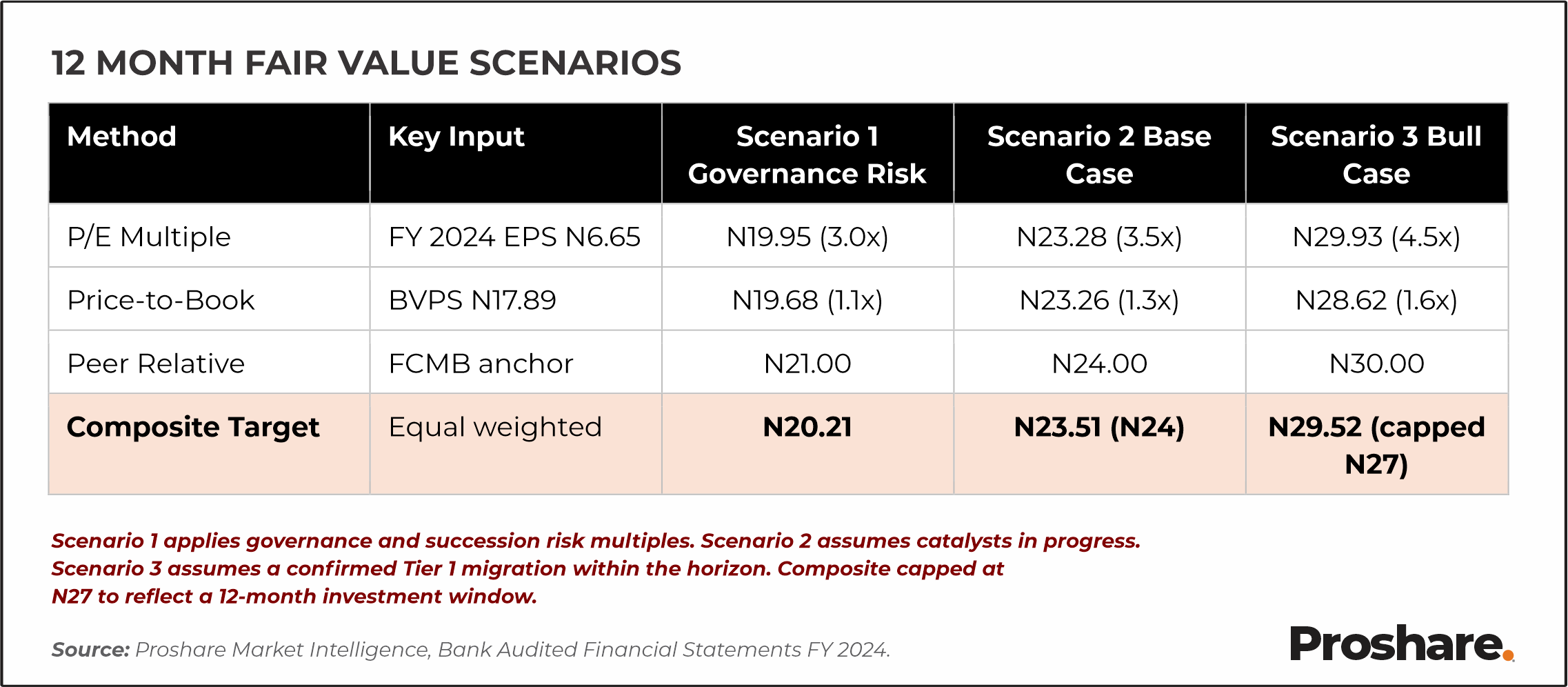
At the reference price of N19.20, the base case composite of N24 implies an upside of approximately 25%, and the bull case of N27 implies approximately 41%. Scenario 1, applying the most cautious multiples consistent with unresolved governance transition, produces a composite of N20.21. The current price sits within the Scenario 1 band, consistent with a market pricing in the risks it is watching rather than the fundamentals it has reported.
CMO Broker Recommendations and Market Consensus
The Proshare Capital Market Operators (CMO) compendium of broker recommendations for the week of April 13–17, 2026, provides an independent market consensus check on the institutional view of Fidelity Bank and its sector peers. The table below presents the banking sector recommendations extracted from the CMO report, sourced from eight registered brokers: Bancorp Securities, Afrinvest, Meristem, Lead Capital, CardinalStone Securities, Apel Asset Management, PAC Research, and Proshare Research.
Financial Markets News
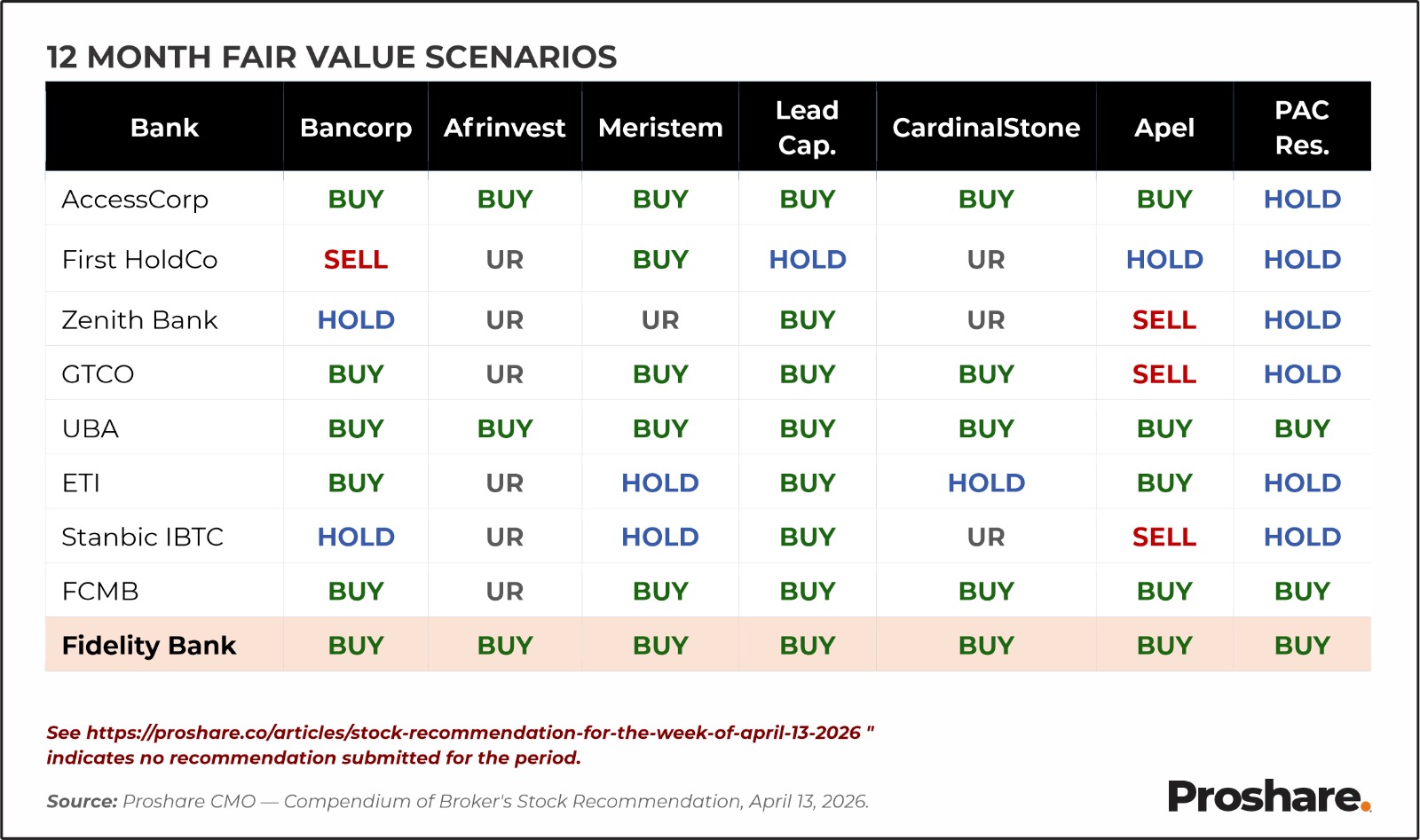
The CMO data provides an instructive signal for this note. Fidelity Bank carries seven BUY recommendations from Bancorp Securities, Afrinvest, Meristem, Lead Capital, CardinalStone, Apel, and PAC Research, with a HOLD from Proshare Research (now revised to a Conditional Buy). This is an overwhelming buy consensus across the broker community. The seven-to-one ratio on the buy side is the strongest concentration of directional conviction among banking stocks in the current CMO period.
Brokerages & Day Trading
Investment Recommendation
Proshare Research assigns Fidelity Bank a HOLD with a positive bias at N19.20, converting to a BUY on confirmation of any two of the three triggers below within the next two quarters. For investors willing to tolerate a six to twelve-month window of active governance monitoring, the entry is asymmetric. For investors requiring confirmed catalyst sequencing, a wait-and-watch posture is equally defensible.
Outlook, Catalysts, and Timing
Three triggers can close the valuation gap within the next 12 months. The first is a public announcement of the successor managing director before the end of Q3 2026. The second is H1 2026 evidence of accelerated digital income growth and a visible roadmap for non-interest revenue diversification. The third is confirmation of progress or a clean outcome from the CBN banking sector stress test, which commenced on 1 April 2026.
The material downside risks mirror these triggers. A delay in the succession announcement beyond Q3 2026 extends the governance premium into the run-up to the 2027 elections. A widening digital income gap relative to FCMB, Stanbic IBTC, and Wema Bank would erode the relative multiple. Deterioration in asset quality, particularly in sectors exposed to foreign-exchange volatility, would alter the NPL narrative that anchors the constructive view.
The conditions for the re-rating are specific, monitorable, and now materially closer to fulfillment than at any prior point in this investment cycle. The test is now whether management and the board provide, within the next two quarters, the dated signals that convert the pending re-rating into a priced one.