
News
FGN Domestic Debt Rises to N80.5trn in Q4 2025, Accounts for 95% of Total Domestic Obligations


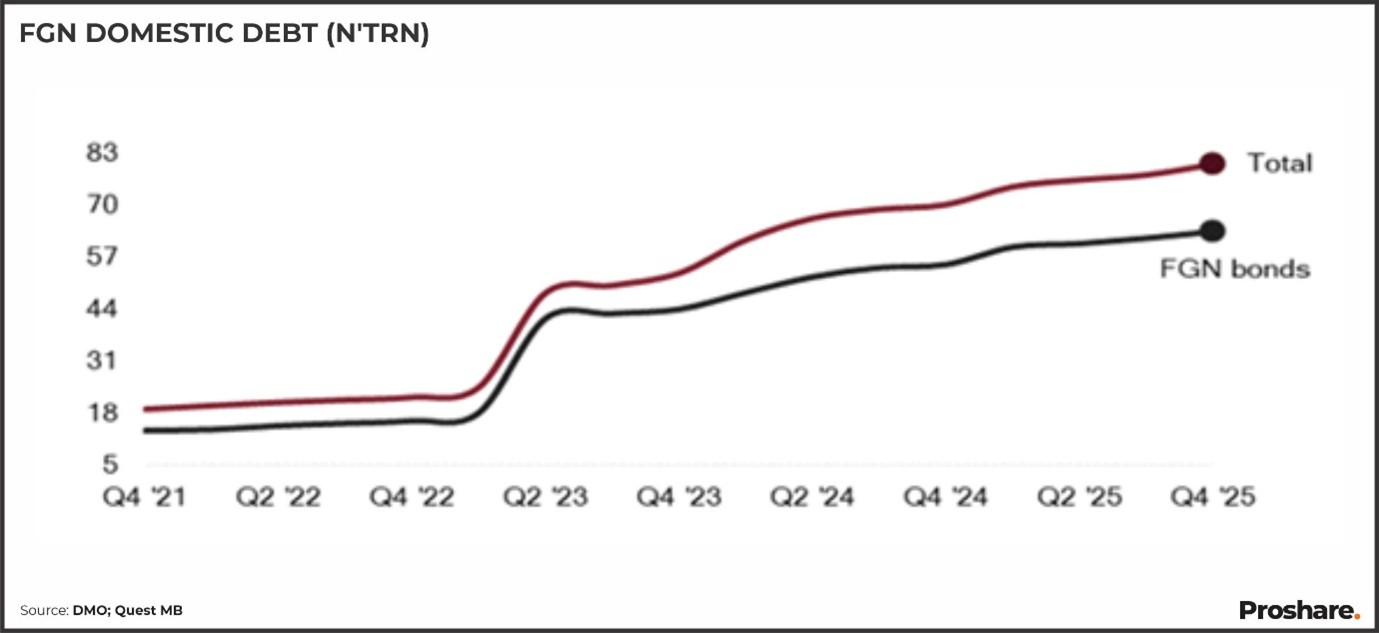
The public debt data recently released by the Debt Management Office (DMO) shows that the Federal Government of Nigeria’s (FGN) domestic debt stock increased by 3% quarter-on-quarter (QoQ), or 14% year-on-year (YoY), to N80.5trn as at Q4 2025. This sum represents 95% of the total public domestic debt stock of N84.9trn, with the balance of N4.4trn comprising debt obligations of the 36 state governments of the federation and the Federal Capital Territory (FCT). The rise in the FGN’s domestic debt stock reflects sustained issuance of domestic debt to fund the 2026 fiscal deficit. Year to date, the FGN has raised almost N2.6trn from the domestic debt market, including allotments from non-competitive bids.
- A breakdown of the domestic debt stock shows that FGN bonds remained the largest component, increasing by 3% QoQ to N63.6trn, and accounting for a 79.1% share of total.
- The value of Nigerian Treasury Bills, the second-largest contributor, increased by 9% QoQ to N13.9trn, up from N12.7trn in the prior quarter.
- Domestic debt accounted for 54.8% of the FGN’s total debt stock, broadly in line with the 55:45 domestic–external split outlined in the DMO’s 2024–2027 Medium Term Debt Management Strategy paper.
- The tilt toward domestic borrowing continues to reflect prevailing financing conditions, with limited reliance on external funding amid macroeconomic and FX considerations.
- The FGN’s domestic debt stock is equivalent to 18.7% of 2025 GDP. However, this ratio rises to 19.7% of GDP when the debt obligations of state governments and the FCT are included.
- The domestic debt profile suggests ample borrowing space when viewed against the DMO’s implied domestic debt to GDP benchmark of 33%. That said, the comfort implied by the domestic debt ratio is tempered by elevated debt service pressures.
- By way of illustration, total debt service reached 84.4% of revenues at the end of H1’2025, according to data from the Budget Office of the Federation, with domestic debt service accounting for around 47% of total debt service.
- Although the 2025 Tax Act is expected to support higher revenues over time, debt sustainability outcomes will depend on its effective implementation and the extent to which it succeeds in broadening revenue mobilisation, and the government’s fiscal discipline (see chart below)
I