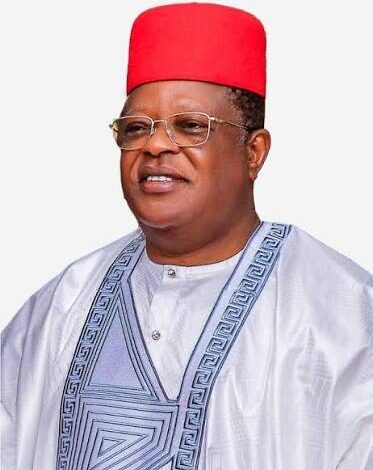
If there is one appointment in President Bola Ahmed Tinubu’s cabinet that is beginning to give flesh to the “Renewed Hope” promise, it is the Federal Ministry of Works. At a time when citizens are tired of big announcements with little to show, putting an engineer with a proven record of delivery in charge of the country’s roads has started to translate policy into pavement. That man is Engr. Sen. David Nweze Umahi, CON, FNSE, FNATE. Two years into the administration, he is not just running a ministry. He is becoming one of the credibility pillars of this government.
Umahi came to Abuja with a résumé already tested in the field. A registered engineer and fellow of both the Nigerian Society of Engineers and the Nigerian Academy of Engineering, he served as Deputy Governor and then two terms as Governor of Ebonyi State between 2015 and 2023. He started under PDP and later defected to APC, saying he needed to align his state with the center. He was elected Senator for Ebonyi South in 2023 but resigned to take the Works portfolio in August 2023. He also holds the national honour of Commander of the Order of the Niger. In Ebonyi he earned the nickname “talk and do” because the capital, Abakaliki, visibly changed under him from a quiet civil-service town to a city with flyovers, dualized roads, markets and new government buildings. That reputation is what President Tinubu is now betting on at the national level.
As Minister of Works, Umahi has moved the conversation away from pothole patching to nation-building through infrastructure. The centerpiece of his tenure is what the Ministry calls the four legacy superhighways. These are PPP-driven, concrete-based corridors designed to cut across all six geopolitical zones. The idea is simple but ambitious: link the country by road in a way that reduces travel time, lowers the cost of moving goods, and ties Nigeria’s economy more closely to itself and to its neighbors. The Lagos-Calabar Coastal Highway, a 700km road, is already under construction in Sections 1 and 2 in Lagos. In June 2026 Umahi told journalists that Deutsche Bank funded 70 percent of those sections and praised the quality as “out of this world.” First Abu Dhabi Bank was also honoured internationally for its participation. The other three are the Sokoto-Badagry Superhighway connecting North-West to South-West, the Calabar-Abuja Superhighway linking South-South to North-Central, and the Abuja-Kano-Kano-Jigawa-Katsina-Maradi corridor which blends road and rail to deepen North-Central to North-West connectivity. According to the Ministry, these projects are meant to improve regional connectivity, facilitate trade and strengthen economic integration. Umahi himself described them as a bold step no past administration had dared to take.
Alongside the legacy projects, he has focused on fixing roads that have embarrassed successive governments. The 107km Enugu-Onitsha Expressway is a clear example. For years it was a death trap and a bottleneck. Under Umahi, portions are being converted from asphalt to concrete to ensure durability and to end the cycle of gridlock and accidents. The Abuja-Kaduna Road, another long-standing headache, is also being worked on. In February 2026 the Minister had to publicly clarify that the contract was awarded to Infiouest International Limited through due process, after rumors linked it to another firm. On the Plateau, he took personal interest in a road that had been in a deplorable state since 1975, and Governor Caleb Mutfwang commended the intervention as a landmark for the state. The pattern here is not to announce 50 new roads, but to concentrate on completing and upgrading critical arteries and to build them to last.
Three policy shifts under Umahi explain why this approach feels different. First is the push for concrete over asphalt. The argument is about lifecycle cost. Concrete roads are more expensive upfront but last longer and require less maintenance, which matters in a country where roads often fail within two rainy seasons. That is why both the Lagos-Calabar and Enugu-Onitsha projects are being done with concrete. Second is funding. The Ministry is leaning more on PPPs and foreign banks rather than relying solely on budget allocations. Lagos-Calabar is the test case, with Deutsche Bank and First Abu Dhabi Bank already involved. That not only eases pressure on federal finances, it also signals to investors that Nigeria’s infrastructure is bankable. Third is protection. The Ministry has raised alarm over the vandalism of roads and bridges and is working with security agencies to safeguard national assets. This matters because no matter how good a road is, it cannot deliver value if it is cut, dug up, or allowed to deteriorate.
All of this feeds directly into the credibility of the Tinubu administration. Nigerians judge government not by white papers but by what they can see and use. When a contractor is pouring concrete on a coastal highway, when a foreign bank puts money into a Nigerian road, when a 50-year-old road in Plateau suddenly gets attention, it creates a sense that the center is working. Roads are the most democratic form of infrastructure. A trader, a student, a transporter all benefit without needing to know the name of the policy. In that sense, Umahi’s work becomes the physical proof of Renewed Hope.
His time as governor of Ebonyi between 2015 and 2023 was essentially the rehearsal for this national role. He ran an infrastructure-first government. He built three flyovers and one underpass in Abakaliki, the first of such in the South-East. He dualized major roads and constructed the Abakaliki Ring Road. He delivered the Abakaliki International Market and Ebonyi Mall to boost commerce, and he built a new Government House and Ecumenical Centre. In agriculture he pushed the “Rice Capital” brand, investing in rice mills, pyramids, and supporting farmers through the CBN Anchor Borrowers Programme. Ebonyi rice became a national name. He revived the Nkalagu Cement Company and pushed for a fertilizer blending plant. In health he upgraded the David Umahi Federal University Teaching Hospital in Uburu and built new primary health centers with a focus on maternal and child care. In education he built model schools and established the Ebonyi State University of Aeronautics and Aviation in Ezza, while also running scholarships for indigent students. On security he set up peace committees to manage communal and herdsmen-farmer clashes. His governance style was hands-on. He favored direct labor to cut costs, and he focused on IGR and budget performance.
That record was not without criticism. There were concerns about the level of borrowing to fund projects, questions about the sustainability and maintenance of some of the infrastructure after he left, and civil society groups raised issues around press freedom and political space. But the visible transformation of Ebonyi gave him political capital that few governors had in 2023, and it is a big reason he was brought into the federal cabinet.
So why does he look like the right choice now? Because Tinubu’s government needed someone who could combine technical competence with political will and a record of execution. Umahi brings engineering training, executive experience, and a willingness to take on the hardest projects. The four legacy highways will not be completed in one tenure. But the fact that funding is being secured, that construction has started, and that the Ministry is changing materials and procurement methods suggests a shift from announcement to implementation. In a government that must prove it can deliver amid economic pressure, that matters.
The test ahead will be completion, maintenance, and equity. Nigerians will want to see these roads finished, not just flagged off. They will want to know that maintenance plans exist so we do not return to the same cycle in five years. And they will watch to ensure that no region feels left out. So far, the Ministry’s messaging has been that no part of the country can talk about marginalization because the President is a leader for all Nigerians.
In the end, David Umahi represents what this administration needs most right now: visible delivery. He is not a theorist. He is a builder. From the flyovers of Abakaliki to the concrete of Lagos-Calabar, his career has been about turning plans into structures. For a government seeking to restore trust, that makes him more than a minister. He is a plus. And for a country that has waited too long for roads that last, he may well be the right choice at the right time.