UBA Slides Another 10% to N44.55 as Sell-Off Extends to Two Sessions, While the Broader Market Rebounds 2.23%

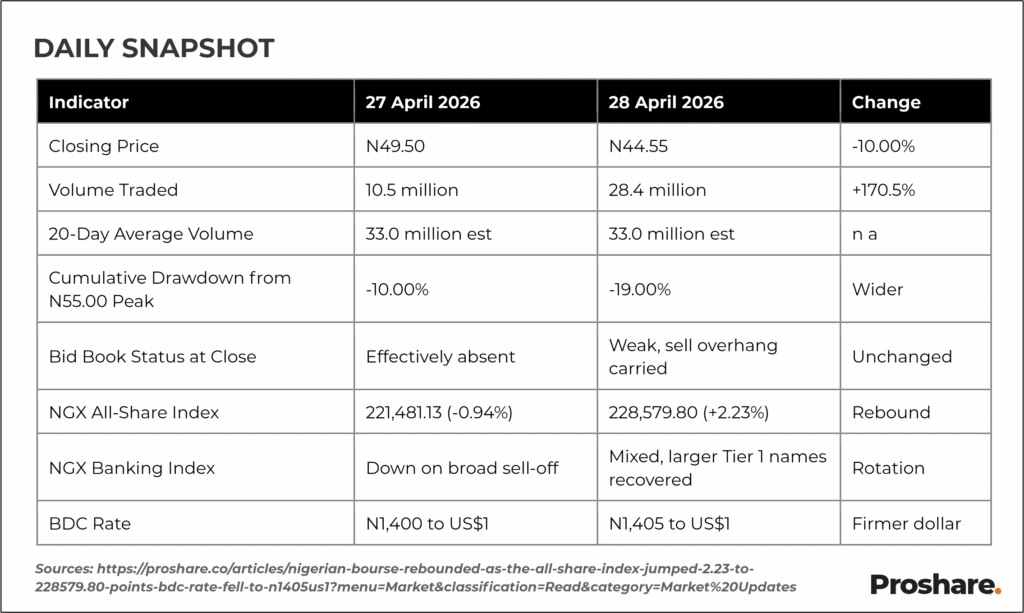
UBA Plc closed Tuesday, 28 April 2026, at N44.55, a further 10.0% decline from Monday’s close of N49.50, extending the post-earnings sell-off into a second consecutive session and taking the cumulative drawdown from the pre-result peak of N55.00 on Friday, 24 April, to 19.0% in less than 48 hours of trading. The two-session move has unwound the entire two-week pre-earnings rally that had carried the stock from N48.00 on 17 April to N55.00 on 24 April.
Volume in Tuesday’s session printed at 28.4 million shares, a meaningful recovery from Monday’s suppressed 10.5 million but still below the 20-day average of approximately 33 million. The depth of the volume recovery, against the continued absence of a bid book at the close, indicates that institutional repositioning is now underway and that the price discovery process has not yet reached a floor. The market is still pricing the information in front of it.
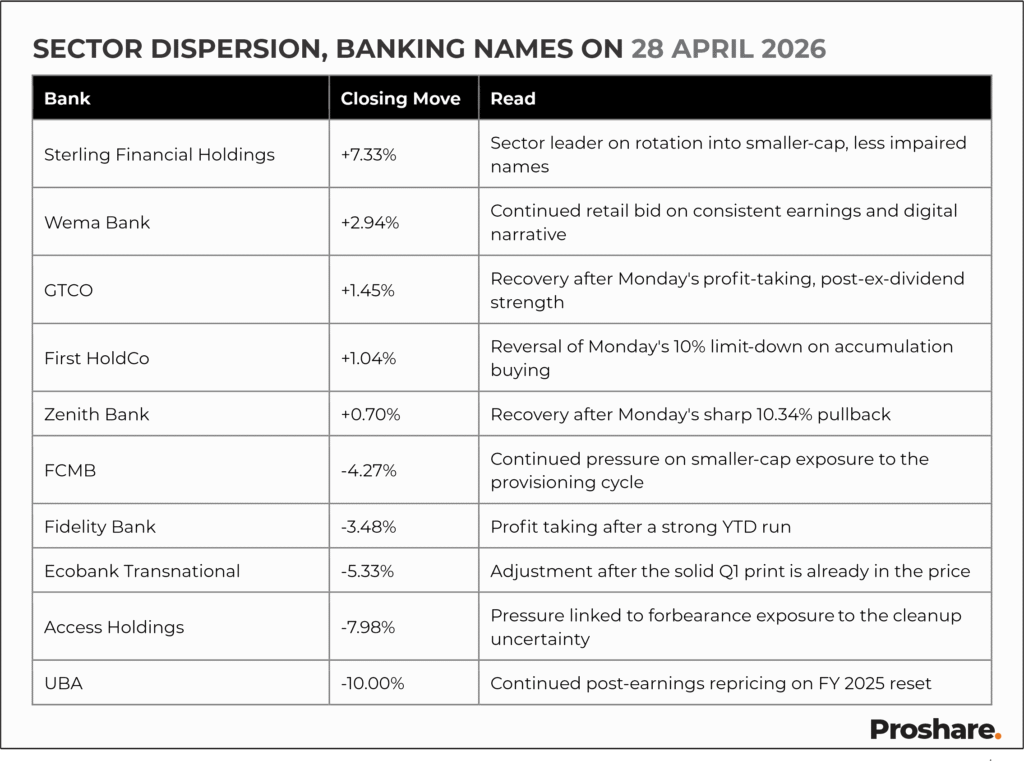
The selling in UBA today stood out against a strongly positive broader tape. The NGX All-Share Index rebounded 2.23% to close at 228,579.80 points, with the BDC rate firming to N1,405 to the US dollar from N1,400 the previous session. The market gained N3.21trn in value on the day. Within banking, Sterling Financial Holdings led the sector with a 7.33% gain, Wema Bank rose 2.94%, and the larger Tier 1 names reversed Monday’s losses, with GTCO up 1.45%, First HoldCo up 1.04%, and Zenith Bank up 0.70%. UBA was the outlier on the downside.
Daily Snapshot
Why UBA Diverged from the Broader Market Rebound
The market context on Tuesday was a clean rebound. Following Monday’s 0.94% pull back to 221,481.13 on the back of profit taking through the debut of extended trading hours, the All-Share Index recovered sharply to a new mid-session and closing high. Banking stocks, with the exception of UBA and a small cluster of names still digesting earnings disappointments, participated in the recovery. Sterling, Wema, GTCO, First HoldCo, and Zenith Bank all printed positive closes. The selling in UBA Plc was therefore not a sympathy move with a weak market but a stock-specific repricing extending into a second session.
The fundamentals already disclosed remain the binding driver. Profit after tax for FY 2025 fell 47.21% to N404.70bn. The N331.07bn impairment charge taken under the CBN forbearance exit drove the cost of risk to 4.17%. Earnings per share fell 55.5% to N9.66, compounded by the dilution effect of the N395bn rights issue completed during the year. The proposed final distribution disappointed shareholders who had subscribed to the rights issue at a premium to the current market price. These fundamentals were known going into Monday’s session. The two-day cumulative move has now repriced the stock to a level that begins to reflect them.
Two technical features of today’s session are worth flagging. The first is volume. The 28.4 million shares traded today represent a 170% increase from Monday and approach the 20-day average. This is consistent with a transition from forced retail selling at the open of Monday’s session to institutional repositioning in Tuesday’s session. The second is the rotation pattern within banking. Sterling, Wema, and the recovering Tier 1 names received what appears to be reallocated capital. The market is not exiting banking. It is selecting within the sector. UBA is the cleanest sell candidate within that selection, given the scale of the FY 2025 reset.
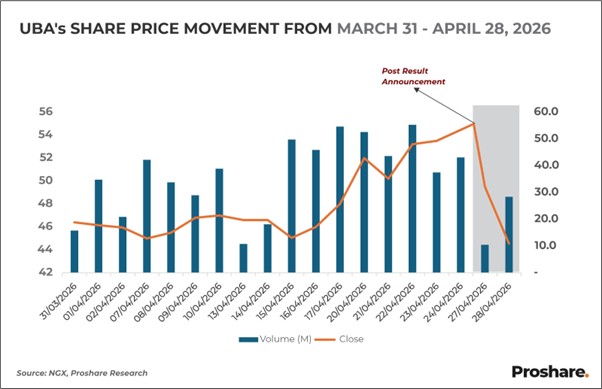
Price Trajectory in Four Phases
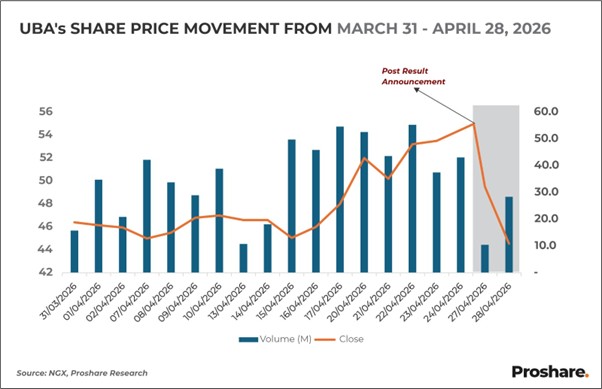
The UBA Plc price action over the past four weeks can be divided into four distinct phases. The table below sets out each phase, price corridor, volume signature, and analytical read. The data is generated from our Data & Content Units share price movement workbook covering 31 March to 28 April 2026.
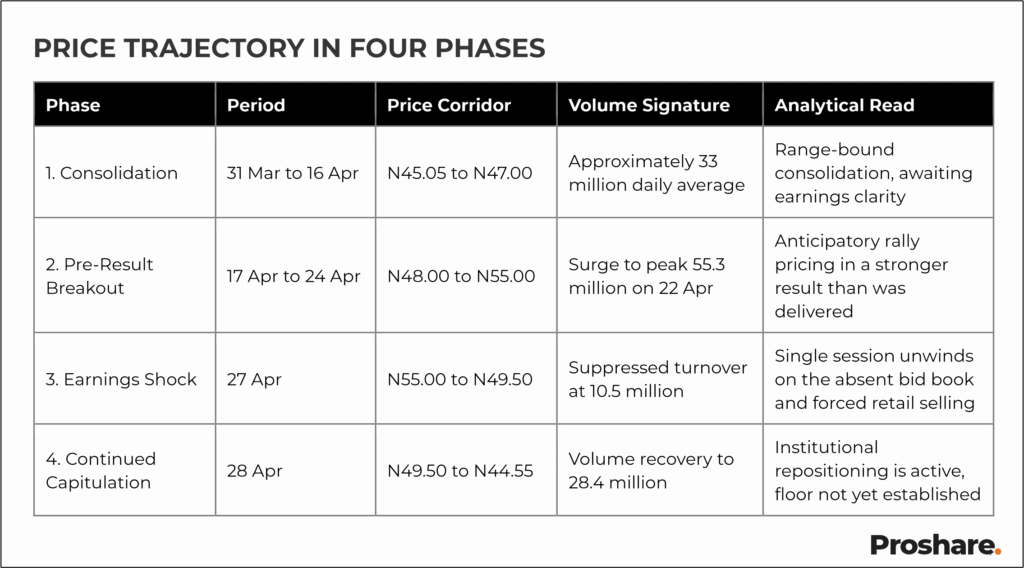
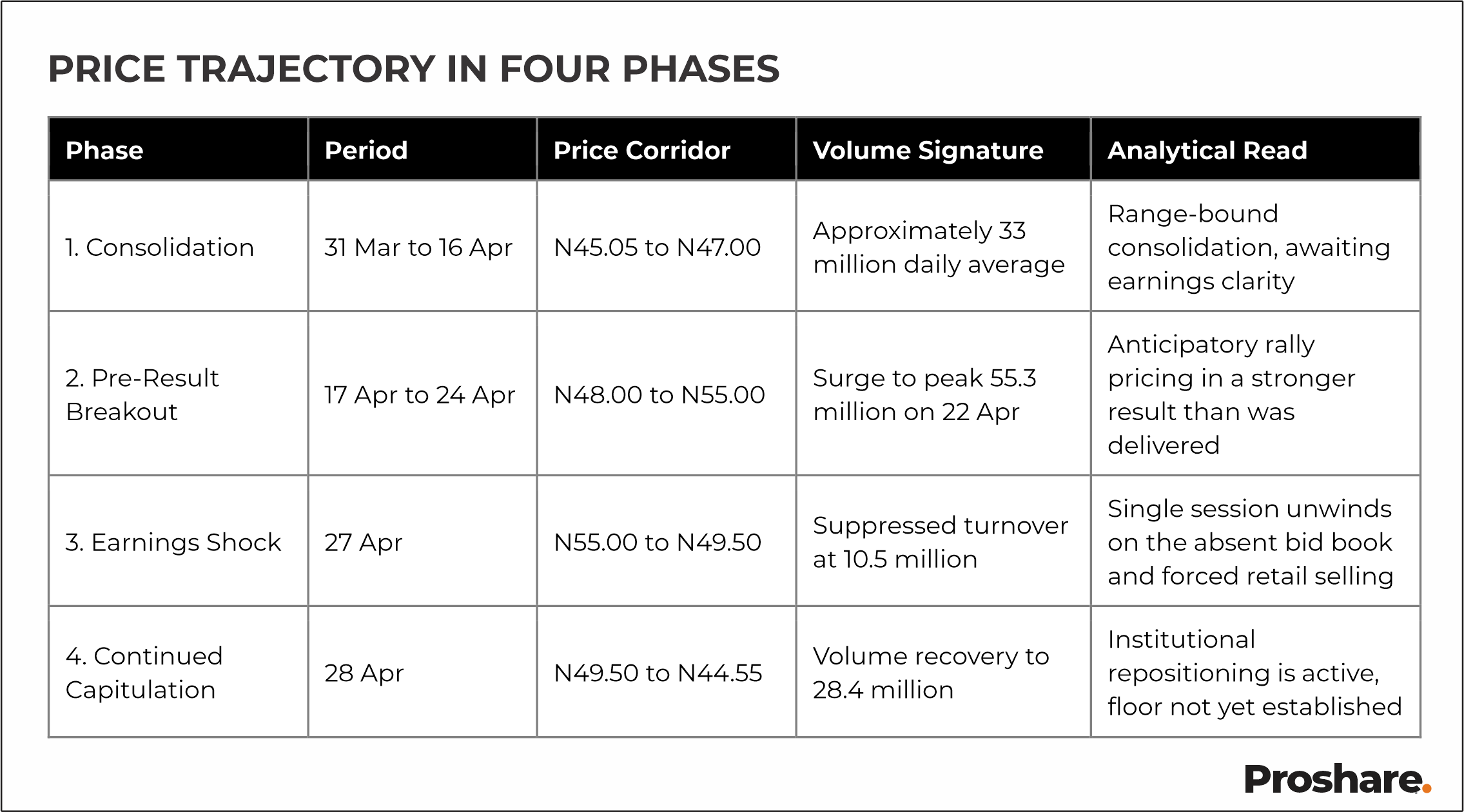
The trajectory matters because it identifies the source of the move. The decline of approximately N10.45 from the 24 April peak to the 28 April close is the unwind of a speculative pre-result rally and a fundamental repricing combined. The pre-result rally added approximately N7.00 from 17 April to 24 April. That portion of the move was reversed inside the first session of selling. The further N5.00 decline through Tuesday is the fundamental repricing on the FY 2025 reset, the dilution from the rights issue, and the absence of a final dividend.
The implication for the next phase of price discovery is that the speculative overhang has now been substantially worked off. What remains is the fundamental repricing, which is governed by sell-side note flow through the week, the cleanup of pending sell orders, and the next institutional benchmark, the H1 2026 result expected in late July or August. Price floors typically establish two to three sessions before the volume-weighted average converges with the day’s mid-range. We are not there yet.
Sector Dispersion, Banking Names on 28 April 2026
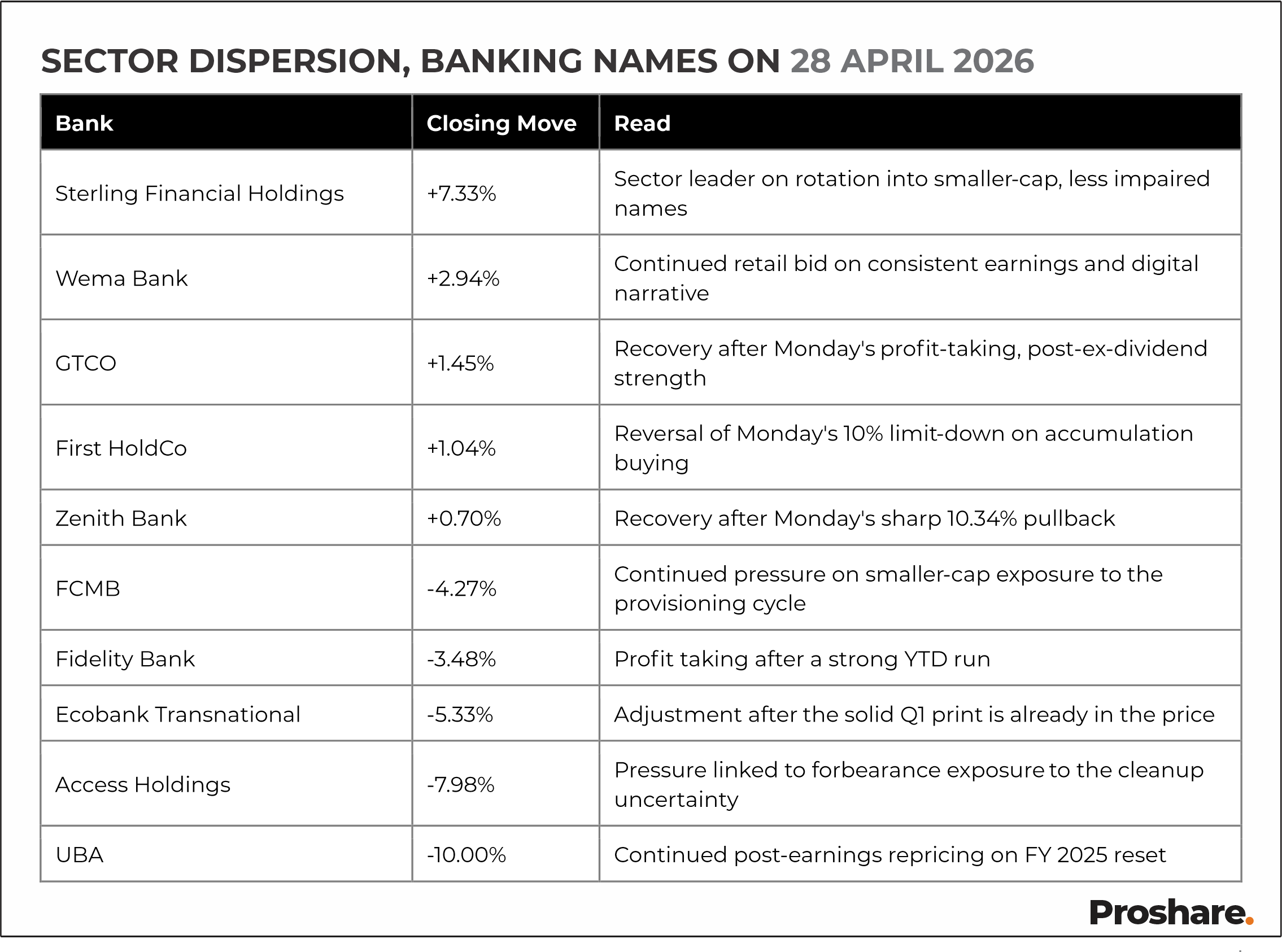
The dispersion within the sector points to an active selection process by domestic institutions and discerning retail. Names with cleaner balance sheets, stronger Q1 momentum, or smaller direct exposure to the forbearance cleanup cycle have attracted capital. Names that are still working through the FY 2025 reset have continued to give back ground. The pattern is constructive for the broader sector narrative, as it shows the market is differentiating rather than indiscriminately selling, but it also serves as a reminder that selectivity will define returns in the next phase of the Tier 1 banking trade.
What Discerning Investors Should Watch
The next 48 to 72 hours of trading will be diagnostic. Three signals are worth tracking specifically.
The first is the depth of the bid book at the opening of each session. Two consecutive sessions in which the daily volume-weighted average price holds above the day’s open would be the first credible indication that the sell-order overhang is being absorbed. Until that signal prints, the price is at risk of further downside.
The second signal is sell-side note flow through the rest of the week. No tracked capital market operator has issued a sell recommendation. Afrinvest moved the stock to Under Review on Monday. Other research houses have maintained neutral to cautiously optimistic positions. A coordinated upgrade or downgrade across two or more major houses would shift the institutional posture and crystallise a new consensus price target. A continuation of the Under Review status with no formal target reset would preserve the current uncertainty and keep the price discovery process active.
The third signal is the H1 2026 confirmation point. The market will price the FY 2025 reset against the trajectory for Q1 2026, when unaudited PAT was reported at N146.6bn, and against the H1 2026 result, which will land in late July or early August. If H1 2026 confirms a normalisation of provisioning and a recovery in core operating metrics, the recovery narrative becomes credible. If H1 2026 prints a softer result than the Q1 run rate suggests, the current correction may not be the floor.
For longer-horizon investors, the relative valuation has improved. UBA closed Tuesday at N44.55, against shareholders’ funds of N4.31trn, a capital adequacy ratio of 23.20%, and NPL coverage of 123.57%. The price-to-book ratio at this level is materially below the Tier 1 average. The medium-term thesis on UBA, anchored on its 20-country African footprint, its post-recap deployment optionality, and its long record of dividend reliability, has not been invalidated by the FY 2025 reset. What has changed is the entry point.
For short-cycle market participants, caution remains warranted. The phrase that has carried through this week is the right one. The market is pricing the information in front of it. Until the bid book stabilises, the institutional positioning settles, and a new consensus emerges from the analyst note flow, the prudent stance is to wait for evidence of price stabilisation before committing fresh capital.
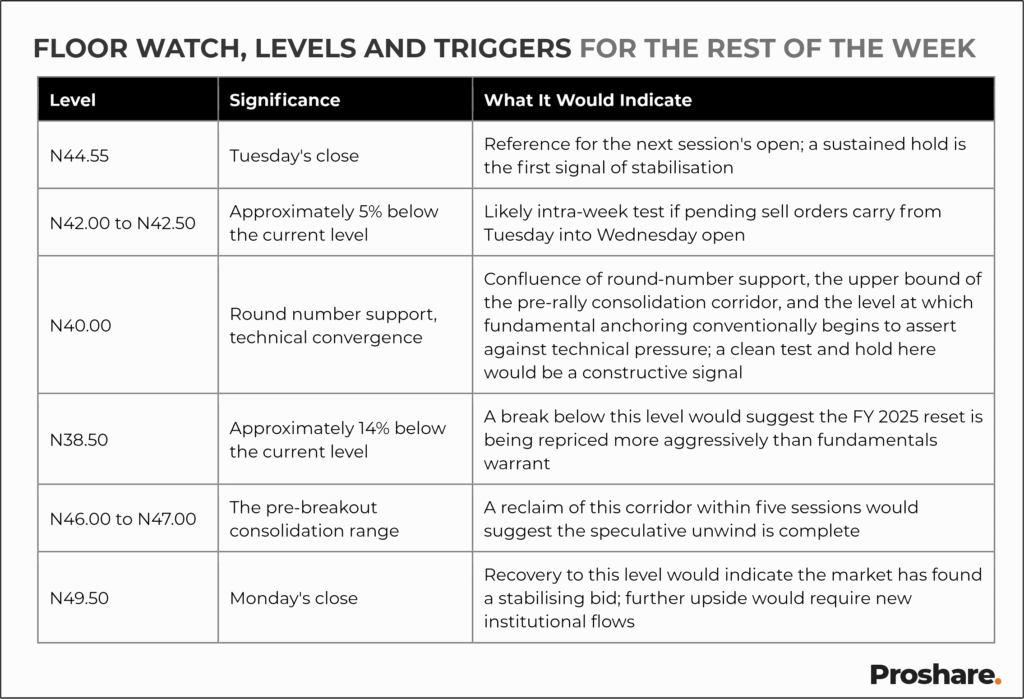
Floor Watch, Levels and Triggers for the Rest of the Week
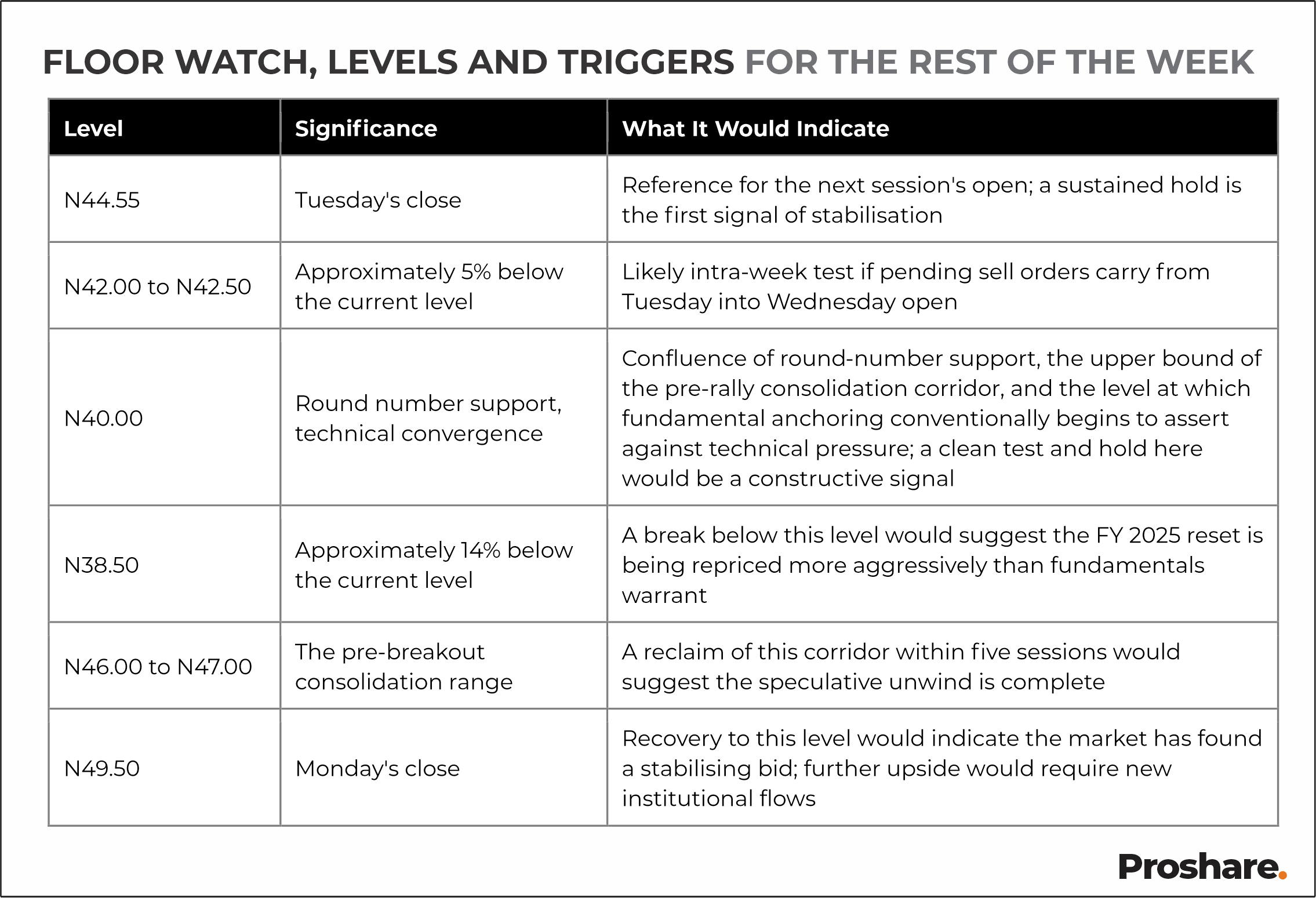
The level structure above is a market structure read, not a price target. It identifies the technical levels that are likely to be tested as the price discovery process continues. The N40.00 marker reflects the confluence of round-number support, the upper bound of the pre-rally consolidation corridor, and the analytical sense of where fundamental value conventionally begins to assert itself against technical pressure. It is a point of technical convergence, not a forecast of a near-term correction floor.

Closing Thoughts and Observation
UBA Plc has now repriced 19% in two sessions following the release of its FY 2025 audited results. The broader market rebounded 2.23% that same day, and the rest of the Tier 1 banking universe largely participated in the recovery. The divergence is stock-specific and earnings-driven. The fundamentals that inform the medium-term case, including the 20-country African footprint, the post-recap capital position, the 123.57% NPL coverage, and the 23.20% capital adequacy ratio, remain intact. What has changed is the entry valuation and the institutional patience required to wait for the next confirmation point.
Proshare will continue to track price action, analyst note flow, and institutional positioning through the rest of the week, with the knowledge that the next material confirmation point is the H1 2026 results. The directional read for the discerning investor is that the bottom of the correction has not yet been confirmed by trading evidence, but the levels at which long-horizon value begins to assert itself are now in sight. The market is doing its work. Investors should let the process c