
Nigeria Misses Revenue Target By N14 Trillion In H1 2026 As Oil Falls 58% Short Of Budget

Nigeria’s H1 2026 fiscal numbers tell a story that is now painfully familiar: a budget built on hope, revenue that refused to follow, and a government left to manage the gap with debt and discipline it has not yet shown.
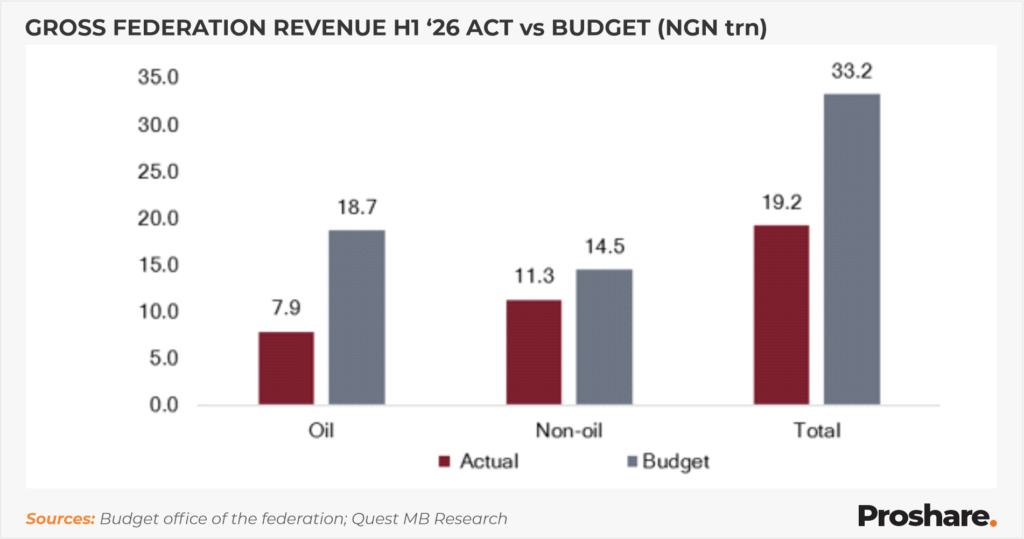
Gross federally collected revenue came in at N19.2 trillion in the first half of the year. That is not just a miss. It is a 42% shortfall against the pro-rata budget benchmark of N33.2 trillion, a gap of N14.0 trillion in just six months. It is also a 5% decline year-on-year, which means Nigeria is not just missing its own ambitious targets, it is actually collecting less than it did a year ago.
The culprit, as always, is oil.
Oil revenue accounted for about 77% of the entire shortfall. Collections totalled N7.9 trillion, nearly 58% below budget expectations and 15% lower than H1 2025. The reason is not a mystery. The budget assumed production of 1.8 million barrels per day. Actual production averaged around 1.6 million barrels per day. That 200,000 barrel gap, compounded over six months, is the difference between a workable budget and a broken one.
Inside the oil numbers, the weakness is even more revealing. Petroleum profit tax and gas revenue collapsed by 30% year-on-year to N2.9 trillion, underperforming its budget benchmark by a staggering 76%. Oil and gas royalties did better, rising 15% year-on-year to N4.1 trillion, but still fell short of the N5.4 trillion half-year target. In other words, even the parts of oil revenue that grew could not keep pace with what the budget promised.
This is the core of Nigeria’s fiscal vulnerability: we continue to budget as if oil will behave, and it continues not to.
But there is a second story in these numbers, and it is the more important one for the future. Non-oil revenue is quietly becoming the backbone of the federation account.
Non-oil revenue grew by 4% year-on-year to N11.3 trillion. It still missed its target of N14.5 trillion by 22%, but its resilience matters. For the first time in recent history, non-oil revenue at N11.3 trillion is significantly larger than oil revenue at N7.9 trillion. The economy that the budget still treats as an oil economy is, in revenue terms, increasingly a non-oil economy.
The star performer is VAT. VAT revenue expanded by 15% year-on-year to N4.8 trillion, coming in only 4% below budget. That is close to a hit in a half-year where almost every other line missed by double digits. It suggests that consumption, formalisation, and improved collection are doing what oil cannot: delivering predictable, growing revenue.
Interpreted critically, this is both good news and a warning. Good news, because it shows diversification is not just a slogan. The tax base is broadening, compliance is improving, and non-oil collections are cushioning what would otherwise have been a fiscal collapse. If oil had been the only story, the shortfall would have been catastrophic.
Warning, because non-oil revenue is still not enough. A 22% miss on non-oil targets shows that even the reform story is being over-promised in the budget. And a 4% growth rate in non-oil revenue cannot offset a 15% fall in oil revenue when the budget assumes both will boom.
The implication is direct and uncomfortable. The significant revenue underperformance constrains fiscal space for capital projects and infrastructure investment. When N14 trillion does not arrive in six months, something has to give. It is either capital spending, which dampens growth, or more borrowing, which increases debt service and squeezes future budgets. Nigeria is increasingly choosing the second option to protect the first, and that is not sustainable.
What H1 2026 proves is that Nigeria’s fiscal problem is no longer just about collecting more revenue. It is about budgeting honestly.
A budget that assumes 1.8 mbpd when production has struggled to sustain 1.6 mbpd is not a plan, it is a wish. A budget that assumes petroleum profit tax will jump by 76% when the sector is contracting is not a forecast, it is fiction. And when fiction meets reality, the credibility of the entire fiscal framework suffers. Investors, lenders, and even state governments who depend on FAAC allocations cannot plan on numbers that will not materialise.
The way forward, as the numbers themselves suggest, is threefold. First, base oil assumptions on conservative, achievable production and price levels, not aspirational ones. Second, double down on what is working: VAT, broadening the tax base, improving compliance, and formalising more of the economy, so that non-oil revenue can move from cushion to driver. Third, match spending discipline to revenue reality. If revenue will be N19 trillion and not N33 trillion, expenditure must be prioritised, not just financed with debt.
Nigeria is not running out of revenue. It is running out of excuses for budgeting as if oil will save it. H1 2026 shows that non-oil collections are gaining ground. The question now is whether fiscal policy will finally catch up with that reality, or continue to chase an oil boom that is no longer coming.