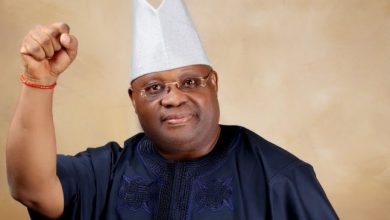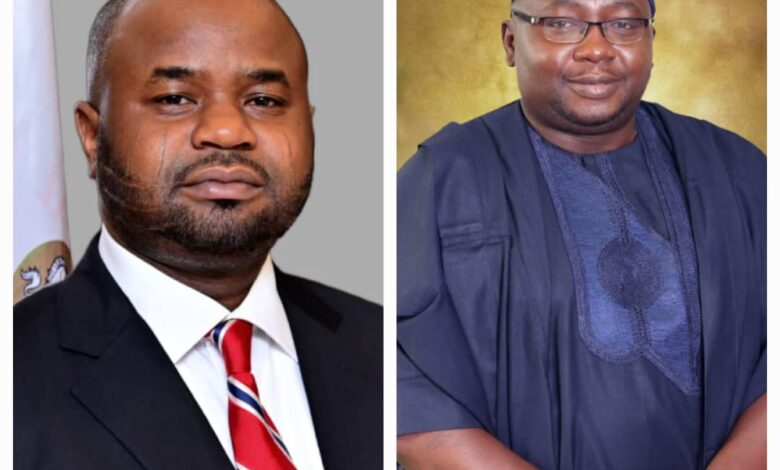
The battle for political supremacy in Oyo State between Zacch Adedeji and Adebayo Adelabu is not a clash of ideologies but a contest of two distinct routes to power, both rooted in patronage yet weaponized differently for the 2027 cycle. Both men emerged from Obafemi Awolowo University with first-class degrees in Accounting, and both climbed the ladder through powerful benefactors rather than through the slow grind of ward-level party work. That shared origin makes their fight instructive, because it reveals how Nigeria’s ruling party now negotiates between technocratic capital and electoral capital in the absence of the old godfathers who once settled such disputes with a phone call.
Adelabu’s ascent was bankrolled by establishment access. The late Aare Arisekola Alao, a towering stakeholder in First Bank, allegedly lifted him from the private sector into the presidency of Goodluck Jonathan, who made him a Deputy Governor at the Central Bank of Nigeria. When electoral ambition took hold, it was another banker, Femi Pedro of the now-defunct First Atlantic Bank, who allegedly walked him into Bola Tinubu’s circle and secured his 2023 appointment as Minister of Power. He carries the political memory of his grandparents’ networks, the goodwill of Ibadan’s mercantile elite, and the scar tissue of two failed governorship bids in 2019 and 2023. Those losses gave him something Adedeji does not have, which is a statewide delegate map and operatives who know how to count heads in a hall. His strategy, therefore, is retail politics. He exploits ministerial visibility by siting transformers and rural electrification projects, turning federal appropriations into localized gratitude. He leverages his Lagos-Tinubu relationship to stay in the room where APC NWC decisions are shaped, and he frames himself as the homegrown son who has bled for the party at the ballot. His strength lies in recognition and structure, but his weaknesses are equally public. The national grid’s fragility and tariff hikes have made “Minister of Darkness” a damaging nickname, and two electoral defeats allow opponents to brand him unelectable. The March 2026 social media post accusing him of sabotaging the party’s 2023 campaign and channeling funds to the PDP has not been substantiated, yet it circulates as a reminder that elite patronage cuts both ways, because the same doors that usher you in can be cited as evidence that you never truly belonged to the base.
Adedeji’s rise is the counter-narrative. He came from what he describes as a very poor background, but brilliance and the palace changed his trajectory. The late Alaafin Adeyemi III allegedly linked him to the late Governor Abiola Ajimobi, who made him Commissioner for Finance in Oyo State. Ajimobi then introduced him to the federal circuit, culminating in Tinubu’s appointment of him as Chairman of the Federal Inland Revenue Service in September 2023, now the Nigeria Revenue Service. He has never stood for election, and that is the core of his strategy. He exploits institutional performance as political currency. Under his watch the tax agency sealed leakages, digitized processes, and posted a record 47.39 trillion naira in 2024 collections, numbers that helped push external reserves toward 45 billion dollars. In a country desperate for fiscal breathing space, that record makes him the “new sheriff” and allows his defenders to ask why anyone would target the only office bringing good news. His strength is presidential dependence. Tinubu’s reforms live or die by revenue, and that gives Adedeji a shield that most ministers do not enjoy. His weakness is structural. He has no elected base, no ward chairmen loyal to him, and no tested campaign vehicle. The April 10, 2026 petition by the Aggrieved Aspirants of Oyo APC illustrates the cost of that gap. They accuse him of becoming an “emergency godfather,” of reserving the deputy governorship for his brother Soji Adedeji, of handpicking Hannah Ogunesan for Oyo North Senate and Remi Oseni for Oyo South, and of nominating all fourteen House of Representatives and thirty-two Assembly candidates without local input. Social media amplified those claims in May 2026 with carousels alleging a 5 million dollar plot and a May 12 Abuja meeting to steer 2027 primaries. His aides dismiss it all as sponsored blackmail, and as of late May 2026 no anti-graft filing or party sanction has emerged. Still, the allegations stick because they tap into a familiar anxiety about Abuja technocrats deciding local tickets.
The weapons in this war are petitions, proxies, and perception. Adelabu uses the grievance of local party leaders who feel shut out of Abuja decisions and the sympathy of members who recall his two campaign tours. He exploits the Ministry of Power’s brick-and-mortar projects to argue that he delivers tangibles while Adedeji delivers spreadsheets. Adedeji uses the presidency’s fiscal imperative to frame any attack on him as sabotage of Tinubu’s economic agenda. He exploits civil society reversals, such as groups that once criticized him now issuing votes of confidence, and high-profile defenders like Femi Fani-Kayode calling suspension demands an absurdity. He also exploits the timing of his results, because it is politically expensive to decapitate the one agency exceeding targets when the federation account needs every kobo. Both men are spending money, but the trail is opaque. Adelabu is said to command a donor network from his banking days and ministerial access, while Adedeji is alleged to have enormous leverage through the tax net, with opponents pointing to unverified claims of 3.5 billion naira moved to the PDP and 5 million dollars deployed for delegate loyalty. None of these money claims have been proven, yet they function as ammunition in a contest where delegate loyalty is the ultimate commodity.
To understand how this fight may end, it helps to use SWOT analysis. SWOT is a simple planning tool that looks at four things: Strengths are the advantages someone already has inside their own camp. Weaknesses are the problems or gaps they carry that can hurt them. Opportunities are outside conditions or chances they can take advantage of. Threats are outside dangers that could block or damage them. When you apply that lens to Adelabu, his strengths are clear. He has statewide name recognition, a campaign structure tested in two governorship runs, and deep family and business ties in Ibadan that still open doors from Beere to Bodija. His opportunities come from Tinubu’s need to win Oyo in 2027, which could force the presidency to back a candidate with real ground game, and Adelabu can present himself as that option. His weaknesses are his two electoral losses and the public anger tied to the power sector, where grid collapses and tariff hikes have given him the “Minister of Darkness” tag. His threats are the possibility that the presidency decides he cannot win and chooses to protect Adedeji’s revenue operation instead, plus the risk that unproven allegations about anti-party activity in 2023 gain enough traction to damage him. For Adedeji, his strengths are technical competence, the personal trust of the President, and a reformer image that matches the administration’s need to show results. His opportunities exist because the deaths of Alaafin, Ajimobi, and Arisekola left a vacuum, and if he can turn federal influence into a local structure, he could emerge as the new power broker. His weaknesses are that he has never won an election, has no ward-level machine, and is seen by many as governing Oyo APC by remote control from Abuja. His threats are the “emergency godfather” label becoming fixed in the public mind, the petitions forcing Tinubu to pick between keeping revenue high and keeping the party quiet, and the basic fact that strong tax numbers do not vote in a delegate primary.
What is unfolding, therefore, is a test of what the All Progressives Congress values most in Oyo State at this moment. If the party prizes winning the governorship above all, Adelabu’s two campaign runs and local networks give him a plausible claim, despite the losses. If the party prizes fiscal survival and a clean break from the old order, Adedeji’s ledger becomes his ballot. The battle is also a referendum on the post-godfather era. With Alaafin, Ajimobi, and Arisekola gone, the question is whether traditional and business elites can still anoint governors, or whether presidential proximity and institutional control now write the list. The April 2026 petition and the May 2026 allegations are not just about Adedeji or Adelabu. They are about who gets to answer that question. For now, Adelabu fights like a man who has invested electoral capital and cannot afford a third write-off. Adedeji fights like a man who was never supposed to be in the political room but now holds the keys to the federation’s purse, and he is learning that in Nigerian politics, the man who counts the money is quickly accused of trying to count the delegates. The danger for the APC is that the two titans weaken each other to the point that neither can deliver Oyo in 2027, leaving the state to the opposition by default. The danger for both men is that they are expendable. Presidents remember revenue, but they also remember who can win a state. In the end, the Ibadan chessboard will not be settled by first-class certificates or by who had the better godfather. It will be settled by who best converts patronage into a primary, and who can do it without burning down the party that gave them the ladder in the first place.