
·
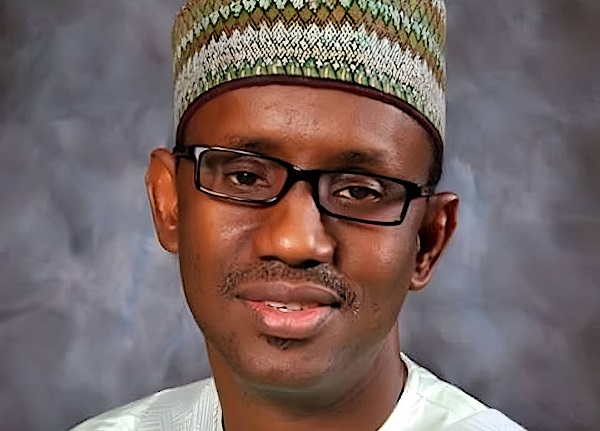
The halls of Aso Rock have always been a theater of whispers, but this week, the volume reached a fever pitch. On Monday, May 11, 2026, the Presidency officially broke its silence to dispel a viral rumor: National Security Adviser (NSA) Nuhu Ribadu had not resigned. The denial was swift, framed as a firm rebuttal to “baseless” claims. Yet, in the high-stakes world of Nigerian power politics, what is unsaid often carries more weight than the official press release.
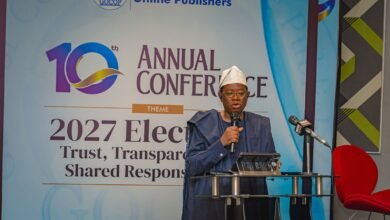
The catalyst for this storm was the appointment of retired Major General Adeyinka A. Famadewa as the pioneer Special Adviser on Homeland Security. While the government portrays this as a technical expansion of the security apparatus, a deeper look reveals a sophisticated political maneuver. This is not just about “supporting the NSA”; it is about the 2027 roadmap, a recent secretive trip to Washington D.C., and a governing philosophy that has defined Bola Ahmed Tinubu’s career for three decades: the art of the permanent checkmate.
The Washington Connection: JD Vance and Marco Rubio
To understand why General Famadewa is appearing now, one must look back at a quiet, under-the-radar trip Ribadu took to Washington D.C. just last week. In the corridors of the U.S. Capitol, the NSA reportedly held closed-door sessions with key American power brokers, including Vice President JD Vance and Secretary of State Marco Rubio.
Image
Nuhu Ribadu and JD Vance
The optics of a Nigerian NSA meeting with the current U.S. administration are significant. Vance and Rubio have been vocal about global stability through the lens of transactional realism.
Image
Nuhu Ribadu and Marco Rubio
For Ribadu, the mission was clear: secure Western backing for Nigeria’s counter-terrorism efforts and, perhaps more crucially, gauge the international temperature for the 2027 election cycle.
However, sources suggest that what Ribadu was told in those rooms did not remain in Washington. The Americans are known for their data-driven assessments of “political stability.” If the U.S. intelligence community shared insights regarding internal dissent or the viability of the current administration’s grip on the 2027 landscape, that information is a double-edged sword. In the paranoid ecosystem of the presidency, an NSA who knows too much—and has his own direct line to the world’s most powerful figures—becomes a variable that needs “balancing.”
The 99th Hour: The Fear of Northern Interests
Despite the public show of solidarity, a cold reality has set in within the President’s inner circle: Tinubu does not fully trust Ribadu. The tension is not necessarily about Ribadu’s competence, but about his ultimate loyalty when the chips are down.
As the 2027 election approaches, the President is increasingly wary that Ribadu, at the “99th hour,” might succumb to the immense pressure of Northern interests. In the volatile landscape of Nigerian regionalism, the fear is that an NSA from the North might prioritize regional power-shifting over the President’s personal political survival. To Tinubu, a brilliant NSA who might hesitate to execute a “crush” order against his own kinsmen or regional power brokers is a liability he cannot afford.
The Antecedents of Paranoia: The Lagos Blueprint
This move is perfectly in line with Tinubu’s historical antecedents. His governance style has always been defined by a deep-seated suspicion of those who might grow too powerful. He never allows a single pillar of support to stand alone; he always installs a counter-pillar to checkmate it.
We saw this repeatedly throughout Tinubu’s political evolution in Lagos. His governing doctrine has never been built around allowing a single subordinate to accumulate unchecked authority. Every major political actor is balanced by another actor, another structure, or another loyalty network. Power, in the Tinubu model, is never left concentrated in one hand for too long.
The Sanwo-Olu era offers one of the clearest examples. While Governor Babajide Sanwo-Olu formally controls the executive arm of government, the Lagos State House of Assembly under Speaker Mudashiru Obasa has often functioned as an autonomous political counterweight rather than a passive legislative partner. Obasa himself is not merely a ceremonial Speaker; he commands a deeply entrenched political machine within Lagos politics and possesses enough independent institutional leverage to remind everyone that the Governor is not the sole center of authority. The arrangement creates a deliberate equilibrium: no matter how powerful the Governor appears publicly, there remains another influential node within the system capable of checking excesses, slowing independent political consolidation, or re-aligning the government back toward the broader political center of gravity.
This architecture is not accidental. It reflects Tinubu’s long-standing belief that political survival depends on layered loyalties and overlapping centers of influence. In his ecosystem, nobody is allowed to become indispensable.
The Ambode episode remains the most dramatic illustration of this philosophy. When Akinwunmi Ambode emerged as Governor in 2015, he was initially viewed as a technocratic loyalist who would preserve the established political order. However, as his tenure progressed, tensions reportedly began to emerge between Ambode’s growing independent style and the expectations of the wider political structure that produced him.
What made Ambode politically vulnerable was not necessarily poor performance. In fact, many Lagosians considered his administration competent in infrastructure and urban development. His real problem was the perception that he was gradually attempting to establish an independent power base outside the traditional patronage architecture that had governed Lagos politics for decades.
Within the Tinubu system, competence alone has never been enough to guarantee survival. Political alignment, consultation, and deference to the larger structure are considered equally important. Once influential blocs within the ruling establishment concluded that Ambode was becoming too autonomous, the machinery that once elevated him began to quietly turn against him.
Party structures shifted.
Key endorsements disappeared.
Grassroots mobilizers withdrew enthusiasm.
Political elites began coordinating against him behind the scenes.
The outcome was historic. For the first time in modern Lagos political history, a sitting governor was denied his party’s ticket for a second term. The removal was not chaotic or emotional; it was methodical. It demonstrated Tinubu’s capacity to discipline even his own highest-ranking office holders if they were perceived to be drifting too far from his orbit.
The same pattern appeared earlier during Tinubu’s own tenure as governor. Deputy governors such as Kofoworola Bucknor-Akerele and later Femi Pedro eventually fell out of favor and exited the structure after questions emerged regarding alignment and loyalty. The lesson across decades has remained remarkably consistent: in the Tinubu political universe, power is delegated, but never fully surrendered.
That historical backdrop is why many analysts interpret recent federal appointments through the same lens. The instinct to create parallel structures, overlapping authorities, and internal counterbalances did not begin in Abuja. It was refined in Lagos over more than two decades and now appears to be operating on a national scale.
This is not a new behavior; it is a survival mechanism practiced over many years. Everything in the Tinubu universe must rotate around the sun—him. In this latest move of checkmating Ribadu, Tinubu has once again shown that he is far more interested in regime security than actual national security.
The Ethnic Fortress: The Eyes and Ears
Enter Major General Adeyinka A. Famadewa. While the Presidency’s official stance is that Famadewa’s office will focus on “Immigration and Civil Defence,” his true role is far more visceral.
Famadewa is a fellow Yoruba man. In the complex ethnic calculus of Nigerian governance, this is the ultimate currency of trust—the “father and mother” of political insurance. By placing Famadewa directly into the most sensitive part of the security architecture, Tinubu has installed a man who possesses not only a professional history with the security establishment, but also a deep ethno-political bond with the President.
Crucially, General Famadewa is not a newcomer to these halls. He served as the Principal General Staff Officer (PGSO) at the Office of the National Security Adviser for six years (2015–2021) under the Buhari administration. During that time, he was the architect of the Intelligence Fusion Centre (IFC), a platform designed to integrate data from the DSS, NIA, and DIA.
Famadewa knows where the bodies are buried; he knows every secret corridor and digital back door in the NSA’s office. The genius of this move is that Famadewa is still in the same building, still has the same institutional knowledge, but he no longer reports to Nuhu Ribadu. He reports directly to Tinubu.
Furthermore, Famadewa is an officer of the old school who understands Hausa. This adds a layer of “linguistic security” to the President’s strategy. Even if Northern interests attempt to plot or converse in the shadows of the vernacular, Famadewa will be there to translate the intent directly to the President. Whatever is happening, Famadewa will be Tinubu’s eyes and ears.
The Northern Response: The Unstoppable Force of Destiny
The North, however, is not blind to these maneuvers. While the President builds his fortress, the murmurs from the Sahel are growing louder. In the quiet corridors of Kaduna and Kano, the sentiment has shifted from cooperation to a stoic observation of the President’s paranoia.
“He can put fifty-five men in that office if he likes,” an anonymous Northern elder stated. “He can surround himself with all the ‘eyes and ears’ in the world. But if destiny is against him, nothing can stop destiny. Whether Famadewa is there or not, what will be, will be.”
This fatalistic confidence suggests that while Tinubu is playing the short game of regime security, the Northern power blocks are waiting for the “99th hour” with a different kind of certainty.
The 2027 Paranoia: Preventing the Great Betrayal
The shadow of 2027 looms over every decision made in 2026. The administration is currently in a state of high alert, purging those with split loyalties and tightening the circle around the “true believers.”
There is a historical precedent in Nigerian politics for the “Security Betrayal.” Presidents often fear that their security chiefs might become kingmakers—or worse, king-breakers. By creating a parallel “Homeland Security” office, Tinubu has fractured Ribadu’s monopoly on security information.
The Strategic Redundancy
The Presidency’s statement emphasized that the new office is meant to SUPPORT the NSA. In the language of power, “support” is often a euphemism for “supervision.”
The specific duties assigned to Famadewa—Immigration, Civil Defence, and Domestic Intelligence—give him control over the border, the paramilitary forces, and the internal surveillance of political actors. By carving these out of the traditional NSA’s portfolio, the President has created a system of Strategic Redundancy. If Ribadu becomes overly influenced by “Washington talk” or Northern regional pressure, the Homeland Security office—led by a trusted Yoruba loyalist who understands the NSA’s office better than anyone—remains a pure, unadulterated line of defense for the President’s personal interests.
Conclusion: A Masterclass in Power Preservation
The appointment of Major General Famadewa is a masterstroke of political engineering. It honors the President’s lifelong commitment to “divide and rule” within his own camp. By denying Ribadu total control, installing a fellow Yoruba man as the shadow NSA, and leveraging Famadewa’s deep institutional history at ONSA, Tinubu believes he has secured his flanks.
As Nigeria moves closer to the next general election, the “Homeland” will no longer be merely about borders, bandits, or counter-terrorism. Increasingly, it will become about the security of the throne itself. General Famadewa is not simply an adviser added to the bureaucracy; he is, in many ways, the President’s insurance policy against a 99th-hour betrayal.
Yet, as many in the North quietly remind us, even the strongest insurance policy cannot negotiate with kaddara. In the end, power may prepare, strategize, and fortify itself from every direction, but destiny has a way of rendering even the most sophisticated political calculations irrelevant.