71.9% OF ADELEKE’S ₦362.3B PROJECTS GO TO EDETh
Bad leadership does not always come as outright failure. Sometimes it comes dressed as development, with big budgets and long project lists, while quietly shifting the weight of the state toward one place. When leadership is driven by narcissistic tendencies, public money stops being a commonwealth and becomes a personal monument. The test is simple: who gets what, and why. In Osun, the numbers answer that question.
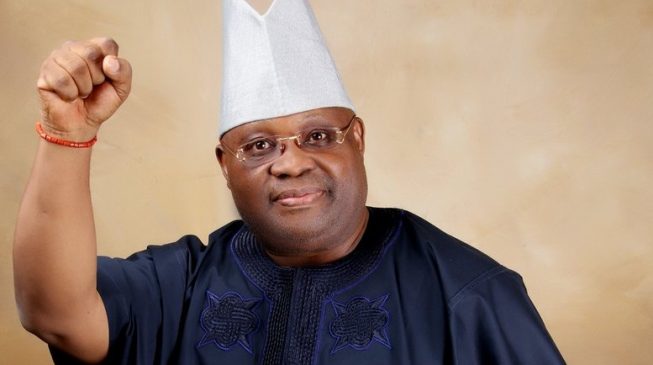
Governor Ademola Adeleke has committed ₦362.3 Billion to 20 major projects. According to the official breakdown, Ede Federal Constituency received 8 projects worth ₦260.5 Billion. That is 71.9% of the entire allocation. The remaining 12 projects across 8 other constituencies share ₦101.8 Billion, or 28.1%. Nearly three of every four naira budgeted under this plan is going to one town.
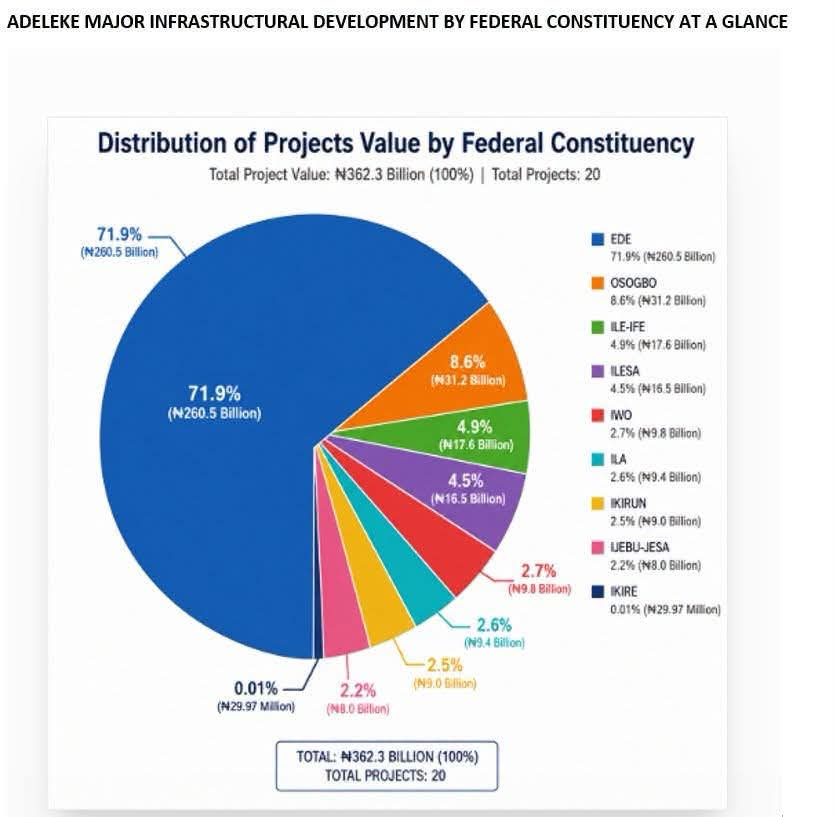
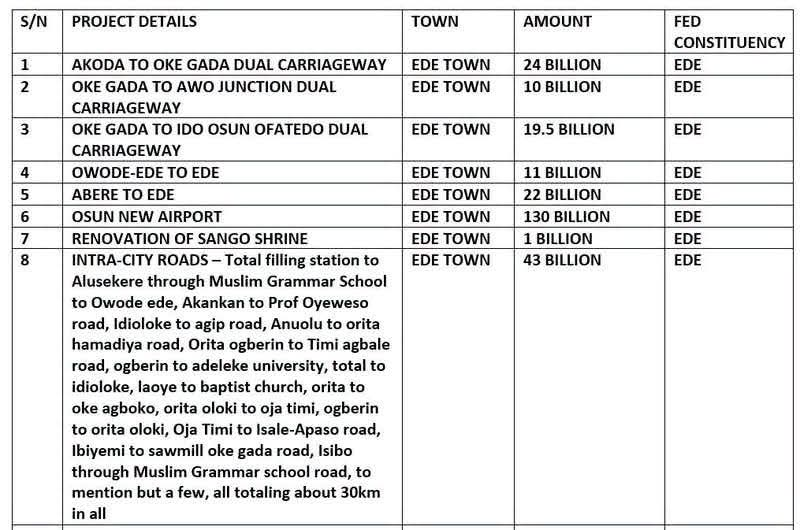
The concentration is driven by the scale of projects in Ede. The list includes the Osun New Airport at ₦130 Billion, the Akoda to Oke Gada Dual Carriageway at ₦24 Billion, Oke Gada to Awo Junction Dual Carriageway at ₦10 Billion, Oke Gada to Ido Osun Ofatedo Dual Carriageway at ₦19.5 Billion, Owode-Ede to Ede Road at ₦11 Billion, Abere to Ede Road at ₦22 Billion, Renovation of Sango Shrine at ₦1 Billion, and Intra-City Roads of about 30km covering Baptist Church, Adeleke University, Oja Timi Market and other areas at ₦43 Billion.
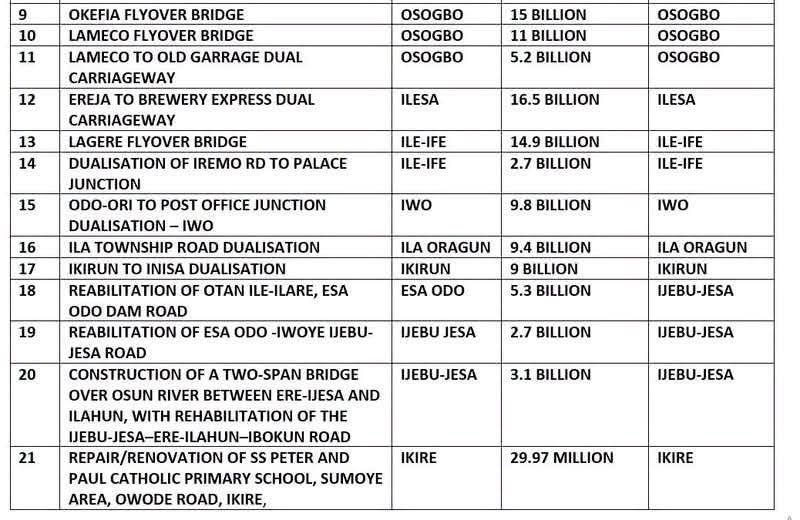
Outside Ede, the allocations are smaller and fewer. In Osogbo, the projects are the OKEFIA FLYOVER at ₦15 Billion, LAMECO FLYOVER at ₦11 Billion, and LAMECO TO OLD GARAGE DUALISATION at ₦5.2 Billion, totaling ₦31.2 Billion. Ile-Ife got the LAGERE FLYOVER at ₦14.9 Billion and IREMO RD DUALISATION at ₦2.7 Billion, totaling ₦17.6 Billion. Ilesa has the EREJA TO BREWERY EXPRESS ROAD DUALISATION at ₦16.5 Billion, with ₦12 Billion of that cost refunded to the state by the Federal Government.
Iwo received the IBA OLUWO TO OLUKOTUN RD DUALISATION at ₦9.8 Billion. Ila got the ILA ORANGUN TO IKIRUN RD DUALISATION at ₦9.4 Billion. Ikirun was allocated the OKITI TO IKIRUN RD DUALISATION at ₦9 Billion. Ijebu-Jesa has three projects: ILARE/IKEJI-IJEBU ROAD REHABILITATION at ₦4 Billion, IJESA BRIDGE at ₦4 Billion, and IJESA ROAD REHABILITATION at ₦3.1 Billion, totaling ₦8 Billion. Ikire received the REHABILITATION OF UNITED AFRICAN SCHOOL at ₦29.97 Million.
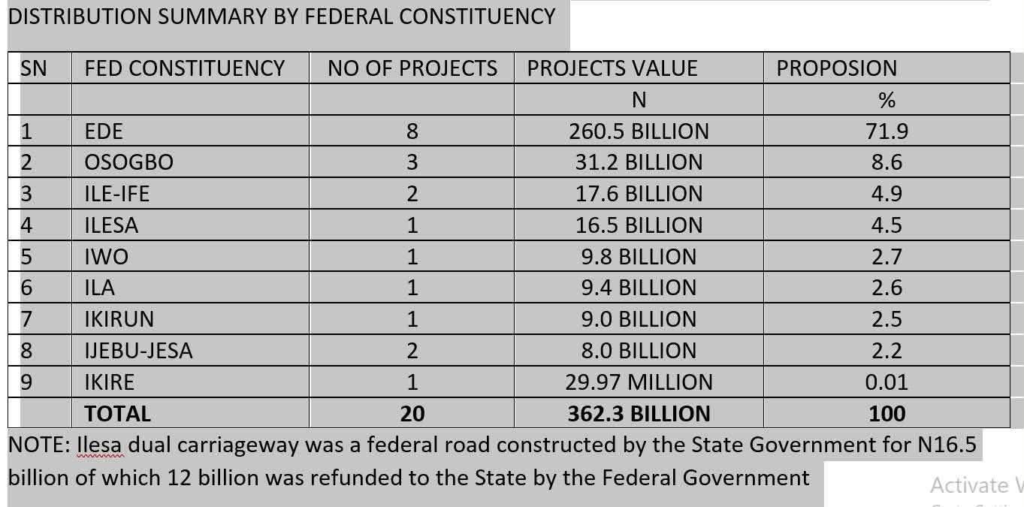
The contrast is direct. Ede is getting an airport, four dual carriageways, 30km of intra-city roads and a cultural site. Osogbo and Ile-Ife are getting flyovers. Iwo, Ila, Ikirun and Ijebu-Jesa are getting single road projects. Ikire’s allocation is a school renovation valued at less than ₦30 Million, compared to ₦130 Billion for one project in Ede.
When 71.9% of state resources are committed to one constituency, governance ceases to look like equity and begins to look like preference. Infrastructure should connect a state, not divide it. The people of Osogbo, Ile-Ife, Ilesa, Iwo, Ila, Ikirun, Ijebu-Jesa and Ikire will measure this administration not only by what was built, but by where it was built. And in politics, that is the number voters remember.
Governor Ademola Adeleke’s administration has drawn sharp criticism over what many see as entrenched nepotism, with key state roles dominated by members of his immediate and extended family. Beyond holding the governorship, Adeleke also serves as Commissioner for Works, while his brother Dr. Deji Adeleke chairs the Advisory Council alongside Yeye Dupe Adeleke as co-chair. The arrangement extends to two designated “First Ladies” — Títí Adeleke for administration and Ngozi Adeleke for academics — and cuts across finance, planning and local governance with Adenike Folasade Adeleke as Commissioner for Federal Affairs, Prof. Maruf Adeleke overseeing Budget and Planning, Tunji Adeleke chairing the local government commission, and Gbolahan Adeleke as Special Adviser on Government House Affairs. Even sports and public funds are not exempt, with David Adeleke named Chairman of the Osun Sport Trust Fund. The concentration of political and fiscal authority within one family raises serious questions about merit, transparency, and the use of Osun taxpayers’ money, suggesting a governance model where public appointments function less as vehicles for service delivery and more as instruments for dynastic control.
The most persistent charge is that Osun is being governed like a family compound. Opposition parties and civic voices have repeatedly pointed to a pattern of appointments that keeps cabinet seats, board chairmanships, and agency headships within the orbit of the Adeleke family and its long-time business allies. The defense from government is always the same: loyalty and competence are not crimes, and the governor is entitled to work with people he trusts. Yet trust is not the standard the Public Service Rules demand. Merit is. When the “Ede factor” becomes shorthand for who gets what, the perception of a state captured by kinship takes root, and perception in politics is a form of reality. A government that campaigned against impunity cannot dismiss this as propaganda when the optics suggest a narrowing of the state to a family project.
From Ede to Ilesa, the same whispers now trail his convoy: who really runs this government, whose pockets are being lined, and whether the line between state power and family empire has been erased. These are not yet court convictions, but they are the allegations that have defined the Adeleke years, and a government that promised daylight owes the public answers before the shadows harden into legacy.
Financial management has become another front. Critics have flagged the pace and detail of budget performance reports, questioning whether the public can truly track how grants, allocations, and loans are moving. The APC alleged in 2024 that fresh loans were taken without disclosure, a claim the government denied by pointing to debt restructuring rather than new borrowing. The dispute itself reveals the problem: in a FAAC-rich season, accountability should be easier, not harder. When IGR is rising and debt is supposedly untouched, the books should be wide open. That they are not, or that the publications come late, feeds the suspicion that windfall revenue is being managed as political capital rather than public trust.
The tone of the administration was set in its first days, and that tone still haunts it. The mass reversal of appointments through Executive Orders — sacking thousands of workers, monarchs, and board members installed by the previous government — was framed as correcting illegality. To those affected, it looked like victimisation without fair hearing. Labour unions protested. Royal stools went to court. The government’s legal argument may stand, but the political damage was done: it told the civil service that job security lasts only until the next election. For a bureaucracy already politicized by years of arrears and half-salary trauma, that message deepened the sense that the state is a spoils system, not a service system.
The same concern shadows Osun’s mineral wealth. The renegotiation of gold mining joint ventures and licenses was presented as a cleanup of a sector abused under past administrations. Yet opposition voices counter that the new deals are simply reallocating control to interests aligned with the governor’s circle. In a state desperate for revenue independence, mining should be Osun’s long-term hedge against FAAC volatility. If the process is opaque, the hedge becomes a rumor, and the promise of sanitization becomes another front in the patronage war. The pattern is familiar: a legitimate policy goal undermined by the suspicion of private gain.
Even relief has become contentious. Palliatives meant to cushion the blow of subsidy removal were rolled out with fanfare, but civil society groups alleged in 2023 and 2024 that distribution was routed through party structures, turning poverty relief into political reward. The government’s reply — that ward committees included all stakeholders — has not silenced the charge that vulnerability is being mapped by party register. When hunger is partisan, the social contract is broken. A government elected on the back of economic pain cannot afford to be seen as rationing compassion.
The Adeleke administration’s blanket response to all this is to call it “APC propaganda” and to point to ongoing projects, cleared arrears, and IGR growth as rebuttal. Delivery is important, but delivery is not immunity. No flyover erases due process questions. No paid salary justifies sacking workers without hearing. No IGR chart excuses a procurement process the public cannot see. In Osun’s adversarial politics, allegations are weapons, and many will be false. But a government that holds power in trust does not win by labeling critics. It wins by opening the books, publishing the contracts, and subjecting its family, its friends, and itself to the same rules it met in the civil service