


Nigerian equities opened the week of June 29, 2026, with broad losses that extended the market’s recent slide, as profit-taking in heavyweight names overwhelmed pockets of buying interest and dragged both listed and unlisted bourses lower. The NGX All-Share Index fell 1.57% to 228,401.92 points from 232,049.02 in the prior session, erasing N2.34trn from investors’ wealth in a single day. That decline pulled the year-to-date return down to 46.78%, a reminder that even after a strong 2026 rally, the market remains vulnerable to sharp corrections when large caps reverse. The Proshare Memorandum Indexes confirmed the weakness, with the market cap-weighted index down 0.24% to 1,354.27 points and the total return float-adjusted index off 0.79% to 936.77 points, showing the downturn was not isolated to a few names but spread across the float.
The selloff was led by blue-chip stocks that had powered much of the year’s gains. MTNN and UNILEVER both hit the 10% daily limit down, while CADBURY dropped 9.82% and WEMABANK fell 7.41%. Other notable losers included DANGSUGAR -4.93%, NGXGROUP -4.17%, FCMB -3.52%, TIP -3.45%, NEM -3.10%, FIRSTHOLDCO -2.48%, WAPCO -2.33%, UCAP -2.01%, ZENITHBANK -1.26%, OANDO -1.24%, UBA -0.88%, GTCO -0.70%, and ACCESSCORP -0.22%, plus 30 additional names. With 47 decliners against only 13 gainers, market breadth was decidedly negative, indicating that selling was not sector-specific but broad-based across banks, consumer goods, industrials, and telecoms. UPDC bucked the trend to top the gainers’ chart, yet it also touched a 52-week low at N3.25, underscoring how fragile sentiment was even among advancers. LEARNAFRCA led the losers, highlighting pressure on smaller caps as well.
Despite the headline drop, trading activity surged, suggesting the decline was orderly rather than panic-driven. Total volume jumped 171.60% to 1.06bn units, valued at N44.57bn across 62,482 deals. IKEJAHOTEL dominated both measures, accounting for 28.94% of volume with 305.54m units and 29.65% of value at N13.21bn, indicating targeted block trades or portfolio rebalancing rather than retail flight. ACCESSCORP and STERLINGNG followed with 27.47% and 3.16% of volume, while ACCESSCORP and PRESCO trailed IKEJAHOTEL in value traded. The concentration of activity in a few names while the broader index fell points to institutional rotation and profit-taking after the market’s 46.78% YTD run, not a wholesale exit.
The NASD OTC market mirrored the NGX weakness, with the NASD Securities Index down 0.36% to 4,261.56 points from 4,277.07. Volume rose to 2.295m units valued at N24.59m across 34 deals, with two gainers and two losers on the day. The parallel move suggests that risk-off sentiment extended beyond listed equities to the unlisted space, even though liquidity remains thin by comparison.
Global and African markets provided a contrast, closing largely bullish on Monday, with Taiwan Weighted leading gainers at 44,999.90 index points. The divergence highlights that Nigeria’s pullback was driven by domestic factors — profit-taking, valuation concerns after a strong first half, and rotation out of recent outperformers — rather than global risk aversion. In commodities, the local picture was mixed. AFEX Commodities Index rose 7.31% to 35.97 points while AFEX Export Index closed flat at 37.55. Maize surged 36.17% to N218.62 and Sorghum added 1.23% to N33.57, reflecting food inflation and supply dynamics, while Soybeans and Paddy rice fell 6.26% and 1.29% to N362.50 and N550 respectively. LCFE prices for Eko Gold and rice variants were unchanged. Globally, gold and silver declined 1.58% and 2.05% to US$4,016.07 and US$57.76, while Brent and WTI advanced 0.93% and 1.53% to US$72.71 and US$70.15 as geopolitical tension between the U.S. and Iran kept crude supported despite improved shipping confidence through the Strait of Hormuz.
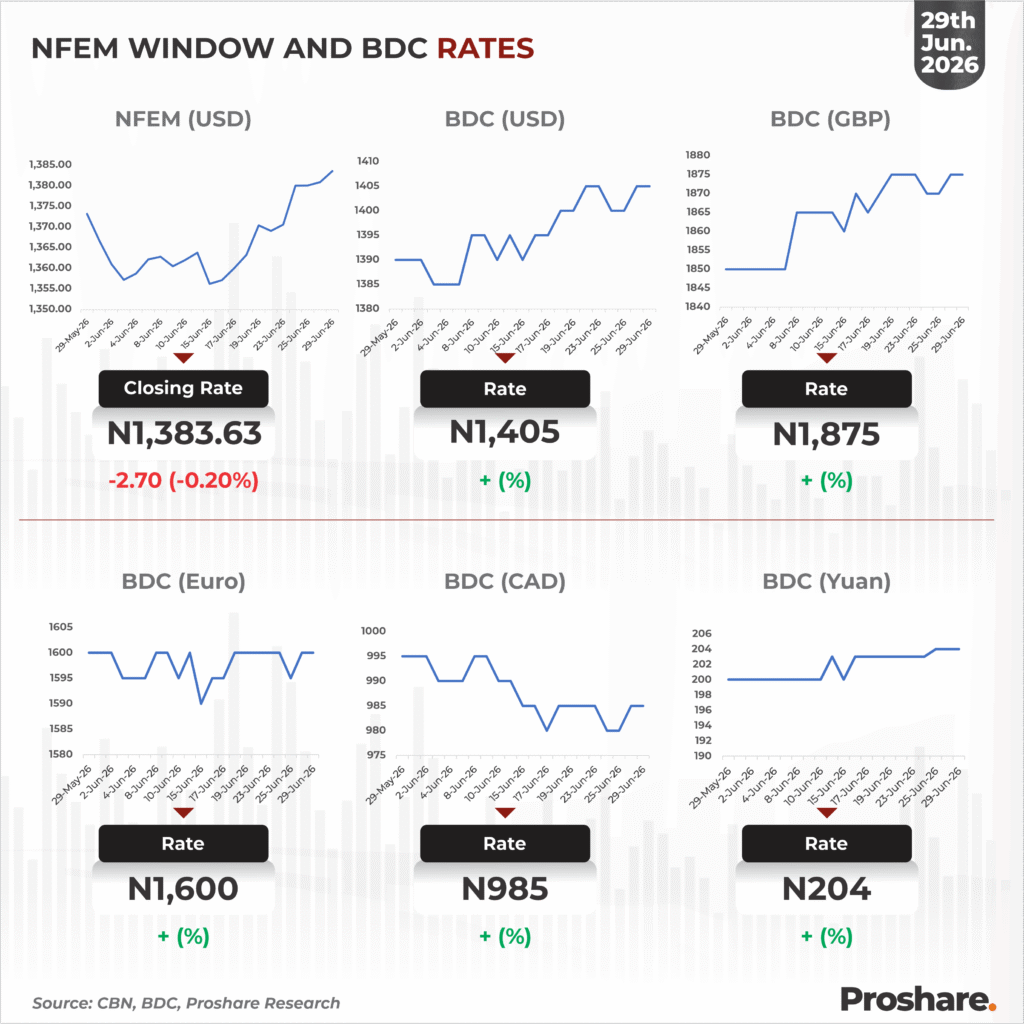
On the currency front, the BDC rate was flat at N1,405/US$1, but the NFEM rate weakened 0.25% to N1,383.63/US$1 from N1,380.93/US$1. The mild depreciation at the official window against a stable parallel rate suggests continued pressure on dollar liquidity even as the spread remains tight. For equities, a weaker naira is a double-edged sword: it boosts the naira value of dollar-linked earnings for exporters and banks with foreign assets, yet it also raises input costs and can trigger foreign portfolio outflows if confidence slips.
Corporate activity continued despite the market drop. MTN Nigeria reported director dealings, Neimeth and Cadbury released AGM resolutions, Airtel Africa disclosed PDMR shareholding, Nascon announced a close period, NAHCO notified of a board meeting, and Ecobank flagged its Q2 closed period. The cluster of disclosures indicates companies are moving into the Q2 earnings season, which may explain some of the profit-taking as investors lock in gains ahead of results and guidance.
Taken together, Monday’s session reflects a market cooling after an extended rally rather than a fundamental breakdown. The 1.57% ASI decline and N2.34trn loss of value are significant, but the jump in volume and concentration in specific counters suggest repositioning by large players. With YTD returns still near 47%, valuations on many large caps remain elevated, and the breadth of the selloff shows sensitivity to that. The key watchpoints going into the rest of the week are whether banks and telecoms stabilize after leading losses, if the NFEM rate steadies or weakens further, and how Q2 earnings guidance from the companies in close period shapes expectations. For now, the bearish open is a reset in sentiment, testing whether the 228,400 level on the ASI holds as support or gives way to deeper profit-taking.