How Nigeria’s Cement Kings Exploit Buyers with Oligopoly Power to Gain 49% Margins

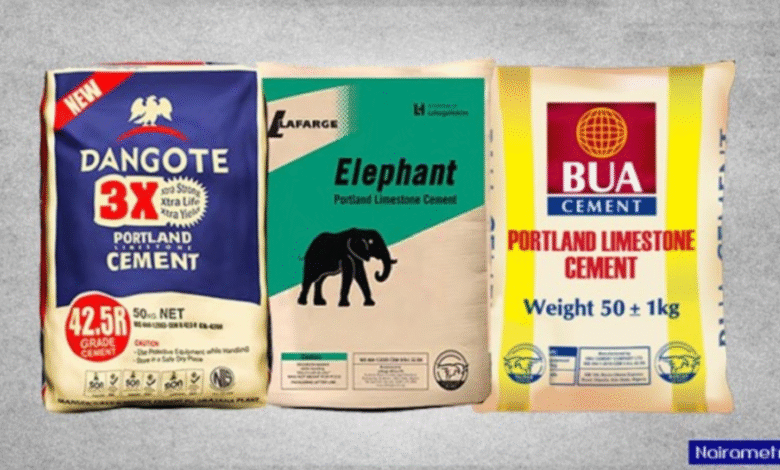
At N10,500 for a 50kg bag in Lagos and N15,000 in remote towns, Nigerian cement is now among the most expensive in the world for a country sitting on vast limestone reserves. Dangote sells for ~N10,400, BUA ~N10,500, Lafarge ~N10,350. The N100 spread is theater. The reality is coordinated pricing from three firms that control the entire domestic market, turning a basic building material into a chokehold on ordinary Nigerians.
Manufacturers blame energy, FX, and logistics. Gas, coal, and petcoke make up 50–60% of cost. Diesel is N1,200/litre. Roads are broken. All true. But none of it explains 49% operating margins — more than double North America’s 20–36% and triple Asia’s 15–25%. In Q1 2026, BUA’s cost of sales rose 0.7% while revenue jumped 22%, pushing gross margin to 56.9%. Lafarge’s costs rose 3.2% against a 34.8% revenue surge, with gross margin at 61.4%. Dangote posted 62.05% gross margin for FY 2025. These are not companies crushed by input costs. These are companies hiding behind them. In competitive markets, a 10% spike in energy gets absorbed, offset, or forces efficiency. In Nigeria, it becomes a 12–15% price hike the next month. Margins don’t fall. They expand. That is not cost pass-through. That is monopoly extraction.
The structure makes the profiteering possible. Three firms own the quarries, the kilns, the trucks, and the depots. Imports are killed by tariffs, FX rationing, and port delays. New entrants need billions of dollars, 5 years, and access to limestone deposits already locked up by incumbents. The same “logistics challenges” that justify N15,000 bags in remote towns are the moat that keeps rivals out. You cannot serve Yobe cheaply from a 1mtpa plant because you’ll never get scale. The Big Three can, and they segment the market: N9,000 near Obajana, N15,000 where transport bites and buyers have no alternative. Price moves in lockstep across brands because it can. When you’re halfway through a bungalow, you don’t shop around at N10,500. You pay or abandon the project. The producers know it. Demand is inelastic. Supply is concentrated. The outcome is predictable.
Follow the money and the “high cost” story collapses. BUA’s profit before tax soared 93.2% to N192.68bn in Q1 2026. Lafarge doubled PAT to N97.95bn. Dangote’s 2025 PAT crossed N1.01trn. Retained earnings at BUA jumped 38.2% in three months to N638.69bn. Lafarge holds N441.44bn cash against N1.5bn debt. These are fortress balance sheets, not survival businesses. If gas and FX were existential threats, costs would track revenue. Instead, costs are flat while prices ratchet. The same company trucks blaming “bad roads” for N15,000 bags deliver near-plant at N9,000 with 55% gross margins. The roads didn’t change. The pricing power did.
The pain lands on ordinary Nigerians. Cement isn’t optional. It’s every block in every school, hospital, drainage, and home. At N10,500 a bag, a modest 3-bedroom needs 400–500 bags: N4.2m–N5.25m for cement alone. Two years ago that was N2.5m. The N2.7m difference didn’t go to gas producers or truck drivers. It went to retained earnings, dividends, and net cash piles. Every N1,000 hike is a direct transfer from artisans, small contractors, and families to a three-firm oligopoly. The industry calls it “pricing power.” On the street, it’s called extortion.
Government enabled this. Pioneer status, FX concessions, and import bans created the monopoly. Now appeals to “cut prices” are ignored because there is no reason to comply. Why would a firm with 49% margins and zero competitive threat voluntarily surrender it? The state traded short-term capacity for long-term price control, and citizens are paying the levy. This is a private tax on shelter, collected not by FIRS but by three boardrooms.
This ends only when the monopoly breaks. That means real import competition triggered when local prices exceed global benchmarks by 40%+. It means opening limestone licensing and rail access to mid-sized regional plants. It means de-linking gas pricing from FX for strategic industries. Press releases won’t do it. Kilns take years to build and the cartel knows it.
Until then, the numbers are clear. Nigerian cement is expensive because three firms can make it expensive and still sell every bag. Costs are the excuse. The 49% margin is the objective. And the pain is yours. If you’re building, tell me your location and I’ll find you the least-bad dealer. But don’t expect a fair price. Not while monopoly power writes the invoice.
BUA Cement Q1 2026: FX Reversal and Cost Control Drive 117% Profit Leap
BUA Cement delivered its strongest quarterly result on record in Q1 2026, with profit after tax more than doubling to N176.38bn from N81.12bn a year earlier, representing a 117.4% increase. The performance was not driven by volume disclosure alone, as the company did not publish tonnage sold for the quarter, but the financials show a powerful combination of margin expansion and non-operating gains. Revenue rose 22.0% year-on-year to N354.98bn, putting the company on an annualized run-rate of N1.42trn, ahead of the N1.18trn posted for full-year 2025. What stands out is how little of that revenue growth was consumed by costs. Cost of sales increased by just 0.7% to N153.08bn despite the 22% top-line growth, pushing gross profit up 45.5% to N201.90bn and lifting gross margin to 56.9% from 47.7% in Q1 2025. That level of cost containment points to the benefits of BUA’s newer, more energy-efficient kiln lines and improved gas utilization, which are now translating into clear operating leverage as scale builds.
Beyond operations, two major reversals reshaped the bottom line. Net finance cost swung from a N17.79bn expense in Q1 2025 to a N161.75m gain this quarter. Finance costs fell 42.5% to N11.12bn while finance income jumped 637.8% to N11.28bn, reflecting both lower borrowings and the impact of a much larger cash balance. Cash and short-term deposits rose 44.1% in just three months to N404.05bn, leaving the company in a strong net cash position on its short-term obligations. The second reversal came from foreign exchange. Where Q1 2025 booked a N836.8m net exchange loss, Q1 2026 recorded a N13.01bn net exchange gain, a N13.85bn positive swing. Combined, the finance and FX movements contributed roughly N31.8bn to profit before tax, which itself grew 93.2% to N192.68bn. Still, the core business delivered: operating profit increased 50.8% to N179.51bn, with selling and distribution expenses up only 7.1% and administrative expenses up 20.1%, both well below revenue growth.
The balance sheet strengthened alongside earnings. Total assets expanded 7.1% from December 2025 to N1.99trn, driven by higher cash and a 2.6% increase in property, plant and equipment to N1.21trn as capacity projects continue. Total liabilities declined 3.8% to N1.14trn, with short-term borrowings down 18.5% to N127.37bn and trade payables falling 20.8% to N294.08bn. At the same time, contract liabilities rose 35.4% to N143.29bn, suggesting robust customer prepayments and demand visibility. Equity jumped 26.2% in the quarter to N849.28bn, powered by a 38.2% increase in retained income to N638.69bn. Liquidity metrics improved meaningfully: the current ratio moved to 1.15x from 0.95x at year-end 2025, and the quick ratio reached 0.90x. With N404.05bn cash against N127.37bn in short-term debt, BUA now has comfortable coverage and room to fund ongoing expansion without stress.
The quality of earnings requires attention. Of the N92.94bn increase in profit before tax year-on-year, about N31.8bn came from the combined finance and FX swings. Those items can be volatile and may not recur at the same level. The remaining improvement, roughly N61.1bn, came from operations, with gross profit alone rising N63.15bn on flat cost of sales. That points to structural efficiency gains rather than one-off items. Net margin for the quarter was 49.7%, compared with 27.9% in Q1 2025, and annualized return on equity using December equity is above 80%, though that will normalize as equity grows. With earnings per share at 520.83 kobo for the quarter, the annualized figure is 2,083.32 kobo. At a share price around N155.00 in late March 2026, that implies a forward P/E of 7.4x, compared with 14.7x on trailing FY 2025 earnings. The valuation reflects both the step-change in profitability and market caution about how much of the FX and finance income benefit is sustainable.
Looking ahead, the key questions are whether gross margin can hold above 55% without disclosed volume data, and whether the company can sustain net finance gains if cash is deployed into its continuing capex program. Foreign exchange remains a swing factor; the N13.01bn gain this quarter could reverse if the naira moves adversely or if the company’s hedging position changes. On the operating side, BUA’s Nigeria-centric model means performance is tied to domestic infrastructure spend, housing activity, and the cost of energy. The current cash position, falling short-term debt, and improved current ratio give it flexibility to manage those risks while funding growth. If subsequent quarters confirm that operating margin can stay above 50% without reliance on FX gains, the market has room to re-rate the stock from its current single-digit forward multiple. For now, Q1 2026 marks a clear inflection in both profitability and balance sheet strength, with execution on cost and cash management doing as much heavy lifting as the top line.
Dangote Cement Q1 2026: Volume Returns, Exports Accelerate as Deleveraging Fuels 53% Profit Jump
Dangote Cement opened 2026 with a performance that confirms its FY 2025 deleveraging story has real staying power, and now adds two new drivers to the mix. Group revenue rose 20.4% year-on-year to N1.198trn while profit after tax jumped 53.5% to N321.1bn, translating to earnings per share of N19.14, up 55.7% from Q1 2025. The key difference between this quarter and last year’s full-year result is volume. After FY 2025 saw revenue grow 20.28% despite a decline in tonnage sold, Q1 2026 delivered a 13.8% rebound in Group volumes to 7.5Mt. That shift matters because it means Dangote is no longer relying only on pricing to drive the top line. With volumes recovering while pricing held firm, gross margin expanded to 62.5% from 59.1% in the same period last year, and gross profit grew 27.6% to N749.3bn, outpacing revenue growth.
The margin strength is most pronounced in Nigeria, where EBITDA increased 33.1% to N525.3bn, representing a 61.0% margin. Management attributed this to a strong reduction in cash cost from a more favorable energy mix and the commissioning of the Okpella mobile refueling unit. The rollout of 300 CNG trucks in Tanzania signals that the same cost playbook is being exported across Pan-African operations. If Nigeria can sustain EBITDA margins above 60%, it effectively bankrolls expansion and absorbs any near-term drag from other markets. At Group level, EBITDA came in at N567.1bn, up 22.8%, with margin improving to 47.3% from 46.4% a year earlier.
Exports moved from boardroom strategy to P&L reality this quarter. Nigeria cement and clinker exports surged 71.6% to 549.6Kt, with the company dispatching 10 clinker vessels to Ghana and Cameroon in just three months. FY 2025 had positioned the Lekki Deep Sea Port corridor as a structural growth lever, and Q1 shows that corridor is already monetizing spare capacity. Nigeria still accounted for roughly 67% of revenue in FY 2025, but converting domestic overcapacity into dollar-linked regional sales reduces naira exposure and lifts overall utilization. With installed capacity now at 55Mta following the commissioning of the 3Mta Côte d’Ivoire grinding plant, Dangote has a clear outlet for tonnage that the home market alone cannot take.
The balance sheet reset from last year continues to pay dividends. Finance costs dropped 24.1% year-on-year to N98.25bn, a direct result of the 55.94% cut in borrowings achieved in FY 2025. Even with finance income falling sharply to N3.04bn, net finance cost still improved, helping lift profit before tax margin to 35.2% from 31.4% in Q1 2025. This confirms that deleveraging was not a one-off earnings kicker but a structural reset of the cost base. The company is now compounding from a higher, cleaner earnings floor.
On expansion, CEO Arvind Pathak reiterated the 80Mta target by 2030, with projects in Itori and Ethiopia progressing. Annualizing Q1 volume gives a 30Mt run-rate, which is still only 55% of the current 55Mta base. The bullish case assumes that African infrastructure demand plus the export channel can absorb another 25Mt over the next four years. If the 13.8% volume growth seen this quarter is sustained, that utilization gap will close quickly and provide significant operating leverage given the fixed-cost nature of cement production.
There are still risks that bear monitoring. Other comprehensive income took a N70.47bn hit from exchange differences on translating foreign operations, far larger than the N11.84bn loss in Q1 2025. A weaker naira boosts Nigeria’s margins but erodes Pan-African asset values and earnings when translated back. Pan-Africa remains a drag relative to Nigeria, contributing N170.62bn of the N421.17bn Group profit before tax, or 40.5%. That is a big improvement from N61.62bn a year ago, so the turnaround has started, but the margin gap to Nigeria is still wide. The other watch item is capex discipline. To reach 80Mta without re-leveraging, Dangote will need to fund growth largely from operating cash flow. Q1 showed operating cash strength last year, but the new build program will test whether the FY 2025 balance sheet prudence holds.
Valuation is where the disconnect appears. At N809.90 per share as of 4 March 2026, Dangote traded at 13.5x FY 2025 earnings. Annualizing Q1 EPS of N19.14 gives N76.56, which implies a forward P/E of 10.6x. The market is therefore pricing 53.5% profit growth, 47% EBITDA margins, and a credible export ramp at a lower multiple than it assigned last year. That suggests skepticism around the sustainability of volume growth or concern that Pan-Africa will weigh on consolidated returns. Yet the numbers show Pan-Africa PBT nearly tripled year-on-year, and Nigeria’s cost structure is still improving.
Taken together, Q1 2026 upgrades the Dangote investment case from a balance sheet repair story to an operating momentum story. Volume is back, exports are scaling, energy costs are falling, and debt is no longer consuming earnings. If Pan-Africa continues narrowing the margin gap with Nigeria and the company executes Itori and Ethiopia without materially increasing leverage, Dangote transitions from Nigeria’s dominant cement producer to Africa’s lowest-cost materials exporter with regional pricing power. At 10.6x annualized earnings, the stock is not priced for that outcome. The next checkpoints are Q2 export tonnage, Pan-Africa margin trends, and capex Africa Q1 2026: Operating Leverage and Cash Build Power 101% Profit Jump
Lafarge Africa Q1 2026: Operating Leverage and Cash Build Power 101% Profit Jump
Lafarge Africa opened 2026 with its strongest first-quarter performance on record, doubling profit after tax to N97.95bn from N48.64bn a year earlier, a 101.4% increase. This was not just a revenue story. It was an operating and treasury story: gross margin expanded to 61.4% from 49.5%, finance income surged nearly sevenfold to N12.55bn, and operating cash flow swung from a N118.36bn outflow in Q1 2025 to a N139.98bn inflow. The result is a business that grew revenue 34.8% to N334.88bn while converting that growth into sharply higher cash and equity.
The company remains Nigeria’s third-largest cement producer, with operations spanning cement, aggregates, and ready-mix concrete. Its footprint is domestic-focused through AshakaCem and its South West/South East plants, with no material Pan-Africa exposure. That Nigeria concentration became an advantage this quarter. Cost of sales rose only 3.2% to N129.39bn despite the 34.8% jump in revenue, reflecting better energy mix, plant efficiency, and fixed-cost absorption. Gross profit increased 67.1% to N205.49bn. The cost discipline extended through operations: selling and distribution costs grew 6.2% to N41.34bn, slower than revenue, while administrative expenses rose 75.1% to N22.64bn largely on higher technical service fees and staff costs. Even after that, operating profit nearly doubled to N141.27bn, with operating margin hitting 42.2% versus 28.9% in Q1 2025.
Finance was the other lever. Finance income climbed to N12.55bn from N1.84bn on higher short-term deposits and realized FX gains, while finance costs rose to N4.69bn from N0.39bn mainly due to unrealized FX movements. The net position was still a N7.85bn positive swing, taking profit before tax up 103.9% to N149.12bn. Tax expense more than doubled to N51.17bn, giving an effective tax rate of 34.3%, but profit after tax still crossed N97.95bn. Earnings per share printed 608 kobo, up from 302 kobo a year earlier. Annualized, that is 2,432 kobo, a run-rate few expected from Lafarge’s recent base.
The balance sheet shows the profit is real cash. Total assets grew 13.6% in three months to N1.37trn, driven by cash and cash equivalents up 13.7% to N441.44bn and PPE up 17.4% to N526.62bn as capex accelerated. The company spent N88.76bn on property, plant and equipment in Q1 alone, nearly nine times Q1 2025’s N10.27bn, signaling confidence in demand and a push to debottleneck. Current assets rose 21.3% to N678.93bn, while current liabilities increased 15.4% to N481.65bn. The current ratio improved to 1.41x from 1.34x at December 2025, and quick ratio sits at 1.18x. Unlike peers that deleveraged in 2025, Lafarge entered Q1 with very little debt. Loans and borrowings are just N1.49bn, mostly lease liabilities. Net cash position is therefore N439.96bn, explaining the jump in interest income. Equity expanded 14.1% in the quarter to N791.95bn on retained earnings growth to N602.88bn. Annualized ROE using Q1 PAT and December equity is 56.5%. Net margin hit 29.3%, up from 19.6% a year ago.
Cash generation was the clearest evidence of quality. Operating cash flow turned positive at N139.98bn versus a N118.36bn outflow in Q1 2025, helped by profit growth and a much smaller working capital drag. Change in net working capital was only -N9.53bn this quarter compared with -N199.97bn last year, as contract liabilities rose N16.88bn to N132.82bn, indicating strong customer prepayments. Investing cash outflow was N82.75bn on heavy capex, offset partly by N6.25bn interest received. Financing outflow was modest at N0.81bn, mainly lease and interest payments. Cash at period end stood at N439.15bn, up from N103.11bn a year earlier. With that liquidity, Lafarge can fund its N88bn+ quarterly capex pace internally while still accumulating cash.
Ownership changed materially at the end of 2025. Holcim signed an agreement on 1 December 2024 to sell its entire 83.81% stake to Huaxin Building Materials Group Co., Ltd. The transaction was approved by the FCCPC on 25 July 2025. The Q1 2026 results are therefore the first full quarter under the new technical partner. Technical service fees rose to N7.87bn from N4.00bn, computed at 3% of net sales capped at 5% of EBITDA per the agreement. The new owner’s footprint in Asia and experience in cost-efficient cement production will be watched for operational synergies, but Q1 shows Lafarge can already deliver strong margins without it.
Risks remain concentrated in Nigeria’s macro environment. Energy and logistics costs, which the company managed well this quarter, can spike quickly. FX exposure is limited on the debt side given the net cash position, but unrealized FX losses did push finance costs higher. Tax expense at 34.3% of PBT is a drag, and the jump in admin costs bears monitoring if it persists. On the upside, the 1.41x current ratio, N441bn cash pile, and negligible borrowings give Lafarge rare balance sheet optionality among Nigerian manufacturers. With capex accelerating and contract liabilities rising, volume momentum looks intact. If gross margin holds above 60% and finance income remains supported by the cash balance, the Q1 annualized P/E of ∼6.4x at a N155 share price leaves room for re-rating. The quarter confirms Lafarge has moved from recovery to compounding: higher tonnage leverage, tighter cost control, and a treasury function that now adds to earnings rather than subtracting from them.