NGXASI Down 0.36% as Profit-Taking Hits Heavyweights, BDC Rate Flat at N1,410/$

The Nigerian equities market closed bearish on Wednesday, August 19, 2026, with the NGX All-Share Index declining by 0.36% to 240,750.47 points. The drop wiped out approximately N555.68bn in market capitalization, though the market’s year-to-date return remains robust at 54.71%. The decline was not broad-based but concentrated in key heavyweights. ARADEL led the losers with a sharp 10.00% fall, while NGXGROUP -2.34%, NEM -1.48%, and GTCO -0.08% also weighed on the index. This shows that investor sentiment is tilting toward profit-taking in names that have driven YTD gains. Despite this, market breadth was perfectly balanced with 27 advancers and 27 decliners, and Proshare’s memorandum indexes actually closed higher. That divergence suggests liquidity is rotating into mid and small caps rather than exiting the market entirely. Trading activity confirmed this, as volume jumped 177.65% to 1.19bn units worth N37.82bn. FTGINSURE alone accounted for 51.17% of volume, while MTNN dominated value at N8.12bn, indicating that retail and institutional interest is still active, just shifting away from the largest caps.Unlisted Market and Global Context Mirror Cautious Mood
The unlisted space followed a similar pattern. The NASD OTC In
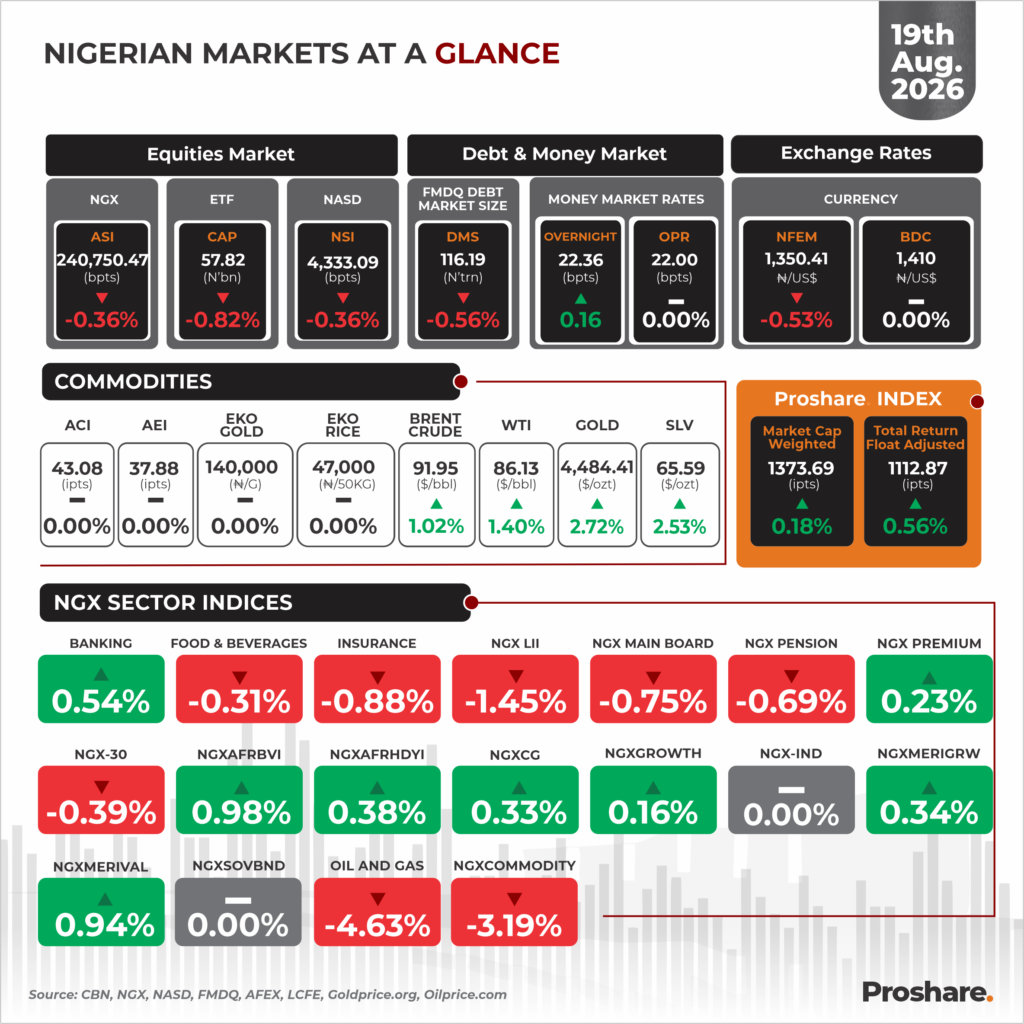
dex fell 0.36% to 4,333.09 points on thin activity of 747,429 units valued at N96.76m. With only one gainer and one loser, the OTC remains illiquid and reactive to sentiment in the main bourse. Globally, the mood was also risk-off. Japan’s Nikkei 225 closed at 65,322.30, leading declines among major indices. African markets were relatively stable, but the global pullback likely reinforced caution among foreign portfolio investors in Nigeria. No debt market data was released, leaving fixed-income traders without fresh signals on rates.Commodities Offer a Mixed Bag, But Oil Provides External Support
Domestic commodities were mixed. The AFEX indices were flat, while Sorghum gained 1.70% to N327.10, but Cocoa fell 2.63% to N6,228.49 and Soybeans slipped 0.15%. Prices at the Lagos Commodities Exchange were unchanged. The more important story is global. Brent crude rose 1.02% to $91.95/bbl and WTI 1.40% to $86.13/bbl amid concerns over shipping disruptions in the Strait of Hormuz. Gold surged 2.72% to $4,484.41/oz. For Nigeria, higher oil prices are a positive external buffer that could support FX reserves and government revenue, even as local equities consolidate. The rally in precious metals also reflects global risk aversion, which may keep foreign investors selective about emerging markets like Nigeria.FX Stability in BDC, But Official Rate Slips
The currency market provided some stability. The BDC rate held flat at N1,410/US$1, offering predictability for SMEs and individuals sourcing dollars outside the official window. However, the NFEM rate weakened by 0.53% to N1,350.41/US$1, widening the gap slightly. This suggests demand pressure is still present in the formal market, but the parallel market is absorbing it without major volatility. For a financial analyst, the flat BDC rate reduces immediate inflationary pressure from FX, while the oil price rally could ease pressure on the official rate in the coming weeks.What This Means
Wednesday’s trade was less about a market reversal and more about consolidation. After a 54.71% YTD run, investors are locking in gains in large caps and redeploying into volume-driven counters. The strong commodity prices and stable parallel FX provide macro support, even as global equities weaken. The key risk remains concentration: as long as a handful of heavyweights drive index moves, volatility will persist. But with activity levels high and external tailwinds from oil building, the underlying structure of the market remains constructive.