
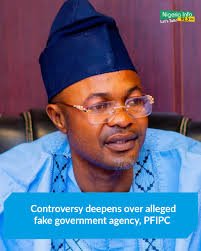
Recent revelations that some entities claiming to be federal government bodies may lack legal authority have ignited one of the fiercest governance debates in recent years. At the center are the disputed Presidential Foreign Intervention Promotion Council allegedly represented by Prince Adeniyi Adeyemi, and the National Brands Development and Made-in-Nigeria Special Project Office. Official statements have been cautious, investigations are ongoing, but the mere possibility that such bodies interacted with ministries, used government platforms, and in at least one reported case found their way into budget documents has triggered outrage across civil society, the media, and the investment community. For Sola Oni, who first framed it as “financial cancer,” this is not a bureaucratic slip. It is evidence that official appearance has outrun legal authority, and that Nigeria’s control systems failed at multiple points to detect, block, or question them. The fundamental question now being asked is simple and damning: who enabled access, what public funds were involved, and how many more such structures exist undetected?
Those who see this as institutional fraud argue that the problem goes far beyond two names. They describe a quiet proliferation of agencies, councils, committees and presidential initiatives that duplicate functions, obscure accountability, and create channels for resources to be diverted. Oni’s central argument is that this behaves like cancer, growing beneath the surface until the damage becomes enormous. Every naira paid to an unnecessary or unauthorised structure is a naira taken from roads, hospitals, schools, security and industrial investment at a time when citizens are being asked to endure subsidy removal, higher taxes and painful reforms. This view finds support in repeated audit findings. The Office of the Auditor-General’s reports for 2021 and 2022 flagged billions in payments to “special projects” with no appropriation backing. BudgIT and the Centre for Social Justice have documented over 400 federal bodies, many with overlapping mandates in trade, agriculture and youth development. The Oronsaye Report of 2012 recommended merging or scrapping 102 agencies to cut cost, yet twelve years later most remain and new ones have emerged under different names. Critics therefore contend that what we are seeing is the culmination of years of weak institutional discipline, where executive fiat creates bodies without Acts of the National Assembly and the budget process fails to ask basic legal questions.
The counter-argument coming from within government and some pro-administration commentators is that this is being blown out of proportion. Their position is that Nigeria is not dealing with criminal ghost agencies but with administrative sloppiness, legacy project offices that were never formally closed, and poor coordination between the Budget Office, Accountant-General and supervising ministries. They point to the Treasury Single Account and IPPIS as evidence that it is now harder to make direct payments to fake entities, and insist that no funds have yet been proven missing in the current cases. From this perspective, the controversy is less about theft and more about record-keeping and the failure to implement past reforms. Officials also note that the 2024 and 2025 budgets are already undergoing a cleanup to remove duplicate votes. To them, calls for a public register are welcome but should not be turned into a political weapon that undermines confidence in government while capacity is being built.
The heat in the debate comes from what is at stake beyond the money. Investors are watching closely because institutional clarity is a core part of any country’s risk profile. Analysts at FSDH and Afrinvest have warned in recent notes that “institutional ambiguity” raises the cost of doing business in Nigeria. Foreign investors do not assess an economy only by inflation or GDP growth. They ask whether rules are predictable, whether agencies are legitimate, and whether contracts will be protected by functioning systems. A country where a government-sounding council can allegedly operate without immediate detection sends the wrong signal about controls, and that alone can push capital elsewhere. At the same time, public trust is taking a direct hit. Labour leaders including the NLC have called the revelations an insult while Nigerians absorb the pains of reform. On social media the hashtag #GhostAgencies trended for days as citizens posted names of obscure councils they had never heard of. Oni captures this sentiment directly: when people begin to suspect that some institutions acting in government’s name lack authority, every legitimate agency becomes suspect and government’s legitimacy erodes.
What both sides are converging on, albeit with different urgency, is the need for radical transparency. Oni is demanding a comprehensive audit of all agencies, councils, committees, special projects and presidential initiatives, backed by a publicly accessible Agency Verification and Public Accountability Portal that lists the legal basis, supervising ministry, mandate, leadership and funding for every recognised body. SERAP has filed suit seeking the same. The Auditor-General has promised a forensic review. Even defenders of government agree that any entity unable to establish its legal foundation should be suspended immediately and investigated, and that the Accountant-General, Budget Office and anti-corruption agencies must track every payment to ensure no public funds go to bodies without verifiable status. Whistle-blowers and journalists who expose suspicious structures should also be protected rather than intimidated.
The controversy therefore exposes three failures at once: a failure of law, because the Constitution requires appropriation for all spending; a failure of process, because budget and payment systems should have flagged these entities earlier; and a failure of leadership, because political will is required to close down duplicates regardless of who benefits from them. Nigeria does not need more institutions. It needs fewer, stronger and fully visible ones. Until every naira spent in the name of government can be traced to a law, a clear mandate, and measurable public value, the suspicion will remain and the leakage will continue. The choice before the Presidency and National Assembly is now stark: publish the register, prosecute those who enabled the abuse, and end the era of opaque structures, or allow the financial cancer to keep growing beneath the surface of the economy.