Disinflation Regains a Foothold in June 2026 but Food Reasserts Itself – Implications for Policy and Outlook


After three consecutive months of mild acceleration, headline inflation finally eased by two basis points to 15.91% year-on-year in June 2026, down from 15.93% in May. The move is marginal, but its composition matters: the deceleration was driven almost entirely by a sharp cooling in core inflation, which fell to 15.92% from 16.82%, even as food inflation reaccelerated for a fifth straight month to 17.52%. The reading reads less as a decisive reversal than as the stall of the previous three months beginning to break in the right direction, with energy-price relief doing the heavy lifting while food-supply pressures persist beneath the surface.
The Central Bank of Nigeria has framed recent inflation dynamics as transitory, holding the Monetary Policy Rate (MPR) at 26.50% at its May meeting and anchoring its outlook to expected external relief. The June print lands days ahead of the 306th Monetary Policy Committee meeting on 20–21 July 2026, against a backdrop of a fragile US–Israel–Iran ceasefire, oil prices holding near US$85 amid lingering Strait of Hormuz conflict risk, pre-election spending in view, and food inflation diverging sharply across states, from -3.54% month-on-month in Borno to a 53.02% year-on-year inflation rate in Kogi.
This EA-Proshare June 2026 inflation update sets out what the data signals for markets, policy, and households over the months ahead. In this review, we highlight the key takeaways from the data.
Headline Inflation Overview
Nigeria’s headline inflation decelerated marginally by 2 basis points (bps) to 15.91% in June 2026, down from 15.93% in May, marking the first monthly decline in three months and a tentative break from the mild acceleration recorded between March and May. Critically, the deceleration was not broad-based: it reflected a pronounced cooling in core inflation offset by renewed food-price momentum, leaving the underlying picture more mixed than the headline alone suggests (see Table 1 below).
Table 1:
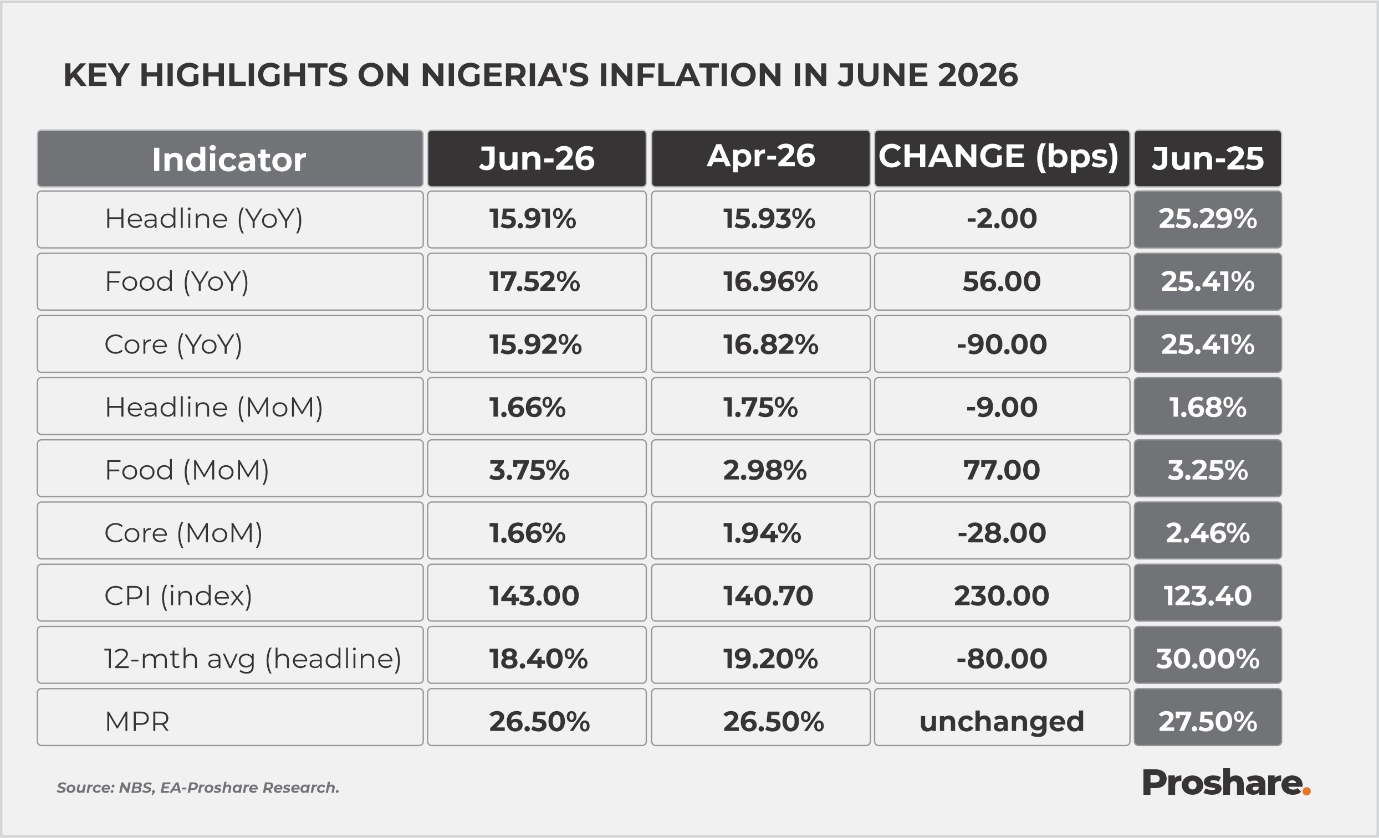
Relative to the same period last year, disinflation has remained structurally unchanged: headline inflation has dropped from 25.29% to 15.91%, food from 25.41% to 17.52%, and core from 25.41% to 15.92%, confirming that Nigeria remains firmly within a year-on-year disinflation cycle despite a monthly path that has stayed sticky, neither worsening nor improving.
On a month-on-month basis, headline inflation fell for a third consecutive month by 8.51 bps to 1.66%, down from 1.75% in May; core inflation cooled to 1.66% from 1.94%, but food inflation rose to 3.75% from 2.98%, its firmest monthly increase in several months. The split reflects a clean separation between an easing energy-and-services complex and a food-supply chokepoint.
The consumer price outcomes in June land against a backdrop of divergent national and global signals; gross foreign reserves rose to a 13 year high to $51.29bn, official and parallel FX rates appreciated by more than 4% (YTD) in June, FX premiums remain in single digit and below 3%, 49% (YoY) growth in tax revenue to N15.8trn in the first five months of 2026 from N10.6trn a year earlier, and an equity market that returned over 48% (YTD) in June despite a correction that resulted in over N13trn sell offs in the market following the FTSE Russell announced delay of Nigeria’s Frontier Market Reclassification by September Pending T+1 Review.
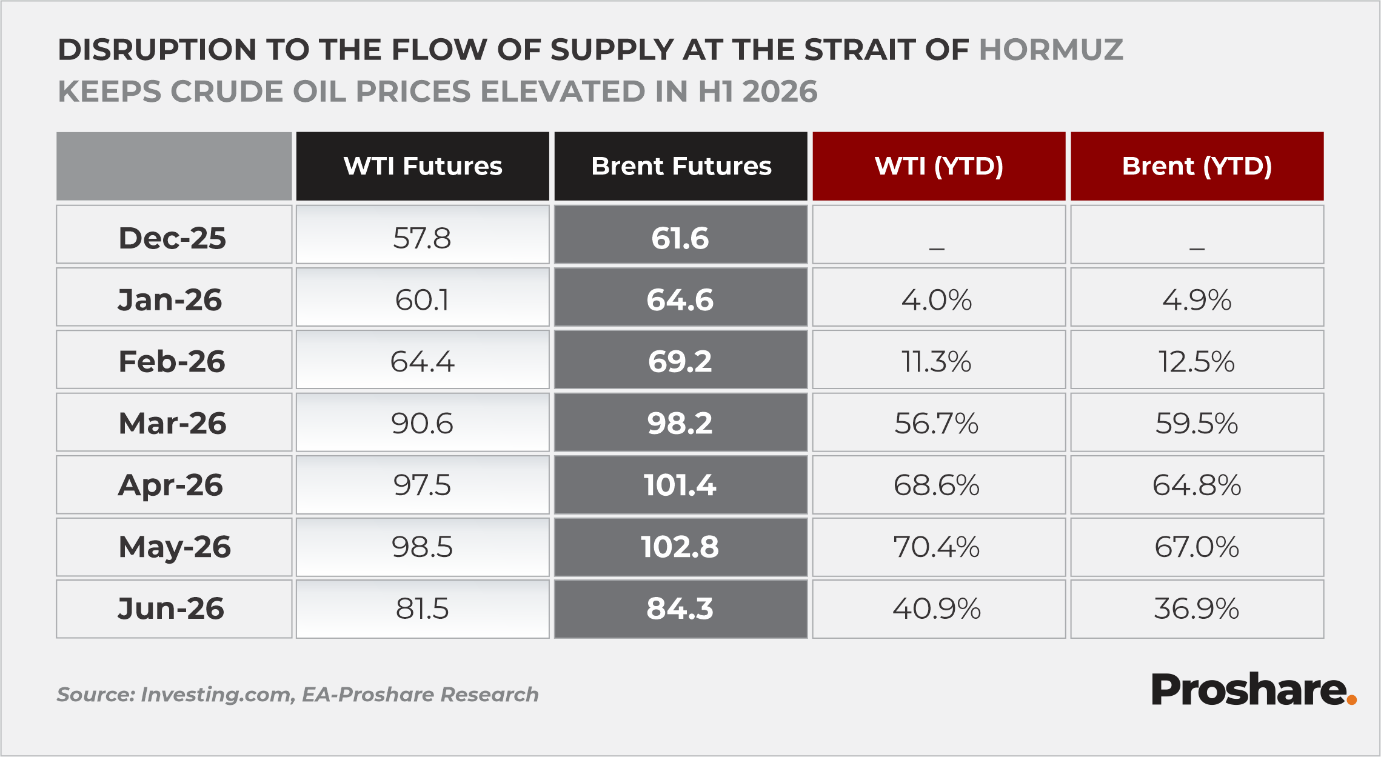
The global oil markets were calm in June, with both Brent and WTI futures falling to averages of $84/bbl and $81.5/bbl, down from $102.8/bbl and $98.5/bbl in May, following the tentative 60-day peace deal between the US and Iran. Conflicts that resurfaced in July shape how this single data point should be read (see Table 2 below).
Table 2:
Food Price Pressures
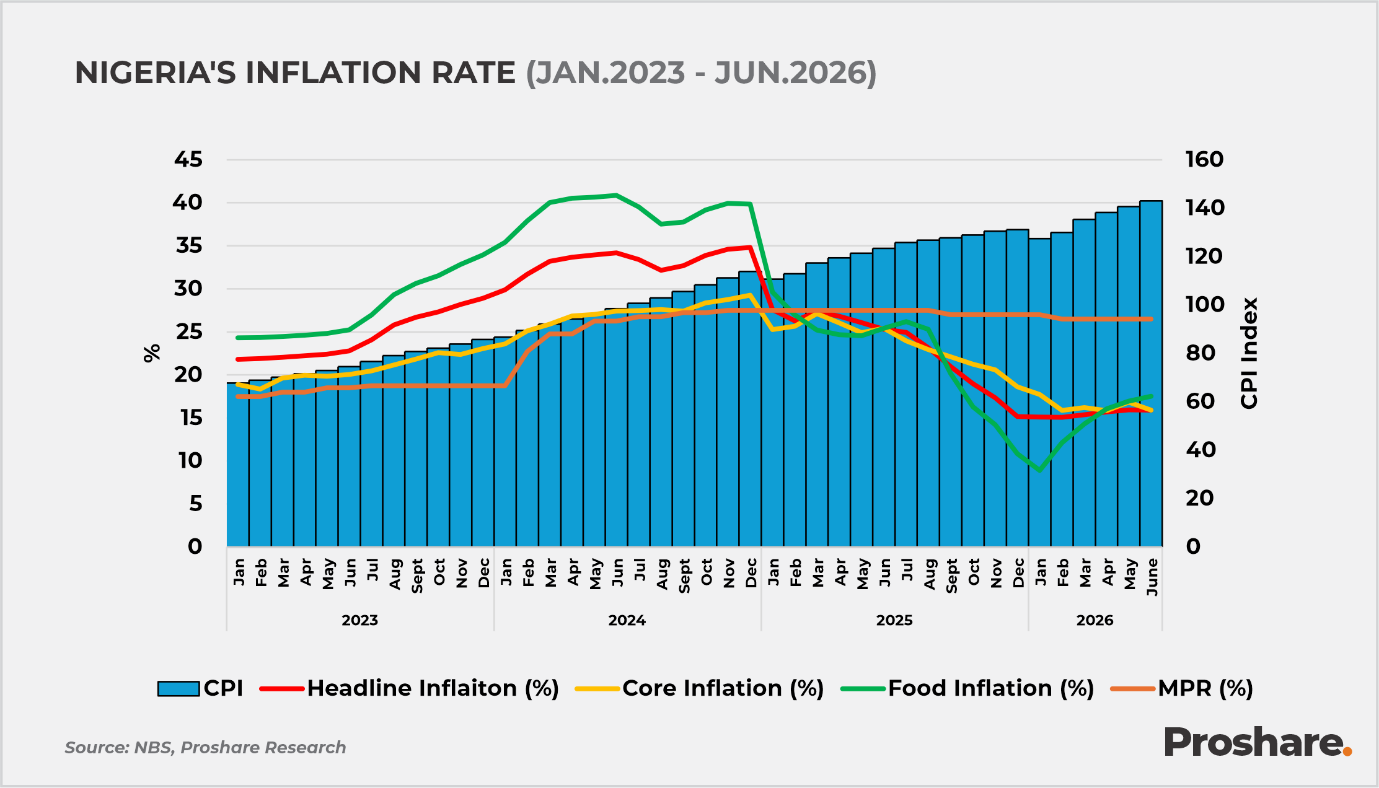
Since hitting a single-digit of 8.89% in January 2026, overall food prices have been on the rise, accelerating by 56 bps to 17.52% in June 2026, up from 16.96% in May, extending its run of consecutive monthly increases to a fifth month. On a month-on-month basis, food inflation quickened to 3.75% from 2.98%.
This is the converse of a similar period last year, when food costs had decelerated for six consecutive months to about 31.93% in June 2026, down from 39% at the end of December 2024. Food cost accounts for about 40.02% of all items in the consumer basket tracked by the National Bureau of Statistics (NBS), and its rise has been influenced by a combination of factors, including higher logistics and supply chain costs amid elevated energy costs. National average PMS rose 51.8% between February (when food inflation first accelerated this year) and May 2026, from N1,051.47/litre to N1,596.25/litre.
The national average price of cooking gas rose from N6,799.18 in February 2026 to N8,706.93 per 5kg in April, based on available data, representing a 28.1% increase over three months. Both intercity and intracity fares rose by roughly 20% between February and May 2026, tracking the PMS move over the same window. Food inflation, already the binding constraint on household welfare, remained above 30% in twenty-five states.
Farm-produce inflation of 4.42% month-on-month sat at the centre of the pressure, reflecting the continued weight of insecurity-linked disruptions along key agricultural corridors, elevated logistics and intra-state distribution costs. The critical question for the second half of the year lies between the direction of energy costs and whether the July–August harvest translates into genuine supply relief (see Chart 1 below).
Chart 1:
Non-Food Price Pressures
Core inflation decelerated by 90 bps to 15.92% in June 2026 from 16.82% in May, reversing the sharp rebound recorded the previous month and driving the headline deceleration. On a month-on-month basis, core inflation slowed to 1.66% from 1.94%. The cooling was led by the energy sub-index, which contracted 7.54% month-on-month as post-ceasefire relief passed through to pump prices and utility costs, easing the pressure on transport and housing that had firmed in May.
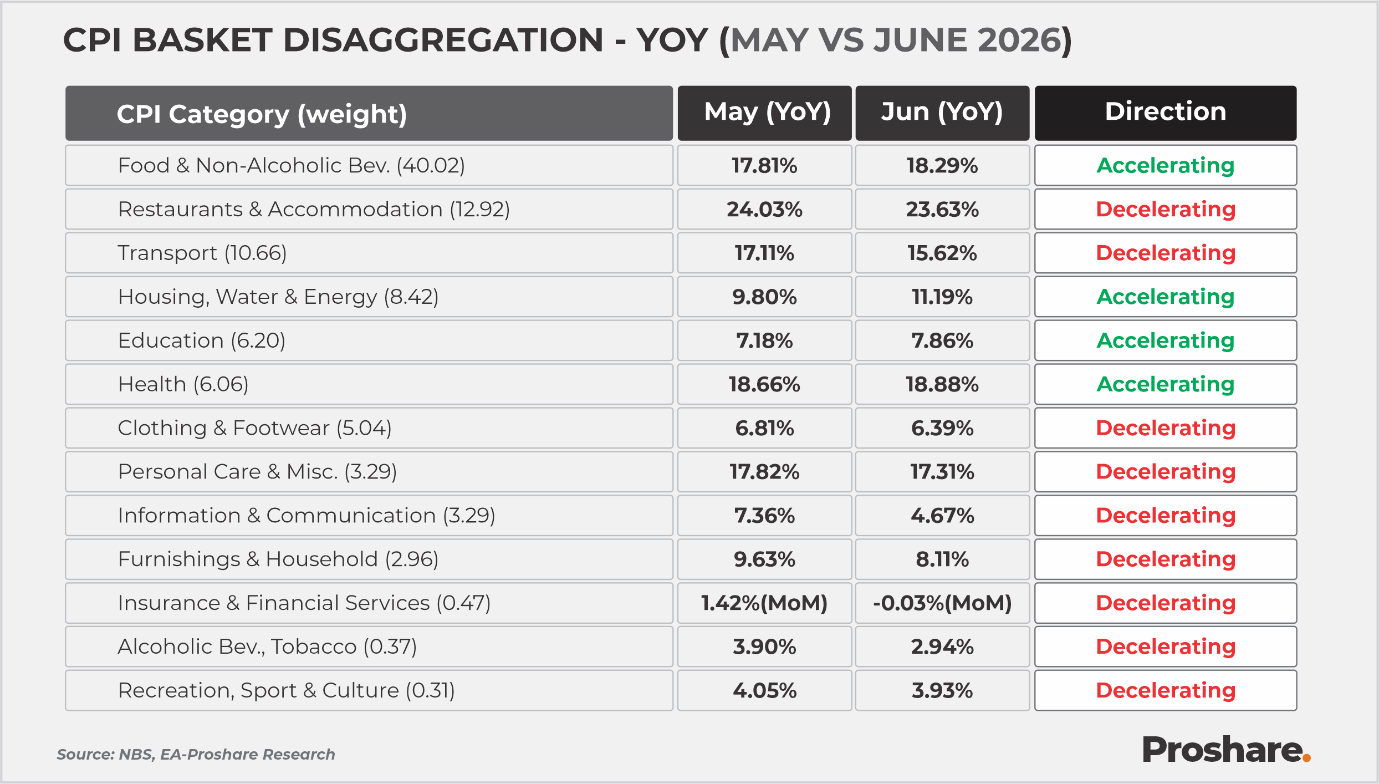
At the sectoral level, the retreat was uneven. Transport inflation moderated notably on a year-on-year basis to 15.62% from 17.11%, consistent with softer energy costs, while information and communication (4.67% from 7.36%) and furnishings (8.11% from 9.63%) also decelerated. Housing, water and energy, by contrast, continued to firm year-on-year to 11.19% from 9.80%, reflecting lagged urban utility adjustments, and health edged higher to 18.88%. The reassertion of core disinflation is significant as a policy signal: it revives the read that the CBN’s tightening is still exerting traction on the embedded, services-heavy component of the basket that the Bank watches most closely.
CPI Basket Disaggregation
A disaggregation of the NBS CPI basket shows that, of the 13 categories monitored by the NBS, four recorded year-on-year acceleration in June 2026 (food & non-alcoholic beverages, Housing and energy, health services, and education services), collectively accounting for roughly 60.70 weight points of the basket, against 38.84 weight points across the eight decelerating categories. This marks a meaningful narrowing of inflationary breadth compared with May, when seven categories were accelerating and accounted for over two-thirds of the basket by weight.
The apparent contradiction- fewer accelerating categories, yet a large share of consumption weight still in the accelerating column- resolves in a single line item. Food and non-alcoholic beverages, at a 40.02% weight, is itself accelerating and dominates the aggregate. Stripping food out, the accelerating set (housing and energy, education, and health) is small and specific, while the disinflation is broad across discretionary and services categories. In short, inflation breadth has narrowed materially, but the one category that matters most for the typical household remains on the wrong side of the ledger (see table 3 below).
Table 3:
Disaggregating the 13 categories monitored by the NBS on a month-on-month basis reveals that four recorded month-on-month acceleration in June 2026 (food & non-alcoholic beverages, transport services, education services, and personal care), collectively accounting for roughly 60.17 weight points of the basket, against 38.84 weight points across the eight decelerating categories.
Rural and Urban Inflation
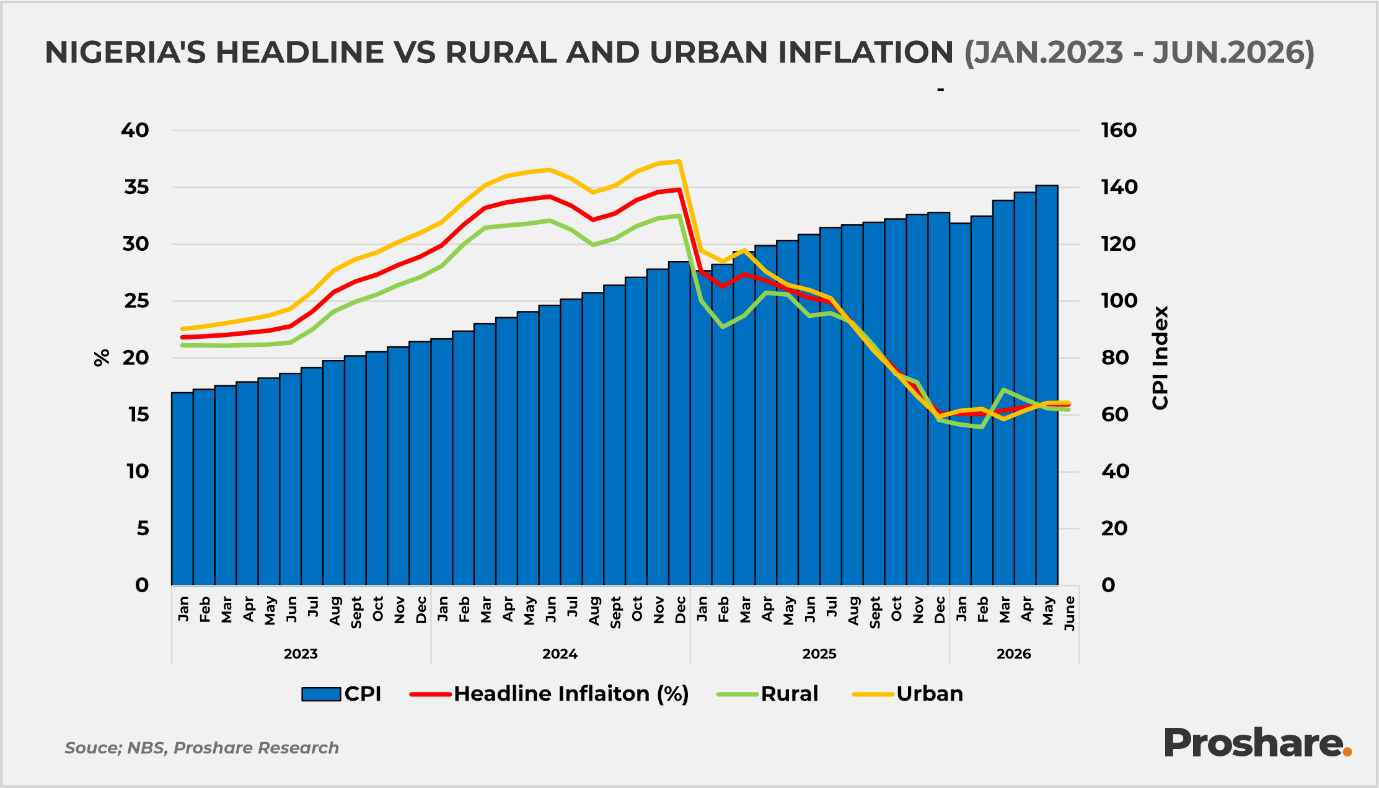
The rural–urban split widened monthly in June. Rural inflation moderated year-on-year to 15.48% (below the national average) from 15.60% in May, while the rural monthly rate slowed sharply to 0.52% from 1.17%. Urban inflation, by contrast, edged up year-on-year to 16.08% (above the national average) from 16.07%, with the urban monthly rate accelerating to 2.13% from 1.99%.
The pattern points to intensifying near-term cost pressure in Nigeria’s cities, where services, housing, and transport carry greater weight, even as rural price momentum cooled, likely reflecting early seasonal food dynamics and localised supply improvements. Urban centres remain more exposed to services-led inflation, while rural areas continue to bear the brunt of food supply-chain frictions (see chart 2 below).
Chart 2:
Profiling Inflation Across States: June 2026
At the upper end of the distribution, Niger (42.23%), Kogi (41.59%), and the FCT–Abuja (39.91%) posted the highest year-on-year headline inflation, a marked change from May’s northern-and-south-eastern cluster and a sign of high price pressures in the North-Central belt. The lowest year-on-year headline rates were recorded in Imo (19.47%), Ebonyi (20.79%), and Katsina (21.87%). According to NBS data, the 36 states and the FCT had headline and food inflation above the national averages of 19.91% and 17.52%, respectively, in June 2026. It is unclear how the 36 surveyed states and the FCT have inflation above the national average.
On a month-on-month basis, Niger (11.65%), Katsina (8.13%), and Kwara (7.52%) recorded the sharpest increases, while Bayelsa (-6.48%), Benue (-5.58%), and Cross River (-5.12%) registered outright monthly declines in their overall price levels, evidence that price dynamics are now moving in opposite directions across the federation (see table 4 below).
Table 4:
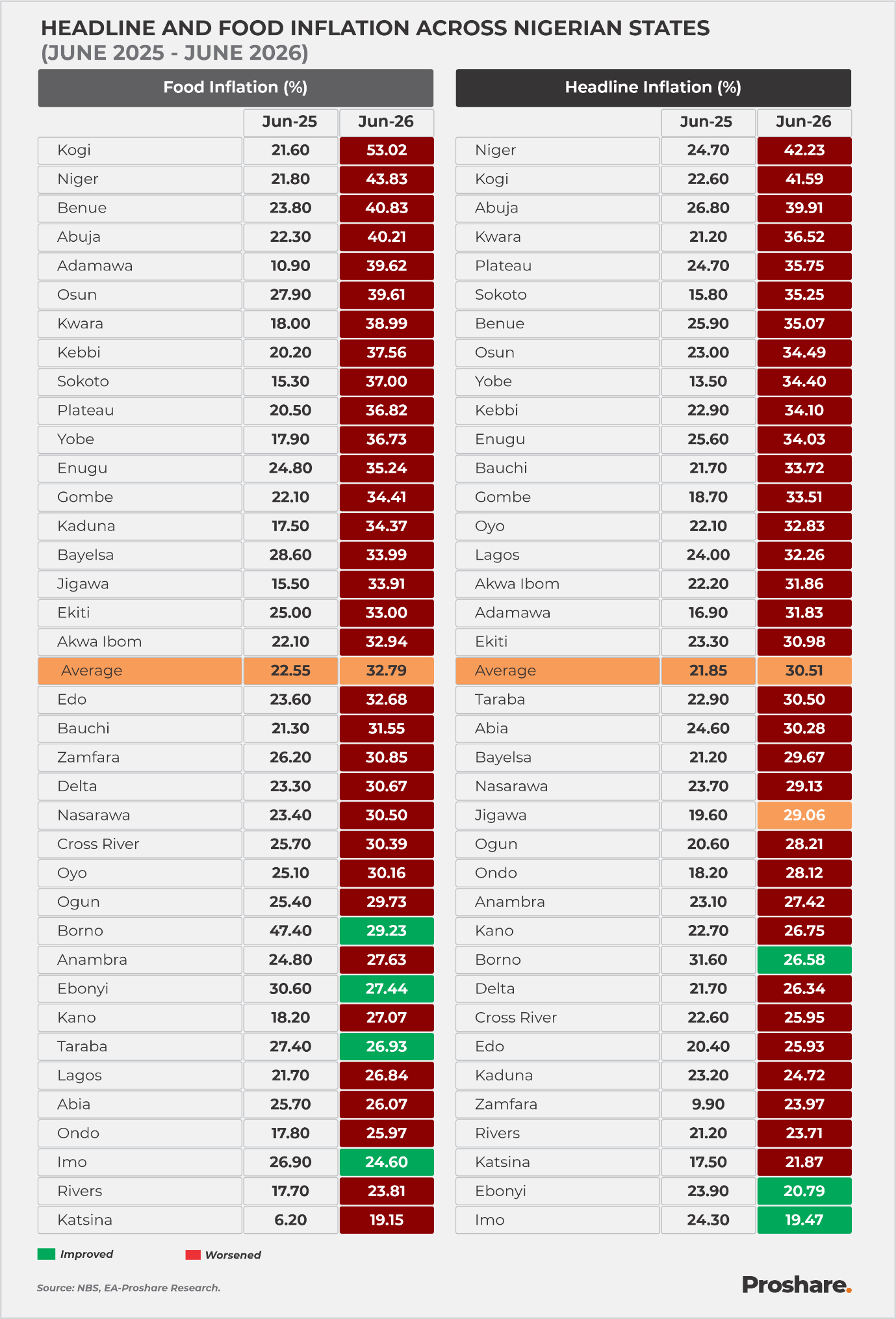
On food inflation, 19 states plus the FCT recorded food inflation above the national average of 17.52%. Food pressures were most acute in Kogi (53.02%), Niger (43.83%), and Benue (40.83%), despite Benue’s standing as a leading agricultural producer, and this clearly indicated that insecurity and distribution bottlenecks, rather than raw output, could be driving the North-Central food problem. The slowest year-on-year food inflation was recorded in Katsina (19.15%), Rivers (23.81%), and Imo (24.60%).
Month-on-month food dynamics tell the seasonal story: Katsina (16.82%), Kebbi (9.79%), and Niger (8.96%) saw the highest monthly food-price acceleration, while Borno (-3.54%), Benue (-2.36%), and Bayelsa (-1.34%) recorded outright monthly food-price declines. Borno’s continued negative monthly reading reflects the lingering effect of humanitarian palliatives and base normalisation (see table below).
For households, the practical reality is that the mild deceleration of inflation offers negligible relief while food, the CPI basket’s largest weight, continues to rise faster than incomes, particularly in Niger, Kogi and the Federal Capital Territory, where residents face headline inflation nearly three times that faced by residents of Imo or Ebonyi.
Bond and equity markets priced the NBS inflation data. Yields on 91-day T-bills were unchanged at 16.30%, while yields on 360-day bills moderated as the market priced in mild inflationary conditions and future deceleration. On the NGX, the benchmark NGX All-Share Index (ASI) mildly declined by 0.21% to close at 242,366.75 points following the NBS inflation data release, down from 242,870.44 points in the previous session. In June, the NGX experienced a correction with an over N13trn sell-off as the market gauged the impact of the announced delays to Nigeria’s Frontier Market Reclassification Pending T+1 Review by FTSE Russell. Inflation remains sticky, but the market remains robust, returning to over 55.75% (YTD) as market breadth remains positive.
Closing Thoughts and Outlook
In June 2026, headline inflation eased only fractionally (down two basis points to 15.91%), but the two-basis-point move carries more signal than its size implies: it marks the first monthly decline in three months and the point at which the March–May stall began to break. EA-Proshare analysts expect headline inflation to remain within the 15-16% band in July 2026.
The trajectory will be shaped by several converging factors: whether the foreign exchange market remains liquid and the exchange rate stays stable, the pace of CBN foreign-exchange management in anchoring naira stability and containing import-cost pass-through, the net impact of the decision of Dangote Petroleum Refinery to sell refined products in dollars in the domestic market and deviate from the naira for crude agreement, whether the Strait of Hormuz stays open or closed, putting pressure on global crude prices; the extent to which harvest-season output translates into genuine food-supply relief in July and August; and the scale of pre-election fiscal spending as the political cycle intensifies.
The Central Bank‘s Monetary Policy Committee meets on July 20-21, with Governor Cardoso in May 2026 having already described the previous uptick in inflation as transitory and externally induced, a framing that could support a further hold on the 26.5% policy rate rather than a cut.
Adapted from the Proshare